
On this page
Start here
Quick answer
Treat a visible spark from a JennAir oven as a stop-use symptom until you know exactly where it came from. A brief ignition spark in the burner area of a gas model can be part of lighting, but it should lead promptly to a safe flame; a spark or blue arc in the cavity, at the control panel, cord, plug, outlet, or behind the appliance is not a normal cooking result. Turn the oven off, keep clear of smoke, flame, gas odor, damaged glass, hot wiring, or repeated breaker trips, and do not restart it to reproduce the event. Once the oven is cool and safe, identify electric, gas, dual-fuel, or combination-microwave construction, record the location and timing of the spark, and use only external model-specific checks. Arrange qualified appliance, electrical, or gas service when the source is not plainly a removable cooking item or a normal brief gas ignition event.
Before you begin
Safety first
- Do not restart to reproduce the spark, remove panels, handle terminal or control wiring, touch heating elements or microwave high-voltage parts, adjust gas components, bypass a door interlock, operate with damaged glass or cord, or continue after gas odor, delayed ignition, smoke, flame, arcing, burning smell, abnormal heat, water near electrics, or repeated trip.
Work through in order
Diagnostic checks
Use only checks that match the exact appliance or system and its official guide.
-
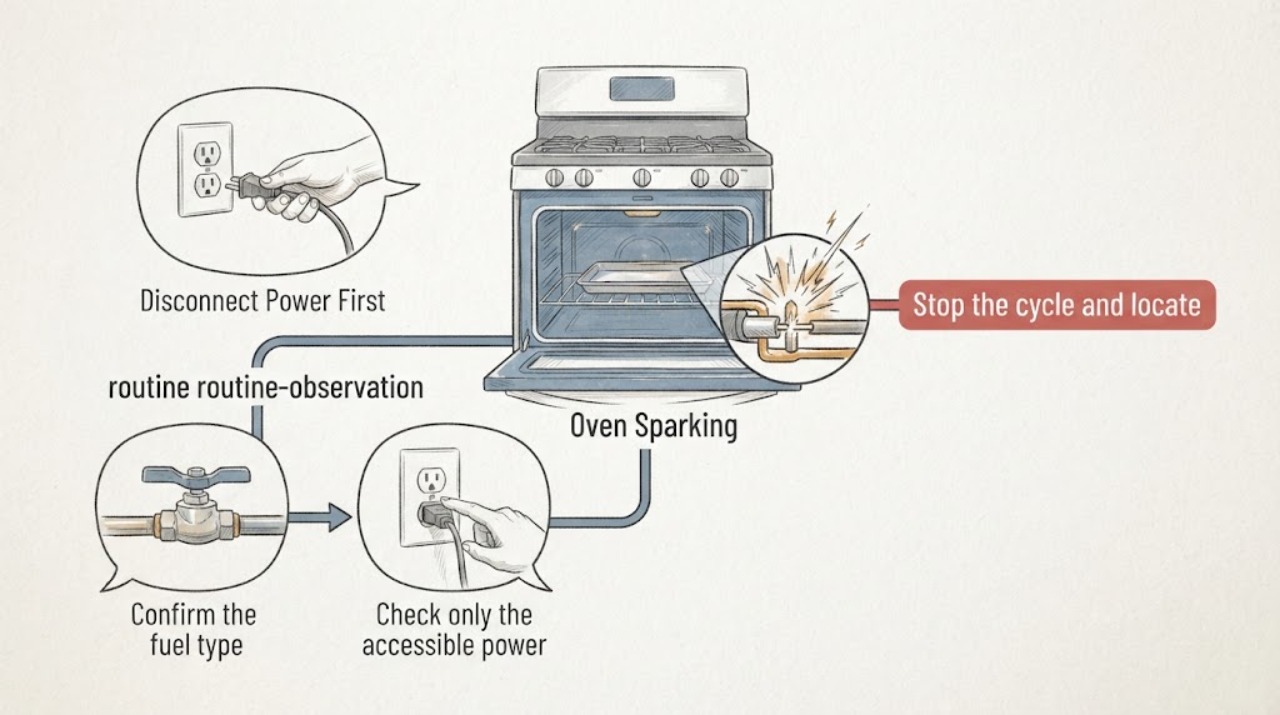
Stop the cycle and locate the spark without opening the oven
If a spark, flash, pop, smoke, or flame occurs, stop the cooking cycle from the control only if the controls are cool and responding. From a safe distance, note whether the event was in the gas burner area, inside a microwave cavity, near an electric heating element, at the control panel or rear, or at the cord, plug, or outlet. Do not open a hot or smoking oven to investigate and do not restart it to see whether the spark returns.
Expected result: There is gas odor, smoke, flame, a continuing arc, burning smell, abnormal heat, damaged glass or cord, water near electrics, or a repeated breaker trip; or the oven is cool and the event was a single brief ignition spark or a removable cooking item sparking in a microwave cavity.
Next step: For any hazard symptom, keep the oven off and leave the area when gas or fire is suspected. If the oven is cool, dry, intact, and the event was clearly limited to a documented ignition or removable microwave item, continue only with the matching external check.
Stop if: Stop immediately for gas odor, delayed ignition, flare, smoke, flame outside the intended burner, electrical arcing, burning smell, hot wiring or plug, damaged glass or cord, water near electrics, or repeated breaker trip.
Why this matters
Why: A hazard symptom requires isolation and qualified help. A brief gas ignition event or a microwave item-related flash may have a different external explanation, but neither justifies repeated operation until the fuel type and exact location are clear.
-
Confirm the fuel type and whether it is a combination wall oven
With the appliance off and cool, read the model label or owner manual and classify it as electric, gas, dual fuel, or a wall oven that includes a microwave cavity. Record whether the spark occurred during Bake, Broil, a gas start, microwave cooking, self-clean, or while the controls were idle. Do not infer the construction from the JennAir nameplate alone and do not remove a panel to identify components.
Expected result: The model is gas or dual fuel with a burner igniter, electric with exposed or hidden heating elements, a combination microwave, or the construction and spark location remain uncertain.
Next step: Use the exact model manual for the matching branch. If the model or source of the spark is uncertain, leave the oven off and provide the model information and event description to qualified appliance service.
Stop if: Do not remove covers, handle terminals, inspect a burner from inside, bypass a door interlock, or operate an unidentified appliance after sparking.
Why this matters
Why: Gas ignition, high-power electric circuits, and microwave arcing have different normal behaviors and different safe stop points. An uncertain identity is a reason to use the model manual or service, not to borrow a procedure from another JennAir model.
-
Check only the accessible power state
If the spark was at the plug, outlet, cord, control area, or an electric oven's rear, keep the appliance off. From a dry, safe position, observe whether the household breaker has opened and whether the visible cord or plug shows melting, scorching, cuts, or looseness. For a wall oven, use the appliance breaker only if it is safely accessible and you can do so without approaching smoke, heat, water, or exposed parts; do not touch or probe the wiring.
Expected result: The breaker is open, the plug or outlet is hot or marked, the cord is damaged, the display is dead, the breaker trips again, or the visible supply appears normal but the spark came from the appliance.
Next step: Do not restore power after an appliance-side spark, damage, smoke, hot connection, or repeat trip. Arrange qualified electrical service for the supply and qualified appliance service for the oven; give them the spark location and breaker behavior.
Stop if: Do not reset a breaker repeatedly, use an adapter or extension cord, pull a cord, touch a hot or wet plug, open a junction or terminal cover, or continue after smoke, arc, burning odor, or heat.
Why this matters
Why: JennAir identifies proper supply and grounding as prerequisites for operation and CPSC identifies sparks, smoke, damaged insulation, and hot plugs as electrical hazards. A normal-looking display or reset breaker does not clear a spark from the appliance.
-
For gas or dual-fuel models, distinguish brief ignition from a failed start
If the spark was at the gas oven's intended igniter during a start, use only the model instructions to note whether a flame appears promptly and the clicking stops. Check the main gas valve's visible normal position only when there is no gas odor and no heat or damage. If the range was recently installed or reconnected, record that fact instead of repeatedly cycling the oven.
Expected result: A brief click or spark is followed promptly by a stable flame; the igniter keeps clicking without a safe flame; ignition is delayed or flares; or the spark occurs when the oven is off or outside the intended burner area.
Next step: If a prompt stable flame is not established, turn the control off and leave the oven unused. For gas odor, delayed ignition, flare, or an off-cycle spark, avoid switches and flames, leave the area, and contact qualified gas or appliance service from a safe location.
Stop if: Never repeat ignition attempts after gas odor, delayed ignition, a flare, smoke, a flame outside the intended burner, or continuous clicking/sparking. Do not adjust the igniter, burner, regulator, gas valve, or wiring.
Why this matters
Why: JennAir says gas igniters can click several times until a flame is detected and that a grounded supply and open main gas valve are prerequisites. Continued sparking, delayed ignition, or sparking outside the intended ignition sequence indicates a gas, ignition, grounding, or control fault rather than normal operation.
-
For an electric oven, treat an element or control-panel flash as a service fault
If an electric JennAir oven sparked during Bake, Broil, preheat, or self-clean, do not touch the element or attempt to remove it. Once cool and without opening the appliance, record which function was selected, whether the display stayed on, whether the breaker opened, and whether the flash was visible in the cavity or behind the controls. Check only the model's visible mode, lock, and delayed-start status if the panel is intact and no hazard remains.
Expected result: The flash was from an element or cavity, behind the control panel, at the rear connection, accompanied by a breaker trip, or the display and controls now appear normal.
Next step: Leave the oven de-energized after any appliance-side flash or repeat trip and arrange qualified appliance and electrical diagnosis. Provide the selected function, spark location, visible damage, and breaker result.
Stop if: Do not energize the element again for comparison, open terminal or control covers, bridge a thermal device, handle live wiring, or use the oven after smoke, arcing, burning odor, abnormal heat, damaged glass, or a repeat trip.
Why this matters
Why: A working display does not prove that a high-power heating circuit is safe. JennAir's electric guidance routes supply, installation, control, and persistent no-heat concerns to the model instructions and service; an arc or flash adds a stop-use boundary.
-
For a combination microwave wall oven, remove only an obvious item-related cause
If the flash was inside a microwave cavity, keep the microwave off and wait until it is safe to open. With power off at the controls and no smoke or damage, look for metal or foil, an unsuitable rack or pan, a rack touching the cavity, spilled food, or soil on the cavity wall or waveguide-cover area. Remove only a clearly removable item according to the owner manual; do not scrub, bend, or replace a cover and do not run a confirmation cycle after a cavity-side arc.
Expected result: A removable metal item or residue clearly coincided with one brief flash and the cavity is intact; the flash was repeated, the cavity or cover is scorched or damaged, or no removable cause is visible.
Next step: If the cavity, door, or waveguide-cover area is marked, damaged, or the event is unexplained or repeated, do not use the microwave or combination oven and arrange qualified service. Do not substitute a rack or cover from another model.
Stop if: Do not operate after repeated arcing, smoke, burning smell, visible cavity or door damage, or a damaged cover. Do not touch high-voltage microwave components or attempt an internal repair.
Why this matters
Why: JennAir says arcing is a blue flash, should prompt immediate shutoff, and can be caused by metal, an accessory rack, food, or soil. Repeated or unexplained arcing may damage the microwave system and needs service even if the oven still powers on.
-
Record the event and use a reset only when the model permits it
Photograph the model label and any complete display code without opening the appliance. Record whether the spark occurred once or repeatedly, the selected function, exact location, gas flame result if applicable, and breaker behavior. Only when the oven is cool, dry, intact, free of gas odor or smoke, and has no appliance-side damage should you consider the exact model's documented one-minute power reset for a control error; a reset is not a spark test.
Expected result: The code clears and no spark returns without starting a cooking cycle; the same code or spark returns; the breaker trips; or the oven remains unavailable.
Next step: If the event, code, or no-operation condition returns, keep the oven off and arrange qualified appliance, electrical, or gas service. Include the model, fuel type, function, spark location, and photographs in the service request.
Stop if: Do not repeat resets, start the oven to reproduce the spark, bypass a lock or door interlock, or continue after gas odor, delayed ignition, smoke, sparks, arcing, burning smell, abnormal heat, damaged glass, or a repeated trip.
Why this matters
Why: JennAir documents a one-minute power reset for some no-power or code conditions, but a reset cannot verify an igniter, heating circuit, microwave system, supply, or control panel after a spark.
Use your observations
Decision map
Find the observation that best matches what you see, then follow the next safe action.
-
PATH 01Next step
What you see
Gas odor, smoke, flame outside the intended burner, continuing arc, burning smell, hot or damaged cord, abnormal heat, damaged glass, water near electrics, or repeated breaker trip
Do this next
Stop using the oven. Avoid switches and flames when gas or fire is suspected, leave the area when appropriate, and contact emergency, gas, electrical, or appliance service from a safe location.
-
PATH 02Next step
What you see
A gas or dual-fuel oven produces only brief intended igniter activity and promptly establishes a stable flame with no odor, flare, or damage
Do this next
Treat the event as possible normal ignition only if the exact model manual supports it; stop and arrange service if clicking or sparking continues or ignition is delayed.
-
PATH 03Next step
What you see
A gas oven keeps clicking or sparking, does not establish a safe flame promptly, sparks while off, or has a flare or delayed ignition
Do this next
Turn the control off without further attempts and arrange qualified gas or appliance service; gas odor requires leaving the area and emergency or gas assistance.
-
PATH 04Next step
What you see
An electric element, control area, rear connection, cord, or outlet flashes, smokes, burns, or trips protection
Do this next
Keep the oven off and arrange qualified appliance and electrical diagnosis. Do not open covers or restore power to reproduce the event.
-
PATH 05Next step
What you see
A combination microwave cavity flashes around metal, foil, a rack, food, or residue, with no visible cavity damage
Do this next
Remove only the clearly removable item using the model manual and keep the microwave off; repeated, unexplained, or damage-related arcing needs qualified service.
-
PATH 06Next step
What you see
The fuel type, cavity construction, or source of the spark cannot be identified safely
Do this next
Do not operate the oven. Give qualified service the model, function, timing, location, and photographs rather than testing another mode.
-
PATH 07Next step
What you see
The exact model-approved reset does not clear the code or the oven sparks again or remains unavailable
Do this next
Leave the oven off and arrange qualified appliance, electrical, or gas service with the recorded event details.
Helpful context
Understand the symptom
First distinguish ignition from an electrical arc
A gas JennAir oven may click while its igniter establishes a flame. That is different from a bright flash in the oven cavity, a spark behind the control panel, a flash at the plug or outlet, or a spark that continues after ignition. A combination wall oven may also have a microwave cavity where metal, an unsuitable rack, food residue, or a damaged cavity surface can create arcing. The location, whether a flame was established, and whether the event stopped immediately are more useful than the sound alone.
Do not troubleshoot a live or damaged oven
Keep the door closed if there is smoke, flame, or a suspected electrical fire. Do not touch the appliance, cord, plug, outlet, gas piping, terminal cover, igniter, heating element, or control wiring when it is hot, wet, damaged, or actively sparking. If gas odor or fire is present, avoid switches and flames, leave the area, and contact emergency or gas services from a safe location.
When checks do not resolve it
Need a professional?
Request qualified appliance service for an appliance-side spark, unexplained or repeated cavity arcing, continued gas ignition sparking, or any post-spark fault. Use qualified electrical service for the outlet, cord, breaker, supply, or wiring and qualified gas service for gas odor, supply, ignition, or flame concerns.
Safety scope: Do not restart to reproduce the spark, remove panels, handle terminal or control wiring, touch heating elements or microwave high-voltage parts, adjust gas components, bypass a door interlock, operate with damaged glass or cord, or continue after gas odor, delayed ignition, smoke, flame, arcing, burning smell, abnormal heat, water near electrics, or repeated trip.
Have this ready
- Provide the exact model and serial information if available, wall oven or range identity, electric/gas/dual-fuel/combination type, selected function, whether the appliance was hot or cool, exact spark location, timing, flame result, display code, breaker behavior, visible damage, and photographs taken from a safe position.
Common questions
FAQ
Is a spark ever normal in a JennAir oven?
A gas JennAir oven may produce brief igniter activity while establishing a flame, and JennAir says the igniters can click several times until the flame is detected. That does not make a continuing spark, an off-cycle spark, delayed ignition, a flare, or an electrical arc normal. Stop and arrange service when the event does not end promptly or its location is uncertain.
What should I do if my JennAir oven sparks behind the controls or at the plug?
Stop using it and do not touch or move the appliance to investigate. If safe and away from heat, smoke, water, or exposed parts, isolate power at the appliance breaker; do not reset it repeatedly. CPSC treats sparks, smoke, damaged insulation, and hot plugs as electrical hazards, so arrange qualified electrical and appliance diagnosis.
Why did my JennAir combination wall oven spark inside the cavity?
If the cavity is a microwave, JennAir identifies metal or foil, an accessory rack, food, or soil buildup as possible causes of arcing. Turn the oven off immediately. Remove only an obvious removable item after the cavity is safe and follow the model manual; do not run another cycle after repeated arcing or when the cavity or cover is marked or damaged.
Why does my JennAir gas oven keep sparking but not light?
A gas igniter may spark briefly while attempting to establish a flame, but continued sparking without prompt safe ignition can indicate a gas-supply, grounding, igniter, or control problem. Turn it off and do not keep trying. Gas odor, delayed ignition, or a flare requires avoiding switches and flames, leaving the area, and contacting qualified gas or emergency service.
Can I reset a JennAir oven after it sparks?
A JennAir one-minute power reset is intended for certain no-power or code conditions, not for proving that a sparked oven is safe. Only consider the exact model's documented reset when the oven is cool, dry, intact, and free of gas odor, smoke, damage, and repeated trips. Do not start the oven to reproduce the event; a returning spark or fault needs service.
Read the exact guide
Official sources
- CPSC Guide to Home Wiring HazardsU.S. Consumer Product Safety Commission · General household electrical safety; appliance-specific instructions and local emergency guidance also apply
- Clicking Noise in a Gas OvenJennAir Product Help · JennAir gas ovens; confirm the exact model and fuel configuration
- Burner(s) Sparking or Clicking - Gas CooktopJennAir Product Help · JennAir gas ignition systems; the oven burner may differ by model
- Oven Not Working - GasJennAir Product Help · JennAir gas ranges; use the exact installation instructions for the model
- Oven Not Heating - Powering On - Electric RangeJennAir Product Help · JennAir electric range ovens; confirm the exact model and owner manual
- Microwave Arcing or Sparking - Wall OvenJennAir Product Help · JennAir wall ovens with a microwave cavity; not conventional-only ovens
- Nothing Is Working - No Power - Wall OvenJennAir Product Help · JennAir wall ovens; range and combination models may differ
Community feedback
Share a repair observation
Share a plain-text repair observation. Accepted observations are published automatically; this page may take a moment to update.