
On this page
Start here
Quick answer
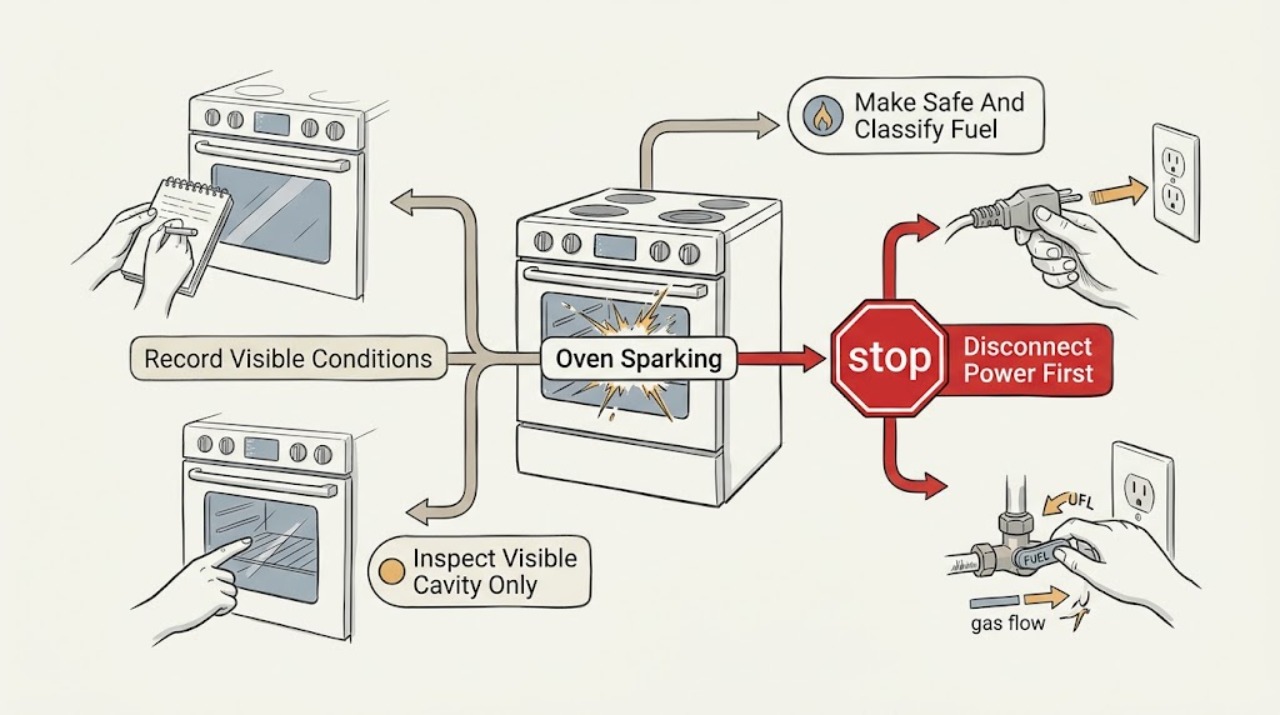
Treat any Kenmore oven spark as a safety decision before a repair clue. Stop the oven and keep clear if the spark is persistent, appears away from a designed gas-ignition point, is accompanied by a gas smell, delayed ignition, abnormal flame, smoke, burning smell, damaged cord, hot outlet, or a breaker trip. If there is a gas smell, do not operate switches or electronics: leave the area and contact local gas emergency help from outside. Once the appliance is cool and safe, identify whether the oven is gas, electric, or dual-fuel, record when the spark occurs, and use the exact model manual from Kenmore. A brief ignition event may be part of some gas-oven start sequences, but repeated sparking without a stable flame or any electrical arcing is not a user-adjustment problem. Do not remove panels, bypass an interlock, touch wiring, or test live parts; arrange qualified appliance service.
Before you begin
Safety first
- This article supports identification, safe visual observation, and exact-manual lookup only. Do not operate a gas-smelling or electrically damaged oven, repeat a hazardous ignition, open panels, touch wiring, bypass safety controls, or perform gas or electrical repair.
Work through in order
Diagnostic checks
Use only checks that match the exact appliance or system and its official guide.
-
Check 1
From a safe position, stop the oven using the normal control if no gas odor or active fire is present, keep people away, and identify whether the appliance is gas, electric, or dual-fuel from its documentation or nameplate without moving it or opening panels.
Expected result: Record whether the event is a brief start spark, repeated clicking, a visible arc, a flash in the cavity, or an unknown event; note any gas smell, smoke, flame abnormality, burning smell, heat damage, wet area, or breaker trip.
Next step: For gas odor or suspected leak, leave immediately without operating switches or electronics and contact local gas emergency help from outside. For smoke, fire, arcing, or electrical damage, stop use and obtain emergency or qualified service help as appropriate.
Stop if: Stop immediately for gas smell or hissing, flames outside the intended burner area, smoke, burning smell, visible electrical arcing, hot or damaged wiring/cord, shock, or a repeated breaker trip.
Why this matters
Why: Gas odor, active fire, smoke, or an electrical hazard overrides diagnosis. Fuel type and spark location determine which model-specific path can be considered; an unknown location is not a reason to repeat the test.
-
Check 2
Without restarting a hazardous appliance or placing hands inside, record when the spark occurs: while selecting a mode, pressing Start, during gas ignition, during preheat, after the oven is hot, when a surface control is used, or when the oven is otherwise idle.
Expected result: Note the exact control or cycle, whether the spark is visible at the intended gas igniter or instead at an element, cavity, wiring area, control, outlet, or plug, and whether a stable flame or normal heat follows.
Next step: Save the observation with the model number and consult the exact Kenmore manual. If the event cannot be located safely or repeats, leave the oven unused and schedule qualified service.
Stop if: Do not open the door to watch a flare, remove racks or panels to see wiring, or repeat a cycle to reproduce a spark, flash, odor, or trip.
Why this matters
Why: A model-dependent ignition event that ends with stable operation is different from a repeated spark, spark at an unintended location, or spark without heat. Location and timing are evidence for service, not permission to expose the component.
-
Check 3
Only after the oven is fully cool and isolated from use, inspect the ordinary visible cavity and door area without removing panels: look for foil or loose metal, spill residue, cracked glass, damaged racks, a displaced burner cover where the manual permits visual inspection, or food contacting an element.
Expected result: Classify the cavity as clean and undamaged, visibly contaminated or obstructed, cracked/damaged, or not safely inspectable; note whether the spark was inside the cavity or behind the controls.
Next step: Follow only the exact manual's cool-oven cleaning instructions for a safe, removable residue. Leave the appliance off and request service for damage, arc marks, hidden sparks, or uncertainty.
Stop if: Do not scrape an element, touch igniters or terminals, remove covers, use water on electrical parts, use foil to shield an element, or clean while hot.
Why this matters
Why: A visible cavity obstruction or residue may explain a localized event only if the manual permits cleaning and no component is damaged. A crack, damaged element, arc mark, or spark behind the panel requires service rather than cleaning.
-
Check 4
From outside the appliance, observe the plug, cord, receptacle, nearby wall, and control display for looseness, discoloration, heat damage, moisture, or a damaged cord; do not pull the range out or remove a cover. Confirm only whether the display has power and whether the circuit has tripped.
Expected result: Record a normal dry connection and display, a dead display after a trip, a loose or hot receptacle, damaged cord, scorch marks, moisture, or repeated tripping when the oven is selected.
Next step: Stop using the oven for any damage, heat, moisture, arc mark, or repeated trip; arrange qualified electrical or appliance service. Use only the model manual for any ordinary reset, and do not keep resetting a fault.
Stop if: Do not touch a hot, wet, loose, or damaged connection; do not use an extension cord, open the electrical compartment, or perform a live electrical test.
Why this matters
Why: A damaged connection or repeated trip can cause arcing or fire risk and needs electrical/appliance service. A normal display does not clear an internal element, igniter, control, or wiring fault.
-
Check 5
For a gas model only, use the exact Kenmore manual to identify the intended burner/igniter location and permitted user observation; do not remove the burner, igniter, bottom panel, or gas line. Do not attempt another ignition if there was an odor, flash, delayed light, or abnormal flame.
Expected result: If a safe manual-approved observation already exists, record whether there is no flame, a stable normal-looking flame, delayed ignition, repeated sparking, yellow/sooty flame, flame lift, or gas continuing without ignition.
Next step: Stop the appliance and obtain qualified gas-appliance service for any failed, delayed, repeated, or abnormal ignition. If gas is smelled, leave and contact local gas authorities from outside.
Stop if: Do not light the burner with a match, test for leaks, adjust jets or gas pressure, bypass an ignition safety, or dismantle the gas path.
Why this matters
Why: A stable flame after the designed start sequence is not proof that the ignition system is healthy, while delayed ignition, repeated sparks, abnormal flame, or gas without ignition can create fire or combustion risk. A gas valve, igniter, burner, supply, or control cannot be selected from appearance alone.
-
Check 6
For an electric or dual-fuel oven, with the appliance cool and unused, visually note whether an element or visible support is cracked, blistered, sagging, split, discolored, or marked by an arc; do not touch it or remove the rear panel.
Expected result: Record an intact-looking element, visible damage or arc marks, a spark from a hidden area, no visible element but a control-area spark, or a spark associated with another mode.
Next step: Leave the oven off and provide photos from a safe distance to qualified appliance service; a technician must isolate and diagnose the heating circuit before selecting a part.
Stop if: Do not touch, bend, scrape, clean, remove, or electrically test an element or terminal, and do not operate the oven with an arc mark or damaged insulation.
Why this matters
Why: Visible element damage or arcing can expose a heating or wiring fault. A normal-looking element does not clear hidden terminals, controls, or insulation, so continued sparking remains a service boundary.
-
Check 7
Prepare a service record from safe observations: complete Kenmore model number, fuel type, selected mode, exact timing and location of the spark, whether a flame or heat followed, error display, power symptoms, odors, smoke, damage, and any prior repair or cleaning.
Expected result: Confirm whether the event was one isolated start observation with no hazard, or whether it repeats, occurs while idle, leaves damage, prevents ignition/heating, or triggers a safety device.
Next step: Use Kenmore's manual and service routes with the record and safe photos. Keep the oven unused until qualified service clears a persistent, unexplained, or hazardous spark.
Stop if: Do not retest to obtain a video, erase a code by repeated resets, operate with damage, or attempt a part replacement based only on the symptom.
Why this matters
Why: A repeatable or unexplained spark is an unresolved ignition, heating, control, wiring, or supply fault; the record lets service identify the correct manual and safe diagnostic scope without repeated exposure.
Use your observations
Decision map
Find the observation that best matches what you see, then follow the next safe action.
-
PATH 01Safety boundary
What you see
Gas is smelled or heard, or gas may be present without a stable flame.
Do this next
Do not operate switches, lights, phones, or other electronics inside; leave immediately and contact local gas authorities or emergency services from outside.
Why this path and its safety boundary
Why it matters: This is a possible gas-leak or unburned-gas emergency, not a spark-adjustment problem.
Safety stop: Do not ignite anything, search for the leak, use the oven, or re-enter until cleared by the appropriate authority.
-
PATH 02Safety boundary
What you see
Smoke, a burning smell, visible flame outside the intended burner area, or an active fire occurs.
Do this next
Stop use, leave the area if needed, and use emergency fire response for an active fire. Arrange qualified appliance service after the area is safe.
Why this path and its safety boundary
Why it matters: The appliance may be overheating or electrically/combustion damaged and must not be tested further.
Safety stop: Do not open the oven to feed a fire, pour liquid on an energized appliance, or restart it to see whether the symptom clears.
-
PATH 03Safety boundary
What you see
The spark is at an element, control, wiring, plug, or receptacle, or the circuit trips, buzzes, or shows heat damage.
Do this next
Leave the oven off and arrange qualified appliance or electrical service. Isolate power only by a dry, safe method and only when no gas hazard is present.
Why this path and its safety boundary
Why it matters: An electrical fault is possible even when the oven still displays power; the visible symptom does not identify the failed component.
Safety stop: Do not touch the connection, open panels, reset repeatedly, bypass a safety device, or perform live electrical measurements.
-
PATH 04Safety boundary
What you see
On a gas model, a brief start spark is observed only at the intended ignition point and a stable flame follows, with no odor, delay, abnormal flame, smoke, or damage.
Do this next
Verify the sequence in the exact Kenmore manual and monitor only as the manual permits. Arrange service if sparking repeats after ignition, moves location, or heating becomes unreliable.
Why this path and its safety boundary
Why it matters: This may match the model's designed ignition sequence, but fuel and ignition designs differ by Kenmore model.
Safety stop: Do not repeat an ignition test after any odor, delayed light, abnormal flame, flash, smoke, or electrical symptom.
-
PATH 05Safety boundary
What you see
A gas model keeps sparking, sparks without a stable flame, lights late, or shows yellow/sooty, lifting, or otherwise abnormal flame.
Do this next
Turn the appliance off, keep it unused, and request qualified gas-appliance service. Leave immediately if gas is smelled.
Why this path and its safety boundary
Why it matters: The ignition, burner, gas supply, valve, control, or combustion path needs professional diagnosis; repeated operation can increase risk.
Safety stop: Do not use a match, adjust gas components, test for leaks, or continue cycling the oven.
-
PATH 06Safety boundary
What you see
The oven is cool and a manual-permitted visible check finds removable residue or a loose metal/food obstruction without component damage.
Do this next
Follow only the exact manual's cool-oven cleaning method, then leave the oven unused if the spark returns or any damage is present.
Why this path and its safety boundary
Why it matters: A visible obstruction may contribute to a localized event, but cleaning cannot validate hidden wiring, igniter, or element condition.
Safety stop: Do not scrape, bend, wet, remove, or shield an element or igniter, and do not clean a hot or energized appliance.
-
PATH 07Safety boundary
What you see
The spark location is unknown, occurs while idle, recurs after a safe observation, or no manual-approved user check explains it.
Do this next
Keep the appliance off and provide the model, timing, location if known, photos, and any code to qualified Kenmore appliance service.
Why this path and its safety boundary
Why it matters: An internal ignition, heating, control, insulation, or wiring issue remains possible and cannot be resolved by symptom alone.
Safety stop: Do not open panels, remove parts, or repeat the event to improve the diagnosis.
-
PATH 08Safety boundary
What you see
The model number is missing, the manual does not match the appliance, or the appliance may fall under a safety notice or recall.
Do this next
Record the model from a safe location, locate the matching Kenmore manual, and check the applicable official safety or recall information before use.
Why this path and its safety boundary
Why it matters: Fuel, ignition sequence, parts, and safety instructions cannot be safely inferred across models.
Safety stop: Do not use a generic code list, install a guessed igniter/element, or continue operating while model identity is unresolved.
Helpful context
Understand the symptom
First separate a designed ignition event from an unsafe arc
Kenmore oven designs vary by model and fuel. On some gas models, the ignition system can spark during a start attempt; that does not make repeated clicking, a spark in the cavity or control area, or a spark without a stable flame safe to investigate by trial. Electric ovens can show arcing at a damaged element, terminal, wire, receptacle, or control. Identify the fuel type and the exact moment of the event without opening the appliance.
Use the exact Kenmore manual and model identity
Kenmore's manual portal covers ovens and ranges and asks for the complete model number. Use it to confirm the ignition sequence, indicator meanings, permitted cleaning, and service boundary for the particular appliance. A gas-valve or igniter part listed for one range is not evidence that it fits another Kenmore model, and no symptom alone identifies a replacement part.
Gas smell and electrical arcing end the user check
A gas odor or sound of escaping gas is an evacuation event: do not use switches, phones, or other electronics inside; leave and contact local gas authorities from outside. For smoke, burning odor, visible electrical arcing, a hot or damaged cord, or a repeated electrical trip, stop using the oven and arrange qualified appliance or electrical service. Keep the door closed if opening it would feed a fire or expose you to heat.
Safety boundary
Stop conditions
- If gas is smelled or heard, do not operate switches or electronics inside; leave immediately and contact local gas emergency help from outside.
- Stop for smoke, fire, burning smell, visible electrical arcing, abnormal flame, delayed ignition, damaged cord, hot outlet, shock, or a repeated breaker trip.
- Do not use a match to light the oven, test for leaks, adjust gas pressure or jets, bypass an ignition or door safety, or dismantle the gas path.
- Do not open panels, reach into wiring or terminals, perform live electrical measurements, or remove/touch a heating element or igniter.
- Do not repeatedly restart or reset an oven to reproduce a spark, erase a code, or confirm a suspected part.
- Use the exact Kenmore model manual; do not infer fuel behavior, error meanings, or part fit from another model.
Only after diagnosis
Potential parts
- oven gas igniter
Consider this category only after a qualified diagnosis confirms a gas-oven ignition fault and the exact model's igniter is the failed component.
Confirm the complete Kenmore model, fuel configuration, connector, and manufacturer fit information; do not select a part from a spark symptom alone. - oven bake or broil heating element
Consider this category only when a qualified diagnosis identifies a damaged or failed electric heating element associated with the spark or no-heat symptom.
Confirm the exact model, element geometry, electrical specification, and manufacturer fit information before ordering; do not touch or test the element. - oven gas valve assembly
Consider this category only after qualified gas-appliance diagnosis links the no-ignition or abnormal-heating condition to the valve rather than the igniter, burner, supply, or control.
Kenmore identifies gas valves as model-specific parts controlling bake and broil gas supply; confirm the exact model and have qualified service install it. - oven control or ignition control
Consider this category only after service rules out the gas path, heating element, wiring, and connection and identifies a control fault.
Confirm the exact model and control revision through Kenmore or qualified service; do not open or replace a control based only on a spark location.
When checks do not resolve it
Need a professional?
Arrange qualified Kenmore appliance service for any repeated or unexplained spark, a spark at an element, control, wiring, plug, or receptacle, a gas model that sparks without stable ignition, delayed or abnormal flame, failure to heat, a damaged component, or a recurring code or breaker trip. Use emergency gas or fire response immediately for gas odor, hissing, smoke, or active fire.
Safety scope: This article supports identification, safe visual observation, and exact-manual lookup only. Do not operate a gas-smelling or electrically damaged oven, repeat a hazardous ignition, open panels, touch wiring, bypass safety controls, or perform gas or electrical repair.
Common questions
FAQ
Is a spark in a Kenmore gas oven always dangerous?
A brief spark at the intended ignition point may be part of a model's start sequence, but exact designs vary. Repeated sparking, delayed ignition, no stable flame, abnormal flame, gas odor, smoke, or an arc at another location is a stop-and-service condition.
What should I do if my Kenmore oven smells like gas while sparking?
Do not operate switches, lights, phones, or other electronics inside. Leave immediately and contact local gas authorities or emergency services from outside. Do not relight the oven or search for the leak yourself.
Could an electric Kenmore oven spark from a heating element?
A damaged element, terminal, wire, control, or connection can be involved, but a visible spark does not identify the failed part. Leave the oven off, do not touch or test the element, and arrange qualified appliance or electrical service.
Can I keep using the oven if the spark stops after one try?
Do not assume it is safe. Record the model, fuel type, mode, spark location and timing, then check the exact Kenmore manual. Any recurrence, odor, delay, abnormal flame, smoke, damage, or breaker trip means stop use and request service.
How do I find the right Kenmore oven manual?
Use Kenmore's official manual portal and enter the complete model number. Do not use another model's ignition sequence, error explanation, or parts list as a substitute.
Can I replace the igniter or element myself?
Sparking involves gas and electrical hazards, and a symptom does not prove which part failed. Do not open panels or work on the appliance; have qualified service confirm the fault and exact model-compatible part.
Read the exact guide
Official sources
- Range Gas Valve Assembly Genuine Original Equipment Manufacturer (OEM) partKenmore · Official Kenmore part page used only for conditional component semantics; the displayed part is not assumed to fit the assigned oven.
- Winter Storms Aren’t Over; CPSC Warns of Deadly Carbon Monoxide Risks and Fires During Power OutagesU.S. Consumer Product Safety Commission · General CPSC emergency guidance used for gas-odor stop conditions; it does not identify a Kenmore oven's ignition design.
- Find Your Manual | Kenmore Appliance Manuals & GuidesKenmore · Official Kenmore manual portal; the assigned topic has no model number, so the exact manual must be located before model-specific operation or repair.
- Appliance and Electrical Fire SafetyU.S. Fire Administration · General U.S. fire-safety guidance applied to stop conditions for a sparking oven; it does not diagnose a Kenmore component.
Community feedback
Share a repair observation
Share a plain-text repair observation. Accepted observations are published automatically; this page may take a moment to update.