
On this page
Start here
Quick answer
Turn the oven off and treat any continuing spark, smoke, flame outside the normal burner area, damaged cord, or gas odor as a stop condition. Once the oven is cool and isolated from power, record where and when the spark appears and check only for removable food, foil, or a visibly damaged element. A Bosch gas model can intentionally create ignition sparks during startup, but repeated sparking after ignition or sparking in an electric oven is not a normal user-adjustment issue; use the model-specific manual and arrange qualified service.
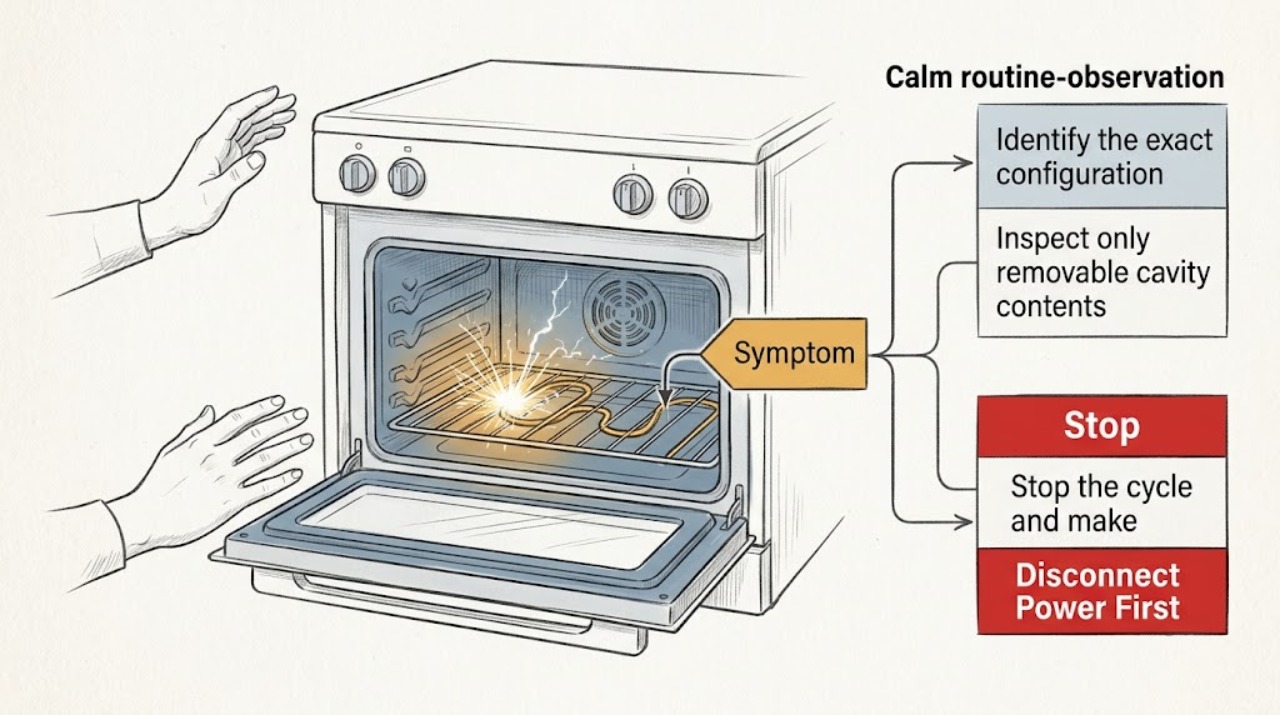
Work through in order
Diagnostic checks
Use only checks that match the exact appliance or system and its official guide.
-
Stop the cycle and make the area safe
Press Cancel or turn the oven control to Off. If there is smoke, an expanding flame, a damaged cord, or a spark that continues after the control is Off, keep clear and isolate power at the accessible breaker only if doing so is safe. Do not touch the oven, plug, or wiring while hot or wet.
Expected result: The spark stops immediately, or it continues, trips a breaker, produces smoke, or leaves a visible burn mark.
Next step: If any stop condition is present, leave the oven isolated and move to service-call information. Do not restore power to repeat the test. If the area is unsafe, leave it and contact local emergency help from a safe location.
Why this matters
Why: A continuing arc, overheating sign, or damaged supply is an electrical/fire stop condition rather than a cleaning or settings issue.
-
Identify the exact Bosch configuration
After the oven is cool and safe, read the E-Nr/model information from the rating plate or existing documentation. Note whether the appliance is electric, gas, or a dual-fuel range with a gas oven, and record the selected cooking mode when the spark occurred.
Expected result: You can identify the model and whether the event came from the cavity, a gas burner ignition point, a control area, or an external cord/connection.
Next step: Use the exact model manual to confirm normal ignition behavior and permitted user checks. If the model or event location cannot be identified safely, stop and give that uncertainty to the servicer.
Why this matters
Why: Bosch manuals and service guidance are model-specific; the same noise has different significance on a gas ignition system and an electric heating circuit.
-
Inspect only removable cavity contents when cold
With the controls Off, power isolated if accessible, and the oven fully cool, remove racks and cookware. Look for foil, metal packaging, a utensil, charred food, grease, or a loose removable accessory that could have contacted an element. Do not scrape an element, bend a burner, remove a cover, or use liquid cleaner inside a warm oven.
Expected result: A removable object or loose residue is present, or the cavity is clear but an element, insulator, lamp area, or wall has a crack, hole, blister, or blackened arc mark.
Next step: Remove only the cool, loose object and follow the model manual's cleaning instructions. If any component or surface is damaged, do not run another cycle; document the location for service.
Why this matters
Why: A removable object can explain a one-time flash; damage or an unexplained mark indicates a component or insulation fault that needs qualified assessment.
-
Use the gas-odor and ignition branch
If this is a gas oven, determine only from observation whether the spark occurred briefly during the model's normal ignition sequence or continued after ignition failed. If you smell unburned gas, do not operate light switches, appliance switches, plugs, or phones inside the building; if it is safe, ventilate and shut off the gas supply, then contact the gas supplier or service from outside.
Expected result: There is no gas odor and the flame is stable after ignition, or there is gas odor, failed ignition, delayed ignition, repeated sparking, a flame-out, or an uneven flame.
Next step: For any odor or abnormal flame, leave the appliance off and do not relight it. For a no-odor event that repeats after the control is Off, still arrange qualified service rather than adjusting the igniter, burner, or gas valve.
Why this matters
Why: A brief documented ignition event may be normal for the exact gas model. Gas odor or abnormal ignition can allow unburned gas to accumulate and is an immediate stop condition.
-
Use the electric-element branch
If this is an electric Bosch oven, note which mode was selected and whether the flash came from the bake/broil element, fan area, lamp area, door edge, or behind the control panel. With power isolated and the appliance cool, make only a visual check for a split element or burn mark; do not remove covers or perform energized electrical measurements.
Expected result: The element has a visible split or hole, an insulator is cracked, wiring is exposed, a breaker trips, or the spark came from an inaccessible area.
Next step: Keep power off and give the model, mode, spark location, and any breaker behavior to a qualified appliance technician. Do not replace an element or open the chassis unless the exact repair is within the technician's scope.
Why this matters
Why: These observations point to high-voltage or insulation damage. A breaker reset may hide the fault and does not prove the oven is safe.
-
Prepare a precise service report
Write down the model/E-Nr, gas or electric configuration, cooking mode, whether the door was open or closed, exact spark location, duration, smell or smoke, flame behavior, breaker response, and anything removed from the cavity. A photo of a cool, de-energized visible mark can help; do not photograph or handle live parts.
Expected result: The event can be reproduced only by energizing the oven, or the evidence already shows damage, gas odor, repeated arcing, or a failed safety behavior.
Next step: Use Bosch oven support or an authorized servicer, keep the oven isolated until advised, and provide the recorded evidence without guessing at a replacement component.
Why this matters
Why: Reproducing a hazardous arc is not a useful user test. A concise timeline and location lets Bosch support or an authorized servicer choose the correct model documentation and safety procedure.
Use your observations
Decision map
Find the observation that best matches what you see, then follow the next safe action.
-
PATH 01Next step
What you see
Smoke, flames outside the expected burner area, gas odor, damaged cord, continuing arc, repeated breaker trip, or a burn mark is present.
Do this next
Arrange qualified service and follow the exact model guidance.
Why this path and its safety boundary
Why it matters: The oven remains out of service pending safety assessment.
-
PATH 02Next step
What you see
The appliance is a gas model and the spark occurs only during the documented ignition sequence, with no gas odor and a stable flame afterward.
Do this next
Arrange qualified service and follow the exact model guidance.
Why this path and its safety boundary
Why it matters: If the event matches the manual and does not recur outside ignition, monitor it. If it repeats or persists, stop using the oven and arrange service.
-
PATH 03Next step
What you see
The model is electric, the spark is in the cavity or behind a control area, or the appliance type/location is uncertain.
Do this next
Arrange qualified service and follow the exact model guidance.
Why this path and its safety boundary
Why it matters: The fault is assessed without exposing the user to high-voltage components.
Helpful context
Understand the symptom
What Bosch oven sparking can mean
The word sparking describes several different events: a brief, model-designed ignition spark on a gas oven; an arc from a damaged heating element or wiring; or a flash caused by foil, a metal object, spilled food, or residue in the cavity. The location and timing matter more than the sound alone. Do not keep repeating the test to make the symptom appear. If the spark continues, is accompanied by smoke or a flame outside the expected burner area, or leaves a burn mark, stop using the oven and arrange service.
Electric and gas models need different boundaries
On a gas Bosch model, a spark can be part of the ignition sequence, but it should not continue indefinitely after the burner has lit. A gas odor, failed ignition, or flame that behaves abnormally is a stop condition. On an electric model, visible arcing near an element, cavity wall, lamp, terminal, or control area is not a user calibration problem; do not remove panels or measure live circuits. The model's owner manual is the authority for the exact appliance and gas/electric configuration.
When checks do not resolve it
Need a professional?
Arrange service for any unexplained, repeated, or inaccessible spark, and immediately for gas odor, smoke, fire signs, damaged wiring, or abnormal flame behavior.
Common questions
FAQ
Is a brief spark always a fault on a Bosch oven?
Not always. A Bosch gas model may make an intentional ignition spark during startup, but the exact model manual controls the expected sequence. A repeated spark after ignition, an electric-oven arc, smoke, gas odor, or a burn mark is not a normal adjustment issue and should be treated as a stop condition.
Can I replace a Bosch heating element or igniter myself?
Do not use sparking as a reason to open the appliance. Bosch says heating-element repairs should be left to experts because ovens use high-voltage electricity, and its manual says appliance repairs should be performed by trained specialist staff.
What should I do if a Bosch gas oven sparks and smells like gas?
Turn the oven off. Do not operate switches, unplug appliances, or use a phone inside the building; if safe, ventilate and shut off the gas supply, leave the area, and contact the gas supplier or service from outside.
What details should I give Bosch service?
Give the E-Nr/model, gas or electric configuration, cooking mode, exact spark location, timing, smoke or odor observations, flame behavior, breaker response, and whether the event repeats with the appliance isolated and cool.
Read the exact guide
Official sources
- User manual and installation instructions HGA120B29SBosch Home Appliances · Bosch gas cooker manual; use the safety and ignition guidance only where the reader's Bosch gas configuration matches the manual, and use the reader's exact model manual for final instructions.
- Oven Troubleshooting: Broken heating elementBosch Home Appliances · Bosch oven heating-element troubleshooting and repair-safety guidance.
- Get Support - Ovens & RangesBosch Home Appliances · Bosch wall ovens and ranges support hub for model manuals, service assistant, troubleshooting, and authorized service paths.
Community feedback
Share a repair observation
Share a plain-text repair observation. Accepted observations are published automatically; this page may take a moment to update.