
On this page
Start here
Quick answer
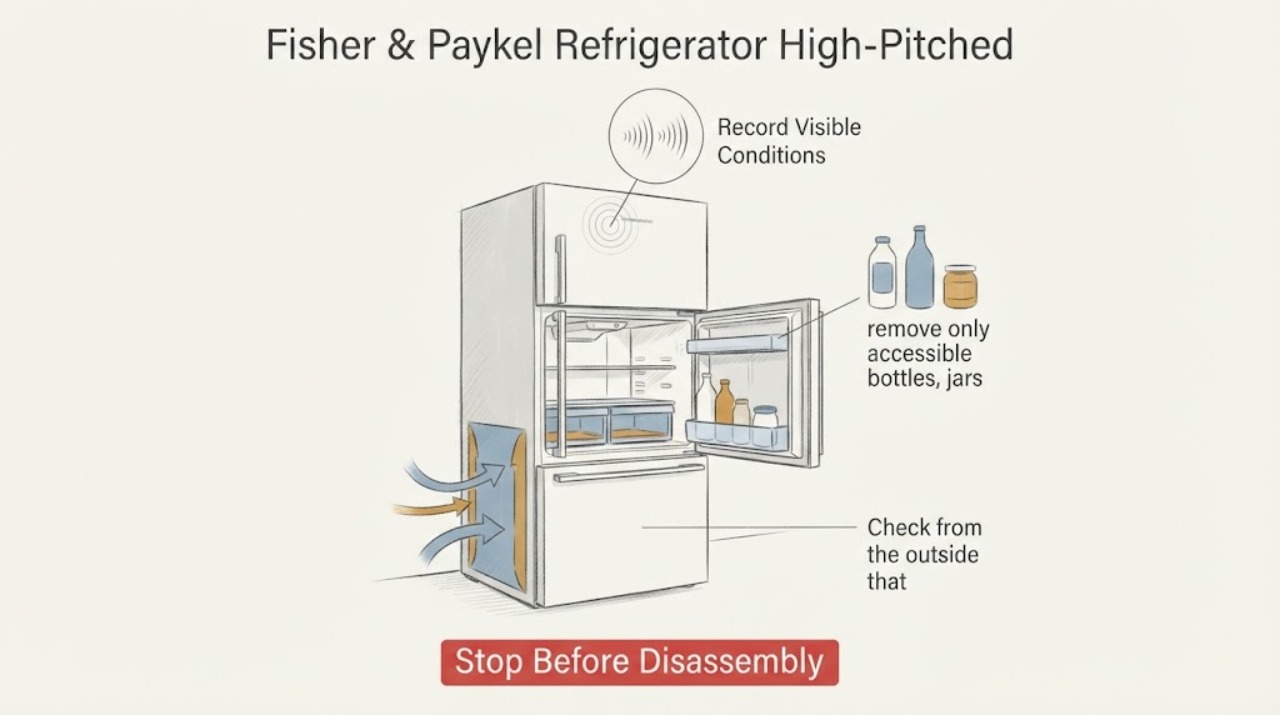
A high-pitched refrigerator sound cannot identify a failed compressor, fan, valve, or sealed-system part by itself. Fisher & Paykel's opened refrigerator guide documents several normal sound groups—fan airflow, defrost cracking or popping, refrigerant movement, pressure-related hissing, cabinet or shelf rattles, and ice-maker sounds—but that guide is explicitly for the listed model families and is not proof for an unidentified appliance. First record when the tone occurs and whether cooling, alarms, water, or ice operation change; check only accessible bottles, door sealing, cabinet contact, level/stability, and visible ventilation. Stop using the refrigerator and arrange qualified service if there is a burning smell, smoke, sparking, damaged cord, water near electrics, refrigerant-circuit damage, loss of cooling, or a persistent tone that cannot be explained by an external condition. Obtain the exact Model Code before applying any model-specific instruction.
Work through in order
Diagnostic checks
Use only checks that match the exact appliance or system and its official guide.
-
Check 1
From outside the refrigerator, record when the high-pitched sound starts and stops. Note whether it follows a door opening or closing, a cooling run, defrost, water dispensing, or ice-making, and whether it is continuous or intermittent. Do not put hands near an exposed fan, rear machinery, or moving parts.
Expected result: The sound is brief after a door closes, occurs only during ice or water operation, follows cooling demand, appears during a defrost period, or remains present independently of those events.
Next step: Record a short description or safe recording, the timing, and any change in cooling or display indicators. Use the exact Model Code to retrieve the applicable guide; do not keep cycling the appliance to reproduce the sound if another hazard is present.
Why this matters
Why: Timing can place the sound in a documented operating context, but it does not prove a particular part. The opened Fisher & Paykel guide describes airflow, refrigerant movement, pressure hissing, defrost sounds, and ice-maker sounds as normal for its listed models; a persistent unexplained tone needs the exact model's documentation or service assessment.
-
Check 2
With the refrigerator stopped and the doors closed, remove only accessible bottles, jars, trays, or packaging that may be touching each other or the cabinet. Listen again during normal operation without removing an interior or rear panel.
Expected result: The tone changes when an accessible item is moved, or it remains unchanged with no visible shelf or container contact.
Next step: Keep containers from touching and monitor one normal cycle. If the sound remains a high, persistent tone, document it and move to model-specific support rather than attempting to reach an internal fan or motor.
Why this matters
Why: A change after an accessible item is moved supports an external rattle or resonance, which the opened Fisher & Paykel guide lists among possible strange sounds. No change does not identify an internal fan, motor, valve, or sealed-system cause.
-
Check 3
Check from the outside that the refrigerator is stable, is not visibly pressed against cabinetry or a wall, and has the ventilation clearance required by the installation instructions for its exact model. Do not slide or tilt a powered refrigerator and do not remove the rear cover.
Expected result: The cabinet rocks, a visible surface is contacting the refrigerator, ventilation openings are obstructed, or the unit appears stable with clear visible space.
Next step: Remove only a plainly visible obstruction without dismantling the appliance and arrange model-specific installation or service advice if stability or clearance cannot be corrected safely. If the unit is stable and clear but the tone persists, continue documenting rather than guessing a part.
Why this matters
Why: An uneven floor, an unlevel cabinet, contact with surrounding surfaces, or blocked ventilation can change vibration and airflow noise. These observations do not establish a refrigeration-system fault, and clearance requirements vary by model.
-
Check 4
Check food temperature, visible frost or condensation, the display for warnings, and whether the refrigerator or freezer is actually cooling as expected. Record any simultaneous water leak, ice-maker change, alarm, or repeated cycling; do not change sealed-system settings or remove panels.
Expected result: Cooling and displays remain normal; cooling is reduced or a warning appears; or water, frost, or an ice-maker symptom occurs with the sound.
Next step: For normal cooling, provide the Model Code and sound timing to Fisher & Paykel support. For reduced cooling, warnings, water near electrics, or food-safety concerns, stop relying on the appliance and arrange qualified service promptly; do not attempt sealed-system or electrical repair.
Why this matters
Why: A high-pitched tone with normal cooling may be a sound or vibration issue but is still not a component diagnosis. Reduced cooling, warnings, or water/frost symptoms broaden the service need and cannot be safely attributed to the tone alone.
-
Check 5
Find and record the complete Model Code and serial information from the appliance label or its official documentation, then use Fisher & Paykel's product-resource and support paths to select the exact refrigerator. Do not substitute a similar-looking Fisher & Paykel model or the example guide used in this article.
Expected result: The Model Code is available and selects an exact product resource, or the label is missing, unreadable, or does not match the available official support results.
Next step: Use the exact Model Code when contacting Fisher & Paykel or an authorized service agent. Until the identity is confirmed, keep checks external and do not order a sound-related part or follow another model's disassembly procedure.
Why this matters
Why: The official resource pages are model-oriented, and the sound guide's listed model families cannot establish behavior for an unidentified refrigerator. An unresolved identity blocks model-specific sound meaning, clearance values, parts, and repair instructions.
-
Check 6
Stop and isolate the refrigerator only when it is safe to do so if there is a burning smell, smoke, sparking, a hot or damaged cord, water contacting electrical areas, or a suspected damaged refrigerant circuit. Ventilate and keep away from sparks or flames if refrigerant-circuit damage is suspected; do not open the cabinet or attempt electrical or sealed-system work.
Expected result: There is no hazard sign and the sound is only a reported tone, or any electrical, refrigerant, smoke, or fire warning is present.
Next step: For any hazard sign, leave the appliance out of use and arrange qualified appliance or electrical service; use emergency help for smoke or fire. For an unexplained but non-hazardous persistent tone, book model-specific service rather than continuing repeated tests.
Why this matters
Why: The Fisher & Paykel safety guidance treats damaged refrigerant circuitry and electrical malfunction as a professional repair boundary. A high-pitched sound alone does not override that boundary, and the warranty page routes covered service to Fisher & Paykel or an authorized service agent.
Use your observations
Decision map
Find the observation that best matches what you see, then follow the next safe action.
-
PATH 01Next step
What you see
The sound is brief and occurs in a documented operating context such as airflow, defrost, refrigerant movement, pressure equalization after a door closes, or ice-maker operation, while cooling remains normal and no hazard is present.
Do this next
Confirm the exact Model Code, compare only with that model's official guide, and monitor for a change in duration, volume, cooling, or warnings. Arrange service if the sound becomes persistent or is joined by another symptom.
Why this path and its safety boundary
Why it matters: For the model families covered by the opened guide, this pattern can be consistent with normal refrigerator operation; the guide does not call every sound high-pitched and it does not establish the behavior of an unidentified model.
-
PATH 02Next step
What you see
The tone changes when an accessible bottle, shelf item, cabinet contact, or visible stability issue is corrected, with no cooling or safety symptom.
Do this next
Keep the unit stable and remove only accessible contact points. If the tone returns without contact or the cabinet cannot be made stable safely, use the exact model's installation or service path.
Why this path and its safety boundary
Why it matters: An external rattle, resonance, uneven floor, or cabinet contact is more plausible than a proven internal component failure, but the observation still does not identify a repair part.
-
PATH 03Next step
What you see
The high-pitched sound is continuous or worsening, cannot be linked to an external item or documented operating event, or occurs with reduced cooling, a warning, abnormal frost, water, or repeated cycling.
Do this next
Record the Model Code, timing, sound location as heard from outside, cooling state, and display warnings; arrange Fisher & Paykel or authorized service and avoid internal access or repeated reproduction tests.
Why this path and its safety boundary
Why it matters: This is an unresolved appliance symptom. It does not prove a compressor, fan, valve, control, or refrigerant fault, but it exceeds what can be safely narrowed without the model and service diagnostics.
-
PATH 04Next step
What you see
There is smoke, burning odor, sparking, a hot or damaged power cord, water at electrical areas, a repeated trip, or suspected damage to the refrigerant circuit.
Do this next
Stop using the refrigerator; isolate power only if doing so is safe, ventilate and leave the area if refrigerant damage is suspected, and obtain qualified appliance/electrical or emergency assistance as appropriate. Do not open the cabinet or restart it to listen again.
Why this path and its safety boundary
Why it matters: The situation is a safety boundary, not a sound-identification exercise. Fisher & Paykel's safety guidance warns against operating equipment that may produce arcs, sparks, or flames around a damaged refrigerant circuit and directs owners to an authorized repairer.
-
PATH 05Next step
What you see
The Model Code cannot be read or the available official resources do not match the refrigerator.
Do this next
Photograph the rating label for service identification and use Fisher & Paykel's support route. Keep the article's checks limited to external observation and safety; do not order a fan, compressor, valve, or control part from the symptom alone.
Why this path and its safety boundary
Why it matters: Model scope is unresolved. The opened guide's sound list and any model-specific clearance or parts information cannot be safely transferred to the unidentified unit.
Helpful context
Understand the symptom
The phrase high-pitched noise is a symptom, not a component diagnosis. The useful distinction is whether the tone follows cooling demand, a door closing, defrost, water or ice operation, or a physical vibration, and whether the refrigerator still holds temperature. Do not label the source as a compressor, evaporator fan, water valve, or refrigerant fault from pitch alone.
The exact Model Code is a required gate for model-specific instructions. Fisher & Paykel's support and resources pages route owners to product resources and troubleshooting by product or model, and its contact guidance says to use the troubleshooting path to find the specific Model Code and documentation. The opened sound guide covers E402B, E442B, E522B, RF522W, RF522A, RF610A, and RF540A in its stated markets; its sound descriptions should be treated as an example of scoped documentation until the appliance identity is confirmed.
When checks do not resolve it
Need a professional?
Book Fisher & Paykel or authorized service for a persistent unexplained high-pitched tone, a tone joined by cooling loss, warnings, abnormal frost, water, or repeated cycling, or any sound that cannot be separated from an internal appliance condition after external checks. Give the technician the exact Model Code, market, serial information, when the sound occurs, where it is heard from outside, what operation precedes it, and any cooling or display change. Leave the refrigerator out of use for smoke, burning odor, sparks, a hot or damaged cord, water near electrical areas, repeated electrical trips, or suspected refrigerant-circuit damage; do not dismantle it or attempt sealed-system/electrical repair.
Common questions
FAQ
Does a high-pitched Fisher & Paykel refrigerator sound prove the compressor is failing?
No. Pitch alone cannot identify a compressor or any other part. Fisher & Paykel's opened guide lists several normal sound groups and external causes for the model families it covers, while its support path is model-specific. Record timing, cooling state, warnings, and the exact Model Code before service; do not order a compressor or fan from the sound alone.
What external checks are safe for a refrigerator making a high tone?
From outside, note when the sound occurs, remove only accessible bottles or packaging that are touching, check for visible cabinet contact or instability, and verify that ventilation openings are not visibly obstructed. Do not remove panels, reach toward fans, alter the refrigerant circuit, or perform live electrical tests. Use the exact model resource for any further instruction.
Why do I need the Fisher & Paykel Model Code before using a sound guide?
The official resources are organized by product and Model Code, and the opened sound guide names its own model families and markets. Without the exact identity, its sound descriptions, installation clearances, parts, and service instructions cannot be assumed to apply to your refrigerator.
When should I stop using the refrigerator instead of listening for the source?
Stop using it for smoke, burning odor, sparks, a hot or damaged cord, water near electrical areas, repeated electrical trips, suspected refrigerant-circuit damage, or a serious cooling failure. Fisher & Paykel's safety guidance calls for ventilation and an authorized repairer for damaged refrigerant circuitry and prohibits operating equipment that could make arcs, sparks, or flames in that area.
Read the exact guide
Official sources
- Ice & Water refrigerator User GuideFisher & Paykel · Opened the manufacturer PDF directly. It is exact evidence only for the models and markets printed in its cover; it is used here for its model-scoped normal-sound descriptions and safety/service boundary, not as proof that an unidentified Fisher & Paykel refrigerator has the same sound behavior.
- Help & SupportFisher & Paykel · Opened the official US Help & Support page. It supports routing the unidentified refrigerator to official troubleshooting, manuals, and service; it does not supply a universal high-pitched-noise diagnosis.
- ResourcesFisher & Paykel · Opened the official US Resources page. It supports selecting the exact product/model resource before using technical instructions; it does not prove a sound meaning for an unidentified appliance.
- Contact UsFisher & Paykel · Opened the official US contact page. It supports obtaining the exact Model Code and documentation through Product Help; it does not establish the cause of a high-pitched sound.
- Warranty InformationFisher & Paykel · Opened Fisher & Paykel's US warranty page. It supports the US service route and the distinction between normal refrigeration noise and a service request; warranty coverage and exclusions are market-specific.
Community feedback
Share a repair observation
Share a plain-text repair observation. Accepted observations are published automatically; this page may take a moment to update.