
On this page
Start here
Quick answer
First identify where the water starts and whether the refrigerator has an Ice & Water or Automatic Ice configuration; not every Fisher & Paykel model has a water connection or dispenser. Water at the rear or around a filter points to the supply path, filter, or connection; drips from a dispenser or ice-maker area require the exact model guide; water inside vegetable bins or on an interior wall can be condensation; and water that appears at the door edge calls for a door-seal and door-closing check. Dry the area, stop using the affected water function, and isolate the water supply and power from a dry accessible point if water is near electrical parts. Do not open panels, alter plumbing pressure, or perform live electrical tests.
Before you begin
Safety first
- If water is near an outlet, cord, compressor, control, or other electrical part, stop using the refrigerator and isolate power and water only from a dry accessible point if safe. Do not open panels, disconnect pressurized tubing, alter water pressure, bypass controls, or perform live electrical testing.
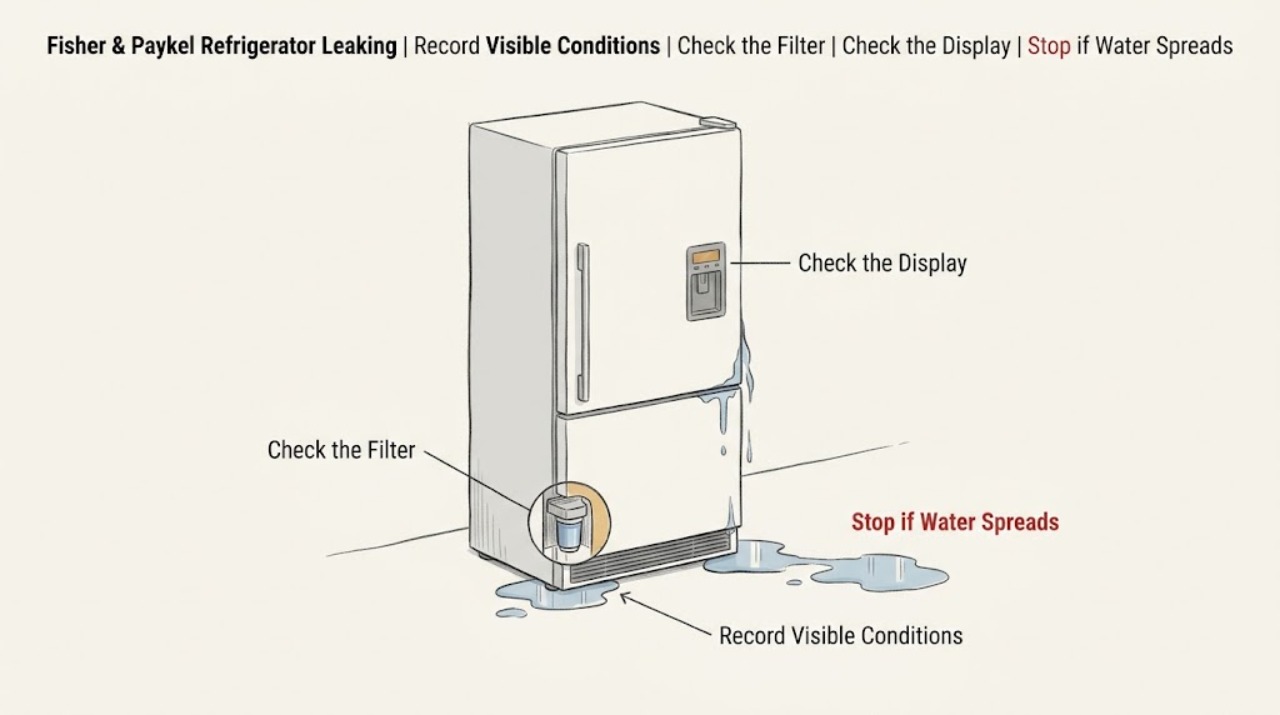
Work through in order
Diagnostic checks
Use only checks that match the exact appliance or system and its official guide.
-
Check 1
Make the area safe, close the refrigerator's accessible water isolation tap if it has one, and trace the wet trail with the appliance and floor dry. Record whether the highest wet point is at the rear connection, filter, dispenser, ice-maker area, inside a compartment, or the door edge.
Expected result: Water stops after the isolation tap is closed, continues without a connected water supply, or is only present as surface moisture or condensation.
Next step: Follow the matching location branch below. If water is near electrical parts, a damaged cord, or an outlet, stop using the refrigerator and isolate power only from a dry accessible point; do not touch wet electrical components.
Why this matters
Why: A change when the tap is closed makes the supply, filter, dispenser, or ice-maker water path more likely. Moisture that does not depend on the water supply points more toward condensation, a door-seal issue, or an internal drainage path.
-
Check 2
For a model confirmed to have Ice & Water hardware, inspect only the visible supply tubing, shutoff connection, filter head or cartridge area, and fittings for a loose connection, kink, crack, or fresh droplet. Do not disconnect a pressurized line or alter a pressure regulator.
Expected result: A visible line or filter area is wet, the filter was recently changed, the filter indicator is on, or all visible connections remain dry.
Next step: Keep the water supply closed and arrange a qualified plumber or Fisher & Paykel service for a persistent connection/filter leak. Replace a filter only when the exact model guide and indicator call for it; do not guess a cartridge or continue operating with a wet fitting.
Why this matters
Why: A wet connection or recently disturbed filter makes the water-supply or filter path more likely. Fisher & Paykel says the filter can restrict flow and that the filter system should be flushed and checked for leaks after installation; a dry exterior does not rule out an internal valve or tubing fault.
-
Check 3
If the leak is at a water or ice dispenser, use the normal user control once after the water is shut off and note whether the drip occurs only after dispensing, continues at rest, or appears around an ice-maker bin. Apply this check only to the exact model's documented Ice & Water or Automatic Ice configuration.
Expected result: A few drips follow recent filter installation or first use, the dispenser keeps dripping while idle, or water appears around the ice-maker or bin area.
Next step: Follow the model guide's flushing instruction only for a confirmed connected model and only with the supply safely controlled. If dripping continues at rest, the ice-maker area is wet, or the model lacks that interface, stop the water function and arrange service; do not remove the dispenser or ice-maker mechanism.
Why this matters
Why: The RF522 guide describes temporary drips while trapped air clears after installation and identifies the external water system, dispenser, and ice maker as model-specific. A drip at rest or water around the ice-maker area is not proof of a bad filter and may require service of a valve, fitting, or internal tubing.
-
Check 4
Inspect the refrigerator compartment and vegetable bins without removing interior panels. Wipe away moisture, check whether produce or frequent door opening explains it, and verify that the door gasket sits flat and the door closes fully without packaging in the way.
Expected result: There is a small amount of moisture in the vegetable bins, condensation on the outside during high humidity, a gasket that is lifted or dirty, or water pooling repeatedly under drawers or on the floor.
Next step: Wipe the moisture, reduce unnecessary door openings, set humidity as the guide permits, and clean/reseat only the accessible gasket. If water returns, reaches the floor, or seems to come from behind a liner or drawer, stop and arrange service rather than probing a drain or removing panels.
Why this matters
Why: The manufacturer treats limited produce-related condensation and some high-humidity exterior condensation as normal, while a door gasket that is not sitting flat can allow excess interior condensation. Repeated pooling after the accessible checks is not explained by those normal conditions and may indicate an internal drainage or other service issue.
-
Check 5
Check the appliance's warnings and the exact model guide after the safe external checks. Note whether the leak is accompanied by a warm cabinet, loss of cooling, a breaker trip, unusual smell, damaged cord, or water near the compressor or control area.
Expected result: The leak persists, cooling is affected, a warning returns, water is near electrical parts, or the required repair would involve a valve, pump, drain, wiring, control, sealed system, or internal tubing.
Next step: Stop using the affected function, isolate power and water from dry accessible controls if safe, protect the floor, and contact Fisher & Paykel or an authorized service provider with the model, leak location, and timing. Do not perform live testing or bypass a safety control.
Why this matters
Why: Those results exceed a user-accessible location or gasket check. Fisher & Paykel directs customers to its technicians or authorized service partners and warns that water-filter installation must follow plumbing requirements; internal refrigeration and electrical work should not be improvised.
Use your observations
Decision map
Find the observation that best matches what you see, then follow the next safe action.
-
PATH 01Next step
What you see
Do this next
Leave the water supply closed, dry the area, and have a qualified plumber or Fisher & Paykel technician inspect the exact model's connection and filter arrangement. Do not loosen a pressurized fitting or alter water pressure.
-
PATH 02Next step
What you see
Do this next
Use only the exact model guide's flushing procedure if the interface and water connection match. If the drip continues at rest or the model does not document that dispenser, close the supply and arrange service.
-
PATH 03Next step
What you see
Do this next
Wipe the moisture, reduce long/frequent door openings, use the guide's humidity setting, and monitor. Escalate if it becomes repeated pooling, reaches the floor, or is accompanied by poor door closure or cooling loss.
-
PATH 04Next step
What you see
Do this next
Remove only an obvious obstruction, clean and reseat the accessible gasket, and verify the door closes. If the seal will not sit flat or water persists, use model-specific service rather than forcing the door or removing hinges.
-
PATH 05Next step
What you see
Do this next
Stop using the refrigerator, isolate power and water from dry accessible controls if safe, and contact Fisher & Paykel support or an authorized technician. Do not open panels, probe a drain, or perform live tests.
Helpful context
Understand the symptom
Start with the water trail, not the part name
Unplug or stop the refrigerator only from a dry, accessible point when water is close to an outlet, cord, or electrical compartment. Use a towel to trace the highest wet point and note whether the water appears at the rear, under the cabinet, around the filter, at a dispenser, inside the cabinet, or along a door edge. A wet floor can be downstream of the real source. Keep the water supply closed while you inspect a connected model, and do not pull panels or reach behind a wet appliance.
Fisher & Paykel models do not all share the same water hardware
The RF135B, RF170B, RF170W, RF170A, and RF201A guide covers Ice & Water, Automatic Ice, and non-Ice & Water versions; the E and RF model guide separately labels water-dispenser troubleshooting for Ice & Water models. Some current integrated models also place the water and ice interface inside the cabinet. Use the full model number and its guide before applying filter, dispenser, or ice-maker instructions.
A leak can be a water-system problem or ordinary condensation
A line or filter leak usually follows the connected water path and may continue while the isolation tap is open. A dispenser drip may follow recent installation or trapped air. By contrast, Fisher & Paykel lists a small amount of condensation in vegetable bins as normal and recommends wiping it and adjusting humidity; condensation on the outside can also occur in high humidity. Persistent pooling after those checks, water under the appliance, or any leak that cannot be located safely needs model-specific service rather than a guessed replacement part.
Only after diagnosis
Potential parts
- refrigerator water filter cartridge
Consider a replacement only when the exact model guide or filter indicator identifies a restricted or due filter and the visible housing is not leaking from a separate fitting.
Confirm the full refrigerator model and the cartridge details printed on the existing filter or official model documentation before ordering; this article does not establish fitment.
When checks do not resolve it
Need a professional?
Use Fisher & Paykel or an authorized service partner when a leak continues after the safe external location checks, appears at a dispenser or ice-maker area while idle, comes from behind a liner or under the cabinet, affects cooling or power, or requires a valve, drain, tubing, control, electrical, or sealed-system repair.
Safety scope: If water is near an outlet, cord, compressor, control, or other electrical part, stop using the refrigerator and isolate power and water only from a dry accessible point if safe. Do not open panels, disconnect pressurized tubing, alter water pressure, bypass controls, or perform live electrical testing.
Common questions
FAQ
How do I tell a Fisher & Paykel water-supply leak from condensation?
Close the accessible water isolation tap and trace the highest wet point. A change at the rear, filter, dispenser, or ice-maker water path makes a connected supply problem more likely. Moisture limited to vegetable bins or a humid exterior with a dry supply path can be condensation, but repeated pooling or water reaching the floor needs service.
Can I apply the filter or dispenser leak steps to any Fisher & Paykel refrigerator?
No. Fisher & Paykel documents Ice & Water, Automatic Ice, and non-Ice & Water configurations. Confirm the full model and whether it has a water connection, external dispenser, internal dispenser, or only an automatic ice bin before using those checks.
Should I remove a panel to find a refrigerator leak?
No. Keep the inspection to dry, user-accessible tubing, filter, gasket, bin, and visible surfaces. If water is behind a liner, under the cabinet, near electrical parts, or cannot be located without disassembly, stop using the appliance and arrange Fisher & Paykel service.
Read the exact guide
Official sources
- ActiveSmart refrigerator installation and user guide — E and RF modelsFisher & Paykel · Fisher & Paykel ActiveSmart E and RF refrigerator model families covered by guide 863186B
- Water Filter ReplacementFisher & Paykel · Fisher & Paykel ice and water refrigerator filter replacement and safety guidance
- Help & Support | Book A Service | Repair | Technician | Fisher and Paykel USAFisher & Paykel · Fisher & Paykel product troubleshooting, manuals, and authorized service support
- INSTALLATION GUIDE / USER GUIDE — ACTIVESMART™ REFRIGERATORFisher & Paykel · Fisher & Paykel ActiveSmart refrigerator models RF135B, RF170B, RF170W, RF170A, and RF201A, including Ice & Water, Automatic Ice, and non-Ice & Water variants
- Ice & Water refrigeratorFisher & Paykel · Fisher & Paykel RF522ADX5 Ice & Water refrigerator and its documented water-filter and dispenser system
Community feedback
Share a repair observation
Share a plain-text repair observation. Accepted observations are published automatically; this page may take a moment to update.