
On this page
Start here
Quick answer
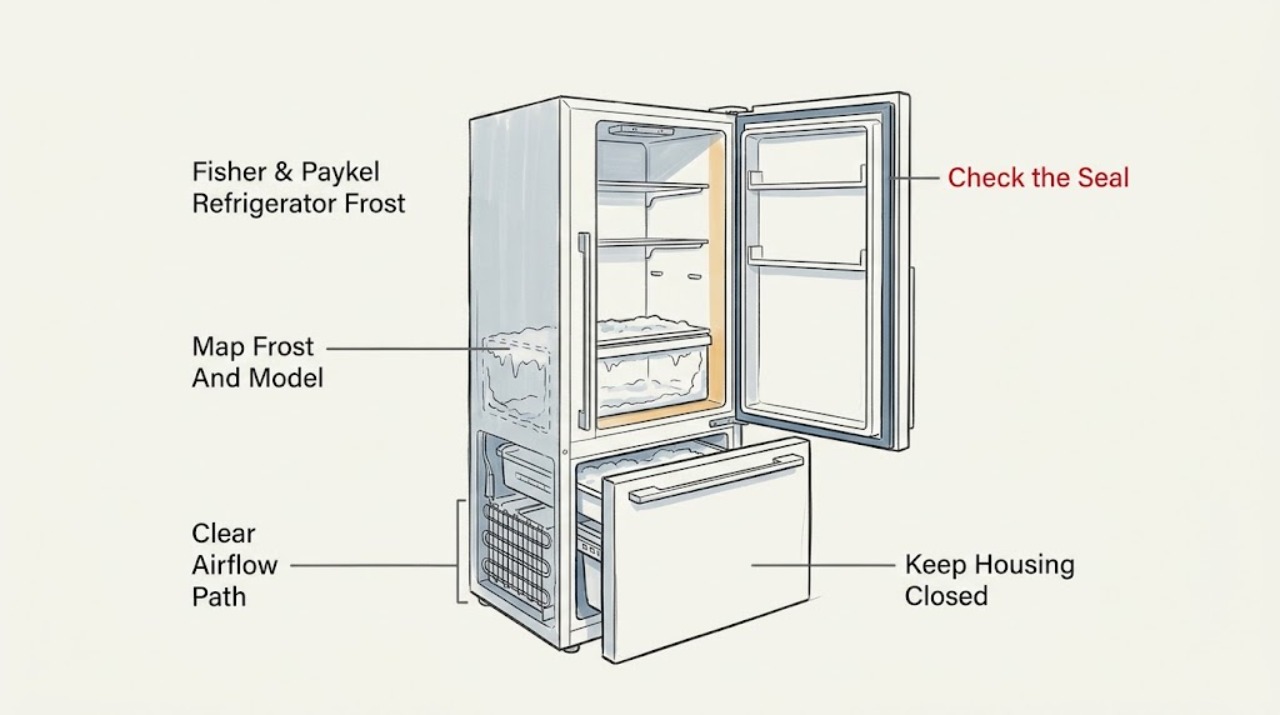
First locate the frost and record the exact model: a thin, temporary change during an automatic defrost event is different from ice that returns or grows on the freezer wall, around the door, or behind an air outlet. On Fisher & Paykel frost-free and integrated examples, frequent or long door openings, a door that does not close tightly, a dirty or leaking gasket, high humidity, or blocked airflow are the safe external checks. Re-seat food and bins so the door and outlets are clear, clean and inspect the gasket without removing it, and minimize door openings. Do not chip frost, use a hair dryer or other heat, force a defrost, remove interior panels, or probe an evaporator. Frost hidden behind a panel, repeated frost with weak cooling, a fan or fault alert, or food warming needs Fisher & Paykel service; protect perishable food if the refrigerator is not staying cold.
Before you begin
Safety first
- The user may record the model and frost pattern, move visible obstructions, clean and inspect the accessible gasket, keep air outlets clear, minimize door openings, and protect food. Evaporator, fan, drain, defrost, sensor, control, wiring, refrigerant, sealed-system, and heavy door or hinge work are for Fisher & Paykel trained personnel.
Work through in order
Diagnostic checks
Use only checks that match the exact appliance or system and its official guide.
-
Check 1
Record the complete model code and photograph or describe where frost appears: evenly on an exposed freezer surface, around the door gasket, beside an air outlet, only behind a removable bin, or behind an interior panel. Note when it appears, whether it clears, and whether the freezer is cooling normally.
Expected result: The frost is a light temporary film, a door-edge band, a localized airflow patch, a thick recurring layer, or hidden behind the liner; cooling is normal or weak.
Next step: Use the temporary/normal branch only when the change is brief and cooling remains normal. Use the gasket and loading branch for door-edge frost. If frost is hidden, recurring, or paired with weak cooling, stop at external observations and arrange service.
Stop if: Do not remove panels or bins that expose the evaporator, fan, heater, drain, or wiring just to locate the frost.
Why this matters
Why: Location and timing separate likely moisture or door-seal causes from an airflow or hidden-system issue. Fisher & Paykel identifies normal automatic defrost sounds in some integrated columns, while frost-free product families are not intended to accumulate persistent thick frost.
-
Check 2
With the door closed, check from outside that packages, shelves, bins, and ice containers are not preventing a tight closure. Inspect the visible gasket for dirt, gaps, flattening, or a section that is out of its channel; wipe it with the mild cleaning method in the exact guide and do not remove it.
Expected result: The door is blocked or ajar, the gasket is dirty or not flat, the cabinet or doors are visibly misaligned, or the door closes and seals evenly.
Next step: Remove only the visible obstruction, clean and dry the gasket, close the door, and observe whether new frost stops forming. If the gasket will not sit flat, the door is misaligned, or frost returns, arrange service.
Stop if: Do not pry out the gasket, loosen hinges, lift a heavy door, or force the door closed against frost or a trapped package.
Why this matters
Why: Official Fisher & Paykel troubleshooting links compartment ice or condensation to a door not closing tightly and a leaking gasket. A visible obstruction or dirty gasket supports an external moisture-entry cause; misalignment or a damaged gasket needs model-specific service rather than a guessed adjustment.
-
Check 3
Check whether the frost followed frequent or long door openings, a large warm load, high room humidity, or food placed directly in front of a visible air outlet. Reposition only items that are visibly blocking the outlet or door, keep food covered, and minimize openings while the compartment stabilizes.
Expected result: Frost follows door use or humid conditions, a visible outlet is blocked, food is touching a cold-air opening, or these conditions are normal but frost still grows.
Next step: Correct only the visible loading or usage condition and monitor one normal cooling period. If frost builds behind a liner, blocks airflow, or returns despite clear doors and outlets, stop and arrange qualified diagnosis.
Stop if: Do not insert objects into an air outlet, scrape ice from a fan opening, or run the refrigerator with a loose panel or blocked fan.
Why this matters
Why: Fisher & Paykel guides associate condensation or ice with frequent/long openings, high humidity, blocked closure, and food or packaging that interferes with airflow. If those external conditions are absent and frost continues, an internal airflow or defrost problem becomes more plausible, but the user cannot select the failed part safely.
-
Check 4
Listen and observe without opening the cabinet: note a brief cracking or popping sound, a short pause, or a small surface change during a documented automatic-defrost period, versus frost that keeps thickening, blocks airflow, or returns rapidly. Do not attempt to accelerate the process.
Expected result: The event is brief and cooling remains normal, or the frost persists/returns and cooling, airflow, or temperature is affected.
Next step: For a brief normal event, leave the appliance operating and keep doors closed. For persistent or recurring frost, record the pattern and use service rather than forcing a manual defrost or removing the liner.
Stop if: Never use a knife, scraper, hair dryer, heat gun, boiling water, mechanical defrost device, or unapproved chemical to remove frost. Do not damage the refrigerant circuit.
Why this matters
Why: Fisher & Paykel describes cracking or popping during automatic defrost as normal on the cited integrated-column family. Persistent accumulation or reduced cooling is a different symptom and should not be treated as normal merely because the refrigerator has an automatic-defrost system.
-
Check 5
Check whether the refrigerator is maintaining safe temperatures without touching internal refrigeration parts. If food is softening, ice cream is melting, a fan is scraping, a fault alarm appears, or the frost is behind a panel, move perishable food to another working appliance or cooler and record the model, frost location, door/gasket observations, and timing for service.
Expected result: Cooling is normal and frost does not return, or food is warming, frost is hidden/recurring, airflow is weak, a fan is obstructed, or an alarm appears.
Next step: Keep the refrigerator closed if it is still safe, but stop using the affected compartment when food safety is uncertain. Arrange Fisher & Paykel trained service and provide the recorded evidence.
Stop if: Do not continue operating a refrigerator with smoke, burning odor, damaged cord, water near electrical parts, refrigerant-circuit damage, or unsafe food temperatures.
Why this matters
Why: Fisher & Paykel advises moving perishable food and calling service when the product is not getting cold. Hidden frost and repeated frost with poor cooling can involve the evaporator, fan, drain, sensor, heater, control, or sealed system; the visible symptom cannot identify which component is compatible.
Use your observations
Decision map
Find the observation that best matches what you see, then follow the next safe action.
-
PATH 01Next step
What you see
A small or short-lived change accompanies a brief cracking/popping or defrost event, cooling remains normal, and no thick layer or blocked outlet develops.
Do this next
Leave the appliance operating, minimize door openings, and monitor. Escalate if the frost persists, returns quickly, affects airflow, or changes the temperature.
Why this path and its safety boundary
Why it matters: The cited Fisher & Paykel integrated-column guide says cracking or popping may occur during automatic defrost and is normal. This is a normal operating event, not proof of a failed defrost system.
-
PATH 02Next step
What you see
Frost is concentrated around a door edge or gasket, the door was left open, packages obstruct closure, the gasket is dirty/not flat, or room humidity is high.
Do this next
Remove visible obstructions, clean and inspect the gasket, close the door fully, and reduce openings. If the gasket or alignment remains abnormal or frost returns, arrange service.
Why this path and its safety boundary
Why it matters: Fisher & Paykel troubleshooting identifies frequent or long door openings, a leaking gasket, high humidity, and a door not closing tightly as causes of condensation or ice inside a compartment.
-
PATH 03Safety boundary
What you see
Frost is localized beside an air outlet or rear wall, blocks airflow, returns behind the liner, or appears with weak fan/cooling performance while the door seal and loading are normal.
Do this next
Do not scrape or remove panels. Keep food safe, record the location and temperature symptoms, and arrange qualified Fisher & Paykel service for evaporator, fan, drain, defrost, sensor, control, or sealed-system diagnosis.
Why this path and its safety boundary
Why it matters: A clear external door and loading path makes an internal airflow or defrost issue more plausible. This is an inference from the symptom pattern, not a model-specific diagnosis; frost-free and integrated designs hide components that the user should not expose.
Safety stop: Do not use heat or sharp tools, probe behind a liner, or perform energized tests.
-
PATH 04Safety boundary
What you see
Thick frost keeps returning, the freezer is not maintaining temperature, food is softening/melting, a fan scrapes, or a fault alarm appears.
Do this next
Move perishable food to a working appliance or cooler, keep doors closed, isolate only if the model's safety instructions require it, and arrange Fisher & Paykel trained service immediately.
Why this path and its safety boundary
Why it matters: Persistent frost with temperature or alarm symptoms is not a safe user-cleaning issue. Fisher & Paykel advises moving perishable food and contacting service when the product is not getting cold.
Safety stop: Do not keep restarting a failing refrigerator, force a defrost, or continue using it when food safety is uncertain or electrical/refrigerant damage is suspected.
Helpful context
Understand the symptom
Classify the frost before touching it
Note whether the frost is a light, short-lived film after a long door opening, a band around the door gasket, a patch near an air outlet or rear wall, or a thick layer that returns after it is removed. Also record whether cooling, airflow, fan sounds, alarms, and door closing are normal. Fisher & Paykel models differ, so the exact model guide controls any user-permitted maintenance; this page deliberately stays with external checks.
Door sealing and moisture are the first safe branch
Warm humid air enters when a freezer door is left open, blocked, misaligned, or not sealing. Move packages and bins that prevent closure, check that the gasket sits flat and is clean, and minimize unnecessary openings. Do not adjust hinges, remove the gasket, or dismantle a drawer or door from a broad symptom.
Do not confuse visible frost with hidden evaporator frost
A small visible patch can follow moisture entry or a normal automatic-defrost event. Frost that forms behind a liner, blocks an air outlet, returns quickly, or accompanies weak cooling is not safely diagnosed by scraping the wall. On a frost-free model, hidden evaporator, fan, drain, sensor, or defrost-system work belongs to qualified service.
Protect food when cooling is affected
If ice cream is melting, food is softening, or the freezer is not holding temperature, move perishable food to another working appliance or cooler and contact service. Keep the doors closed as much as practical while recording the model, frost location, timing, temperature symptoms, and any alarm or unusual sound.
Safety boundary
Stop conditions
- Stop immediately for smoke, burning odor, a damaged cord, water near electrical parts, refrigerant-circuit damage, a fan scraping behind a panel, a fault alarm, or food warming to an unsafe condition.
- Do not use a knife, scraper, hair dryer, heat gun, boiling water, mechanical device, or unapproved chemical to accelerate defrosting or remove frost.
- Do not remove interior panels, probe air outlets, touch the evaporator or fan, bypass a sensor, or perform live electrical or sealed-system testing.
- Do not remove or adjust a heavy refrigerator door, hinge, gasket, drawer runner, or cabinet alignment hardware from the frost symptom alone.
- Arrange Fisher & Paykel trained service for recurring frost after clear door and loading conditions, hidden frost, weak cooling, internal airflow/defrost symptoms, or any refrigerant, electrical, or food-safety concern.
When checks do not resolve it
Need a professional?
Arrange Fisher & Paykel trained service when frost is hidden behind a liner, returns after the visible door, gasket, loading, and opening checks, blocks airflow, or is accompanied by weak cooling, fan scraping, an alarm, water leakage, or unsafe food temperatures. Move perishable food to another working appliance or cooler if the refrigerator is not staying cold. Evaporator, fan, drain, defrost heater, sensor, control, refrigerant, wiring, and door-alignment work are professional tasks.
Safety scope: The user may record the model and frost pattern, move visible obstructions, clean and inspect the accessible gasket, keep air outlets clear, minimize door openings, and protect food. Evaporator, fan, drain, defrost, sensor, control, wiring, refrigerant, sealed-system, and heavy door or hinge work are for Fisher & Paykel trained personnel.
Common questions
FAQ
Why is my Fisher & Paykel refrigerator building up frost?
Start with the frost location. Official Fisher & Paykel guidance links compartment ice or condensation to frequent or long door openings, a dirty or leaking gasket, high humidity, a door that does not close tightly, and visible obstructions. If the frost is hidden or returns with weak cooling after those checks, arrange service rather than scraping the liner.
Is a little frost during defrost normal?
A brief cracking or popping sound during automatic defrost is documented as normal on the cited Fisher & Paykel integrated-column family. A short-lived surface change with normal cooling can be observed, but persistent or rapidly returning thick frost, blocked airflow, or temperature loss is not a normal-user-maintenance condition.
How do I check the door gasket for frost buildup?
Move packages or bins that prevent a tight closure, then inspect the visible gasket for dirt, gaps, flattening, or a section that is not seated. Clean it only with the exact guide's mild method and do not remove or adjust it. If the door remains misaligned or frost returns, use Fisher & Paykel service.
Can I use a hair dryer or knife to remove refrigerator frost?
No. Fisher & Paykel warns against mechanical devices or other means to accelerate defrosting unless the manufacturer recommends them. A sharp tool or heat can damage the liner, wiring, evaporator, or refrigerant circuit. Follow only an exact model instruction; for a frost-free refrigerator or hidden frost, arrange service.
When should I call for Fisher & Paykel frost-buildup service?
Call when frost is behind a panel, returns after a clean gasket and clear door, blocks an air outlet, or accompanies weak cooling, fan scraping, a fault alarm, water, or melting food. Move perishable food to another working appliance or cooler if the refrigerator is not staying cold. Internal evaporator, fan, drain, defrost, sensor, control, wiring, and sealed-system work is professional service.
Read the exact guide
Official sources
- Freestanding French Door Refrigerator Freezer, 32", 17 cu ft — RF170ADX4 NFisher & Paykel · Specific RF170 product page used only to establish that this model family is frost-free and uses adaptive defrost; it does not supply a universal frost repair procedure for unspecified models.
- Integrated Refrigerator & Freezer User Guide — RS1884F, RS2484S/SH, RS3084S/SH and related modelsFisher & Paykel · Model-family example for integrated columns; defrost behavior, control sequences, and serviceable parts may differ on other refrigerators.
- ActiveSmart Refrigerator User Guide — B-model refrigerator and freezer familyFisher & Paykel · Older model-family example for gasket, door closure, and frost troubleshooting; do not infer its controls, intervals, or parts for an unspecified refrigerator.
- ActiveSmart Integrated Refrigerator Freezer User Guide — RS80A, RS90A and RS9120WFisher & Paykel · Model-family example for integrated refrigerators; the frost and door-gasket checks are cited for the listed models and do not authorize panel or sealed-system work on other models.
Community feedback
Share a repair observation
Share a plain-text repair observation. Accepted observations are published automatically; this page may take a moment to update.