
On this page
Start here
Quick answer
First identify whether water is actively leaking from an Ice & Water connection, collecting in the vegetable bins, appearing at the door gasket, or coming from a spill or condensation. Fisher & Paykel refrigerator guides support wiping visible water, checking that the cabinet and door gasket seal correctly, minimizing prolonged door openings, and—on Ice & Water models—checking the accessible supply line, filter condition, water connection, and dispenser drip tray. Turn off the refrigerator's water supply if a connected line is leaking, disconnect power only when safe around water, and arrange Fisher & Paykel service for a persistent leak, damaged hose or cord, water near electrical parts, or any condition requiring panels or sealed-system access.
Work through in order
Diagnostic checks
Use only checks that match the exact appliance or system and its official guide.
-
Check 1
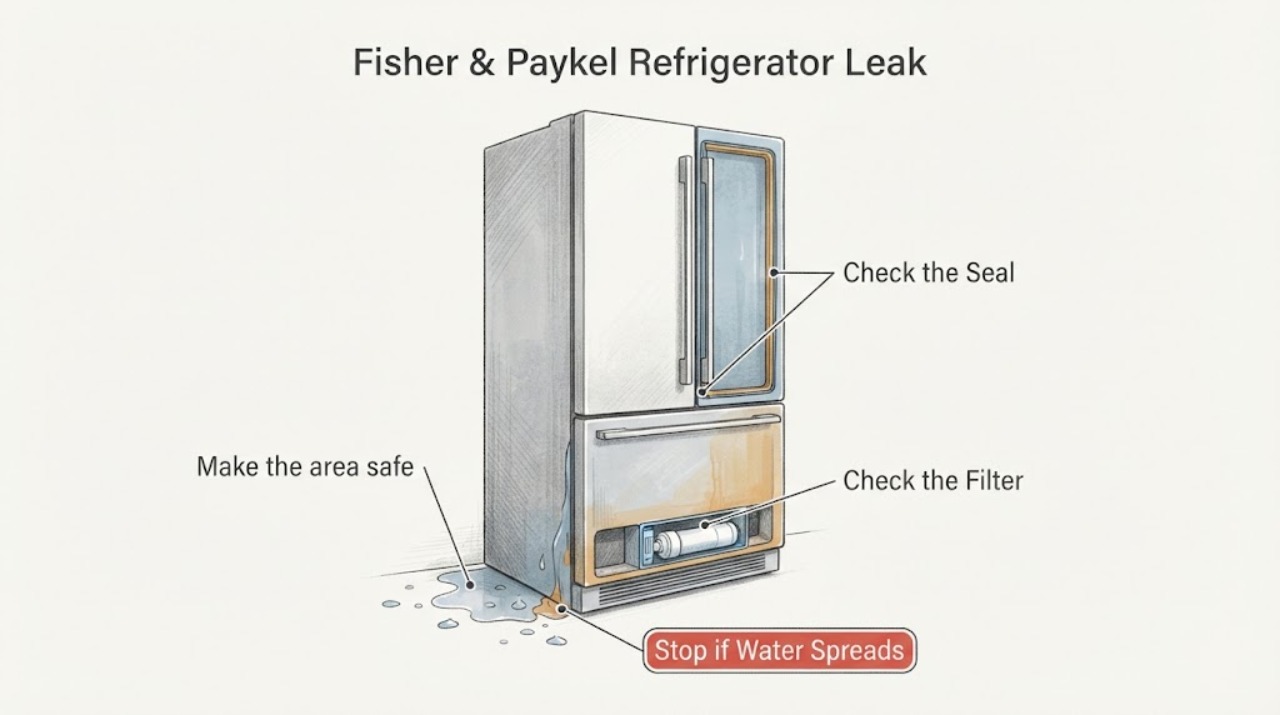
Make the area safe and map the water before moving the refrigerator: dry the floor, protect food from contamination, and note whether water is actively flowing, appears only after dispensing, is inside the vegetable bins, or is near the rear or power cord.
Expected result: Record the time, location, amount, and whether the water returns after dispensing, door opening, defrosting, or a new filter installation. Do not pull the refrigerator through a wet area or touch a wet plug.
Next step: Turn off the refrigerator water supply if an Ice & Water connection is actively leaking. If water is near electrical parts or the cord, disconnect power only when safe and arrange service; do not open the rear cover.
Why this matters
Why: A puddle at the dispenser or a water line is a different branch from condensation in a humidity bin or water caused by a door that does not seal. Location alone does not identify an internal component.
-
Check 2
Check the cabinet and door seal from the outside: confirm the refrigerator is stable and level, remove any visible package or food preventing closure, and inspect whether the gasket sits flat and seals around the door.
Expected result: Look for a visible gap, folded or dirty gasket, a door left ajar, or moisture on the outside or inside door edge. Do not pry the gasket out or adjust hinges without the exact model instructions.
Next step: Clean and dry only the visible gasket and move an obstruction if that restores a normal seal. If the gasket is damaged, the door remains misaligned, or water returns, use the exact manual or service rather than forcing the door.
Why this matters
Why: Fisher & Paykel guides associate poor door sealing with condensation, ice buildup, and temperature problems; high humidity and long door openings can also produce condensation that may be mistaken for a leak.
-
Check 3
On an Ice & Water model, inspect only the accessible water supply and filter area for a visible kink, loose external connection, wet filter housing, or a drip that starts after dispensing; keep the water supply off while examining an active leak.
Expected result: Check whether the supply line is kinked or leaking, whether a filter was recently installed, and whether the drip tray overflows only after dispensing. Do not disconnect a pressurized line, remove panels, or infer a failed valve from slow flow.
Next step: Follow the exact model guide for filter seating or flushing only when there is no active leak and the connection is designed for user access. Turn off water and request service for a damaged line, housing, persistent leak, or inaccessible connection.
Why this matters
Why: Fisher & Paykel documents supply-line kinks or leaks, blocked filters, air after a new filter, and trapped air in the tank as possible dispenser or drip-tray conditions on the covered Ice & Water family.
-
Check 4
If water is inside the refrigerator near the vegetable bins rather than pooling at a supply connection, check the visible humidity setting and wipe the bin dry; reduce prolonged door openings and keep food from obstructing the door seal.
Expected result: See whether the water is limited to the humidity-controlled bins, whether the amount changes with high humidity or door openings, and whether the gasket seals flat when closed.
Next step: Monitor after the visible adjustment. If water reaches shelves or the floor, the gasket does not seal, food is warming, or the condition persists, arrange model-specific service rather than assuming a blocked drain.
Why this matters
Why: Fisher & Paykel states that a small amount of condensation in the vegetable bins is beneficial; excess water can be wiped and the humidity control adjusted, while frequent door openings or a leaking gasket can increase condensation.
-
Check 5
Check for an Ice & Water freezer-door or ice-maker condition only when the appliance has those features: confirm the freezer door closes tightly, the ice bin is correctly seated, and the visible water supply is connected without kinks.
Expected result: Look for ice buildup, a door left ajar, a bin out of position, or a water line that is visibly squashed. Do not chip ice with a sharp object or remove the ice maker, valve, or sealed-system cover.
Next step: Correct only a visible door obstruction or external kink if safe. For active water, damaged parts, recurring ice buildup, or any internal leak, stop using the water/ice function and book service.
Why this matters
Why: The Fisher & Paykel refrigerator guide links ice buildup to a door that does not close tightly and lists water supply, bin position, pressure, and a kinked line among ice-maker checks; these observations do not prove the cause of a floor leak.
Use your observations
Decision map
Find the observation that best matches what you see, then follow the next safe action.
-
PATH 01Next step
What you see
If water is actively coming from an external Ice & Water line, filter connection, or dispenser area
Do this next
Turn off the refrigerator water supply, contain the water, and arrange service if the connection, filter housing, hose, or dispenser continues to leak. Do not disconnect pressurized tubing or remove panels.
Why this path and its safety boundary
Why it matters: This is a water-supply or dispenser branch, not evidence of a sealed refrigeration fault; the covered guides support checking visible kinks, leaks, filter condition, and drip-tray behavior.
-
PATH 02Next step
What you see
If water is limited to the humidity-controlled vegetable bins and there is no active external flow
Do this next
Wipe the bins, adjust the documented humidity control if present, minimize door openings, and check the visible gasket. Use service if the water spreads to shelves or the floor or the seal remains abnormal.
Why this path and its safety boundary
Why it matters: Condensation from produce, humidity, prolonged door openings, or a poor gasket seal is consistent with the opened Fisher & Paykel troubleshooting guidance.
-
PATH 03Next step
What you see
If the freezer door does not close tightly, ice buildup is present, or the gasket is visibly displaced
Do this next
Move only visible obstructions and clean/dry the gasket. Stop if the door, gasket, or ice cannot be corrected without disassembly and contact Fisher & Paykel service.
Why this path and its safety boundary
Why it matters: Door sealing and humidity can create condensation or ice conditions, but the symptom does not identify a drain or refrigeration component.
-
PATH 04Next step
What you see
If water is near the cord or electrical parts, the cabinet is damaged, the leak persists after the visible checks, or water comes from behind a panel
Do this next
Keep clear of the wet electrical area, disconnect power only when safe, turn off the refrigerator water supply, protect food, and contact Fisher & Paykel Customer Care or an authorised service partner.
Why this path and its safety boundary
Why it matters: The condition has crossed the safe external-check boundary and may involve electrical, plumbing, or sealed-system service.
Helpful context
Understand the symptom
A Fisher & Paykel refrigerator leak is a symptom, not a confirmed failed part. The opened guides cover different refrigerator families and distinguish normal condensation or water in humidity bins from Ice & Water supply, filter, dispenser, and door-seal conditions. With no model number in the task, use only the branch that matches the appliance and stop at visible checks; do not remove covers, disconnect pressurized fittings, or diagnose a drain, valve, tubing, or sealed refrigeration component from the location of a puddle alone.
When checks do not resolve it
Need a professional?
Arrange Fisher & Paykel or qualified appliance service for an active or recurring leak, a damaged water line or filter housing, water near electrical parts, a door or gasket that will not seal, water behind a panel, rising food temperature, or any condition requiring cabinet, valve, drain, or sealed-system access. Do not run the refrigerator with a wet plug, pull panels, disconnect pressurized tubing, chip ice with a sharp tool, or guess a replacement part.
Common questions
FAQ
Is water in a Fisher & Paykel refrigerator vegetable bin always a leak?
No. Fisher & Paykel says a small amount of water or condensation in humidity-controlled bins can be beneficial. Excess water can be wiped and the humidity setting or door-seal condition checked, but water reaching shelves or the floor needs further model-specific assessment.
What should I do first if my Ice & Water Fisher & Paykel refrigerator is leaking?
Contain the water and turn off the refrigerator water supply if an accessible supply line, filter connection, or dispenser area is actively wet. Do not disconnect pressurized tubing or remove panels. Use the exact guide for filter or flushing steps only after the active leak is controlled.
Can I diagnose the refrigerator leak by replacing a valve or drain part?
No. The symptom and puddle location do not prove a failed valve, drain, filter housing, or sealed-system part. Fisher & Paykel directs persistent or concealed problems to Customer Care or an authorised service partner, and the exact model is needed before discussing fit or access.
Read the exact guide
Official sources
- Contact UsFisher & Paykel Appliances · Official Fisher & Paykel US support page used for service escalation only; it does not replace the exact refrigerator manual.
- User Guide RF610ADUX5 French Door Fridge FreezerFisher & Paykel Appliances · Official AU user guide for the RF610ADUX5 family; Ice & Water checks are conditional and must be confirmed against the user's exact refrigerator model.
- Ice & Water refrigerator — RF522ADX5 Freestanding French Door Fridge Freezer Installation/User GuideFisher & Paykel Appliances · Official Fisher & Paykel guide for the RF522ADX5 family; visible condensation and gasket checks are used as family-scoped examples, not universal part or repair instructions.
Community feedback
Share a repair observation
Share a plain-text repair observation. Accepted observations are published automatically; this page may take a moment to update.