
On this page
Start here
Quick answer
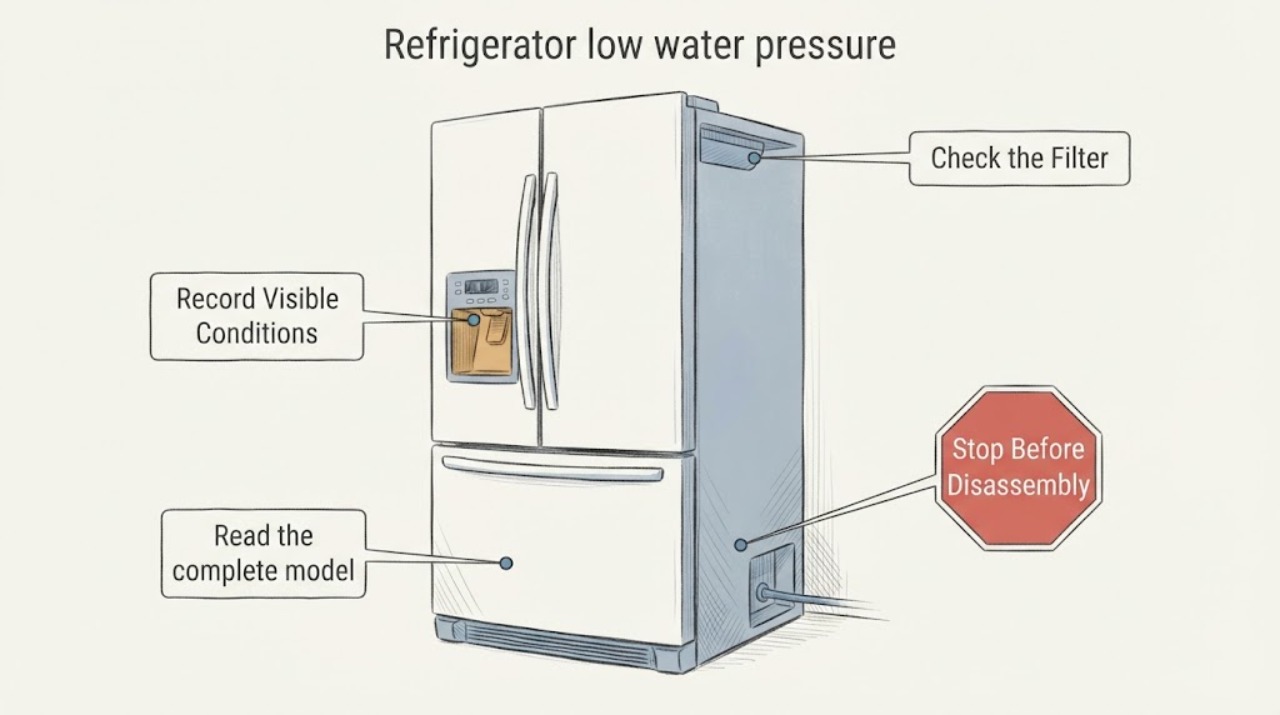
RF170 is a series label, not a complete model identity: Fisher & Paykel's opened US/CA guide covers RF170B, RF170W and RF170A, and says Automatic Ice and non-Ice & Water configurations do not have an external dispenser. Confirm the full rating-label suffix and market first. For a dispenser whose flow has gradually weakened, compare the water stream and ice production, then check the filter's age/indicator and seating, whether the system was flushed after filter installation, the fully open water supply and visible line for kinks or leaks. The guide also lists low water pressure and, separately, water frozen in the tank. Do not disconnect pressurized tubing or infer a failed valve or pump from weak flow. If the exact model's accessible checks do not restore flow, or a leak reaches the cabinet or electrical area, arrange qualified service.
Work through in order
Diagnostic checks
Use only checks that match the exact appliance or system and its official guide.
-
Check 1
Read the complete model and serial label without moving the refrigerator, and confirm whether the unit is an RF170B, RF170W, RF170A or another full suffix and whether its market/configuration is Ice & Water. Check that the dispenser lock is not active before testing the pad gently.
Expected result: The label shows only RF170, the full suffix differs from the guide, the configuration is Automatic Ice or non-Ice & Water, or the dispenser lock indicator is active.
Next step: Use the exact full-model guide and market instructions. If the lock is active, release it only with the documented control sequence; do not copy a sequence from another RF170 suffix or open the control panel.
Why this matters
Why: RF170 is used across several configurations; some listed configurations do not have an external water dispenser. A lock can disable dispensing without a water-path or component failure.
-
Check 2
Run one brief, consistent dispense into the same container and compare the stream with the earlier symptom; at the same time record whether the ice maker is producing ice and whether the freezer and fresh-food compartments are operating normally. Do not hold the pad indefinitely.
Expected result: Only the dispenser is weak, both dispenser and ice production are weak, flow starts with sputtering air, or the freezer/refrigerator temperature is abnormal.
Next step: Use the pattern to choose the filter/supply branch, not to name a valve or pump. If cooling or ice production is also abnormal, protect food and record that broader symptom for service.
Why this matters
Why: A dispenser-only change makes the local pad or dispenser path more plausible. Weak water and weak ice together fit a shared supply, filter or pressure restriction better. Sputtering after installation or filter work can reflect trapped air, while abnormal cooling changes the service priority and does not prove a water component failure.
-
Check 3
Inspect the accessible filter indicator and cartridge history. If a filter was recently installed, follow the exact full-model and cartridge instructions to seat it and flush trapped air; if it is due or the guide identifies it as blocked, use only a replacement confirmed for the complete model.
Expected result: The filter indicator is active, the cartridge is near its service interval, the flow changed after replacement and was not flushed, or the filter is current and correctly installed.
Next step: Perform only the documented filter seating or flush, then compare one short dispense. Do not reset a filter indicator before the filter is changed, force the cartridge, or treat a filter swap as proof that an internal part is good.
Why this matters
Why: Fisher & Paykel lists a blocked filter as a cause of dispenser failure and lists trapped air after installation as a separate cause. A current, correctly installed and flushed filter shifts attention to supply pressure or another concealed path.
-
Check 4
From a dry, safe position, confirm the household water supply to the refrigerator is on and inspect the visible supply tubing for a kink, squash, wet joint or leak; do not pull the appliance, loosen a fitting or disconnect tubing under pressure.
Expected result: The supply is off or partly closed, the visible line is kinked/squashed or leaking, or the visible supply appears normal.
Next step: Open only a normally operating accessible shutoff or correct a clearly visible kink without moving the refrigerator. Stop using the water system for a leak and arrange qualified plumbing/appliance service if the line or valve needs disassembly.
Why this matters
Why: The guide lists low water pressure and a kinked or squashed line as distinct causes. A visible leak is a water-damage risk, while a normal visible line leaves the actual pressure and concealed water path unresolved.
-
Check 5
If the dispenser stopped or weakened in unusually cold conditions, compare the symptom with the exact guide's temperature guidance and check the fresh-food and freezer settings once; do not repeatedly change settings or use a heat source near the appliance.
Expected result: The guide's water-frozen-in-tank condition fits the symptom, settings are colder than intended, or temperatures and settings are normal.
Next step: Apply only the model-documented setting correction once and allow the appliance to stabilize. If flow remains weak, the freezer is not operating normally, or the issue recurs, stop at external checks and arrange service.
Why this matters
Why: Fisher & Paykel lists water frozen in the tank separately and directs a warmer setting in the fresh-food compartment and freezer. Normal settings and temperatures make this explanation less supported; they do not diagnose a valve or pump.
Use your observations
Decision map
Find the observation that best matches what you see, then follow the next safe action.
-
PATH 01Next step
What you see
The full label shows an RF170 configuration without an external dispenser, or the dispenser lock is active and ice production/cooling are otherwise normal.
Do this next
Confirm the exact market and Ice & Water configuration, then use only the corresponding manual's lock/dispensing procedure.
Why this path and its safety boundary
Why it matters: This is an identity or control-state mismatch, not evidence of low household water pressure or a failed valve.
-
PATH 02Next step
What you see
Flow weakened after filter installation or replacement, sputters with air, and the supply line is dry and unkinked.
Do this next
Re-seat and flush only according to the exact model and cartridge instructions, then perform one brief comparison dispense. Escalate if flow stays low.
Why this path and its safety boundary
Why it matters: Trapped air or filter seating is more likely than a new internal pump or valve diagnosis.
-
PATH 03Next step
What you see
The dispenser and ice maker both have reduced output, especially with an active filter warning, a kinked line or a confirmed low-pressure supply.
Do this next
Correct only the visible supply or filter condition that is documented for the full model. Arrange service or plumbing help if pressure, a fitting or concealed tubing needs measurement or disassembly.
Why this path and its safety boundary
Why it matters: A shared supply/filter/pressure restriction is more likely than a dispenser-only pad problem, but the observation does not identify a valve.
-
PATH 04Next step
What you see
The lock is off, the correct configuration is confirmed, filter and flush are normal, the visible supply is open and unkinked, and ice production/cooling are normal, but the dispenser remains weak.
Do this next
Stop repeated dispensing tests and arrange qualified Fisher & Paykel or appliance service with the full suffix and the flow/ice/filter/supply record.
Why this path and its safety boundary
Why it matters: A local dispenser path or concealed water component remains possible, but these observations cannot safely distinguish a valve, pad, tank or tubing fault.
-
PATH 05Next step
What you see
Water is leaking, reaches flooring or an electrical area, the refrigerator is not cooling, or food safety is uncertain.
Do this next
Stop using the dispenser and ice maker, protect food and flooring, isolate power only from a dry safe position if needed, and obtain qualified service. Do not move the refrigerator alone.
Why this path and its safety boundary
Why it matters: Water damage, electrical and food-safety concerns override pressure troubleshooting.
Helpful context
Understand the symptom
The Fisher & Paykel guide is deliberately broader than one RF170 suffix: it covers RF170B, RF170W and RF170A in US/Canada, and warns that the models shown may not be available in every market. It also separates Ice & Water, Automatic Ice and non-Ice & Water configurations. A report that simply says RF170 therefore needs the complete model code and confirmation that the refrigerator actually has the water-dispenser configuration before a control sequence or filter procedure is applied.
For the pressure complaint, the same guide's troubleshooting table lists low water pressure, a kinked or squashed line, a blocked filter and trapped air as different possibilities. It separately lists a dispenser lock and water frozen in the tank. The safest interpretation is a shared-flow check first, followed by a model-specific service decision; weak water does not identify a valve or pump by itself.
Only after diagnosis
Potential parts
- refrigerator water filter cartridge
Consider a filter only when the exact model/configuration is confirmed and the guide-supported filter age, warning or blocked-filter result fits the reduced flow.
RF170 is a series label; confirm the complete suffix, market and cartridge instructions before ordering or installing any filter.
When checks do not resolve it
Need a professional?
Arrange qualified Fisher & Paykel or appliance service when the full RF170 suffix/configuration cannot be confirmed, pressure remains low after the model-specific filter and visible supply checks, the dispenser and ice maker are both affected without an obvious correction, the freezer or refrigerator temperature is abnormal, a leak persists, or the next step would require pressure measurement, tubing disconnection, panels or electrical access. Stop immediately for water near electrical parts, smoke, sparking or a damaged cord.
Have this ready
- The complete rating-label model and market, whether the unit is Ice & Water, the dispenser flow pattern, filter age and warning state, whether the filter was recently flushed, ice production and compartment-temperature observations, and visible supply-line findings.
Common questions
FAQ
Is RF170 enough information to choose a filter or dispensing procedure?
No. Fisher & Paykel's opened US/CA guide covers RF170B, RF170W and RF170A and notes that configurations and market availability differ. Read the complete rating-label suffix and confirm that the refrigerator is an Ice & Water model before using a model-specific procedure.
Why can water pressure fall gradually while the ice maker also slows?
The guide lists low water pressure, a kinked or squashed supply line, and a blocked filter as possible causes, and lists trapped air after installation separately. When both outputs weaken, check those shared external conditions before considering a concealed component.
Can the tank freeze and stop the dispenser?
The RF170 guide lists water frozen in the tank and directs a warmer setting in the fresh-food compartment and freezer. Apply that instruction only to the exact model's documented controls; do not use a hair dryer or other heat source.
Read the exact guide
Official sources
- ACTIVESMART™ REFRIGERATOR — ICE & WATER, AUTOMATIC ICE AND NON-ICE & WATER MODELSFisher & Paykel · The guide identifies the RF170 series and the RF170B, RF170W and RF170A variants on its cover, warns that models may not be available in all markets, and distinguishes Ice & Water, Automatic Ice and non-Ice & Water configurations. Its dispensing and troubleshooting sections cover lock state, flushing/air, filter, supply pressure, line kinks and water frozen in the tank.
Community feedback
Share a repair observation
Share a plain-text repair observation. Accepted observations are published automatically; this page may take a moment to update.