
On this page
Start here
Quick answer
On the KitchenAid KRMF706ESS05, separate household or reverse-osmosis supply pressure from a restriction introduced by the filter service before replacing another part. KitchenAid's matching owner-manual family requires 35–120 psi at the refrigerator and gives a safe screen: with the filter removed using the manual's procedure, 1 cup (237 mL) in 8 seconds or less meets the minimum; slower flow points to low supply pressure. KitchenAid also says a clogged or incorrectly installed filter can slow both the dispenser and ice maker, and that trapped air after filter replacement can reduce flow. Compare dispenser flow with the approved filter/bypass arrangement, flush the system, and arrange a plumber or appliance service based on which result changes.
Before you begin
Safety first
- Keep the water dispenser and ice maker off for a continuing leak. Do not disconnect pressurized tubing, move the refrigerator alone, open door or cabinet panels, touch wiring, or replace a valve, housing, or tube solely from a slow-flow symptom. Protect flooring and food if water is present.
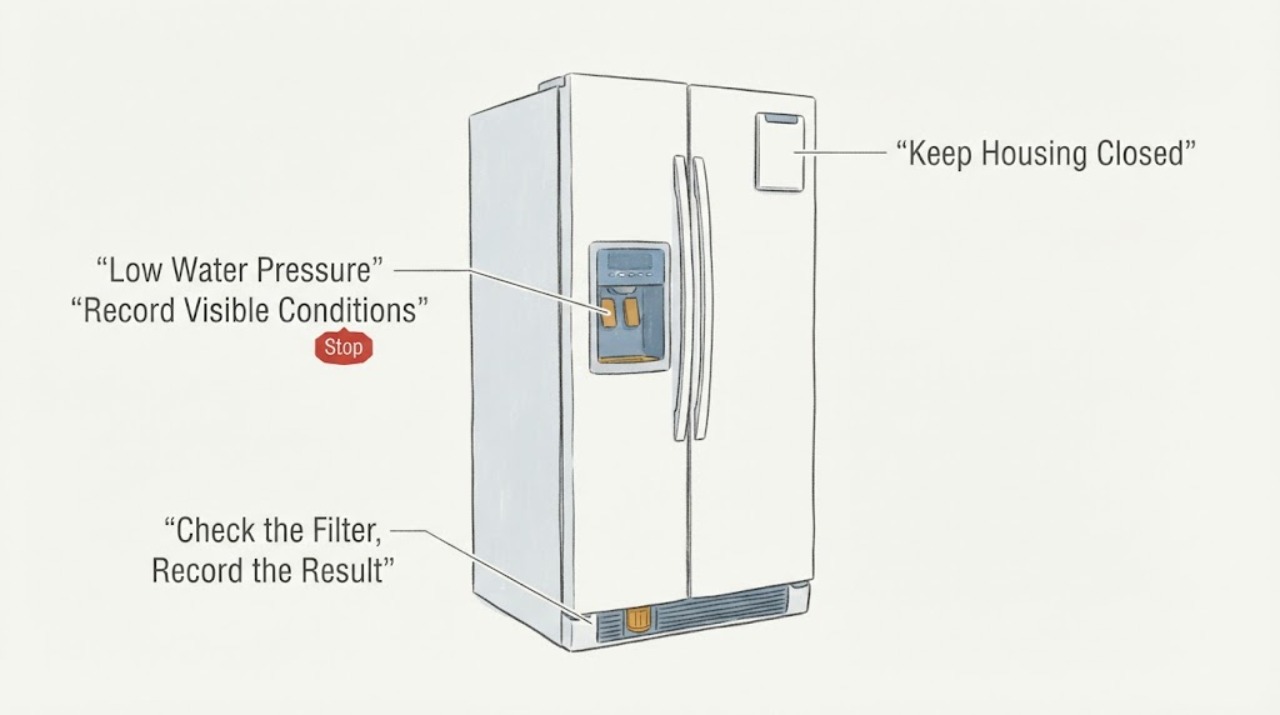
Work through in order
Diagnostic checks
Use only checks that match the exact appliance or system and its official guide.
-
Check 1
Confirm the complete model number KRMF706ESS05 from the refrigerator label, close all refrigerator doors, select the water function, and record whether the slowdown began after the filter or housing work. Also note whether ice production or ice shape changed at the same time.
Expected result: The exact model and door-dispenser symptom are confirmed, with either only the dispenser affected or both water dispensing and ice production affected.
Next step: Continue with the filter/bypass comparison and unfiltered flow screen. If the model cannot be confirmed, stop using model-specific filter or bypass instructions and obtain the matching manual.
Stop if: Do not open the door panels, remove tubing, or continue dispensing if water is leaking onto the floor or near electrical parts.
Why this matters
Why: This is a model with an exterior ice-and-water dispenser. A dispenser-only change keeps the filter fit, dispenser path, valve, or door tubing in play; a simultaneous ice-maker change makes supply pressure, a filter restriction, or a shared inlet path more likely.
-
Check 2
From a dry, accessible position, inspect the household shutoff, exposed supply tube, and the refrigerator connection for a closed valve, kink, crush, or visible leak. If the refrigerator is supplied through reverse osmosis, note whether its storage tank is refilled and whether its prefilter is restricted; do not disconnect a pressurized line.
Expected result: A supply tube or valve is visibly restricted or leaking, the reverse-osmosis system is not recovering, or the accessible supply path looks normal.
Next step: For a supply or RO issue, leave the refrigerator water system off and have a licensed plumber correct the supply. If the accessible supply path is dry and normal, continue to the filter comparison.
Stop if: Do not force a shutoff valve, loosen a fitting, move the refrigerator, or use an improvised connection to increase flow.
Why this matters
Why: KitchenAid requires 35–120 psi at the refrigerator and warns that low pressure reduces dispenser flow; its manual also identifies reverse-osmosis pressure and a blocked RO sediment filter as possible contributors. A visible supply-side issue is not evidence that the refrigerator valve or dispenser is defective.
-
Check 3
Record a short dispenser sample, then remove the filter only as the KRMF706ESS05 manual directs. If the manual's arrangement calls for a blue bypass cap, install that approved cap before dispensing the comparison sample; otherwise do not leave an open filter socket. Use the same container and door-closed condition for both samples.
Expected result: Flow becomes noticeably stronger with the approved filter/bypass arrangement, or it remains slow with the filter path bypassed as directed.
Next step: If flow improves, reinstall the exact model-approved filter with its seals and locking position checked, then flush it. If flow does not improve, use the unfiltered cup-flow screen and arrange service rather than buying another generic filter.
Stop if: Do not force the cartridge, discard seals, operate with a continuing leak, or substitute a cap or cartridge that the exact manual does not approve.
Why this matters
Why: A clear increase points to a restricted, incorrect, damaged, or incompletely seated filter path rather than proving the new housing is good. Little or no increase shifts suspicion toward household pressure, the inlet valve, dispenser tube, or another downstream restriction.
-
Check 4
With the filter removed or approved bypass arrangement in place, use the owner's-manual flow screen: dispense 1 cup (237 mL) into a container and time the fill without opening panels or touching wiring.
Expected result: The cup fills in 8 seconds or less, or it takes longer than 8 seconds.
Next step: For a fill longer than 8 seconds, have a licensed plumber check the cold-water or RO supply. For 8 seconds or less with a slow filtered dispenser, arrange KitchenAid or qualified appliance service to assess the inlet valve, water-system housing, and door/dispenser tube using the exact model documentation.
Stop if: Do not disassemble the water valve, door, housing, or tubing to pursue a pressure reading yourself.
Why this matters
Why: KitchenAid's manual treats 8 seconds or less with the filter removed as meeting the minimum water-pressure requirement; longer than 8 seconds indicates supply pressure below the recommendation. This separates a plumbing/RO problem from a restriction that remains inside the refrigerator path.
-
Check 5
After the correct filter or approved bypass arrangement is restored, flush the water system in a sturdy container using 5 seconds dispensing and 5 seconds released, repeating until flow is steady and the filter's manual-specified volume (the KitchenAid guidance is typically 1–4 gallons) has passed.
Expected result: Flow steadies after flushing, or it remains weak after the documented flush and the filter area stays dry.
Next step: Monitor a restored steady stream. If flow remains weak, or if the filter housing becomes wet, stop using the water dispenser and schedule appliance service with the model, filter arrangement, cup-flow time, and housing-work date.
Stop if: Do not keep cycling the dispenser through a leak, overflow the container, or open the refrigerator enclosure.
Why this matters
Why: Air introduced during filter or housing service can cause temporary spitting, dripping, or decreased flow. If a complete model-approved flush does not restore flow, trapped air alone is no longer a sufficient explanation.
Use your observations
Decision map
Find the observation that best matches what you see, then follow the next safe action.
-
PATH 01Next step
What you see
The unfiltered or approved-bypass cup takes longer than 8 seconds, the dispenser and ice maker are both weak, or a reverse-osmosis tank/prefilter cannot maintain supply.
Do this next
Keep the refrigerator water system off as needed and have a licensed plumber assess the cold-water shutoff, household line, or reverse-osmosis system.
Why this path and its safety boundary
Why it matters: The shared supply is below the KitchenAid recommendation or is restricted before the refrigerator; replacing another refrigerator part is unlikely to correct the cause.
-
PATH 02Next step
What you see
The approved-bypass or filter-removed sample is clearly stronger, and the slow flow returns when the replacement filter is installed.
Do this next
Use only the exact manual's filter and bypass arrangement, verify that the seals and lock are correct without force, then perform the documented flush. Escalate if the filter path remains slow or wet.
Why this path and its safety boundary
Why it matters: The restriction is associated with the filter cartridge, seals, orientation, locking position, or filter interface; the new housing alone does not rule out an installation or cartridge problem.
-
PATH 03Next step
What you see
The unfiltered cup passes in 8 seconds or less, the supply path is dry, but the door dispenser remains slow; or the dispenser changes when the door moves while the ice maker is normal.
Do this next
Stop selecting replacement parts by symptom and arrange KitchenAid or qualified appliance service to trace the exact KRMF706ESS05 water path. Do not remove door panels or tubing as an owner check.
Why this path and its safety boundary
Why it matters: Adequate unfiltered supply with a dispenser-only symptom makes a downstream refrigerator water path—such as the inlet valve, dispenser tube, housing interface, or door-side tubing—more likely than household pressure.
-
PATH 04Next step
What you see
Flow improves after the documented flush and no filter-area leak is present.
Do this next
Use the dispenser normally and watch for renewed slowdown, dripping, or a wet housing. If any returns, stop water dispensing and arrange service.
Why this path and its safety boundary
Why it matters: Air introduced during filter or housing service was a plausible temporary restriction; a stable stream after flushing is different from a persistent low-flow fault.
Helpful context
Understand the symptom
Why replacing the housing does not identify the restriction
The exact KitchenAid parts list shows a water valve, water tubes, a water-system housing, and a water reservoir in this model family. A new housing therefore does not prove that household pressure, a filter fit, trapped air, the valve, or the door-side water path is healthy. The useful split is whether flow improves with the approved filter/bypass arrangement and whether the unfiltered cup-flow screen passes.
Use the model identity before selecting a filter or bypass
KRMF706ESS05 is the stainless-steel variant named in KitchenAid's parts list. Filter locations and installation styles differ across KitchenAid models. Use the exact owner's manual and its approved bypass-cap procedure; do not borrow a filter number, cap, or reset sequence from another refrigerator.
Only after diagnosis
Potential parts
- KitchenAid refrigerator water filter cartridge
Consider only when the approved-bypass comparison shows a clear flow increase or the cartridge cannot be seated and flushed as directed.
Confirm KRMF706ESS05 and the exact regional manual/filter arrangement before ordering; a generic KitchenAid filter label does not establish fit. - refrigerator water inlet valve
Consider only after the supply passes the unfiltered cup-flow screen and the dispenser remains slow with the filter path correctly installed; a slow stream alone does not identify the valve.
Have a qualified technician confirm the valve and exact model fit before ordering or replacing it. - refrigerator dispenser or door water tube
Consider only when the unfiltered supply is adequate but the door dispenser remains slow or changes with door movement, and service confirms a tubing restriction.
Confirm the complete model and the tube location in the manufacturer's parts documentation; do not substitute generic tubing.
When checks do not resolve it
Need a professional?
Call a licensed plumber when the unfiltered cup takes longer than 8 seconds or the household/RO supply is suspect. Arrange KitchenAid or qualified appliance service when unfiltered flow passes but the door dispenser remains slow, when the housing or door path leaks, when flow changes with door movement, or when the documented filter installation and flush do not restore flow.
Safety scope: Keep the water dispenser and ice maker off for a continuing leak. Do not disconnect pressurized tubing, move the refrigerator alone, open door or cabinet panels, touch wiring, or replace a valve, housing, or tube solely from a slow-flow symptom. Protect flooring and food if water is present.
Have this ready
- Provide the full model KRMF706ESS05, serial number if available, filter and housing service dates, whether the ice maker is also affected, the cup-flow time with the approved filter/bypass arrangement, any RO details, and photos of only dry external connections or visible water.
Common questions
FAQ
Why is the KitchenAid dispenser still slow after replacing the filter and housing?
The replacement does not distinguish household or reverse-osmosis pressure from an incorrectly seated or restricted filter, trapped air, or a downstream valve or door-tube restriction. Compare flow with the exact manual's approved filter/bypass arrangement, use the unfiltered one-cup screen, and flush before selecting another part.
Can I run the KRMF706ESS05 without its water filter?
The KitchenAid owner manual permits dispenser use without a filter only when the model's approved bypass cap is installed; the water will not be filtered. Follow the exact manual rather than leaving an open filter socket or using a cap from another model.
What water pressure does this KitchenAid refrigerator need?
The matching KitchenAid owner-manual family specifies 35–120 psi at the refrigerator. Its practical screen is to dispense one cup with the filter removed: 8 seconds or less meets the minimum in the manual, while longer indicates that the supply should be checked by a licensed plumber.
What if the ice maker is normal but only the door dispenser is slow?
If the approved-bypass cup-flow screen passes and the ice maker is normal, the symptom points away from shared household pressure and toward the dispenser-side path, such as the inlet valve, housing interface, or door tube. Those components require model-specific service assessment rather than a guessed replacement.
Read the exact guide
Official sources
- Owner's ManualKitchenAid · Official KitchenAid owner manual opened directly and linked by the exact model's parts list; use the model label and manual match before applying any style-specific filter step.
- How to Flush the Water System in a RefrigeratorKitchenAid Product Help · Official KitchenAid product-help page opened for post-filter-service flushing and air-related flow symptoms.
- KitchenAid® KRMF706ESS05/KRMF706EBS05 Refrigerator Repair Parts ListKitchenAid · Official KitchenAid repair-parts PDF opened for the exact assigned model; it confirms the model scope and the water-system component classes relevant to service escalation.
- KRMF706ESS | KitchenAidKitchenAid · Official KitchenAid owner-center page opened for the KRMF706ESS family; it identifies the 25.8-cu.-ft. multi-door refrigerator and its exterior ice-and-water dispenser. The exact ESS05 suffix is confirmed by the repair-parts PDF.
- Does the Water Filter Need to be Replaced?KitchenAid Product Help · Official KitchenAid product-help page opened for refrigerator dispenser flow; it supplies the filter-removed comparison used in this article but does not replace the exact model manual's filter procedure.
Community feedback
Share a repair observation
Share a plain-text repair observation. Accepted observations are published automatically; this page may take a moment to update.