
On this page
Start here
Quick answer
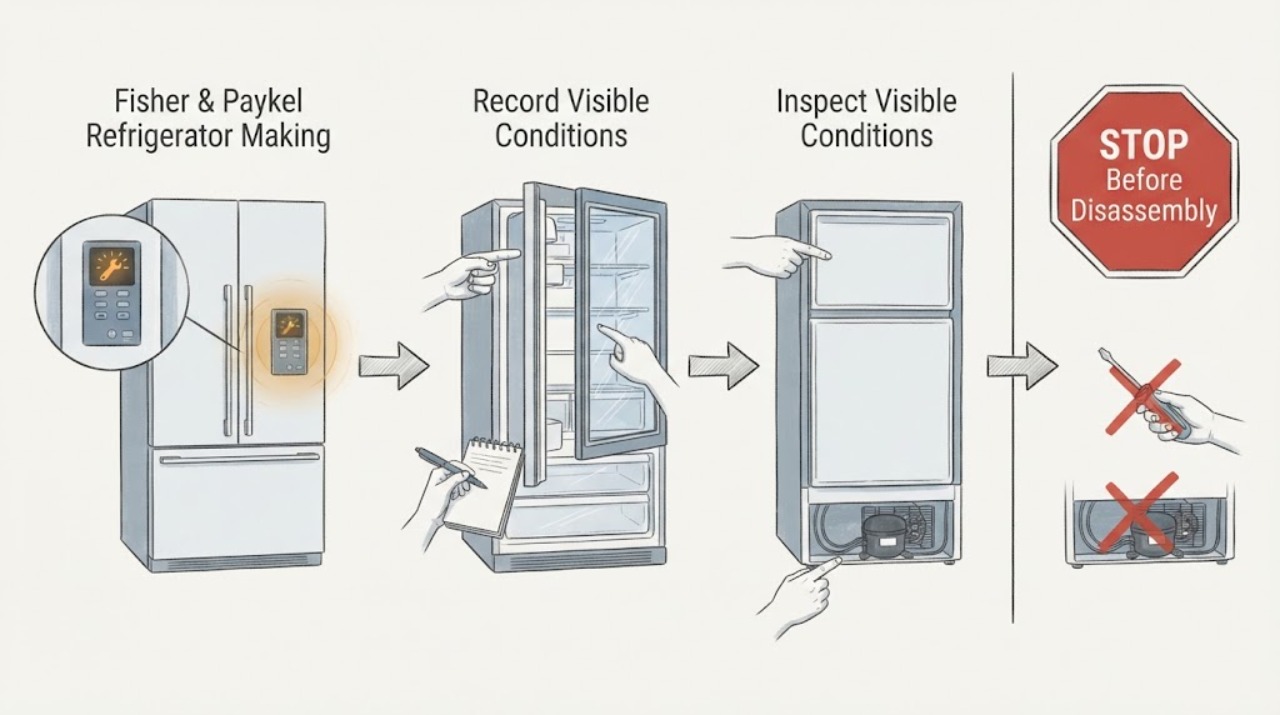
Do not decode an unspecified Fisher & Paykel refrigerator code by guessing from the noise. First identify and record the exact model, the code or light sequence, the number of beeps, and where the sound comes from. Fisher & Paykel manuals for refrigerator families list airflow, humming, refrigerant gurgling, hissing after a door closes, defrost cracking or popping, ice-maker sounds, and shelf or cabinet rattles as possible normal sounds; the same manuals route a fault display or rapid-beep alarm to a trained service technician. Check only visible causes such as an unstable cabinet or rattling containers, and protect perishable food if the refrigerator is not staying cold. Do not open panels, touch fans, or perform electrical or sealed-system tests.
Work through in order
Diagnostic checks
Use only checks that match the exact appliance or system and its official guide.
-
Check 1
Record the exact noise before trying to interpret the code: note whether it is airflow, a low hum, gurgling, hissing after a door closes, cracking or popping, ticking, rattling, scraping, or a different sound, and note whether it is brief or continuous.
Expected result: The sound matches a documented normal category and is brief or tied to cooling, defrost, a door closing, or ice-maker operation; or it is harsh, new, persistent, or worsening.
Next step: For a normal-pattern sound with no cooling problem, continue to the visible stability and rattle check. For a harsh or worsening sound, stop investigating internal parts and arrange model-specific service.
Why this matters
Why: A documented normal category may not indicate a failed part, while an unrecognized or worsening sound cannot be diagnosed from sound alone.
-
Check 2
Check visible installation and storage causes without removing panels: observe whether the cabinet is stable and level where the exact installation guide allows it, and separate bottles, jars, bins, or shelves that are touching.
Expected result: The noise changes when a visible container is moved or when a permitted external stability issue is corrected; or it continues unchanged with no visible rattle.
Next step: If the visible rattle stops, monitor the appliance without opening it. If the sound continues, document its timing and arrange exact-model support rather than making an internal diagnosis.
Why this matters
Why: Fisher & Paykel lists an unstable cabinet, uneven floor, and rattling containers as possible sound sources, but a continuing sound is not proof of a fan, compressor, valve, or sealed-system fault.
-
Check 3
Capture the code identity exactly: record the full displayed letters and numbers, any temperature-light sequence, how many beeps occur when the refrigerator door is opened, the model code, and the region.
Expected result: A code or alarm is repeatable; only a vague symbol or sound is available; or no code is present.
Next step: Use the exact model's official user guide or Fisher & Paykel Customer Care with the recorded code. Do not substitute a code meaning from another model or reset repeatedly to suppress an unknown fault.
Why this matters
Why: A repeatable code is a model-specific service input, not a diagnosis that can be inferred from the noise. The opened integrated-column manual uses rapid beeps and a displayed code for a fault, but other Fisher & Paykel families may present warnings differently.
-
Check 4
Check cooling and food condition from the outside: observe whether the refrigerator and freezer are holding their expected temperatures, whether food is softening, and whether the alarm or noise occurs with a door left open or after frequent openings.
Expected result: The appliance is not getting cold or perishable food is warming; or temperatures remain stable and the sound follows a documented operating event.
Next step: If cooling is lost, move perishable food to another refrigerator or cooler and arrange service promptly. If cooling is stable, keep the exact sound/code record and follow the model-specific guide.
Why this matters
Why: A warming refrigerator is a food-safety and service issue even if the sound resembles a normal fan or compressor sound; stable temperatures make a normal operating sound or external rattle more plausible but do not validate an unknown code.
-
Check 5
Keep the refrigerator closed and out of internal service if there is smoke, a burning smell, sparking, damaged wiring, a refrigerant concern, or a need to remove a cover or reach a fan or compressor.
Expected result: A hazardous sign or an internal repair would be required; or only the visible sound and code observations remain.
Next step: Stop using the appliance when safe to do so, keep people away from the hazard, and contact Fisher & Paykel trained service or a qualified electrician as appropriate. Do not open the cabinet or perform live testing.
Why this matters
Why: Fisher & Paykel reserves hazardous servicing and electrical repairs for trained or qualified personnel; the visible checks cannot establish a safe internal repair.
Use your observations
Decision map
Find the observation that best matches what you see, then follow the next safe action.
-
PATH 01Next step
What you see
The sound is a brief airflow, low hum, gurgle, post-door hissing, defrost crack/pop, short valve tick, ice-maker sound, or shelf/container rattle, and the appliance is cooling normally with no displayed fault.
Do this next
Check only the visible cabinet stability and container contact permitted by the exact model guide, then monitor the sound without opening the appliance.
Why this path and its safety boundary
Why it matters: The opened Fisher & Paykel refrigerator guide lists these patterns as possible normal operation or visible installation/storage noise.
-
PATH 02Next step
What you see
The noise is scraping, grinding, unusually loud, continuous, worsening, or unchanged after visible rattles are removed.
Do this next
Stop internal troubleshooting, preserve the exact model and sound timing record, and arrange Fisher & Paykel trained service.
Why this path and its safety boundary
Why it matters: The sound is outside the normal examples that were verified, and it does not identify whether a fan, compressor, valve, door gasket, or other component is involved.
-
PATH 03Next step
What you see
Rapid beeps or a displayed code occurs when the door is opened, or a code is visible even though the sound seems normal.
Do this next
Record the exact code and beep/light sequence, then use the matching official guide or contact Customer Care. Do not guess the code from the noise or apply a code from another family.
Why this path and its safety boundary
Why it matters: For the opened integrated-column family, Fisher & Paykel treats rapid beeps plus a displayed code as a fault indication; the code meaning remains model-specific.
-
PATH 04Next step
What you see
The refrigerator is warming, ice cream or other perishables are softening, or cooling is lost along with the noise.
Do this next
Move perishable food to another appliance or cooler and arrange prompt trained service. Do not repeatedly restart the appliance to test it.
Why this path and its safety boundary
Why it matters: The issue is no longer only a sound question; Fisher & Paykel's manual treats loss of cooling as a reason to protect food and call service.
Helpful context
Understand the symptom
Separate a normal refrigerator sound from a fault indication
The sound alone does not identify an error. In an opened Fisher & Paykel integrated-column manual, fan airflow, compressor humming, refrigerant gurgling, a short hissing sound after a freezer door closes, defrost cracking or popping, and ice-maker operation are listed as normal possibilities. A low-frequency valve tick can also be brief and normal. A harsh, new, persistent, or worsening sound needs the exact model and service guidance rather than a guessed component diagnosis.
Treat the error code as a separate identity question
Write down every letter, number, symbol, temperature-light sequence, and beep pattern exactly as shown. Fisher & Paykel's opened manual says a fault in that documented family is accompanied by rapid beeps and a displayed code, then directs the owner to record the code and contact a trained technician. Because no code or model was supplied here, no code meaning is inferred.
Stop at visible checks and food protection
A visible cabinet or shelf issue can create noise without proving a refrigeration fault. Check for a stable, level installation where the model's installation instructions permit a user check, and make sure bottles or containers are not touching. If the refrigerator is warming, treat that as a separate food-safety problem: move perishable food to another appliance or cooler and arrange service. Do not remove covers or reach toward a fan or compressor.
When checks do not resolve it
Need a professional?
Arrange Fisher & Paykel trained service for an unrecognized, harsh, persistent, or worsening noise; a repeatable displayed code or rapid-beep alarm; loss of cooling; smoke, burning smell, sparking, damaged wiring, or any need to remove panels or reach an internal component. Protect perishable food if temperatures rise. Do not diagnose or replace a fan, compressor, valve, gasket, control, or sealed-system part from sound or an unspecified code.
Common questions
FAQ
Is humming or gurgling always a Fisher & Paykel refrigerator fault?
No. The opened Fisher & Paykel integrated-column guide lists compressor humming and refrigerant running-water or gurgling sounds as normal possibilities. A new, harsh, persistent, or worsening sound, especially with warming or a displayed code, needs exact-model service assessment.
What should I do when the refrigerator shows an error code but the code is not identified?
Record the complete code, temperature-light sequence, beep count, model code, and region. Fisher & Paykel's official guidance directs owners to use the exact model documentation or contact a trained technician; do not borrow a code meaning from another refrigerator family.
Can I remove a panel to find the source of the refrigerator noise?
No. Fisher & Paykel states that servicing the refrigerator is hazardous for anyone other than a trained supported technician and reserves electrical repairs for trained personnel or a qualified electrician. Keep checks to visible stability, containers, the display, and food temperature.
Read the exact guide
Official sources
- Contact Us | Fisher & Paykel USAFisher & Paykel · Opened Fisher & Paykel's official US support page. It directs users to model-specific product help and service booking rather than supplying a universal refrigerator code table.
- User Guide — Integrated Column Refrigerator Freezer RS2484S, RS3084S, RS1884F, RS2484F, RS3084FFisher & Paykel · Opened the official US/Canada PDF and verified the refrigerator-family headings. Sound examples and the rapid-beep/code behavior are explicitly scoped to this integrated-column family; they are used as conditional examples, not as universal code meanings.
Community feedback
Share a repair observation
Share a plain-text repair observation. Accepted observations are published automatically; this page may take a moment to update.