
On this page
Start here
Quick answer
This diagnosis applies only to a Fisher & Paykel refrigerator whose exact model has a water dispenser, an ice dispenser, or both; models without those features cannot be diagnosed from this page. First say whether water, ice, or both fail, then check whether the ice maker is still making new ice. If water is slow or absent while ice production continues, the water-side path—filter condition, supply, pressure, tubing, or a valve—becomes more likely. If water works and the ice maker is producing ice but the dispenser is empty or will not deliver it, focus on the ice bin, a visible ice clump, correct bin seating, and the model's dispenser controls. If neither side works, or the ice maker is not producing, check only the exact guide's safe settings and external supply conditions. Do not touch the moving ice-maker mechanism, remove rear covers, loosen pressurized connections, or use a replacement part without model confirmation. A leak, water near electrical parts, repeated electrical fault, damaged cord, or persistent failure after the external checks requires Fisher & Paykel or qualified appliance service.
Before you begin
Safety first
- The user may identify the exact model, observe the controls and bin, check a filter indicator, inspect accessible tubing and the external supply, and follow the exact guide for a user-removable filter or bin. Plumbing connections, rear covers, internal valves, motors, wiring, sensors, pressurized leaks, and live electrical checks are for qualified professionals.
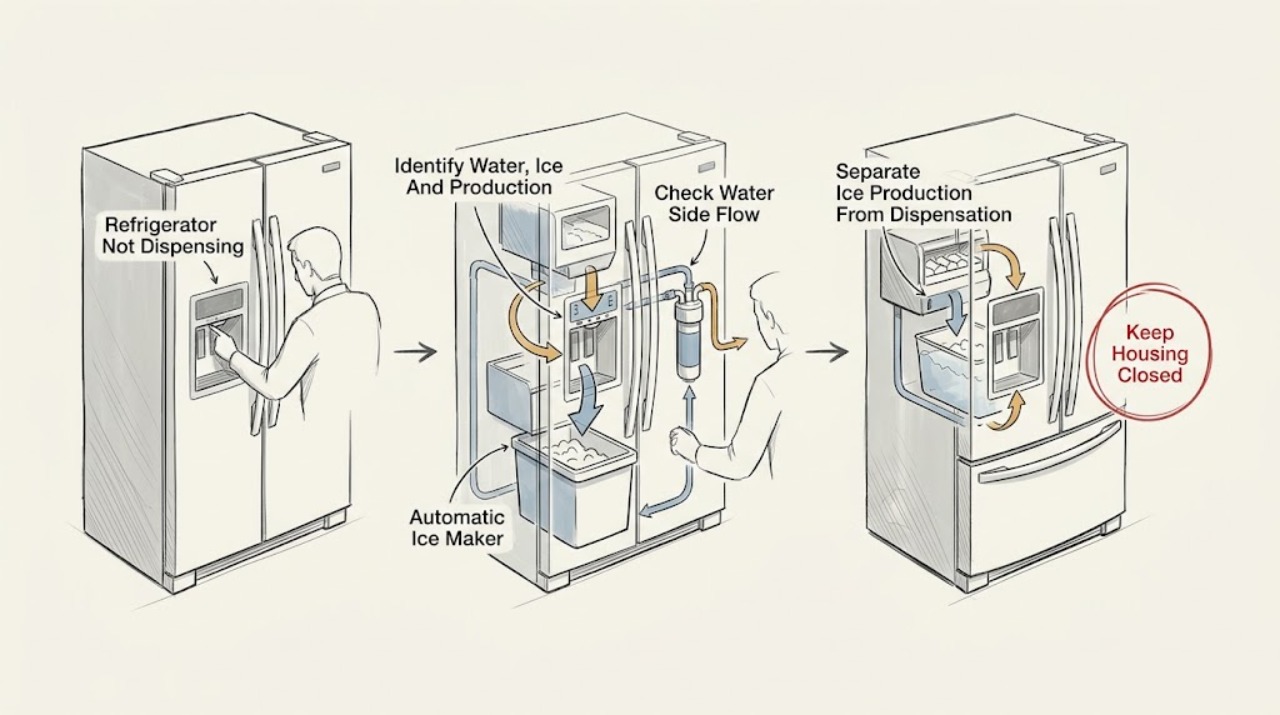
Work through in order
Diagnostic checks
Use only checks that match the exact appliance or system and its official guide.
-
Check 1
Read the complete Fisher & Paykel model number and confirm that the exact model has an Ice & Water or Automatic Ice feature. Then classify the symptom as water not dispensing, ice not dispensing, both not dispensing, or no new ice being made.
Expected result: The model has no dispenser feature; water fails but ice is present; ice fails but water works; both fail; or the ice bin is empty because the maker is not producing new ice.
Next step: Use the matching branch below and keep the exact model guide available. Do not apply a button sequence from another Fisher & Paykel family.
Stop if: Do not reach into the ice maker or assume that a dispenser symptom identifies a particular valve, motor, or control part.
Why this matters
Why: A non-dispenser model is outside this page's scope. Water-only failure points first to the water path; ice-only failure with a full bin points to bin or dispenser delivery; an empty bin requires the ice-production branch before treating it as an auger or dispenser fault.
-
Check 2
For a water-dispenser complaint, use the exact model's normal dispensing control and collect a short sample in a cup. Observe whether water flows normally, flows slowly, sputters, or does not flow. From outside the appliance, look for a visibly kinked or crushed accessible water tube and check whether the household supply is on, without loosening a connection.
Expected result: Water flow is normal, slow or intermittent, absent while the ice maker still makes ice, or absent together with ice production.
Next step: Check the filter indicator and exact guide's filter instructions, verify only the external supply and visible tubing, and arrange service if the flow remains abnormal. Follow the model's documented flushing procedure after a filter or installation change rather than inventing a volume or reset.
Stop if: Stop for a leak, water near the power connection, damaged tubing, or a connection that would need to be opened under pressure.
Why this matters
Why: Slow or intermittent flow makes a restricted filter, low supply pressure, trapped air after installation, or tubing restriction more likely. No water with continuing ice production narrows attention to the dispenser-side water path; no water plus no ice keeps supply, filter, pressure, and model-specific control conditions in play.
-
Check 3
For an ice complaint, observe the ice bin without touching the ejector or other moving ice-maker parts: is there usable ice, a large visible clump, a correctly seated bin, or no ice because the maker is not harvesting? If the exact guide provides an ice-maker status control, confirm its displayed on/off state without changing hidden service settings.
Expected result: The bin is full and ice production is continuing; the bin is empty but new ice is being made; ice is visibly clumped; the bin is missing or not seated; or no new ice is being produced.
Next step: If the bin can be removed as the exact guide describes, use only that guide to reseat it or safely deal with a visible clump. If the maker is not producing, continue to the production branch; if production is normal but delivery still fails, arrange dispenser/ice-bin service.
Stop if: Do not put fingers into the automatic ice mechanism, force an ejector, chip ice against the mechanism, or remove internal covers.
Why this matters
Why: A full bin with ongoing production separates a delivery problem from an ice-production problem. A missing, mis-seated, or visibly clumped bin can prevent delivery. An empty bin with no new ice follows the official production checks for the maker, water supply, freezer operation, line, pressure, and filter.
-
Check 4
With the refrigerator operating normally, inspect only the user-accessible filter indicator, ice-bin position, dispenser lock or control indication if the exact model documents one, and visible supply tubing. If the guide says the disposable filter is due, frozen, or clogged, replace it only with the exact model-compatible filter and follow the guide's leak check and flush procedure.
Expected result: The filter indicator is lit or the filter is overdue; the filter is frozen; the bin is not in its specified position; a visible line is kinked; or these external conditions are normal.
Next step: Correct only the documented external condition, then perform one brief normal dispensing test. If water or ice still will not dispense, stop ordering parts from the symptom and give the service technician the model, side affected, flow result, and production result.
Stop if: Do not remove a rear cover, bypass a filter, open plumbing, or substitute a filter or bin without confirming the exact model.
Why this matters
Why: Fisher & Paykel identifies a clogged or frozen filter, incorrect bin position, water supply, low pressure, and a kinked line as possible causes for ice-maker or water symptoms on applicable models. A normal external check does not rule out an internal valve, dispenser motor, sensor, wiring, or control fault.
-
Check 5
After the architecture, water-versus-ice symptom, production status, filter, bin, and visible supply checks are documented, stop testing if the refrigerator still will not dispense. Record whether the unit makes new ice, whether water flow is slow or absent, any display indication, recent filter or plumbing work, and any visible moisture.
Expected result: The dispenser returns to normal after an external correction; water or ice remains unavailable; a leak appears; the cord or electrical area is damaged; or a rear/internal component would need access.
Next step: For persistent failure, contact Fisher & Paykel or a qualified appliance technician and provide the exact model and the separate water, ice-production, and ice-delivery observations. If water is near electrical parts or the unit is damaged, leave it disconnected from a safe dry location and arrange prompt service.
Stop if: Do not repeatedly cycle power, run the refrigerator with an active leak, perform live electrical tests, or dismantle the dispenser, valve, ice maker, or rear compartment.
Why this matters
Why: A successful external correction supports a setting, filter, bin, or visible-supply condition. Persistent failure after those checks is not enough to identify an inlet valve, dispenser motor, auger, sensor, control, or wiring part, and a leak or electrical hazard takes priority.
Use your observations
Decision map
Find the observation that best matches what you see, then follow the next safe action.
-
PATH 01Safety boundary
What you see
The ice maker continues to produce ice, but the water dispenser is slow or completely dry.
Do this next
Check the documented filter indicator and visible supply line without opening plumbing. If the flow remains abnormal, use qualified service for the water-dispenser path.
Why this path and its safety boundary
Why it matters: The refrigerator has evidence of water reaching the ice-making system, so a dispenser-side filter restriction, tubing/pressure issue, control path, or valve is more likely than a simple empty ice bin. This does not prove which internal component failed.
Safety stop: Stop for a leak, water near electricity, or any need to open a pressurized or internal connection.
-
PATH 02Safety boundary
What you see
Water dispenses normally and the ice maker is making new ice, but the ice dispenser does not deliver ice.
Do this next
Use the exact guide to remove and correctly reseat the bin or address a visible clump only if that is an owner step. If a full, correctly seated bin still will not dispense, arrange model-specific service.
Why this path and its safety boundary
Why it matters: The supply and production observations make a delivery-side issue—bin seating, a visible ice clump, dispenser control, or internal auger/motor path—more likely than a general loss of water supply.
Safety stop: Do not force the auger, chip ice against the mechanism, or open the dispenser housing.
-
PATH 03Safety boundary
What you see
Neither water nor ice dispenses, and the ice maker is also not producing new ice.
Do this next
Confirm the refrigerator has the stated dispenser features, inspect the documented filter and external supply conditions, and use service if both paths remain unavailable or any alarm or leak is present.
Why this path and its safety boundary
Why it matters: A shared supply, filter, pressure, visible tubing, power/control, or model-specific operating condition becomes more plausible than two independent bin-delivery failures. The exact model determines which checks apply.
Safety stop: Do not infer a failed valve or control board, open the rear compartment, or keep testing after an electrical or water hazard.
-
PATH 04Safety boundary
What you see
The ice bin is empty because no new ice is being made, regardless of whether the water dispenser works.
Do this next
Follow the exact model guide for the maker's on/off state, bin position, freezer operation, filter, and external water path. If production does not resume, arrange service for the ice-maker system.
Why this path and its safety boundary
Why it matters: This is primarily an ice-production problem, not proof that the dispenser mechanism is broken. Fisher & Paykel lists an ice maker being off, an incorrect or missing bin, no water supply, a nonworking freezer, low pressure, a kinked line, and a clogged filter among applicable troubleshooting causes.
Safety stop: Do not touch the ejector mechanism, force a harvest cycle, or attempt internal electrical, valve, sensor, or sealed-system work.
Helpful context
Understand the symptom
Confirm the dispenser architecture before troubleshooting
Fisher & Paykel sells refrigerators with different combinations of features. The RF170 family guide separates Ice & Water, Automatic Ice, and non-Ice & Water models, while selected Series 9 integrated models explicitly combine an internal water dispenser with an ice maker. A refrigerator without the matching feature will not respond to a dispenser check, so read the exact model number and guide before interpreting silence as a fault.
Water delivery and ice production are different paths
A dispenser can fail even while the refrigerator continues making ice, and an ice maker can stop producing even though water dispensing still works. Treat the cup test, the amount of ice already in the bin, and the presence or absence of new ice as separate observations. A slow water stream, an empty ice bin, and a full bin that will not release ice point to different next steps.
Use the exact model guide for filters and controls
Fisher & Paykel's guides identify filter indicators, water-line and pressure conditions, bin position, and ice-maker settings as model-dependent checks. A filter cartridge is conditional rather than a universal answer: an indicator, overdue filter, frozen filter, restricted flow, or the exact guide's instruction is needed before considering replacement.
Know where a user check ends
The owner can observe the display, controls, bin, filter indicator, accessible tubing, and external supply condition without opening the appliance. Plumbing installation, rear-compartment access, internal valves, motors, wiring, and a persistent leak belong with an authorized plumber or trained appliance technician.
Only after diagnosis
Potential parts
- water filter cartridge
Consider only when the exact model guide or filter indicator identifies a due, frozen, clogged, or otherwise restricted disposable filter and the model-compatible cartridge is confirmed.
Confirm the complete refrigerator model and the official fit information; do not assume a filter for one Fisher & Paykel family fits another. - ice storage bin or auger assembly
Consider only when the ice maker is visibly producing ice, the bin is correctly seated and not clumped, and a qualified diagnosis identifies the delivery assembly rather than a water-supply or production fault.
The bin and auger geometry varies by refrigerator architecture; verify the exact model and let the service provider confirm the component. - water inlet or dispenser valve
Consider only after documented filter, supply, pressure, visible tubing, and control checks leave a persistent water-side failure and a qualified technician identifies the valve path.
Valve configuration is model-specific and involves water and electrical connections; do not order or install from the symptom alone.
When checks do not resolve it
Need a professional?
Call Fisher & Paykel or qualified appliance service when water or ice remains unavailable after the exact model's external checks, the ice maker does not resume production, a correctly seated full bin will not dispense, a filter or supply correction does not restore flow, or any internal component or plumbing connection would need access. Leave the refrigerator disconnected from a safe dry location and arrange prompt help for a leak near electrical parts, damaged cord, burning smell, sparking, or water entering the appliance.
Safety scope: The user may identify the exact model, observe the controls and bin, check a filter indicator, inspect accessible tubing and the external supply, and follow the exact guide for a user-removable filter or bin. Plumbing connections, rear covers, internal valves, motors, wiring, sensors, pressurized leaks, and live electrical checks are for qualified professionals.
Common questions
FAQ
Why does my Fisher & Paykel refrigerator make ice but not dispense water?
Ice production and water dispensing are separate observations. If new ice is being made but the water stream is slow or absent, check the exact model's filter indicator and only the visible supply/tubing conditions. A persistent water-side failure needs model-specific service; do not infer a valve or open a pressurized connection.
What if water works but the Fisher & Paykel ice dispenser does not?
First confirm that the ice maker is still producing new ice. If the bin contains ice, use the exact guide to check its seating and address only a visible clump. A full, correctly seated bin that still will not deliver ice needs dispenser or auger diagnosis rather than a guessed replacement part.
Can a clogged filter stop a Fisher & Paykel refrigerator from dispensing?
On applicable Ice & Water or Automatic Ice models, Fisher & Paykel lists a clogged or frozen filter as a possible cause of water or ice-maker symptoms. Replace it only when the exact model guide or indicator supports that diagnosis, and use the documented flush and leak-check procedure.
Why is the dispenser empty when the ice maker is not making new ice?
An empty bin can be a production failure rather than a dispenser failure. Check the exact guide's ice-maker state, bin position, freezer operation, water supply, pressure, visible tubing, and filter conditions. If new ice does not resume, arrange service for the ice-making system.
When should I stop using the refrigerator and call service?
Stop and arrange prompt service for a leak near electrical parts, damaged cord, sparking, burning smell, water entering the appliance, or any need to remove a rear cover or open plumbing. Persistent no-dispense or no-ice symptoms after safe model-specific checks also need qualified diagnosis.
Read the exact guide
Official sources
- Help and SupportFisher & Paykel · Fisher & Paykel appliances; exact model documentation and local service availability govern.
- RF170WDRUX5 N Installation GuideFisher & Paykel · RF170WDRUX5 N installation family and its documented water/ice connection requirements; exact model instructions take precedence.
- 30" Series 9 Integrated Refrigerator Freezer, Ice & WaterFisher & Paykel · RS3084WLUK1 product configuration; it demonstrates that the stated dispenser architecture exists but does not establish fit or controls for other models.
- ActiveSmart Refrigerator User Guide RF605QDUVX1 and RF605QDVX1Fisher & Paykel · RF605QDUVX1 and RF605QDVX1 quad-door models and only the water/ice features fitted to the exact model.
- RF170WDLUX5 N User GuideFisher & Paykel · RF135B, RF170B, RF170W, RF170A, and RF201A family variants where the exact model has the stated water or ice features.
Community feedback
Share a repair observation
Share a plain-text repair observation. Accepted observations are published automatically; this page may take a moment to update.