
On this page
Start here
Quick answer
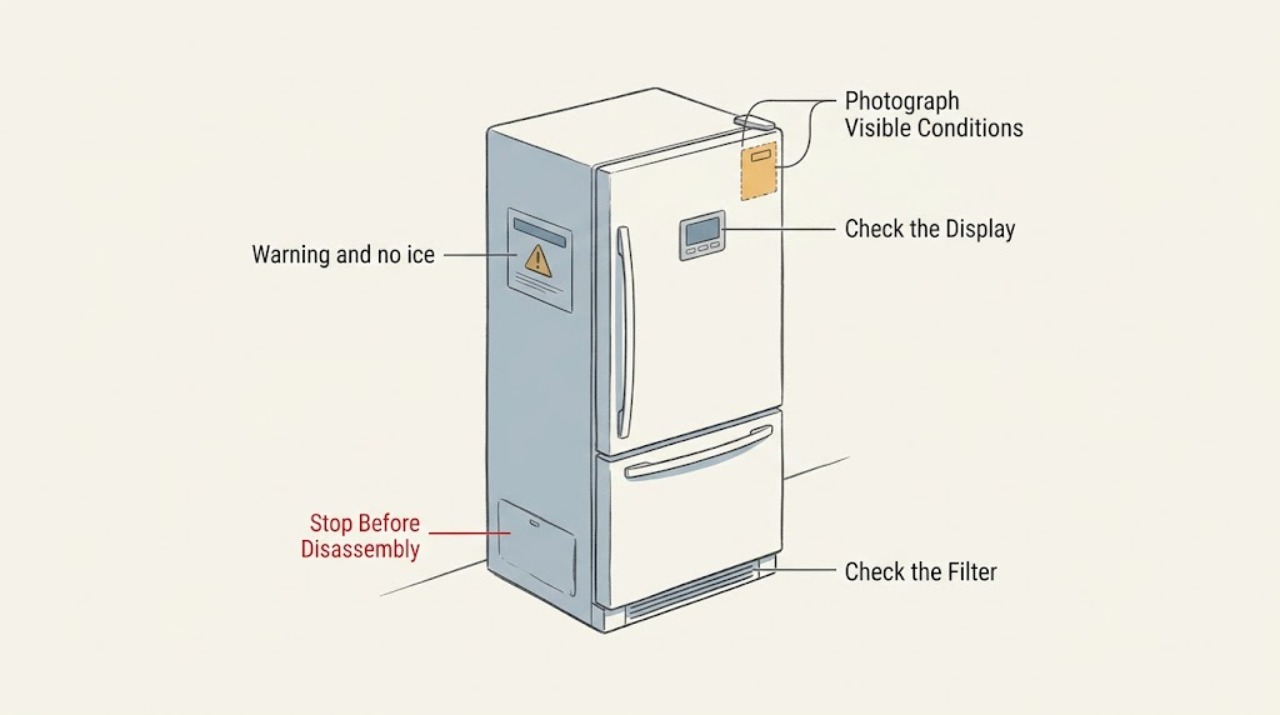
The RS36A80J1N is an Ice model with an automatic freezer ice maker, but a vague warning is not enough to identify an ice-maker failure. First record whether the warning is a fault alarm with a beep count and temperature-light sequence, or simply an ice-control indicator. Confirm Ice On/Off is enabled, the freezer is operating, and the visible water line and filter status are normal. This model's guide describes roughly eight cubes every 3–4 hours, depending on freezer temperature and door openings; if no ice returns after the external checks, or the freezer, water connection, or warning is abnormal, stop experimenting and arrange Fisher & Paykel service.
Work through in order
Diagnostic checks
Use only checks that match the exact appliance or system and its official guide.
-
Check 1
Record the complete warning before changing any setting: count the beeps when the refrigerator door is opened, photograph or write down the number and sequence of temperature lights, and note whether the ice bin is empty, contains clumped cubes, or contains loose cubes that are not being delivered.
Expected result: There is a reproducible beep/light sequence, only an Ice On/Off or Ice Boost indicator, or no warning at all; the bin is empty or already contains ice.
Next step: Keep the record with the exact RS36A80J1N model and use the matching guide. If a fault sequence is present, do not keep cycling the ice maker while trying to decode it; move to the service boundary after the safe checks.
Why this matters
Why: On this model, Fisher & Paykel uses the beep count and temperature-light sequence to identify a fault alarm. An empty bin without that sequence is a production-path symptom, while existing clumped or loose cubes point toward storage or delivery rather than no ice making.
-
Check 2
Check the internal control panel with the refrigerator operating normally and confirm Ice On/Off is enabled; use Ice Boost only if the guide's control is clearly identified and extra production is actually needed. Do not press or touch the ejector mechanism in the freezer.
Expected result: The ice maker was off, Ice Boost is active, or the ice maker was already on with no visible change in the bin.
Next step: If it was off, enable it once and allow a normal production interval. If it was already on or a fault warning remains, continue with external water and freezer observations and do not open the ice-maker mechanism.
Why this matters
Why: The guide says Ice On/Off activates the automatic maker, the indicator illuminates when active, and Ice Boost also turns ice making on. A maker that is already enabled needs water/freezer checks rather than repeated button presses.
-
Check 3
Look from a dry, accessible area at the refrigerator's visible water supply route and filter indicator. Check only for an obviously closed supply, a kinked or squashed line, a leak, or a filter-change indication; do not move the integrated refrigerator or loosen a water connection.
Expected result: The supply appears off or restricted, the line is kinked/leaking, the filter indicator is illuminated, or the visible supply and filter status are normal.
Next step: Correct only a plainly external, manual-authorized condition. Replace the filter only with the exact model instructions and stop if water is leaking or near electrical parts; otherwise allow the system one normal interval before escalating.
Why this matters
Why: The RS36A80 family guide lists an off or unconnected supply, low water pressure, a kinked line, and a clogged filter among causes of a maker that does not work. A normal visible path does not prove that the internal inlet or control is good, and a leak changes the task to a safety stop.
-
Check 4
Check the freezer's actual operating condition without changing sealed-system controls: confirm it is running, the freezer door closes fully, and there is no obvious door obstruction or heavy frost pattern. Keep door openings brief while the temperature stabilizes.
Expected result: The freezer is cold and operating with a closed, sealing door, or it is warm/not working, the door was left ajar, or frost/obstruction prevents a proper seal.
Next step: Correct only an obvious external door obstruction or gasket seating issue. If the freezer is warm, not operating, or has a persistent frost/sealing problem, stop ice troubleshooting and request refrigerator service.
Why this matters
Why: The guide identifies the freezer compartment not working and a freezer set too warm as reasons for no or slow ice, and it links a door left ajar to slow freezing. No ice does not isolate the ice-maker assembly when the freezer itself is not functioning.
-
Check 5
If the ice bin contains old or clumped cubes, follow the guide's safe bin-cleaning procedure: remove the bin only as the model guide shows, loosen or discard clumped ice, dry it, and refit it securely with the scoop in front. Keep fingers away from any moving ice-maker parts.
Expected result: The bin is empty, cubes are stuck together or wet, the bin does not seat correctly, or loose cubes are present but the outlet still does not deliver them.
Next step: Allow one normal harvest or delivery attempt after a correct refit. If the bin will not seat or loose cubes still do not move, turn the affected ice function off and arrange model-specific service.
Why this matters
Why: The guide says old cubes can become cloudy, shrink, and stick together, and it recommends cleaning the bin and returning it correctly. A loose, correctly seated bin with no delivery is a different dispenser or internal mechanism symptom, not proof of a particular part.
-
Check 6
After one external correction, observe one normal ice-making interval rather than repeatedly forcing cycles. Record whether cubes appear, whether the warning sequence returns, whether water dispensing also fails, and whether any leak, unusual sound, or cooling problem develops.
Expected result: Ice resumes within the model's normal interval, the bin remains empty despite normal controls and supply, the warning returns, or cooling/water symptoms appear at the same time.
Next step: Keep the refrigerator operating only if it is cooling safely. For persistent no-ice, a recurring warning, a warm freezer, a leak, or a simultaneous water failure, stop the ice function as appropriate and contact Fisher & Paykel or an authorized service technician.
Why this matters
Why: Recovery after a control, visible line, filter, door, or clump correction supports that condition as the immediate cause. Persistent failure with normal external conditions leaves internal ice-maker, inlet, pressure, freezer, or control causes unresolved and does not justify guessing a replacement part.
Use your observations
Decision map
Find the observation that best matches what you see, then follow the next safe action.
-
PATH 01Next step
What you see
A repeatable beep count and temperature-light sequence appears when the refrigerator door opens.
Do this next
Stop repeatedly cycling the ice function, preserve the beep/light record and model number, and contact Fisher & Paykel Customer Care or a trained service technician.
Why this path and its safety boundary
Why it matters: The guide treats this as a fault alarm that needs the recorded sequence for service; it is not enough to call the warning an ice-maker failure or infer a part.
-
PATH 02Next step
What you see
There is no fault sequence, but Ice On/Off was disabled or the refrigerator was just installed or reactivated and the freezer is operating normally.
Do this next
Enable the maker once using the exact guide, keep door openings brief, and observe one normal interval. If no ice appears afterward, continue to the water and service branches.
Why this path and its safety boundary
Why it matters: A disabled maker or normal startup/harvest delay is more likely than a failed ice-maker assembly. The guide documents Ice On/Off and a production rate of approximately eight cubes every 3–4 hours under varying conditions.
-
PATH 03Next step
What you see
The maker is enabled and the freezer is working, but the visible water supply is off/restricted, the filter indicator is on, or the line is kinked.
Do this next
Correct only the safe external condition or replace the filter according to the exact instructions. If there is a leak or the visible path is normal but no ice returns, stop and arrange service.
Why this path and its safety boundary
Why it matters: The documented external water path can explain no or slow ice, but it does not select an internal valve, pressure, or filter-housing part.
-
PATH 04Next step
What you see
The freezer is warm/not running, the door cannot seal, or no ice returns after the control, water, filter, bin, and normal-interval checks.
Do this next
Keep the affected ice function off and request Fisher & Paykel or authorized service. If food is warming, move perishables to a safe appliance or cooler and follow the guide's food-safety advice.
Why this path and its safety boundary
Why it matters: The remaining possibilities include a freezer/cooling condition or an internal ice-making, inlet, pressure, dispenser, or control fault. The user-facing observations cannot safely distinguish those parts.
Helpful context
Understand the symptom
What the warning may mean on this model
Fisher & Paykel identifies RS36A80J1N as the 36-inch Series 7 integrated French-door refrigerator freezer with an automatic ice maker and Ice Boost. In the matching guide, a fault alarm is documented by counting the beeps when the refrigerator door opens and recording the number and sequence of temperature lights. That is different from a normal ice-maker sound or the Ice On/Off indicator. Do not convert the word warning into a part diagnosis until the display, beeps, and lights are recorded.
A normal production delay is possible
The guide says the automatic maker produces about eight cubes every 3–4 hours, with freezer temperature and door openings affecting the result. A recently installed, recently reactivated, or frequently opened freezer can therefore look empty before a fault is established. The safe decision is to verify the control and external conditions, then observe one normal interval rather than repeatedly forcing the mechanism.
When checks do not resolve it
Need a professional?
Stop and arrange trained Fisher & Paykel service for a repeatable fault warning sequence, a freezer that is warm or not operating, persistent no-ice after the documented external checks, a bin that will not seat, or loose cubes that will not dispense. Stop immediately for a water leak near electrical parts, damaged cord or outlet, smoke, burning odor, refrigerant damage, or unsafe cabinet movement. Do not open panels, touch the ejector mechanism while operating, disconnect pressurized tubing, perform live electrical or water-pressure tests, or work on the sealed refrigeration system.
Have this ready
- Explain whether this is no new ice, a delivery problem with existing cubes, or a warning alarm. The exact guide separates control, water, freezer, clumping, and fault-alarm observations; do not present a guessed part as the diagnosis.
Common questions
FAQ
Is an empty ice bin after a few hours automatically a failure?
No. The matching guide describes about eight cubes every 3–4 hours, depending on freezer temperature and door openings, and startup or reactivation can require a normal interval. Verify Ice On/Off, freezer operation, and visible water conditions first.
What should I record if the refrigerator shows a warning?
Count the beeps when the refrigerator door opens and record the number and sequence of temperature lights on the internal control panel. The guide directs that information to Fisher & Paykel service; do not infer an ice-maker part from the word warning alone.
Read the exact guide
Official sources
- US CA User Guide ActiveSmart Integrated Refrigerator French Door Refrigerator FreezerFisher & Paykel · Official US/Canada guide covering RS36A80 models; verify market-specific controls if the installed unit's label or display differs
- Integrated French Door Refrigerator Freezer, 36", IceFisher & Paykel Canada · Official product page for the assigned RS36A80J1N family; use the matching regional guide for control behavior
Community feedback
Share a repair observation
Share a plain-text repair observation. Accepted observations are published automatically; this page may take a moment to update.