
On this page
Start here
Quick answer
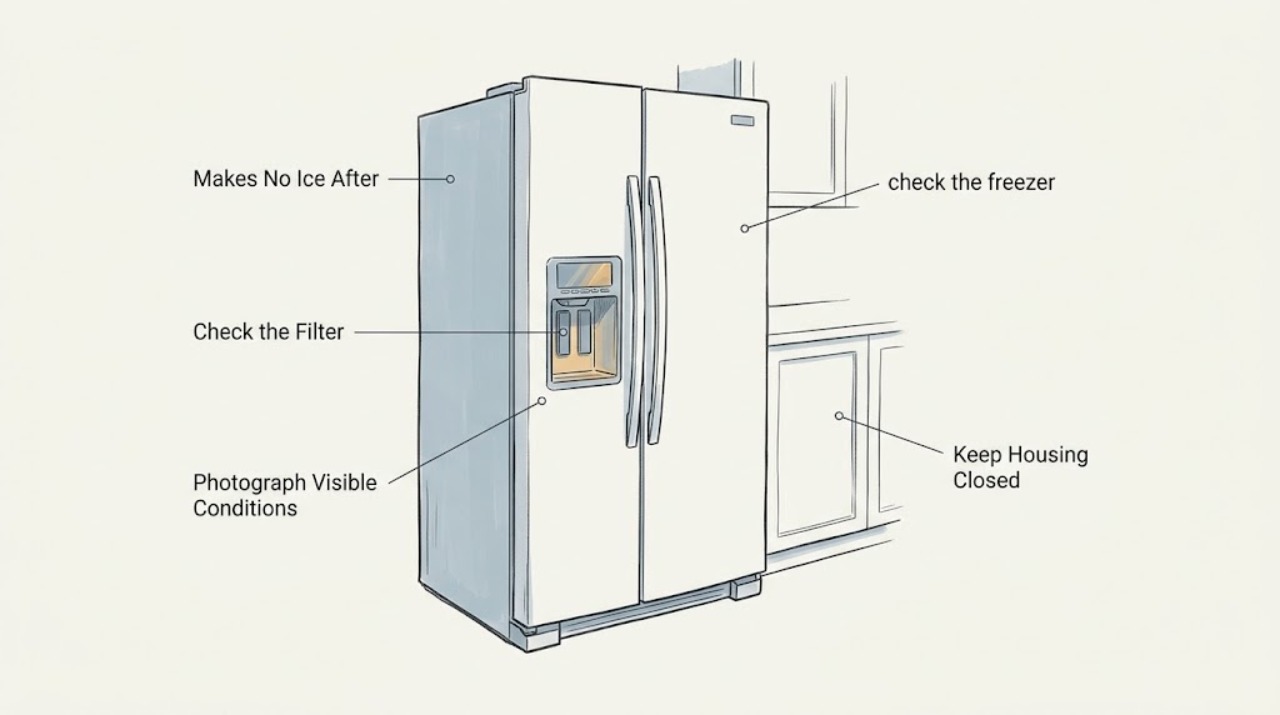
On a KitchenAid KRFC704FSS01 that still makes little or no ice after the ice-maker assembly and dual water inlet valve were replaced, do not keep buying parts or enter service mode. First confirm the complete model and record exactly where FF appeared; the opened KitchenAid service manual documents the water-valve and ice-maker systems for the KRFC704F* family, but it does not establish FF as a general owner-facing error meaning. KitchenAid's public troubleshooting instead starts with the maker being on, freezer temperature, water supply, filter seating/flow, and visible line kinks. From a stopped, dry refrigerator, check for water at the dispenser, a properly seated filter, normal freezer cooling, a dry or filled ice tray, and leaks around the recent work. A normal dispenser with a dry tray after both replacements points to a fill-path, wiring, control, or model-specific ice-maker diagnosis—not proof that another valve or fill tube should be ordered. Shut off water and stop the maker for any leak, overfill, frost that blocks cooling, or water near electrical parts; use qualified KitchenAid service for internal testing.
Before you begin
Safety first
- Owner checks stop at a dry refrigerator: exact model and FF context, visible ice-tray/bin state, freezer cooling, one brief front dispenser observation, filter seating per the model instructions, and accessible dry water-line checks. Do not enter service mode, repeat an unidentified fill test, force the tray or bail arm, warm a frozen tube, apply power to a valve, measure live circuits, remove panels, or disconnect water fittings under pressure.
Work through in order
Diagnostic checks
Use only checks that match the exact appliance or system and its official guide.
-
Check 1
Stop the ice maker and inspect the refrigerator from a dry, safe position after the recent parts work. Do not reach into the ice-maker mechanism, force a tray, or repeatedly energize it. If a water connection, filter housing, or valve area is wet, close the refrigerator's accessible water shutoff before any further observation; do not touch wet electrical parts.
Expected result: Everything around the recent work is dry, or there is a drip, spray, overfill, standing water, frost melt, water near wiring, or a burning/electrical odor.
Next step: For any leak or water near electricity, leave the maker off, shut off water from a safe accessible point, and arrange qualified appliance service. If the refrigerator is dry and stable, continue with non-invasive identification.
Stop if: Stop immediately for uncontrolled water, overfilling, moisture near electrical connectors, smoke, burning odor, or a hot/damaged cord or outlet.
Why this matters
Why: A leak or water near electrical parts changes the problem from low-ice troubleshooting to a water and electrical safety stop. Dryness does not prove that the new valve or maker is correctly installed.
-
Check 2
Read the rating label and photograph the complete model, including the final digits KRFC704FSS01, serial/market information, and which ice maker is affected. Record whether FF appeared on the normal display or only after a prior technician/service test, what the test was intended to do, and whether the code appeared immediately or after water was requested.
Expected result: The label confirms KRFC704FSS01, has a different suffix, or is unreadable; FF is a normal user display, an isolated test result, or an unexplained display with no procedure recorded.
Next step: Use the complete label and market when requesting model literature or service. Do not translate FF from another KitchenAid platform, repeat an unidentified test, or order a part from the letters alone.
Stop if: Do not enter service mode, use a button sequence copied from a forum, or remove panels to locate the label.
Why this matters
Why: The opened KitchenAid support page identifies the KRFC704FSS product family, and the service manual covers KRFC704F* models, but neither establishes that every FF display has one owner-facing meaning. A test result without its test context cannot select a valve, fill tube, control, or ice-maker part.
-
Check 3
With the refrigerator operating normally and no active leak, check the freezer and the ice-maker area without touching the mechanism. Note whether other frozen food is solid, whether the ice tray is dry, partly filled, full of frozen cubes, or visibly jammed, and whether the ice bin is seated. Do not force the bail arm, ejector, tray, or bucket.
Expected result: The freezer is warm or frosty, the tray is dry, the tray contains frozen cubes that are not harvested, the bin is absent/not seated, or the tray and bin look normal.
Next step: Correct only an obvious bin position or model-documented on/off state. If cooling is poor, frost blocks the ice-box airflow, or the mechanism is jammed, stop the maker and arrange service rather than forcing or thawing it with heat.
Stop if: Do not use sharp tools, hot water, a hair dryer, or hands inside the ejector/gear area.
Why this matters
Why: KitchenAid identifies freezer temperature and an ice maker being off as common causes. A dry tray keeps water delivery and fill timing in consideration; frozen cubes that never release shift attention toward harvest, sensing, bin detection, or a jam. No visible condition proves which newly replaced component is at fault.
-
Check 4
Make one brief, normal water-dispenser observation from the front and compare its flow with the ice symptom. If the filter was recently handled, verify from the manual that it is fully seated and sealed; use only the manual's front-access filter procedure. Do not bypass the filter indefinitely, loosen a pressurized fitting, or pull the refrigerator out by the water line.
Expected result: Water flow is normal, weak, absent, sputtering after filter work, or accompanied by a filter-housing leak.
Next step: Follow KitchenAid's filter-seating and flushing guidance for a visible filter issue. For weak flow, a leak, or any tubing work, shut off water and use qualified service; do not use a valve replacement as a substitute for tracing the path.
Stop if: Stop for a filter-housing leak, water near electrical parts, a disconnected line, or a need to move the refrigerator or open a valve compartment.
Why this matters
Why: Normal dispenser flow makes a shared household supply or clogged filter less likely, but it does not prove that the ice-maker branch fills. Weak or absent water at both functions keeps the supply, filter, kink, or isolation path in consideration. A filter leak is an installation/sealing issue, not evidence for another ice-maker part.
-
Check 5
Do not repeat the earlier FF/fill test. Instead, write a sequence for the technician from existing evidence: after the replacements, did the tray ever receive water during normal operation, was the fill brief or absent, did ice later freeze, did it harvest, and did the problem change only temporarily after a reset or power interruption? Include photos of the tray, bin, filter, and any dry connection, but do not remove covers.
Expected result: The new parts made no change, made a temporary change, produced a short/partial fill, or produced a full tray that never harvested; the exact FF context is known or unknown.
Next step: Give the sequence and complete model to qualified KitchenAid service. Ask the provider to verify the actual fill-versus-harvest path and installation of the recently replaced parts before recommending any additional component.
Stop if: Do not enter service mode, apply power directly to a valve, measure live circuits, warm a frozen tube, or purchase a control, tube, valve, or maker solely from FF.
Why this matters
Why: A no-change result after replacement lowers the value of further blind parts swapping. A short fill or temporary recovery leaves the water path, fill-tube restriction/heater, valve activation, wiring, control timing, temperature, or harvest sequence open; a full tray that is not dumped points away from a simple fill shortage. FF remains a context-dependent test result unless the exact model documentation defines it.
Use your observations
Decision map
Find the observation that best matches what you see, then follow the next safe action.
-
PATH 01Next step
What you see
The dispenser is weak or absent as well as the ice maker, or the filter was recently changed and the flow changed afterward.
Do this next
Check only the visible, dry front-access filter and line conditions using the model guidance. Shut off water and arrange service for leaks, pressure, disconnected tubing, or any valve-compartment work.
Why this path and its safety boundary
Why it matters: A shared water supply, filter seating/restriction, kink, or isolation path is more likely than an isolated ice-maker harvest fault. KitchenAid specifically links a restricted supply and incorrectly seated filter with low or absent ice production.
-
PATH 02Next step
What you see
The freezer is cold, the maker is enabled, the bin is seated, and dispenser flow is normal, but the tray remains dry after the ice maker and dual valve were replaced.
Do this next
Keep the maker off if it buzzes continuously or repeatedly calls without water. Provide the replacement dates, part identities if documented, FF context, and tray/dispenser observations to qualified service for internal diagnosis.
Why this path and its safety boundary
Why it matters: This narrows the evidence to the ice-maker call, fill tubing/heater or restriction, wiring/control timing, or a model-specific water-path problem. It does not prove that the new valve or maker is bad, and it does not justify a third part.
-
PATH 03Next step
What you see
The tray contains solid frozen cubes but does not release them, or the bin is not detected/seated while water and freezer cooling are normal.
Do this next
Do not force the tray or reach into the mechanism. Reseat only a visibly mispositioned bin as the model literature permits; otherwise leave the maker off and request model-specific service.
Why this path and its safety boundary
Why it matters: The problem is more consistent with harvest, bin detection, sensing, or a mechanical jam than with a missing fill. The service manual describes separate ice-maker and bin-switch functions for the KRFC704F* family, but the visible symptom does not identify which one failed.
-
PATH 04Next step
What you see
FF appears only in a prior or unidentified service test, the normal display does not define it, or the code returns despite a completed fill/harvest sequence.
Do this next
Stop repeating diagnostics and ask qualified service to identify the exact test, model documentation, and actual fill/harvest result. Treat the exact-model Reddit report as anecdotal context only, not as proof of a control-board, valve, or fill-tube failure.
Why this path and its safety boundary
Why it matters: The opened official service manual documents what the valve and ice-maker systems do but does not provide a general owner-facing FF definition for this case. An isolated test code cannot be safely converted into a part diagnosis or compared with another KitchenAid generation.
-
PATH 05Safety boundary
What you see
There is a leak, overfill, water near electrical areas, severe frost or warming, a continuous valve buzz, burning odor, or any damaged connection after the replacement work.
Do this next
Leave the maker off, shut off water from a safe dry position, protect food as needed, and obtain qualified appliance/electrical service. Do not restart to reproduce the event.
Why this path and its safety boundary
Why it matters: This is a water, electrical, or food-safety stop. Continued cycling can worsen flooding or damage and will not safely establish which part was installed or failed.
Safety stop: Keep the refrigerator or affected ice system isolated until the responsible qualified provider evaluates it.
Helpful context
Understand the symptom
Replacing two parts changes the decision path. It makes a repeated no-ice symptom more useful as a flow-and-sequence problem, but it does not prove that the replacements are correct, installed correctly, or the only possible causes. The exact community report for a KRFC704FSS01 described an immediate FF result during a fill test, a later successful short fill, and still-poor normal production after an ice maker and dual valve had been replaced. That is a useful model-specific report, not a diagnosis for every refrigerator.
The KitchenAid service manual opened for this research covers KRFC704F* family models and explains that the ice maker, water valves, isolation valve, fill tube heater, sensors, and control interfaces form separate parts of the sequence. Its diagnostic procedures are marked for service technicians. This article uses that separation to decide what to observe next, but does not give an owner a service-mode sequence or a component replacement conclusion.
When checks do not resolve it
Need a professional?
Request KitchenAid or qualified refrigerator service for a dry tray after the maker and valve replacement, incomplete or temporary fills, unexplained FF, failed harvest, continuous buzzing, leaks, overfill, frost/cooling issues, or any need to access the fill tube, heater, valves, wiring, sensors, control, or ice-maker mechanism.
Safety scope: Owner checks stop at a dry refrigerator: exact model and FF context, visible ice-tray/bin state, freezer cooling, one brief front dispenser observation, filter seating per the model instructions, and accessible dry water-line checks. Do not enter service mode, repeat an unidentified fill test, force the tray or bail arm, warm a frozen tube, apply power to a valve, measure live circuits, remove panels, or disconnect water fittings under pressure.
Have this ready
- Provide KRFC704FSS01 and serial/market, the exact FF display context, which ice maker is affected, replacement dates and documented part identities, dispenser-flow result, filter history, freezer/ice-box condition, tray and bin state, whether water ever filled normally, and any leak or buzz timeline.
Common questions
FAQ
What does FF mean on a KitchenAid KRFC704FSS01 ice-maker fill test?
The opened KitchenAid service manual does not establish FF as a general owner-facing meaning for this situation. The exact-model community report saw FF appear immediately during a fill test, but that is anecdotal. Record the precise test context and have qualified service interpret it against the complete model documentation; do not use FF alone to select a part.
If I already replaced the ice maker and dual water valve, what should I replace next?
Do not choose another part from the no-ice symptom or FF alone. First compare dispenser flow, filter seating, freezer/ice-box cooling, dry versus filled tray, and whether the replacements changed the normal fill or harvest sequence. A normal dispenser with a dry tray needs model-specific water-path and control diagnosis, not automatic replacement of a fill tube or board.
Can a clogged or incorrectly installed filter cause low ice after a valve replacement?
Yes. KitchenAid says a restricted or incorrectly seated filter can reduce or stop water flow to the ice maker and dispenser and can also leak at the housing. Check only the front-access filter using the model instructions; stop for a leak or water near electrical parts and do not treat a filter issue as proof the newly replaced valve is bad.
Should I run the KRFC704FSS01 service tests again to see whether FF clears?
No. The opened service manual labels its diagnostic procedures for service technicians, and repeating an unidentified test can add confusion without proving a component. Give the technician the prior test name or photo, the FF timing, and the normal tray/dispenser observations instead.
Read the exact guide
Official sources
- KitchenAid KRFC704 - No Ice. New Ice Maker & Dual Water Inlet Valve Installed. Next step?Reddit / r/appliancerepair · Lived-experience evidence only. It matches the exact KRFC704FSS01 model and replacement timeline, but its proposed causes and part suggestions are unverified and are not used as instructions.
- KRFC704FSS | KitchenAidKitchenAid · The opened Owner's Center identifies the KRFC704FSS French-door bottom-freezer refrigerator family and directs owners to model manuals, troubleshooting, and service. The assigned KRFC704FSS01 suffix must still be confirmed on the rating label before applying model-specific controls.
- Not Dispensing Ice or Water - RefrigeratorKitchenAid Product Help · Supports front-access checks for control lock, filter seating, water supply, visible kinks, and flushing after filter or initial installation; it is not used to infer the condition of the replaced valve.
- Service - Manual - w11366204 - French-Door Bottom Mount RefrigeratorKitchenAid · The opened official service manual explicitly lists KRFC704F* family models and describes the water system, dual valve, in-door ice maker, fill path, sensors, bin switch, and harvest path. It is marked for service technician use; this article does not expose its diagnostic sequences or live tests.
- Not Making Ice - RefrigeratorKitchenAid Product Help · Supports safe owner-level checks for maker on/off status, freezer condition, filter installation, water-line routing, and low/no ice. It does not decode FF for KRFC704FSS01 or select a replacement part.
Community feedback
Share a repair observation
Share a plain-text repair observation. Accepted observations are published automatically; this page may take a moment to update.