
On this page
Start here
Quick answer
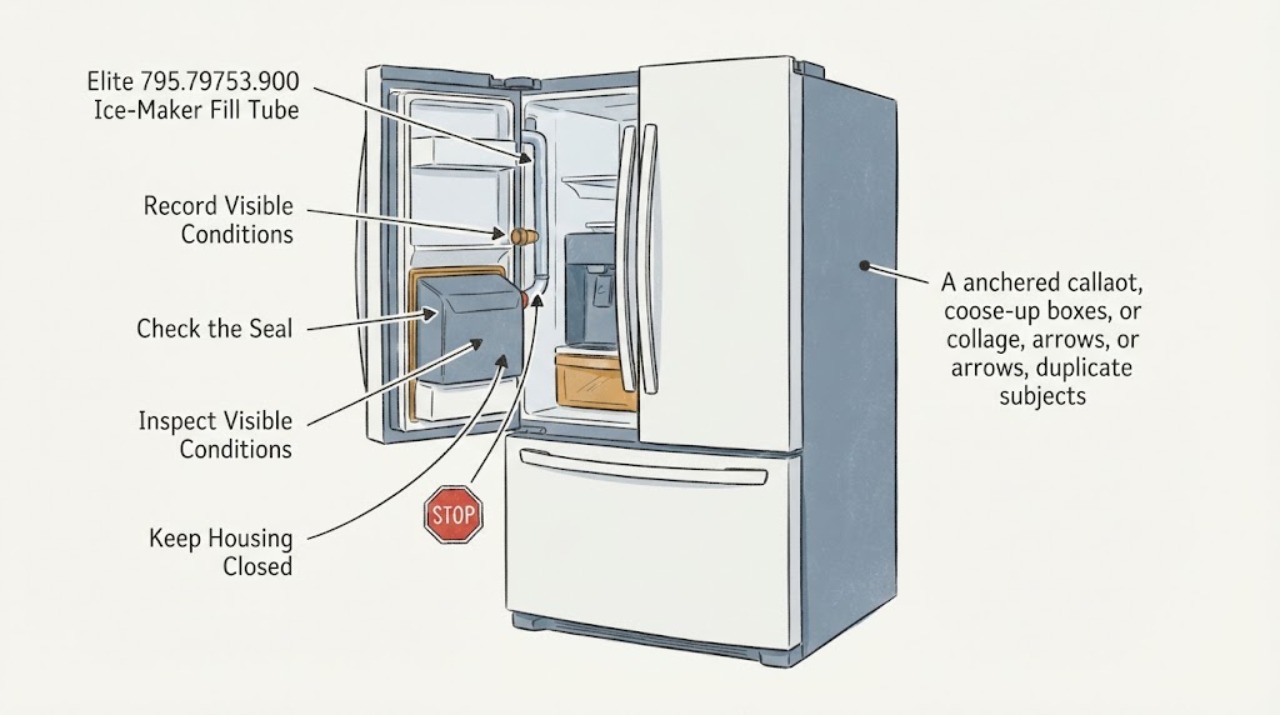
For the Kenmore Elite 795.79753.900, verify the complete model identity and confirm that the left-door ice maker is enabled, the bin and door are seated, and the freezer is cold enough for normal ice making. Compare normal dispenser flow with the ice-maker result and look only at the visible fill opening for an obvious frost plug or leak. A report for this exact model describes the ice maker cycling normally after the line was cleared, then the fill line freezing again within about 2–3 hours; that pattern moves the decision away from repeatedly clearing the ice maker and toward a model-specific door fill-path, valve, or embedded anti-freeze circuit diagnosis. Do not pry, heat, pull the door apart, disconnect water tubing, run a forced test, or choose a valve, heater, or ice-maker assembly from the symptom alone.
Work through in order
Diagnostic checks
Use only checks that match the exact appliance or system and its official guide.
-
Check 1
From a safe standing position, read the complete rating-label model number and confirm that it is 795.79753.900. Record that the ice maker is in the left door, the date the no-ice symptom began, whether the fill opening looks blocked, and whether any water or ice is present around the door. Do not remove the door trim, ice maker cover, or tubing to obtain the label.
Expected result: The complete model and left-door ice-maker location are confirmed, or the number is partial, different, or unreadable.
Next step: Use the complete model in Kenmore's manual and customer-care routes. If identity cannot be confirmed without moving the appliance or opening a panel, stop at identification and service.
Stop if: Do not pull out the refrigerator, remove a door, open a panel, or reach behind a tight installation to find the label.
Why this matters
Why: The exact Reddit report is specific to 795.79753.900, while Kenmore's official manual route is model-number based. A partial or different number cannot safely inherit the reported door layout or any repair conclusion.
-
Check 2
Using only normal user controls and the matching manual, confirm that ice making is enabled, the ice bin is seated, and the shutoff arm or visible full-bin sensor is not raised or blocked. Check that the left door closes fully and its gasket contacts the cabinet. Do not force an arm, reach into the ejector, or start a hidden test cycle.
Expected result: The ice maker is off, the bin or arm is out of position, the door or gasket has a gap, or all visible controls and closure are normal.
Next step: Correct only a harmless position shown in the exact manual and allow normal production time. If the arm will not move normally, the sensor is inaccessible, or the door cannot seal, arrange service rather than forcing it.
Stop if: Stop for a broken arm, packed ice around the mechanism, a damaged gasket or hinge, loose wiring, or any need to remove the ice maker.
Why this matters
Why: An off control, full-bin signal, or door that cannot seal can pause production without establishing a fill-tube or valve failure. Normal settings and closure move the decision toward temperature, water delivery, or the ice-maker mechanism.
-
Check 3
Check the freezer from outside the mechanism: confirm it is maintaining the exact manual's operating guidance, note whether frozen food is firm, and look for a door obstruction, broad frost, or a blocked cold-air path. Do not scrape frost, use a hair dryer or heat gun, or remove an interior panel to reach the fill tube.
Expected result: The freezer is warm or broadly frosted, the door or airflow is compromised, or the freezer is cold with no broad cooling symptom.
Next step: Remove only an obvious door or vent obstruction and follow the model manual's temperature guidance. For persistent warmth, heavy frost, or a door that will not seal, protect food and arrange refrigerator service.
Stop if: Stop for softening food, rapid frost return, a fan blocked by ice, exposed wiring, or any need to force a defrost or touch refrigeration components.
Why this matters
Why: A warm or poorly sealed freezer can stop ice production generally. A cold, sealed freezer with a localized left-door fill blockage makes a system-specific fill-path problem more plausible, but it still does not identify a heater, valve, or other part.
-
Check 4
If the refrigerator has a dispenser, use it normally for a brief comparison and note whether its flow is usual, weak, or absent. Inspect only visible external water-line routing and the filter housing for a kink, recent filter change, or leak; do not disconnect the line or operate an unknown shutoff.
Expected result: Dispenser flow is also weak or dry, dispenser flow is normal while the ice maker does not fill, flow changed after a filter change, or there is a leak.
Next step: Follow only the exact manual's filter-seating instruction and document the comparison. Keep water and ice functions off for a leak or inaccessible connection and arrange qualified appliance service for line, pressure, or valve diagnosis.
Stop if: Stop for water near electrical equipment, a bulging or cracked line, a filter housing leak, a seized shutoff, or any need to disconnect tubing.
Why this matters
Why: Weak flow at both outlets makes a supply, filter, line, or inlet-valve path more likely. Normal dispenser flow narrows the issue toward the ice-maker branch but cannot prove that the valve or fill tube is defective. A leak is a safety boundary, not a test result.
-
Check 5
Without a forced harvest, manual fill, or disassembly, observe the visible ice mold and fill opening during normal operation over a safe period. Record whether the mold stays dry, receives water, contains frozen cubes that remain, or works briefly and then stops after a repeat freeze at the left-door fill opening. Do not clear the ice with a tool or direct heat.
Expected result: The mold stays dry, the mold fills but cubes do not harvest, the ice maker cycles normally while the fill opening refreezes, or the mechanism is silent or jammed.
Next step: Record the timing and pattern, then stop owner testing. Give the exact model and observations to qualified appliance service so the door fill path and model-specific water controls can be diagnosed with safe power and water isolation.
Stop if: Stop for a jammed ejector, exposed heater or wiring, unusual heat or smell, water leakage, or any need to bridge contacts, probe voltage, remove a tube, or open the door skin.
Why this matters
Why: A dry mold can reflect water delivery, a frozen fill path, a valve outlet, or control timing; retained cubes point to harvest-side service; and repeated refreezing after otherwise normal cycling is the distinctive pattern reported for this exact model. The report and its comments discuss possible door-heater or valve causes, but they do not provide manufacturer confirmation or a safe user repair.
Use your observations
Decision map
Find the observation that best matches what you see, then follow the next safe action.
-
PATH 01Next step
What you see
The freezer is warm, the door or gasket does not seal, or broad frost blocks airflow while the ice maker has stopped.
Do this next
Correct only a harmless outside obstruction using the exact manual's guidance, protect warming food, and arrange refrigerator service for persistent warmth, heavy frost, or a damaged door seal.
Why this path and its safety boundary
Why it matters: This is a cabinet-temperature or airflow branch rather than evidence that the left-door fill tube or a valve has failed.
-
PATH 02Next step
What you see
The dispenser is weak or dry, or flow changed after a filter change, and the ice maker also does not fill.
Do this next
Use only the model-specific filter and visible-routing instructions; for a leak or any line/pressure diagnosis, keep the functions off and call qualified service.
Why this path and its safety boundary
Why it matters: A shared supply, filter, line, or inlet-valve path is more likely than an isolated harvest fault, but the observation does not select a replacement part.
-
PATH 03Next step
What you see
The freezer is cold and sealed, the ice maker is enabled, the mold can cycle, but the left-door fill opening refreezes again after it is cleared or the unit works for only a short period.
Do this next
Stop repeating clearing attempts and arrange service for the exact model to inspect the internal door water path and related controls. Do not heat, pry, remove the door skin, or order a heater or valve from this pattern alone.
Why this path and its safety boundary
Why it matters: This matches the distinctive exact-model report: a recurring door fill-path restriction remains after the ice maker itself appears functional. Community comments mention a possible door heater or leaking valve, but those are unverified hypotheses, not a part recommendation.
-
PATH 04Next step
What you see
There is a leak, water near electrical equipment, exposed wiring, unusual heat or odor, a jammed mechanism, repeated electrical trips, or food is warming.
Do this next
Stop using the ice maker, isolate water or power only from a safe dry position when possible, protect food if cooling is affected, and contact qualified appliance or electrical service.
Why this path and its safety boundary
Why it matters: The event has crossed an appliance, electrical, water, or food-safety boundary; continued ice testing could increase damage or injury risk.
Helpful context
Understand the symptom
The exact-model report matters here: 795.79753.900 is described as a French-door Kenmore with the ice maker in the left door, and the reported failure is a fill line that refreezes after the ice maker itself appears to cycle. That is not proof of a failed heater, valve, or ice-maker assembly. Kenmore's official manual page routes owners by complete model number, so use the full label and the matching manual before attempting any owner procedure.
Do not treat a tube that looks frozen as permission to remove the door skin or thaw it with direct heat. The fill path may be inside the door, and a recurring blockage can be caused by water delivery or an internal component that cannot be safely distinguished from a visible check. Keep the ice maker off if there is a leak, exposed wiring, unusual heat, or a jammed mechanism.
When checks do not resolve it
Need a professional?
Arrange qualified appliance service when the freezer is cold and sealed but the mold remains dry, the left-door fill path repeatedly freezes, the ice maker will not harvest, water delivery requires line or pressure diagnosis, or the exact model manual does not support a safe owner action. Call promptly for a leak, water near electrics, exposed wiring, unusual heat or odor, repeated electrical trips, a jammed mechanism, or warming food. Do not use direct heat, sharp tools, a forced test cycle, manual fill, door disassembly, live electrical testing, or a guessed valve, heater, or ice-maker replacement.
Common questions
FAQ
Does normal ice-maker cycling prove the fill tube or valve is good on 795.79753.900?
No. The exact-model report says the ice maker could cycle after the line was cleared, but the line froze again within about 2–3 hours. That pattern keeps the door fill path and water controls in the service diagnosis without proving a heater, valve, or ice-maker part.
Can I thaw the left-door fill tube with a hair dryer, heat gun, or sharp tool?
Do not. The available exact-model evidence does not provide a safe, model-specific thaw procedure, and a fill path inside a door may include water and electrical components. Do not pry, apply direct heat, remove the door skin, or disconnect tubing; document the visible pattern and arrange service if it recurs.
Should I order a heater or water valve because the fill tube keeps freezing?
Not from this symptom alone. A community comment raised a possible door heater or leaking valve, but that is not manufacturer confirmation or compatibility evidence for this exact model. Use the complete model and observations for service diagnosis instead of choosing a part by appearance or a generic 795-series listing.
Read the exact guide
Official sources
- Find Your Manual | Kenmore Appliance Manuals & GuidesKenmore · The opened official page says owners should enter the complete model number to access manuals for refrigerators and other appliances. It is used to route a lookup for 795 79753 900 (79579753900) and set an identity boundary, not as proof of a fill-tube heater, valve, or exact internal repair.
- Customer Care & Support | Kenmore AppliancesKenmore · The opened official page provides customer-care, parts/literature, product-manual, and repair-service routes. It does not establish a universal fix or a compatible part for this refrigerator.
- Kenmore Elite 795.79753.900 Ice Maker Tube FreezingReddit r/appliancerepair · An exact-model community report used only as a lived symptom and timing report. It is not manufacturer confirmation, a wiring diagram, a parts-compatibility source, or proof of the commenter’s heater/valve hypotheses.
Community feedback
Share a repair observation
Share a plain-text repair observation. Accepted observations are published automatically; this page may take a moment to update.