
On this page
Start here
Quick answer
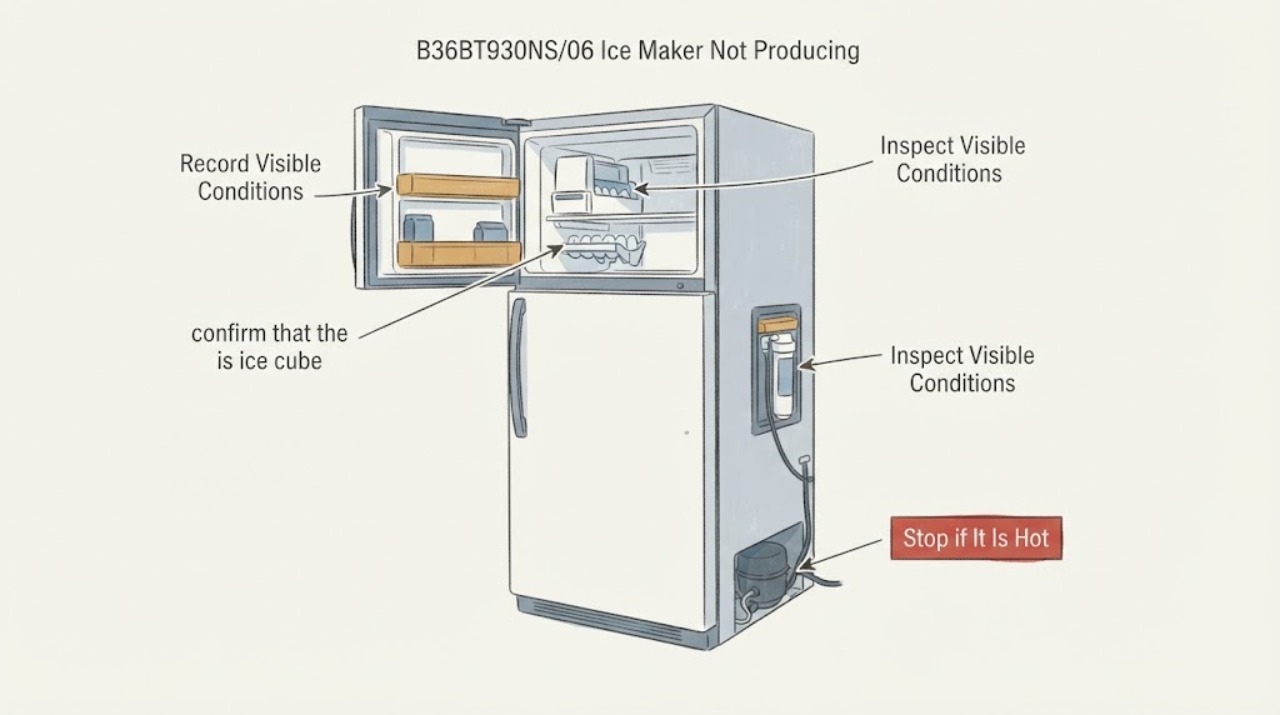
For Bosch B36BT930NS/06, first check the normal display setting for ice-cube production, the freezer temperature, the ice cube container's seating and whether anything is stored in the container. Bosch's exact-family manual says ice production starts only after the appliance reaches its set temperature, stops when the container is full, and can stop when the filter is blocked or needs replacement. It also lists no water supply, low pressure and a kinked hose as causes. If the filter is genuinely due, install and seat the filter or approved bypass cartridge specified for this E-Nr and reset the filter counter using the manual; do not guess a part or use hidden service-mode instructions. If water, settings and temperature are normal but ice still does not return after the documented wait, arrange Bosch service.
Before you begin
Safety first
- Do not dismantle the ice maker, gearbox, water valve or cabinet, enter hidden service mode, heat an ice blockage with a hair dryer, disconnect pressurized tubing or probe energized parts. Bosch states that repairs or replacement should be performed by the manufacturer or an authorized provider and that original parts are required.
Work through in order
Diagnostic checks
Use only checks that match the exact appliance or system and its official guide.
-
Check 1
Open the normal settings screen for the refrigerator and confirm that ice-cube production is enabled. Also note whether Vacation, Sabbath or Demo mode is active, and record the freezer temperature shown by the appliance.
Expected result: Ice-cube production is off, a mode that disables the ice maker is active, or the freezer is warmer than its set temperature.
Next step: Use only the B36BT930NS/06 manual's normal user controls to leave the mode or enable ice production. If the freezer cannot reach its set temperature, stop at that external observation and request service rather than opening panels.
Why this matters
Why: Bosch lists switched-off ice production and a freezer that is too warm as direct reasons for no ice; the manual also says Sabbath mode switches off the ice maker and Demo mode switches off cooling.
-
Check 2
With the ice maker and container accessible without removing covers, confirm that the ice cube container is fully inserted and empty of bottles, food or a misplaced scoop. Do not force a tray, ejector or sensor.
Expected result: The container is not fully seated, is obstructed, or is genuinely full; otherwise it appears correctly seated and clear.
Next step: Correct only the seating or removable obstruction described by the manual. If the container is not full but the appliance continues to report full, leave the mechanism alone and arrange service.
Why this matters
Why: The manual says an improperly inserted container can stop the ice maker, that stored objects can block or damage it, and that production stops automatically when the container is full.
-
Check 3
Inspect only the accessible water shutoff, tubing and filter seating. Look for a closed supply, a visible kink or a filter that is not turned fully to the manual's stop. Do not disconnect pressurized tubing or infer water pressure from a guessed number.
Expected result: Water supply is off, the hose is kinked, the filter is visibly mis-seated or the external path looks normal.
Next step: Restore only a clearly closed supply or visible hose alignment if safe. If the filter is due, use the exact Bosch manual's filter or approved bypass-cartridge procedure and reset the counter; if water flow or pressure remains uncertain, use a technician.
Why this matters
Why: Bosch lists no water supply, low pressure, a kinked hose and a blocked or replacement-due filter as ice-maker fault branches. A normal-looking external path does not prove the inlet valve or ice maker is good.
-
Check 4
After a documented setting/filter correction, leave the doors closed as practical and allow the freezer to reach its set temperature. Record whether any new ice appears over the next normal production period, rather than repeatedly resetting the appliance.
Expected result: Ice begins to form, the container remains empty after the documented wait, or water leaks/abnormal noises appear.
Next step: If ice returns, monitor the alert and filter counter. If it does not, or if there is leaking, unusual noise or no ice-maker power, stop user troubleshooting and contact Bosch or an authorized service provider.
Why this matters
Why: Bosch says production begins after the set temperature is reached and an empty container can take around 24 hours to fill. A persistent empty container after the external checks is not enough evidence to identify a replaceable part.
Use your observations
Decision map
Find the observation that best matches what you see, then follow the next safe action.
-
PATH 01Next step
What you see
The display shows ice production off, Vacation/Sabbath/Demo mode, or a freezer temperature that has not reached the set value.
Do this next
Correct only the normal user setting using the exact manual and allow the appliance to reach temperature. Request service if the mode cannot be changed or the freezer stays warm.
Why this path and its safety boundary
Why it matters: A documented control or temperature condition can prevent ice production without proving a failed ice-maker assembly.
-
PATH 02Next step
What you see
The ice container is not seated, contains an object, or is actually full.
Do this next
Remove only a loose, user-accessible obstruction and seat the container as documented. Do not pry the tray or sensor; service is required if the full alert remains with an empty, correctly seated container.
Why this path and its safety boundary
Why it matters: The container position, obstruction or full-level sensor can explain the stop condition under Bosch's manual.
-
PATH 03Next step
What you see
The filter alert remains and the filter is past its documented interval, visibly mis-seated or suspected blocked, while the water supply and hose are otherwise normal.
Do this next
Replace or use the approved bypass cartridge specified for this E-Nr, seat it fully, reset the counter as the manual directs, and discard the initial ice as instructed. Do not choose an unverified filter or claim that a filter reset proves an internal repair.
Why this path and its safety boundary
Why it matters: The manual lists a blocked or replacement-due filter as a reason ice production may stop, and provides a filter-counter procedure.
-
PATH 04Next step
What you see
The display and water path look normal, the freezer reaches temperature, the container is empty and seated, and no ice appears after the documented waiting period.
Do this next
Arrange Bosch service and provide the full E-Nr, alert history, filter status, freezer temperature and whether the container ever cycles. Do not remove the ice maker or enter a hidden service mode.
Why this path and its safety boundary
Why it matters: The user-level branches have been exhausted; the official manual does not support identifying a failed valve, motor, sensor or control board from these observations alone.
Helpful context
Understand the symptom
What is confirmed for this Bosch model
The opened post identifies a built-in Bosch B36BT930NS/06 refrigerator that is not producing ice or filling the tray. The poster says a hard reset can restore a few cycles, then production stops, and says the water line and filter were replaced. Bosch's official support page identifies B36BT930NS/06 as a Benchmark built-in bottom-freezer refrigerator and links a use-and-care manual covering ice production, water filtering and fault handling.
The two alerts need separate checks
A full-tray alert can reflect the container or its fill-level detection, while an expired-filter alert concerns the water-filter counter or filter condition. Bosch's manual says ice production stops automatically when the ice container is full, warns not to store bottles or food in that container, and lists a blocked or replacement-due filter among the reasons production can stop. Those statements support checking the documented user controls and water path, not replacing the ice maker or declaring a sensor failure.
Use the manual's waiting and service boundary
The manual says ice production starts once the appliance reaches the set temperature and that an empty container can take around 24 hours to fill. It directs the owner to customer service when the ice maker has no power, when water supply or pressure cannot be corrected, or when the fault remains. Do not copy hidden-pocket, app, hard-reset or internal self-test instructions from community comments into a model-specific repair procedure.
When checks do not resolve it
Need a professional?
Use Bosch service when the freezer does not reach temperature, the ice maker has no power, water supply or pressure cannot be corrected, the full alert remains with an empty correctly seated container, water leaks, or no ice returns after the manual's external checks and waiting period.
Safety scope: Do not dismantle the ice maker, gearbox, water valve or cabinet, enter hidden service mode, heat an ice blockage with a hair dryer, disconnect pressurized tubing or probe energized parts. Bosch states that repairs or replacement should be performed by the manufacturer or an authorized provider and that original parts are required.
Have this ready
- Provide the complete E-Nr B36BT930NS/06, photos of the ice-tray-full and water-expired/filter alerts, freezer temperature, filter or bypass-cartridge status, water-supply observations, container seating and the time since the last correction.
Common questions
FAQ
Does the expired-filter alert prove that the Bosch ice maker is defective?
No. Bosch's manual lists a blocked or replacement-due filter as one possible reason ice production stops, alongside settings, freezer temperature, container seating, water supply, pressure and hose condition. A filter alert should be handled through the exact manual procedure before a part diagnosis is considered.
How long can an empty ice container take to fill?
Bosch states that after switching on or removing many cubes, an empty ice container can take around 24 hours to fill. Keep the doors closed as practical and do not treat one reset cycle as proof that the fault is fixed.
What should I do if the ice-tray-full alert appears while the bin is empty?
Confirm that the ice container is fully inserted and contains no bottle, food or misplaced scoop. If it remains empty, correctly seated and still reports full, do not pry or disassemble the mechanism; arrange Bosch service.
Can I use instructions for another Bosch refrigerator's physical buttons?
Do not assume so. The exact post says this model has a touch screen and that physical-button instructions from another post were not relevant. Use the B36BT930NS/06 manual or Bosch support for control steps.
Read the exact guide
Official sources
- Bosch Refrigerator-Freezer Instruction Manual: B36BT930NSBosch Home Appliances · Opened the Bosch-hosted PDF linked by the exact B36BT930NS/06 support page. The cover identifies B36BT930NS and the manual covers the assigned ice tray full, water expired and replace filter context through its full-container and water-filter branches; it does not treat that alert wording as proof of a failed part.
- Spare parts, accessories & online support - B36BT930NS/06Bosch Home Appliances · Opened Bosch's exact E-Nr support page. It identifies B36BT930NS/06 as a Benchmark built-in bottom-freezer refrigerator and links the use-and-care manual, installation documents and service path.
- Bosch Built-in Fridge Ice Maker not workingReddit / r/appliancerepair · Opened the exact Reddit post. The original author identifies B36BT930NS/06, reports no ice/no water filling, intermittent recovery after resets, a replaced water line/filter and a touch-screen model. Comments from other users and models are not used as model-specific instructions.
Community feedback
Share a repair observation
Share a plain-text repair observation. Accepted observations are published automatically; this page may take a moment to update.