
On this page
Start here
Quick answer
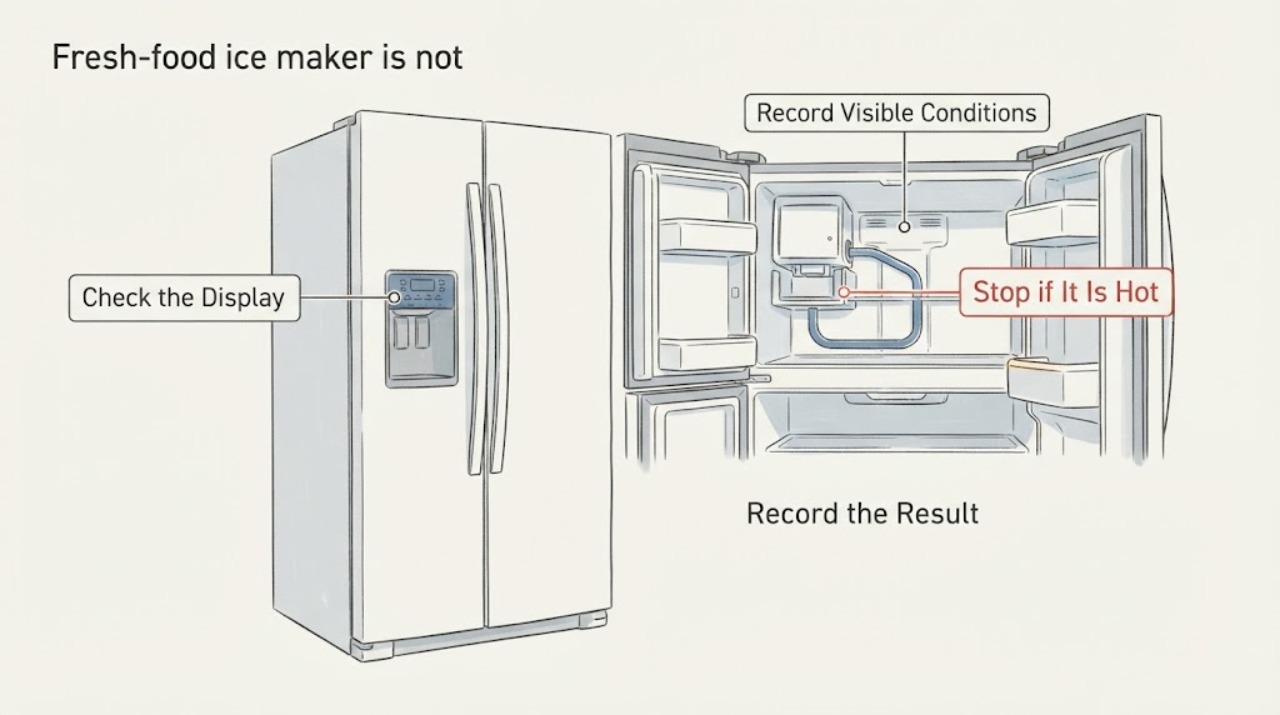
Kenmore 253.70313211 is documented by an exact-model owner report as having an ice maker in the fresh-food compartment, so do not apply a freezer ice maker’s wire-arm procedure or another Kenmore model’s test sequence. First confirm the full model and location, then use the control-panel instruction in the exact Kenmore manual for the ice-maker enable state. Check only visible water-supply conditions, dispenser flow, filter seating/age, bin position, and whether the refrigerator is cold and has had enough time after a connection or power interruption. A second exact-model report describes a top ice maker and a frozen water-line symptom, so the fill path belongs in the decision tree without proving a failed part. If water flow is normal, the maker is enabled, the refrigerator is cold, and the mold remains dry or cubes are not harvested, stop before forced tests, contact bridging, tube removal, or part purchase and arrange exact-model appliance service.
Work through in order
Diagnostic checks
Use only checks that match the exact appliance or system and its official guide.
-
Check 1
Read the model and serial label inside the refrigerator compartment and confirm the number is Kenmore 253.70313211 or the same complete model shown on the service record. Confirm that the ice maker is physically in the fresh-food compartment and identify the control-panel Ice Off icon; do not start with a freezer wire-arm or another model’s test-key sequence.
Expected result: The label matches 253.70313211 and the maker is in the fresh-food section; the label has an additional suffix or different model; or the appliance actually has a freezer maker rather than the described fresh-food maker.
Next step: Use the complete model manual for every later setting or filter instruction. If the label does not match, stop this model-specific path and use the correct manual instead.
Stop if: Do not bridge contacts, hold unknown keys, remove the ice-maker cover, or order a part from the 253 prefix alone.
Why this matters
Why: The exact model and maker location determine the applicable control, sensor, bin, and manual. The exact-model reports place this maker in the fresh-food/top area, so a freezer procedure can give a false result or cause damage.
-
Check 2
From the dry floor and normal user-accessible control panel, check the fresh-food ice maker’s enable indicator exactly as the complete Kenmore manual describes. Do not guess at a key-hold duration from another 253 model. Confirm the fresh-food bin is seated and not packed full.
Expected result: Ice Off is illuminated; the icon changes state and the indicator goes out; the control will not change; the bin is full or mis-seated; or the control is on and the bin is correctly seated.
Next step: Correct only the documented control/bin condition and wait for the model’s normal production period. If the indicator will not change, the bin will not seat, or the signal bale is damaged, arrange service.
Stop if: Do not force the bale, reach into the mechanism, or apply a freezer-arm test to the fresh-food maker.
Why this matters
Why: An off control or full-bin signal can stop production without a failed component. The exact model’s control and bin/sensor arrangement must be followed; an unknown bale or sensor must not be forced.
-
Check 3
Check the refrigerator’s visible water supply condition without disconnecting anything: household water valve open, line not visibly kinked behind the cabinet, and water dispenser flow comparable with its usual flow if the unit has a dispenser. Record whether the dispenser is weak/dry or normal.
Expected result: The dispenser is weak or dry; dispenser flow is normal while the fresh-food ice maker stays dry; the model has no dispenser; or a leak, bulging line, or water near electrical equipment is visible.
Next step: Record the comparison and follow only the exact manual for filter status or priming. Leave water functions off and arrange service for a leak, inaccessible connection, or pressure/line test.
Stop if: Do not disconnect a pressurized line, move the refrigerator across a wet floor, operate an unknown shutoff, or work near water and power together.
Why this matters
Why: Weak flow at the dispenser and ice maker keeps household supply, filter, line, and inlet-valve paths in focus. Normal dispenser flow narrows the issue toward the fresh-food maker’s fill outlet, fill path, control, or harvest stage but does not prove a valve or assembly.
-
Check 4
Check the water filter status and history against the complete model manual. If the filter was recently changed, verify only its visible seating and that the manual’s installation steps were followed; if dispenser flow has slowed or the filter is overdue under that manual, record the condition before using the model-approved replacement procedure.
Expected result: The filter is not seated, was recently changed when flow declined, is overdue under the exact manual, flow is slow, or the filter is correctly seated with normal water flow.
Next step: Use only the exact model’s filter replacement/reset procedure and observe for leaks. If the filter housing leaks, the filter will not lock, or water remains restricted after the documented step, stop and arrange service.
Stop if: Do not substitute a filter from another 253 model, force the cartridge, remove tubing, or use heat or tools to clear a fill path.
Why this matters
Why: A restricted or incorrectly installed filter can reduce water delivered to the ice maker, but this is only a water-delivery clue, not proof that the filter, valve, or ice maker is defective.
-
Check 5
Confirm the refrigerator has cooled normally and note the time since installation, water connection, or a power interruption. If it is newly installed or the water system was just connected, follow the complete model manual’s startup and priming interval rather than borrowing a 253-family number.
Expected result: The unit has been installed or reconnected recently; the refrigerator is not at normal temperature; initial cycles were empty; or the unit is cold and the exact manual’s interval has passed.
Next step: Keep the water connection and controls in the documented state, then reassess after the full period. Protect food and arrange refrigerator service if cooling itself is abnormal.
Stop if: Do not lower temperatures beyond the manual, repeatedly power-cycle the unit, or open panels to accelerate ice production.
Why this matters
Why: Cooling and water-line priming can delay initial ice production, but the applicable interval is model-specific. A cold refrigerator past the documented period with correct controls requires the water/mold branch rather than more waiting.
-
Check 6
Without removing the fresh-food ice-maker assembly or initiating a forced test, observe the accessible mold/bin result after the exact manual’s safe waiting period. Record whether the mold stays dry, receives water but does not freeze, freezes cubes that remain, or produces ice that is not moving into the bin.
Expected result: The mold is dry; water is present but does not freeze; frozen cubes remain in the mold; ice is not moving into the bin; or there is no normal motor/valve activity and the refrigerator is cold.
Next step: Document the pattern and request exact-model service for the appropriate water-delivery, control, or harvest diagnosis. Do not name or buy a part solely from the observation.
Stop if: Stop for a jammed mechanism, unusual heat or smell, exposed wiring, water leak, or any need to bridge contacts, probe voltage, remove a tube, or remove the ice maker.
Why this matters
Why: A dry mold points toward supply, filter, fill path, valve, or control. Water that does not freeze points toward a temperature/cooling problem. Frozen cubes that remain point toward harvest mechanics. An apparently empty bin is not proof of no production until the exact model’s bin arrangement is confirmed.
Use your observations
Decision map
Find the observation that best matches what you see, then follow the next safe action.
-
PATH 01Next step
What you see
The Ice Off indicator is illuminated or the fresh-food bin is full/mis-seated, while the refrigerator otherwise cools normally and there is no hazard.
Do this next
Turn the fresh-food maker on only with the exact panel instruction, seat the bin, and allow normal production time. Arrange service if the indicator, bin, or bale will not operate normally.
Why this path and its safety boundary
Why it matters: A documented control or full-bin signal can stop the fresh-food ice maker without proving an ice-maker failure. This model’s exact control and sensor arrangement must be used, not a freezer maker’s wire-arm procedure.
-
PATH 02Next step
What you see
The unit is newly installed or the water system was just connected, the refrigerator is cooling, and less than about 24 hours have passed or initial cycles were empty.
Do this next
Wait through the documented period without forced tests, then recheck the bin/mold and water flow. Escalate if no ice appears after the period with correct controls and supply.
Why this path and its safety boundary
Why it matters: Air in new water lines and the normal cooling/priming period can delay the first fresh-food ice. Use the exact model’s documented interval instead of a generic 253-family estimate.
-
PATH 03Next step
What you see
The fresh-food maker is enabled, the refrigerator is cold, the dispenser is weak/dry or the filter is old/not seated, and the mold remains dry.
Do this next
Perform only the model-approved visible filter/seating check and arrange appliance or plumbing service for restricted flow, leaks, or line/valve testing.
Why this path and its safety boundary
Why it matters: A water-delivery restriction is more likely than a harvest fault; filter, water line, valve/supply, and priming remain in this pattern. The exact failed part is not established.
-
PATH 04Next step
What you see
The fresh-food maker is enabled, the refrigerator is cold, water flow is normal, the filter is correctly seated, and the mold contains frozen cubes that remain or the maker stays silent.
Do this next
Keep hands and tools out of the mechanism and request exact-model appliance service. Do not initiate a forced cycle, bridge contacts, remove the assembly, or order a replacement part from the symptom.
Why this path and its safety boundary
Why it matters: The symptom shifts toward the fresh-food maker’s harvest/control mechanism rather than household supply, but a motor, sensor, heater, or assembly cannot be selected from observation alone.
-
PATH 05Next step
What you see
A leak, water near electrical equipment, exposed wiring, unusual heat/smell, repeated breaker trip, food warming, or a damaged filter housing appears at any point.
Do this next
Stop using the ice maker, isolate power only if safe, protect food if cooling is affected, and obtain qualified appliance, plumbing, or electrical help as appropriate.
Why this path and its safety boundary
Why it matters: This is a stop-use safety condition, not an ordinary ice-production adjustment.
Helpful context
Understand the symptom
This is a fresh-food ice maker, not the freezer-arm setup
The exact-model community reports place this maker in the fresh-food compartment/top area, while the official Kenmore portal requires the complete model number before retrieving instructions. The freezer section’s wire-arm procedure is not a universal test or reset for this appliance. Confirm the full Kenmore model and physical location before using any instruction, because a 253 prefix alone does not guarantee the same control panel or ice-maker arrangement.
A dry mold and an unharvested mold mean different things
After the exact manual’s enable state is confirmed and the refrigerator has reached normal temperature, record what the mold or bin does without opening the assembly. A dry mold keeps water delivery, filter, supply, valve, fill path, and control in the decision set. Water that freezes but is not released shifts attention toward the ice-maker harvest mechanism. Record time since installation, water connection, or power restoration instead of assuming another model’s startup interval. These patterns narrow service diagnosis but do not identify a replacement part by themselves.
When checks do not resolve it
Need a professional?
Have this ready
- Full model 253.70313211 and serial number, refrigerator style and exact ice-maker location, Ice Off indicator state, bin and plastic bale position, time since installation or water reconnection, dispenser-flow comparison, filter age/seating/history, refrigerator temperature symptoms, mold pattern, leaks, noises, and any photos. Do not request a specific valve, filter, heater, motor, or complete assembly solely from no-ice symptoms.
Common questions
FAQ
Can I lower the freezer wire arm to turn on the Kenmore 253.70313211 ice maker?
Do not assume that a freezer wire-arm procedure applies to this fresh-food ice maker. Confirm the full model and location, then use the exact Kenmore manual’s control instruction; the official portal requires the complete model number before retrieving it.
How long should a newly installed fresh-food ice maker take to make ice?
Use the exact Kenmore manual’s cooling, startup, and priming interval. Do not borrow a time estimate from another 253 model; record how long the unit has been connected and whether the refrigerator is actually cold before diagnosing a failed part.
The water dispenser works but the fresh-food ice maker is dry. Is the valve bad?
Not necessarily. Normal dispenser flow narrows the issue toward the fresh-food ice maker’s fill outlet, fill path, control, or harvest stage, but it does not prove a valve or assembly. Record the dry-mold pattern and arrange exact-model service before replacing a part.
Why does the fresh-food ice bin look empty when the maker is running?
Check that the bin is seated and confirm the exact model’s bin arrangement in its manual. An empty-looking area does not by itself prove that the maker is not producing; first distinguish a dry mold from ice that is not being moved or stored.
Should I replace the filter first?
Only after confirming the exact model’s filter type and procedure. A restricted or incorrectly seated filter can reduce water delivery, but a filter change is not a substitute for diagnosis when flow is normal or a leak is present.
Read the exact guide
Official sources
- Refrigerator Ice line freezingReddit r/appliancerepair · Exact-model community report for Kenmore 253.70313211; the post describes a top refrigerator ice maker and a recurring frozen water-line symptom while ice production stopped.
- Kenmore Fresh Food Ice Maker not automatically workingReddit r/appliancerepair · Exact-model community report for Kenmore 253.70313211; the post identifies the ice maker as being in the refrigerator/fresh-food compartment and describes recurring non-production.
- Kenmore Appliance Manuals & GuidesKenmore / Transform SR Brands · Official Kenmore manual portal; it directs owners to enter the full model number, including 253 70313211, and explains that manuals and resources are model-specific.
Community feedback
Share a repair observation
Share a plain-text repair observation. Accepted observations are published automatically; this page may take a moment to update.