
On this page
Start here
Quick answer
About five ice cubes per day is not enough information by itself to identify a failed Bosch ice-maker part. First establish whether this Bosch 500 Series refrigerator is still within its startup period, because Bosch guidance for comparable refrigerator ice makers allows about 24 hours for the first batch and about 72 hours for full production. Then verify the complete E-Nr, ice-maker on state, correctly aligned bin, closed freezer door, visible water supply, filter installation and flushing, and actual freezer temperature. If production remains very low after startup and those checks are normal, stop experimenting and request Bosch service with the complete model and serial information; do not select a valve or ice-maker assembly from the series name alone.
Before you begin
Safety first
- User checks stop at model identification, normal controls, bin alignment, freezer-door closure, visible water-line condition, filter instructions, and temperature observation. Internal ice-maker, valve, fill-path, sensor, control, electrical, and pressurized plumbing work belongs to qualified service.
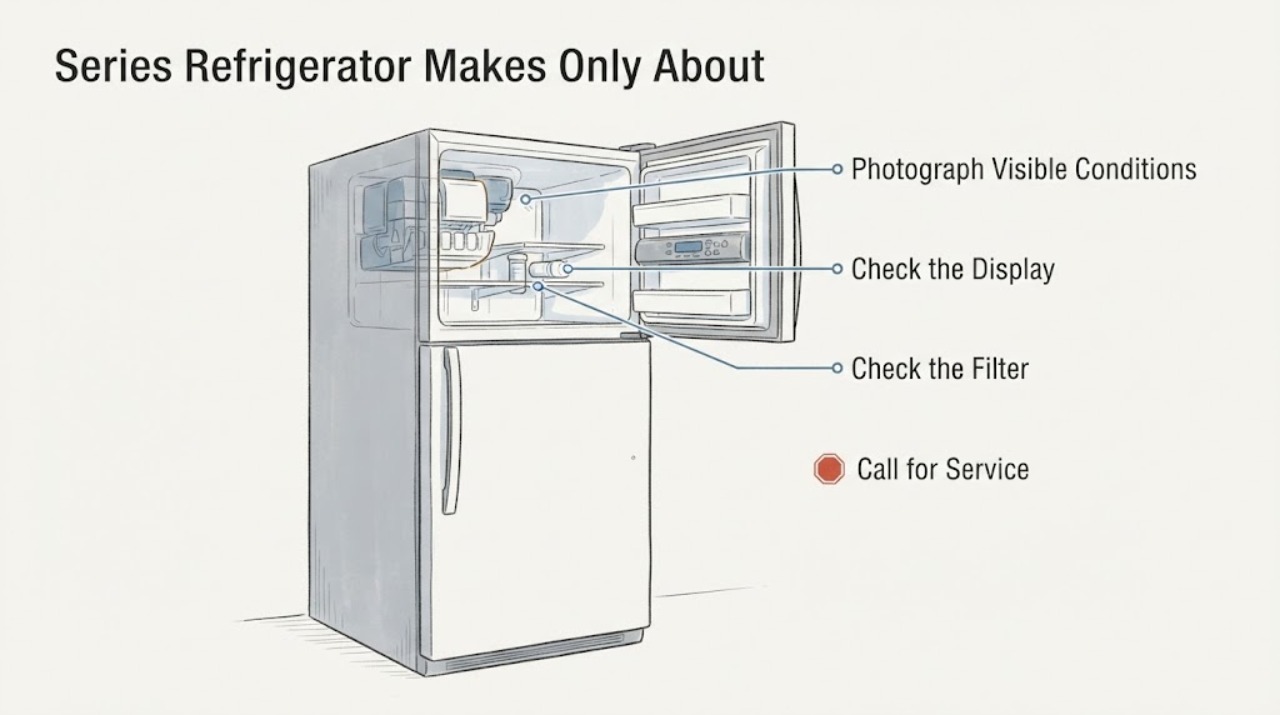
Work through in order
Diagnostic checks
Use only checks that match the exact appliance or system and its official guide.
-
Check 1
Find and photograph the complete Bosch model number or E-Nr and FD information from the appliance rating label, then record whether the refrigerator is a 500 Series French Door or another configuration, when it was installed or reconnected, and how many cubes were made during a defined 24-hour period.
Expected result: Only the family label “500” is available, or a complete E-Nr and installation history are available; the five-cube count is from the first day, after startup, or an unknown interval.
Next step: Use the complete E-Nr for the model's manual and ice-maker controls. Until the measurement window and startup state are known, do not diagnose a valve, sensor, or ice-maker assembly.
Why this matters
Why: “500” is a series label rather than a complete service identity. Bosch routes manuals and support by the complete model, and a first-day count cannot be compared with steady operation without knowing how long the ice maker has been cold and running.
-
Check 2
If the refrigerator was newly installed, reconnected, or recently powered off, leave the ice maker in its normal enabled state and follow the model manual's startup guidance. Do not repeatedly cycle the control or remove the bin just to count early cubes.
Expected result: The first batch has not yet had about 24 hours, the bin has not had about 72 hours to fill, or the refrigerator has already been operating beyond that startup window.
Next step: Complete one documented startup measurement window. If the refrigerator is beyond startup and still produces only about five cubes per day, continue with the water, setting, and temperature checks rather than assuming normal break-in.
Why this matters
Why: Bosch refrigerator guidance says ice production begins after the freezer reaches its set temperature, with about 24 hours for the first batch and about 72 hours for full production in the comparable manual. Five cubes during early recovery is not equivalent to five cubes per day after stable operation.
-
Check 3
From a safe accessible point, confirm that the household water shutoff is open, the visible supply line is not kinked or crushed, and the dispenser has normal flow if the model has one. Check the filter only as the exact model manual permits; after a new filter or connection, flush the system as directed and do not loosen a pressurized fitting.
Expected result: The line is restricted or wet, dispenser flow is weak, the filter was recently changed and not flushed or seated, or water flow is normal and dry.
Next step: Correct only a visible, non-pressurized obstruction and follow the exact manual for filter seating or flushing. Shut off water before any hose work and call a qualified plumber or appliance technician for leaks, pressure questions, or internal water-path work.
Why this matters
Why: A restricted line, low pressure, reverse-osmosis arrangement, air after installation, or an incorrectly installed filter can reduce the water reaching the ice maker. Normal dispenser flow lowers the likelihood of a shared external restriction but does not prove the ice-maker valve or fill path.
-
Check 4
Using only the normal controls and without reaching into the mechanism, verify that the ice maker is on, the ice bin is inserted and aligned, and the freezer door closes completely. Check that the freezer is actually maintaining the temperature specified in the exact manual and that the bin is not being treated as a place to store other items.
Expected result: The ice maker is off, the bin is misaligned, the freezer door remains ajar, the freezer is not at its required condition, or all visible settings and closure are normal.
Next step: Restore only the documented on state, bin position, or door closure. Do not force a shutoff arm or use an unverified test mode; if the visible conditions are normal and output remains low, proceed to the service branch.
Why this matters
Why: Bosch says an incorrectly inserted or aligned bin can prevent ice production, and its troubleshooting guidance also lists the ice-maker on state, a closed freezer door, and the freezer reaching temperature as relevant checks. A normal visible setting does not prove the internal mechanism is working.
-
Check 5
After the startup window and safe external checks, record one complete production interval, water and dispenser result, freezer temperature reading, ice-maker setting, and any ejector jam or leak visible without tools. Do not remove panels or repeatedly restart the refrigerator to force ice production.
Expected result: Production recovers after the documented setup corrections, or it stays near five cubes per day despite stable cooling, water flow, bin alignment, and an enabled ice maker.
Next step: If output remains low, arrange Bosch service and provide the complete E-Nr/FD, measurement interval, installation date, water/filter history, temperature reading, and photos. Do not buy or install a valve or ice-maker assembly based only on the series label or cube count.
Why this matters
Why: Recovery after a startup, water, filter, setting, or door issue points to that condition rather than a proven component failure. Persistent low production after those conditions are normal narrows the problem to an internal ice-maker, fill, sensing, or control diagnosis that requires the complete model identity.
Use your observations
Decision map
Find the observation that best matches what you see, then follow the next safe action.
-
PATH 01Next step
What you see
The refrigerator is within the first 24 hours after installation or has not had about 72 hours to reach full ice production.
Do this next
Follow the exact model's startup instructions through one complete measurement window. Do not call a part defective before the startup condition is resolved unless there is a leak, unsafe temperature, or another hazard.
Why this path and its safety boundary
Why it matters: The five-cube observation may be an early startup result rather than a steady production rate.
-
PATH 02Next step
What you see
The bin is misaligned, the ice maker is off, the freezer door is not fully closed, or the freezer has not reached its required condition.
Do this next
Correct the visible documented condition and repeat only the normal production observation. Stop if the door, bin, or shutoff mechanism binds or is damaged.
Why this path and its safety boundary
Why it matters: A configuration or temperature condition is more likely than a confirmed ice-maker component fault.
-
PATH 03Next step
What you see
The dispenser is weak or absent, the filter was just installed without flushing, the line is kinked, or water is wet at an accessible connection.
Do this next
Use only the manual-approved front-access filter and flushing steps. Shut off water for hose work and use qualified service for a leak, pressure problem, or internal connection.
Why this path and its safety boundary
Why it matters: A shared water-supply, pressure, air, or filter condition is more likely than an isolated ice-maker failure.
-
PATH 04Next step
What you see
The refrigerator is beyond startup, the freezer and water supply are stable, the ice maker and bin are correctly set, and production remains around five cubes per day.
Do this next
Request Bosch service with the complete E-Nr/FD and production log. Do not select a replacement part or open the ice-maker and electrical areas to test it.
Why this path and its safety boundary
Why it matters: The evidence supports a model-specific service diagnosis, but it does not distinguish the valve, fill path, sensor, motor, or control from external observations.
-
PATH 05Next step
What you see
The complete model is unknown or the appliance's configuration does not match the 500 Series documentation being consulted.
Do this next
Stop model-specific adjustments and retrieve the full E-Nr and FD from the rating label or Bosch support. Use the exact manual before changing settings, removing a filter, or considering any part.
Why this path and its safety boundary
Why it matters: Control layout, filter arrangement, ice-maker design, and production specification remain unresolved; series-level assumptions could send the repair down the wrong path.
Helpful context
Understand the symptom
What the 500 Series identity does and does not tell you
Bosch uses 500 Series for more than one refrigerator configuration. The official Bosch product page opened for this research shows a 500 Series French Door Bottom Mount refrigerator with QuickIce Pro, while its support page identifies a complete individual E-Nr and provides the matching manuals. The task supplies only “500,” not a complete E-Nr, so use the series-level checks below and do not assume every 500 model has the same ice-maker control, filter, or production specification.
Safety boundary
Keep this troubleshooting external and low risk. Do not remove the rear cover, reach into a moving or jammed ice maker, bypass a shutoff arm, disconnect a pressurized water line, perform live electrical tests, or order a part from the cube count. Stop for a leak, water near electrical parts, damaged wiring, smoke, burning odor, or food that is no longer being kept safely cold.
When checks do not resolve it
Need a professional?
Arrange Bosch service when production remains very low after the documented startup period and external checks, when the ice maker jams or overfills, or when there is a leak, water near electrical parts, unsafe cooling, smoke, burning odor, damaged wiring, or a repeat breaker trip.
Safety scope: User checks stop at model identification, normal controls, bin alignment, freezer-door closure, visible water-line condition, filter instructions, and temperature observation. Internal ice-maker, valve, fill-path, sensor, control, electrical, and pressurized plumbing work belongs to qualified service.
Have this ready
- Provide the complete Bosch E-Nr and FD, 500 Series configuration, installation or reconnection date, production interval, freezer temperature, ice-maker setting, water and filter history, dispenser result, and visible leak or jam observations.
Common questions
FAQ
Is five ice cubes in the first day proof that a Bosch 500 Series ice maker is defective?
No. Bosch guidance allows about 24 hours for a first batch and about 72 hours for full production in the comparable manual. Measure after startup and verify water, filter, bin, freezer-door, and on-state conditions first.
Does the Bosch 500 Series label identify the correct ice-maker part?
No. Bosch support pages route manuals and parts by the complete E-Nr. “500” is a family label, so do not order a valve or ice-maker assembly without the exact model and a confirmed diagnosis.
Can I remove the water filter or disconnect the line as a quick test?
Only follow the exact model's filter instructions. Air and pressure can eject water or the filter, and hose work should begin with the water supply safely shut off; use qualified service for leaks, pressure questions, or internal connections.
Read the exact guide
Official sources
- Refrigerator FAQs | Top Tips | BoschBosch Home Appliances · Bosch refrigerator owner tips for ice-bin alignment, filter handling, and post-loading temperature recovery
- B36CD50SNS French Door Bottom Mount Refrigerator | BOSCH USBosch Home Appliances · Bosch 500 Series refrigerator family identity and published QuickIce Pro feature; B36CD50SNS is a family example, not asserted as the user's complete model
- W10577851A.fmBosch Home Appliances · Bosch refrigerator operating instructions for a comparable automatic ice-maker design; used for startup, water, filter, temperature, and safety checks, not asserted as an exact 500 Series manual
- Appliance Information - French Door Bottom Mount Refrigerator | B36CD50SNB/01Bosch Home Appliances · Bosch 500 Series support workflow showing complete model identity, manuals, owner support, and service routing
Community feedback
Share a repair observation
Share a plain-text repair observation. Accepted observations are published automatically; this page may take a moment to update.