
On this page
Start here
Quick answer
First separate a completely dead refrigerator from a refrigerator that has lights or a display but is not cooling, and from a single warm compartment or failed feature. For no power, check the plug, outlet, wall switch or isolator, and house fuse from outside the appliance; some Fisher & Paykel models may also be turned off or in Sabbath Mode. If the display and lights work but food is warming, protect perishables in another appliance or cooler and check only the temperature setting, door seal, blocked air outlets, recent loading, and whether the cabinet is level. A motor that runs for a long time can follow hot weather, frequent door openings, a large new load, a low setting, or a poor door seal, but repeated warm storage is not a reason to open the sealed system. Fisher & Paykel LED lighting and refrigeration repairs require trained service, and suspected refrigerant-circuit damage is an immediate stop-use condition. Do not dismantle the compressor, fans, wiring, controls, or refrigerant circuit.
Before you begin
Safety first
- This article covers external power checks, model-guide operating modes, settings, visible air outlets and seals, food protection, and sound classification. Refrigeration circuit, compressor, fan, defrost, sensor, control, water, door harness, LED, and energized electrical work belongs to Fisher & Paykel or qualified service.
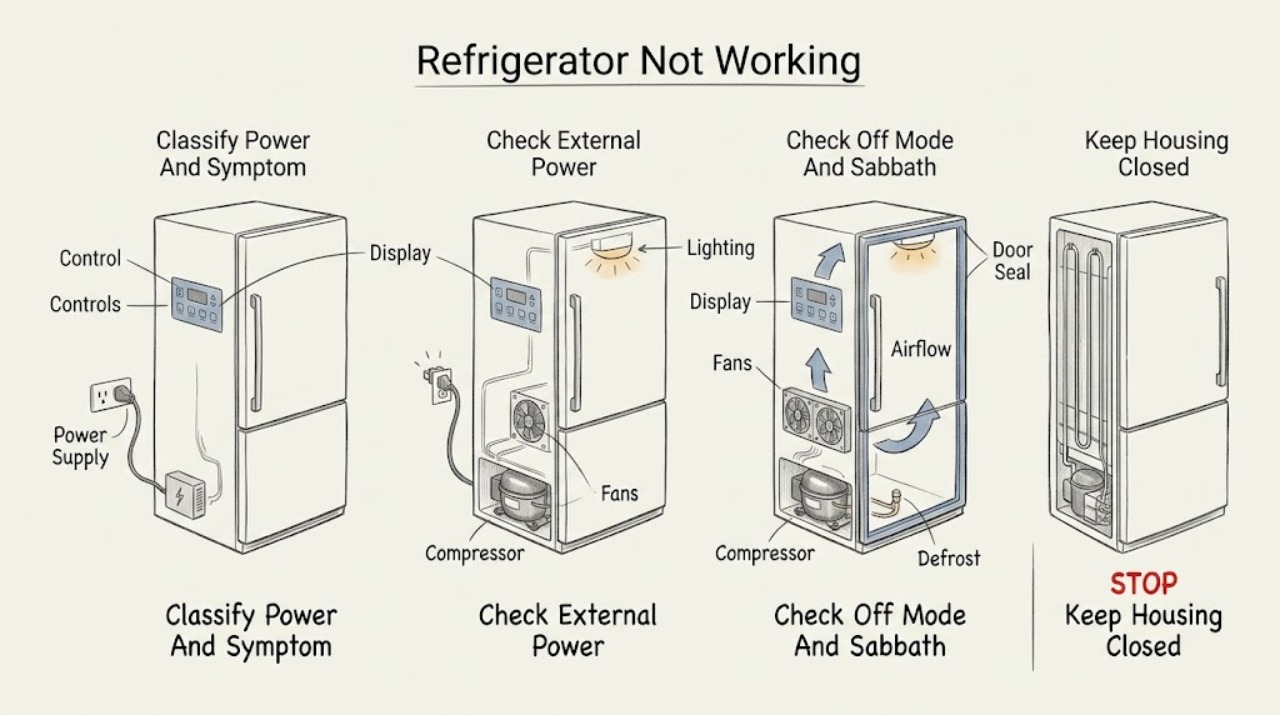
Work through in order
Diagnostic checks
Use only checks that match the exact appliance or system and its official guide.
-
Check 1
Without opening panels, check whether the interior light, display, external controls, door alarm, fan sound, or compressor sound is present. Classify the report as (a) no light/display and no operation, (b) light/display present but both compartments warm, (c) one compartment or variable-temperature zone warm, or (d) a single feature such as light, ice maker, water dispenser, or alarm not working.
Expected result: The refrigerator is completely dark, powered but warm, warm in only one zone, or has one feature failure while cooling continues elsewhere.
Next step: Continue only with the matching checks below and record the exact model code; do not move directly to a compressor, fan, board, or dispenser part.
Stop if: If food is warming, protect perishables before spending time on diagnosis.
Why this matters
Why: These patterns point to different branches: supply/control state, cooling/airflow/door sealing, zone or mode settings, or a feature-specific component. They should not be treated as one generic no-power fault.
-
Check 2
For a dark or unresponsive refrigerator, verify the plug is fully inserted, the wall switch or isolator is on, and the outlet can power another safe appliance. Check the house fuse or breaker visually and reset it only once if there is no smell, heat, water, or visible damage at the refrigerator. Do not remove the rear cover or test live wiring.
Expected result: The outlet or switch was off and the refrigerator returns; the outlet works but the refrigerator remains dark; the breaker trips again; or the cord, plug, or outlet is hot, wet, cracked, or scorched.
Next step: If power returns, observe whether cooling resumes. If it remains dead or trips again, leave it disconnected and arrange qualified service.
Stop if: Do not keep resetting a breaker, use an extension cord, or touch wet or damaged electrical parts.
Why this matters
Why: An external supply issue can explain a completely dead unit. A sound outlet with no response, or any repeated trip or damaged power hardware, shifts the issue to internal power, control, or wiring service.
-
Check 3
If power is present but the display, lighting, or cooling appears disabled, check the exact User Guide for an off state, Sabbath Mode, showroom/demo state, or control lock. Use only the model-specific button sequence shown in that guide; do not guess a reset combination from another Fisher & Paykel refrigerator.
Expected result: The guide confirms the refrigerator was turned off or in Sabbath Mode and the documented sequence restores operation; the display remains blank; or the display returns but the compartments remain warm.
Next step: Allow the appliance time to resume its normal cycle after a documented mode change. If the unit stays dark or warm, protect food and arrange service.
Stop if: Do not open the control console or bypass a mode, lock, or safety circuit.
Why this matters
Why: A deliberate operating mode can suppress lighting, display, or cooling indicators without a failed compressor. A returning display with no cooling is a separate refrigeration branch, while a blank display with sound supply suggests control or electrical service.
-
Check 4
For a lit display with one warm compartment or zone, confirm the displayed temperature setting and the active food/zone mode in the exact guide. Check that air outlets are not covered by food, and that the compartment has not been switched to a different variable-temperature mode. Do not set extreme values as a test or block vents with containers.
Expected result: The setting or mode was incorrect, an air outlet was blocked, one drawer/zone is warm while another cools, or settings and outlets are correct but the zone remains warm.
Next step: Restore the documented mode and clear the outlet, then allow the refrigerator to stabilize with the doors closed. Escalate if the affected zone does not recover or food is at risk.
Stop if: Do not remove interior panels, probe air ducts, or attempt to access an evaporator or sensor.
Why this matters
Why: A setting, mode, or blocked outlet can affect one zone without proving a whole-appliance failure. A persistent single-zone failure with correct settings can involve a fan, sensor, damper, evaporator, or control path that requires the model guide and service.
-
Check 5
Inspect the door and drawer gasket from the outside for dirt, folds, gaps, or a package preventing closure. Confirm the cabinet is reasonably level and that shelves or bins are not forcing a door open. Note recent heavy loading, frequent openings, hot weather, or a recent installation; keep doors closed during the recovery check.
Expected result: A gasket is dirty or not sealing, the door is obstructed or misaligned, the cabinet is not level, or the seal and loading are normal.
Next step: Clean and seat the gasket, remove the obstruction, and allow temperatures to stabilize. Do not adjust hinges or remove a heavy door without the exact installation guide and assistance.
Stop if: Do not force a door, use heat to reshape a gasket, or continue if the door cannot seal or a hinge/water-line harness is damaged.
Why this matters
Why: Fisher & Paykel lists poor door sealing, frequent openings, hot weather, and a large new load as reasons for long motor operation or warm storage. A clean, tight seal and normal load shift the concern toward airflow, defrost, or refrigeration service.
-
Check 6
Listen from outside for a normal fan airflow sound, compressor hum, water or refrigerant gurgle, or defrost cracking/popping, and note whether the motor is running for long periods. Do not use sound alone as proof of cooling; check whether each affected compartment is actually recovering and whether there is a fault display.
Expected result: Normal airflow/hum or defrost sounds occur while temperatures recover; the motor runs for long periods and storage remains warm; there is no sound at all with power present; or an unfamiliar loud sound, repeated clicking, or fault indicator appears.
Next step: Keep doors closed and protect food. If temperatures do not recover or a fault repeats, stop user testing and arrange service rather than opening the machinery compartment.
Stop if: Do not touch a compressor, fan, refrigerant line, or electrical component while energized or hot.
Why this matters
Why: Fisher & Paykel describes several sounds and longer runtimes as normal or context-dependent, but a warm compartment, no response, or repeated abnormal sound makes a cooling, control, fan, compressor-start, or sealed-system fault more likely.
-
Check 7
If cooling is normal but one feature fails, identify whether it is the LED light, display/door alarm, ice maker, water dispenser, or another zone control. Check only the model-approved setting, child/key lock, filter indicator, water supply, or visible obstruction; do not open a door harness or light module.
Expected result: Only one feature is affected while cooling is normal; multiple functions in one door or zone fail together; or the feature failure accompanies warming, leaks, or electrical symptoms.
Next step: Apply the exact feature guide once. Fisher & Paykel specifies that LED lighting cannot be serviced by the user on the cited models; arrange service for persistent feature failure or any door wiring, water, or control access.
Stop if: Do not remove an LED module, pierce a water line, bypass a door switch, or perform live electrical tests.
Why this matters
Why: A single-feature failure may be limited to a lamp, dispenser, water path, sensor, or control. Multiple functions in one door/zone or a concurrent cooling failure make a shared harness/control or refrigeration issue more likely.
-
Check 8
After the external checks, perform no prolonged test if food is warming. Record the model, which zones and features work, display or alarm behavior, settings, door-seal observations, sounds, and the time the temperature problem began. Keep the appliance in a safe state while arranging Fisher & Paykel or qualified service.
Expected result: The refrigerator recovers after an external correction; one zone or feature remains failed; both compartments remain warm; or there is a refrigerant, electrical, water, smoke, or heat hazard.
Next step: Move perishables to another appliance/cooler and arrange trained service, providing the recorded symptom pattern. Do not order a compressor, board, fan, or sensor without exact-model diagnosis.
Stop if: Do not operate a refrigerator with suspected refrigerant-circuit damage, burning smell, sparking, damaged cord, or water near electrical parts.
Why this matters
Why: Recovery after a mode, outlet, setting, seal, or airflow correction supports an external cause. Persistent warming or a hazard can involve fans, sensors, controls, compressor-start components, defrost, wiring, or the sealed refrigerant circuit.
Use your observations
Decision map
Find the observation that best matches what you see, then follow the next safe action.
-
PATH 01Safety boundary
What you see
The interior light and display are dark, no fan or compressor response is heard, and the external outlet/switch appears powered.
Do this next
Use only the exact model guide to check the off or Sabbath state once. If it remains dark with sound supply, leave it disconnected and arrange service.
Why this path and its safety boundary
Why it matters: A refrigerator-off setting, Sabbath mode on applicable models, internal power/control fault, or wiring issue is more likely than a cooling-only problem.
Safety stop: Do not remove covers or repeatedly reset a breaker.
-
PATH 02Safety boundary
What you see
Lights or display work, but the refrigerator and freezer or all active compartments are warming; the setting, door seal, and visible air outlets are correct.
Do this next
Protect food and arrange Fisher & Paykel or qualified service. Provide the temperature symptom, motor sound, display behavior, and external checks; do not open the sealed system.
Why this path and its safety boundary
Why it matters: A cooling-system, compressor-start, fan, defrost, sensor, control, or sealed-system fault is more likely than a simple setting issue.
Safety stop: Do not keep the appliance running indefinitely with melting food or suspected refrigerant damage.
-
PATH 03Safety boundary
What you see
One drawer, compartment, or variable-temperature zone is warm while another remains cold, or food is directly blocking a documented air outlet.
Do this next
Restore the documented zone mode, clear the outlet, check the seal, and allow stabilization. If one zone stays warm, arrange model-specific service.
Why this path and its safety boundary
Why it matters: A mode/setting, blocked outlet, door seal, local fan/damper, sensor, or zone control is more likely than complete loss of power.
Safety stop: Do not remove interior panels or probe hidden ducts, fans, evaporators, or sensors.
-
PATH 04Safety boundary
What you see
The motor runs for long periods after hot weather, frequent door openings, a large new load, or a recent setting change, but compartments are gradually recovering and the door seals.
Do this next
Minimize openings, keep vents clear, maintain the documented setting, and monitor recovery. Escalate if storage remains warm, the runtime is unchanged after stabilization, or an unfamiliar sound/fault appears.
Why this path and its safety boundary
Why it matters: A normal load or ambient recovery is more likely than an immediate motor failure.
Safety stop: Do not infer that long runtime is safe when food is warming or a seal is leaking.
-
PATH 05Safety boundary
What you see
Cooling is normal but the LED light, display/alarm, ice maker, water dispenser, or another individual feature fails.
Do this next
Use the exact model guide for settings and visible checks. Arrange service for LED lighting or any internal water, wiring, control, or dispenser access.
Why this path and its safety boundary
Why it matters: A feature-specific lamp, water path, sensor, door harness, actuator, or control issue is more likely than a whole-refrigerator power fault.
Safety stop: Do not replace an LED module or work on a door harness or water circuit yourself.
Helpful context
Understand the symptom
“Not working” does not always mean no power
A dark refrigerator with no interior light is a supply or control-state branch. A lit display with warm food means the cabinet has power but cooling, airflow, settings, door sealing, defrost, or a sealed system must be considered. A single warm drawer or failed dispenser can be limited to one zone or feature. Fisher & Paykel sells freestanding, integrated, French-door, and multi-zone products, so identify what still operates before selecting a fix.
Protect food before testing
If ice cream is melting or perishable food is warming, move it to another working refrigerator, freezer, or suitable cooler before troubleshooting. Keep the doors closed while arranging the transfer. A brief external check is reasonable, but a refrigerator that remains warm should not be left running indefinitely while waiting for a cooling fault to resolve.
Single-zone and single-feature faults need the model guide
A model may have separate evaporators, variable-temperature zones, ice and water hardware, Sabbath mode, a door alarm, or user-serviceable versus service-only lighting. A working freezer does not prove every refrigerator zone is cooling, and a working light does not prove the compressor or fan circuit is healthy. Use the full model code and its official guide before changing settings or ordering parts.
Safety boundary
Stop conditions
- Move perishable food to another working appliance or suitable cooler if the refrigerator is not getting cold, and arrange service promptly.
- Stop using and isolate the refrigerator for smoke, sparking, burning smell, a hot or damaged cord/plug, water near electrical parts, or suspected refrigerant-circuit damage; ventilate and avoid flames or arc-producing equipment if the circuit may be damaged.
- Do not open the compressor, sealed refrigerant circuit, evaporator, fan, control, door harness, water system, or LED module, and do not perform live electrical tests.
- Do not keep resetting a breaker or leave a warming refrigerator running indefinitely while food is at risk.
Only after diagnosis
Potential parts
- door gasket or seal
Consider this only if the exact model's seal is damaged or cannot be cleaned and seated, and service or the official parts documentation confirms the fit.
Door and drawer gasket shapes vary by refrigerator family and hinge configuration; match the complete model code. - water filter or water-system component
Consider this only for a model equipped with a water or ice feature when the exact guide and diagnosis identify a filter or external water component issue.
Not every Fisher & Paykel refrigerator has water/ice hardware; do not infer a filter or valve from a general not-working symptom. - LED light assembly
Consider this only after trained service confirms a failed service-only LED assembly; the cited guides do not authorize user replacement.
Lighting is model-specific and may be integrated with the control or door harness. - fan, sensor, control, compressor-start, or defrost assembly
Consider this only after qualified diagnosis isolates the component following the power, mode, setting, seal, airflow, and food-safety checks.
Do not select a sealed-system, compressor, fan, sensor, board, or defrost part from a broad no-working symptom alone.
When checks do not resolve it
Need a professional?
Arrange Fisher & Paykel or qualified refrigeration service when external power and model-specific modes are correct but the unit remains dark, when both compartments or one zone remain warm, when a feature failure requires LED, water, door-harness, fan, sensor, control, compressor, defrost, or sealed-system access, or when any electrical, water, heat, smoke, or refrigerant hazard is present.
Safety scope: This article covers external power checks, model-guide operating modes, settings, visible air outlets and seals, food protection, and sound classification. Refrigeration circuit, compressor, fan, defrost, sensor, control, water, door harness, LED, and energized electrical work belongs to Fisher & Paykel or qualified service.
Common questions
FAQ
What should I check first if my Fisher & Paykel refrigerator is completely dead?
Check the plug, wall switch or isolator, outlet, and house fuse from outside the appliance. Then use the exact model guide to check whether the refrigerator is turned off or in Sabbath Mode. If the outlet works but the refrigerator remains dark, arrange service rather than opening the electrical compartment.
Why is my Fisher & Paykel refrigerator lit up but not cooling?
A lit display proves only that some power is present. Check the temperature setting, active zone mode, blocked air outlets, door seal, recent heavy loading, and frequent openings. If both compartments remain warm or food is melting, move perishables to another appliance or cooler and contact trained service.
Why is only one Fisher & Paykel refrigerator compartment warm?
A single warm zone can follow a wrong variable-temperature mode, a blocked air outlet, a poor local seal, or a zone-specific fan, sensor, damper, or control issue. Restore the documented mode and clear visible obstructions; persistent one-zone warming needs the exact model guide and service diagnosis.
Is a Fisher & Paykel refrigerator that runs constantly necessarily broken?
Not necessarily. Fisher & Paykel lists hot weather, frequent door openings, a large new load, a low temperature setting, and an imperfect door seal as reasons for long motor operation. If the cabinet remains warm, the seal is sound, or an unfamiliar sound or fault appears, treat it as a service issue.
Can I replace the light or repair the cooling system myself?
Do not assume so. Fisher & Paykel says the LED light cannot be serviced by the user on the cited models, and warns that refrigerant-circuit and electrical repairs require trained service. Confirm the exact model before considering any user-level maintenance.
Read the exact guide
Official sources
- ActiveSmart Refrigerator Freezer User Guide: RF605QFisher & Paykel · Model-specific guide used for food-protection, refrigerant/electrical safety, LED service, normal sounds, and broad all-model troubleshooting examples.
- Integrated Refrigerator Freezer User Guide: RB60V18Fisher & Paykel · Model-specific integrated refrigerator/freezer guide used for power, off state, lights, motor runtime, warm compartments, settings, seals, and air outlets.
- ActiveSmart Refrigerator Installation Guide: RF172GFisher & Paykel · Model-specific French-door guide used to corroborate distinct power, LED, Sabbath Mode, long-runtime, seal, and warm-storage branches.
- 61cm Series 11 Integrated Refrigerator Freezer, Ice & Water: RS6121WLUE1Fisher & Paykel · Specific current integrated Ice & Water column product; used to demonstrate model variation, not to prescribe controls for other refrigerators.
- Fisher & Paykel USA Help & SupportFisher & Paykel · Brand support page for locating model-specific help and service.
Community feedback
Share a repair observation
Share a plain-text repair observation. Accepted observations are published automatically; this page may take a moment to update.