
On this page
Start here
Quick answer
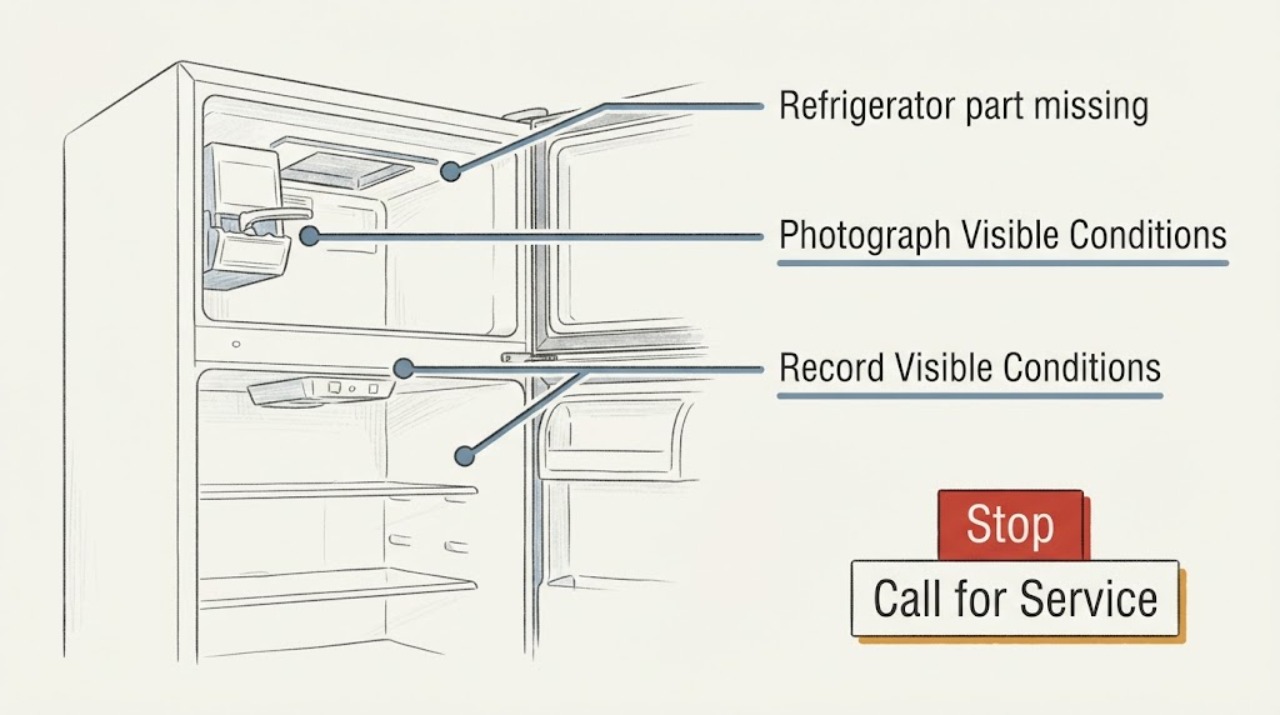
The Fisher & Paykel RF170ADUS ice maker should not be treated as safe to run solely because a loose lever looks unimportant. Fisher & Paykel's RF170A-family guide says automatic ice fills the storage bin until it detects that the bin is full, but it does not identify a fallen external lever as the full-bin detector. The manufacturer's parts site names a component LEVER BIN DETECT, yet the opened listing does not prove fitment for every RF170ADUS suffix. Photograph the exact model label and the fallen piece, confirm the ice bin is correctly seated, and leave the ice maker off while the lever's identity and mounting are confirmed. For an extended absence, follow the guide's vacation procedure: turn the ice maker off and shut off the refrigerator water supply. Do not put fingers into the ejector mechanism, force the lever back, glue it, or order a part by appearance alone.
Work through in order
Diagnostic checks
Use only checks that match the exact appliance or system and its official guide.
-
Check 1
Read and photograph the complete rating-label model code, including every suffix, and photograph the fallen lever in place before moving it. Note whether the storage bin is present, fully seated, and positioned under the ice maker, and save the loose piece rather than discarding it.
Expected result: The label supplies a complete RF170ADUS variant and the piece is a separate intact lever; the model is only a partial RF170ADUS identity; the bin is missing or not seated; or the lever mount appears cracked or broken.
Next step: Keep the piece and model photos for an exact Fisher & Paykel support lookup. If the bin is absent, mis-seated, or the mount is damaged, leave the ice maker off and use the service branch below.
Stop if: Do not order a replacement from a photograph, bend the lever, or remove the ice-maker housing to identify it.
Why this matters
Why: The manufacturer guide covers the RF170A family, but the parts listing does not establish fitment for every suffix. A loose part cannot be identified safely by shape alone, and an absent or mis-seated bin changes the ice maker's expected shutoff behavior.
-
Check 2
With the ice maker switched OFF at the internal control panel, make only a visual check of the bin and the accessible lever area. Do not place fingers near the ejector mechanism, rotate gears, or run a harvest cycle to see what happens.
Expected result: The bin clips or sits fully in its documented position and the lever is merely detached; the lever is broken at its mount; ice or plastic is obstructing the area; or the ice maker was still enabled.
Next step: Leave ice making OFF while the exact manual or Fisher & Paykel service channel confirms the part and re-fit procedure. Remove only loose ice from the accessible bin, not from the mechanism or behind a cover.
Stop if: Do not test with the bin removed, bypass a lever, enter a diagnostic mode, or touch moving ice-maker parts.
Why this matters
Why: The guide says the automatic system detects a full bin and separately warns against contact with moving ejector parts. Visual seating can reveal an obvious obstruction, but it cannot prove which lever provides the full-bin signal or whether a broken mount affects the mechanism.
-
Check 3
If the family will be away, use the model guide's vacation setup: turn the ice maker OFF on the internal control panel and shut off the refrigerator water supply only at an accessible, known-safe shutoff. Record the control state and inspect the floor and cabinet for existing water before leaving.
Expected result: The ice-maker indicator is off and the water supply is safely closed; the control will not turn off; the shutoff cannot be identified; or there is water, ice overflow, or dampness around the appliance.
Next step: Do not leave the appliance making ice with the lever unresolved. Arrange Fisher & Paykel or qualified appliance service, and provide the full model, photos, and whether water or ice escaped.
Stop if: Do not pull the refrigerator out, disturb plumbing, or reach behind the appliance if doing so could damage the cord or water line.
Why this matters
Why: The guide specifically uses ice-maker OFF plus water shutoff for a vacation. A control that will not disable ice production or any leak/overflow means the detached part is no longer just a cosmetic concern and unattended operation adds property-damage risk.
-
Check 4
Give Fisher & Paykel the complete model suffix, market, photos of the lever and its mounting point, and the current bin position. Ask whether the exact model uses the listed bin-detect lever and whether the documented repair is a user-accessible re-fit or a service job.
Expected result: Support confirms the exact part and a documented re-fit; support cannot match the suffix; the mounting point is damaged; or the ice maker has overfilled, continued cycling, or leaked.
Next step: Follow only the exact model's documented re-fit instructions if provided. Otherwise keep ice making OFF and book service; do not substitute a similar lever or attempt internal ice-maker repair.
Stop if: Do not use glue, tape, a bent substitute, live electrical tests, or a forced harvest cycle to keep the ice maker running.
Why this matters
Why: The opened official parts page confirms the component name but not universal RF170ADUS compatibility. Confirmation of fit and procedure must come from the exact model documentation or service channel; abnormal ice or water behavior raises the need for a complete ice-maker inspection.
Use your observations
Decision map
Find the observation that best matches what you see, then follow the next safe action.
-
PATH 01Next step
What you see
The full model suffix is known, the bin is seated, the lever is intact but detached, and there is no broken plastic, overflow, or water.
Do this next
Keep the ice maker OFF and have Fisher & Paykel confirm the exact re-fit procedure for the model and market before restoring ice production.
Why this path and its safety boundary
Why it matters: This is a component-identification and mounting question, not evidence that the part is cosmetic. The official material supports bin-full detection and names a bin-detect lever, but it does not show that this exact detached piece can be reinserted by the owner.
-
PATH 02Next step
What you see
The bin is missing or not seated, the lever mount is cracked, or the ice maker can cycle without a correctly positioned bin.
Do this next
Turn ice making OFF, keep the bin and loose part together, and arrange exact-model service; do not bypass the bin or test a harvest cycle.
Why this path and its safety boundary
Why it matters: The physical conditions needed for reliable bin detection are not established, so unattended ice production could allow ice to spill or the mechanism to be damaged.
-
PATH 03Next step
What you see
Ice is spilling, the bin is overfilled, water is present, or the ice maker continues trying to make ice after the bin is full.
Do this next
Switch the ice maker OFF and shut off the refrigerator water supply from a safe accessible valve, then arrange service. If water is near electrical parts, keep clear and isolate power only if safe.
Why this path and its safety boundary
Why it matters: The problem has progressed from a missing part to a possible shutoff or water-control failure. The guide's full-bin behavior is not being observed, and continued operation can create water or ice damage.
-
PATH 04Next step
What you see
The family will be away for an extended period and the lever identity or mounting is still uncertain.
Do this next
Use that procedure, leave the ice maker off, and obtain exact-model confirmation before turning it back on. After a long absence, follow the guide's return flushing and first-harvest discard instructions.
Why this path and its safety boundary
Why it matters: The manufacturer provides a vacation procedure precisely to avoid unattended ice and water operation: ice maker OFF and refrigerator water supply OFF.
-
PATH 05Next step
What you see
Only the partial identity RF170ADUS is available, or the part page cannot be matched to the full label and market.
Do this next
Do not buy or install by appearance. Supply the complete model suffix and photos to Fisher & Paykel support or a qualified appliance technician while leaving ice making OFF.
Why this path and its safety boundary
Why it matters: The official listing's name is useful for discussion but is not a compatibility confirmation. Similar-looking ice-maker levers can have different mounting or sensing roles.
Helpful context
Understand the symptom
What the fallen lever does and does not prove
The guide establishes the appliance-level behavior—automatic ice pauses when the storage bin is detected as full. The parts listing establishes a manufacturer component name, LEVER BIN DETECT. Neither opened source maps the detached piece to a particular RF170ADUS suffix or shows whether the piece is a removable bin-present interlock, a full-bin shutoff lever, or a broken part of the ice-maker mechanism. That distinction is why the first check is identity and seating, not a temperature or airflow check.
Use the absence period to reduce risk
If nobody will be present to notice an overflowing bin or water problem, keep automatic ice off until the mounting and part identity are resolved. The RF170A-family guide's vacation instructions also call for shutting off the refrigerator water supply; on return, it describes flushing the water tank and discarding the first three ice harvests before normal use.
Only after diagnosis
Potential parts
- ice-maker bin-detect lever
Consider this category only if the exact model lookup confirms that the fallen piece is the manufacturer's bin-detect lever and the mounting point is intact.
The opened Fisher & Paykel listing names LEVER BIN DETECT but does not establish fitment for every RF170ADUS suffix or market; confirm the full model before ordering.
When checks do not resolve it
Need a professional?
Book Fisher & Paykel or qualified appliance service when the bin is missing or cannot seat, the lever mount is damaged, the ice maker overfills or leaks, the control will not disable ice making, or the exact part and re-fit procedure cannot be confirmed from the full model label.
Common questions
FAQ
Does the fallen bin-detect lever detect when the ice bin is full?
The RF170A-family guide confirms that the automatic ice maker detects when the storage bin is full, and Fisher & Paykel lists a component called LEVER BIN DETECT. The opened sources do not prove that the detached piece on every RF170ADUS suffix is the full-bin detector, so do not infer its function from the name or shape.
Can the refrigerator make ice while this lever is missing?
Do not use continued ice production as a safety test. With the lever identity and mounting unconfirmed, leave ice making OFF; the guide warns against contact with the ejector mechanism and provides an OFF-and-water-shutoff procedure for vacations.
What should I do before leaving the house for a long time?
Turn the ice maker OFF on the internal control panel and shut off the refrigerator water supply as described in the RF170A-family guide. On return, restore water, flush the water tank as instructed, turn ice making on, and discard the first three harvests.
Read the exact guide
Official sources
- LEVER BIN DETECT - 836912 | Fisher & Paykel USAFisher & Paykel Appliances Ltd. · The opened manufacturer page names a part LEVER BIN DETECT and exposes manufacturer support/service routes, but does not display model compatibility for every RF170ADUS suffix or market.
- USER GUIDE — ACTIVESMART™ REFRIGERATOR — RF170A & RF201AFisher & Paykel Appliances Ltd. · The PDF names RF170A and covers the US/CA family, automatic ice behavior, ejector safety, bin care, vacation shutdown, and ice-maker troubleshooting. It does not identify the detached lever on every RF170ADUS suffix.
Community feedback
Share a repair observation
Share a plain-text repair observation. Accepted observations are published automatically; this page may take a moment to update.