
On this page
Start here
Quick answer
For a Fisher & Paykel refrigerator making ice slowly, first separate slow freezing from small cubes, no ice, or clumped ice. In the opened US/CA user guides, slow freezing is associated with a freezer door left ajar or a freezer set too warm; small cubes are associated with low water pressure or a restricted filter. Confirm the ice maker is on, the bin is correctly seated, and the water supply is connected. Check the door seal, freezer mode, accessible water line, and filter only as the exact model guide permits. Some models document ICE BOOST or a Soft Freeze mode, but those controls are not universal. If frozen food is soft or melting, a fault is displayed, or ice remains slow after the external checks, protect the food and arrange Fisher & Paykel supported service rather than opening the water or ice-making system.
Before you begin
Safety first
- No internal water-line, valve, sensor, fan, control, ejector-mechanism, cabinet-opening, or live-electrical repair instructions are provided.
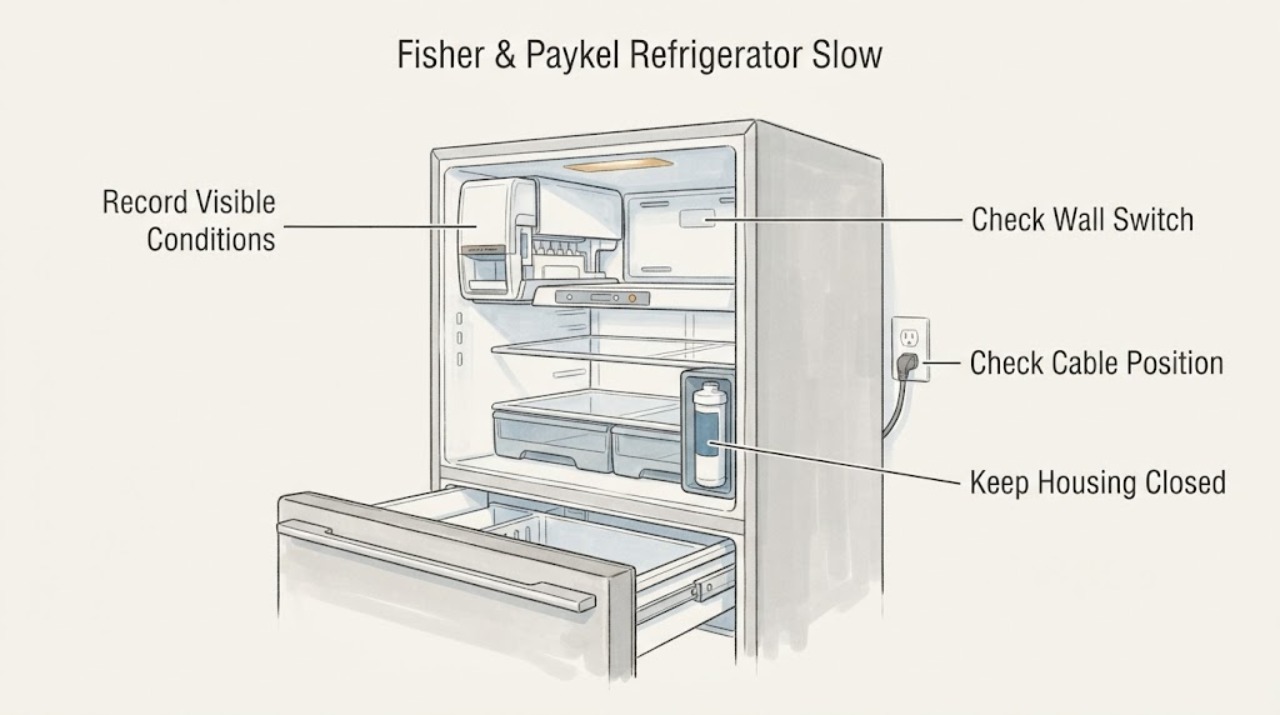
Work through in order
Diagnostic checks
Use only checks that match the exact appliance or system and its official guide.
-
Check 1
Classify the symptom as slow freezing, small cubes, no ice, or wet/clumped ice, and record the full refrigerator model and region before changing controls.
Expected result: The freezer still makes ice slowly, cube size is reduced, no ice is produced, or ice is wet and sticking together.
Next step: Use the matching branch below and the exact model guide; do not apply an ICE BOOST or bin procedure from a different model family.
Stop if: If the symptom cannot be classified, document the cycle time, cube appearance, freezer condition, and model for service instead of repeatedly testing the unit.
Why this matters
Why: Fisher & Paykel's guides use different decision rows for these symptoms; a single generic reset or button sequence would not identify the cause.
-
Check 2
Confirm the automatic ice maker is switched on, the ice bin is present and seated in the model-specified position, and the refrigerator has a connected water supply.
Expected result: The ice maker was off, the bin was missing or mis-seated, or the water supply was off or disconnected; alternatively all three were already correct.
Next step: Correct the accessible setting, bin position, or water supply according to the exact guide and allow the appliance to make ice without opening the mechanism.
Stop if: If these conditions are correct and there is still no production, continue to the temperature and water-flow checks and prepare for service if unresolved.
Why this matters
Why: The opened Fisher & Paykel troubleshooting tables list these as first-line causes of an ice maker that does not work or produces no new ice, but they do not prove an internal component failure.
-
Check 3
Check that the freezer door closes tightly and that the freezer is not set to a warmer mode or temperature; use the exact guide's normal Freezer mode where applicable.
Expected result: The door was left ajar or does not seal, the freezer is set too warm or to Soft Freeze, or the temperature and seal are correct.
Next step: Close or clear the door, correct only the model-supported temperature or mode setting, and allow time for the freezer to stabilize before judging production.
Stop if: If the door seals and the freezer is in the proper mode but ice remains slow, continue with the water pressure and filter branch.
Why this matters
Why: Fisher & Paykel associates slow ice freezing with a door left ajar or a freezer that is too warm; the RS2484 guide says Soft Freeze is not the normal ice-making mode for its named models.
-
Check 4
For small cubes or reduced fill, inspect the accessible incoming water line for a kink or squash and check the filter indicator or model instructions for a restricted filter; do not disconnect pressurized tubing.
Expected result: The line is kinked, the filter is blocked or due for replacement, water pressure is low, or the accessible supply appears normal.
Next step: Restore only the accessible water path or replace the filter using the exact model instructions; if the line remains restricted or the filter does not resolve the symptom, request service.
Stop if: If the external line and filter are normal, do not open the rear panel or diagnose the inlet valve; arrange model-specific service if production remains low.
Why this matters
Why: The opened guides associate small cubes and low production with low pressure, a restricted or kinked line, and a blocked filter; a normal external check does not clear an internal line or valve.
-
Check 5
Use ICE BOOST only when the exact model guide documents it, and clear large clumps or an ice bin left out only as that guide directs; never touch the moving ejector mechanism.
Expected result: The model has ICE BOOST and production improves temporarily, or the ice is clumped/wet and remains unchanged.
Next step: Return the model to its normal documented mode after the boost period and request service if slow production returns or the bin repeatedly clumps.
Stop if: If the model has no documented boost or the symptom persists, do not copy another family's control sequence or enter the ice-maker mechanism.
Why this matters
Why: The RS2484 and RS3684 guides document ICE BOOST for their named models, while the guides treat long door openings, high ambient temperature, a removed bin, and storage time as clumping factors; a temporary boost is not a repair.
-
Check 6
Stop troubleshooting and protect the food when frozen items are soft or melting, a fault code appears, the freezer is not working, water is leaking, or the ice maker remains slow after the external checks.
Expected result: A food-temperature, water, or displayed-fault warning is present, or the problem persists with correct settings, supply, door seal, and filter.
Next step: Move vulnerable frozen food to a suitable working freezer or cooler, record the model and any code, keep hands away from moving ice-maker parts, and arrange Fisher & Paykel supported service.
Why this matters
Why: The opened Fisher & Paykel guides route these conditions to Customer Care or supported service and do not support a user diagnosis of an internal valve, line, sensor, fan, or control.
Use your observations
Decision map
Find the observation that best matches what you see, then follow the next safe action.
-
PATH 01Next step
What you see
The freezer is cold enough, the door closes and seals, and the symptom is slow freezing rather than small cubes or no ice.
Do this next
Correct the door or model-supported temperature/mode setting and allow the freezer to stabilize; request service if the slow production remains.
Why this path and its safety boundary
Why it matters: Fisher & Paykel's opened tables point first to a door left ajar or a freezer set too warm for slow ice freezing.
-
PATH 02Next step
What you see
Cubes are small or the ice maker fills slowly, while the external water line is kinked or the filter is restricted.
Do this next
Correct or replace only the accessible, model-supported water-path item; arrange service if flow remains restricted.
Why this path and its safety boundary
Why it matters: The opened guides associate this result with low water pressure, a kinked line, or a blocked filter rather than a confirmed valve failure.
-
PATH 03Next step
What you see
The ice bin is clumped or wet after long door openings, high ambient temperature, or being left out of the freezer.
Do this next
Follow the exact guide to loosen or discard clumped ice and reseat the bin; request service if clumping returns under normal use.
Why this path and its safety boundary
Why it matters: Fisher & Paykel lists those conditions as clumping factors and does not treat them as proof of an internal ice-maker fault.
-
PATH 04Next step
What you see
The freezer is not working, frozen food is soft or melting, a fault code is displayed, or the ice maker remains slow after the external checks.
Do this next
Protect the food, keep the appliance and moving ice-maker mechanism untouched, record the model/code, and contact Fisher & Paykel supported service.
Why this path and its safety boundary
Why it matters: The issue needs model-specific service and may involve food-safety or water-system risk; the opened guides do not authorize internal repair.
Helpful context
Understand the symptom
Slow ice production is not one diagnosis. A freezer that takes longer to freeze, makes small cubes, stops making ice, or produces clumps follows different checks. The opened Fisher & Paykel US/CA guides repeatedly begin with the ice maker being on, a seated bin, a connected water supply, a working freezer, and the correct freezer temperature before any internal fault is considered.
For slow freezing, Fisher & Paykel's opened tables point to a door left ajar or a freezer set too warm. For small cubes, they point to water pressure and a blocked filter. Long door openings, warm ambient conditions, a bin left out, or ice that has been stored can cause clumping. Controls differ by model: some guides document ICE BOOST and some document Soft Freeze, so use the exact model guide rather than copying another panel's sequence.
Keep the user checks external. Do not reach into the moving ejector mechanism, open the water system, or diagnose a valve, sensor, or control board from slow ice alone. If frozen food is soft or melting, a fault code appears, or the external checks do not restore production, protect the food and contact Fisher & Paykel supported service.
When checks do not resolve it
Need a professional?
Arrange Fisher & Paykel supported service when the freezer is not working, frozen food is soft or melting, a fault code appears, the external water line remains restricted, or slow ice production persists after the exact model's settings, door, bin and filter checks. Provide the full model, region, symptom type, and any displayed fault.
Safety scope: No internal water-line, valve, sensor, fan, control, ejector-mechanism, cabinet-opening, or live-electrical repair instructions are provided.
Common questions
FAQ
Why is my Fisher & Paykel refrigerator making ice slowly?
First decide whether cubes freeze slowly, are small, or are not being produced. The opened guides associate slow freezing with a door left ajar or freezer set too warm, while small cubes or slow filling point to water pressure, a restricted line, or a blocked filter.
Can I turn on ICE BOOST?
Only if the exact model guide documents that feature. The opened RS2484 and RS3684 guides document ICE BOOST for their named model families; do not assume the same menu exists on an unidentified refrigerator.
Could the water filter cause slow ice production?
Yes, within the opened model-family guidance a blocked or restricted filter is associated with small cubes or reduced water flow. Use only the exact model's filter instructions and arrange service if the external water path and filter do not resolve the problem.
What if the freezer food is soft or melting?
Move the food to a suitable working freezer or cooler and contact Fisher & Paykel supported service. The opened guide treats soft or melting frozen food as an urgent service condition rather than a reason to keep testing ice production.
Read the exact guide
Official sources
- RS2484WR/RS2484WL/RS3084WR/RS3084WL Integrated Refrigerator Freezer User GuideFisher & Paykel · Fisher & Paykel RS2484WR, RS2484WL, RS3084WR and RS3084WL refrigerator families in US/CA; ice features and troubleshooting
- RS32A72/RS36A72/RS36A380/RS36W80 Refrigerator Freezer User GuideFisher & Paykel · Fisher & Paykel RS32A72, RS36A72, RS36A380 and RS36W80 refrigerator families in US/CA; ice-maker troubleshooting
- RS3684WRUVE1/RS3684WLUVE1 Integrated Refrigerator Freezer User GuideFisher & Paykel · Fisher & Paykel RS3684WRUVE1 and RS3684WLUVE1 refrigerator families in US/CA; ICE, ICE BOOST and service boundaries
- RF170WDLUX5 N Freestanding Refrigerator Freezer User GuideFisher & Paykel · Fisher & Paykel RF170WDLUX5 N refrigerator family in US/CA; automatic ice maker and slow ice freezing troubleshooting
Community feedback
Share a repair observation
Share a plain-text repair observation. Accepted observations are published automatically; this page may take a moment to update.