
On this page
Start here
Quick answer
Uneven cooling in a Fisher & Paykel refrigerator is often first distinguished by where and when the temperature differs. Protect perishable food if the appliance is not getting cold, then record the warm and cold locations and check the exact model's temperature setting. Fisher & Paykel says its refrigeration relies on temperature, humidity and calibrated airflow, and its refrigerator guides identify blocked air outlets, frequent or long door openings, recently added food, incorrect settings and a door gasket that does not seal as possible contributors to warm or freezing zones. Move food away from air outlets, make sure doors close tightly and allow the cabinet time to stabilize after loading or repeated openings. If the exact model's settings and visible airflow/door checks do not correct the pattern, or a fault alarm/code appears, arrange Fisher & Paykel service rather than opening the sealed system or replacing a fan, sensor or control from temperature variation alone.
Before you begin
Safety first
- Do not open rear covers, enter the refrigerant circuit, bypass sensors, replace a fan/damper/compressor from symptoms alone, or leave perishable food in a warming refrigerator while testing.
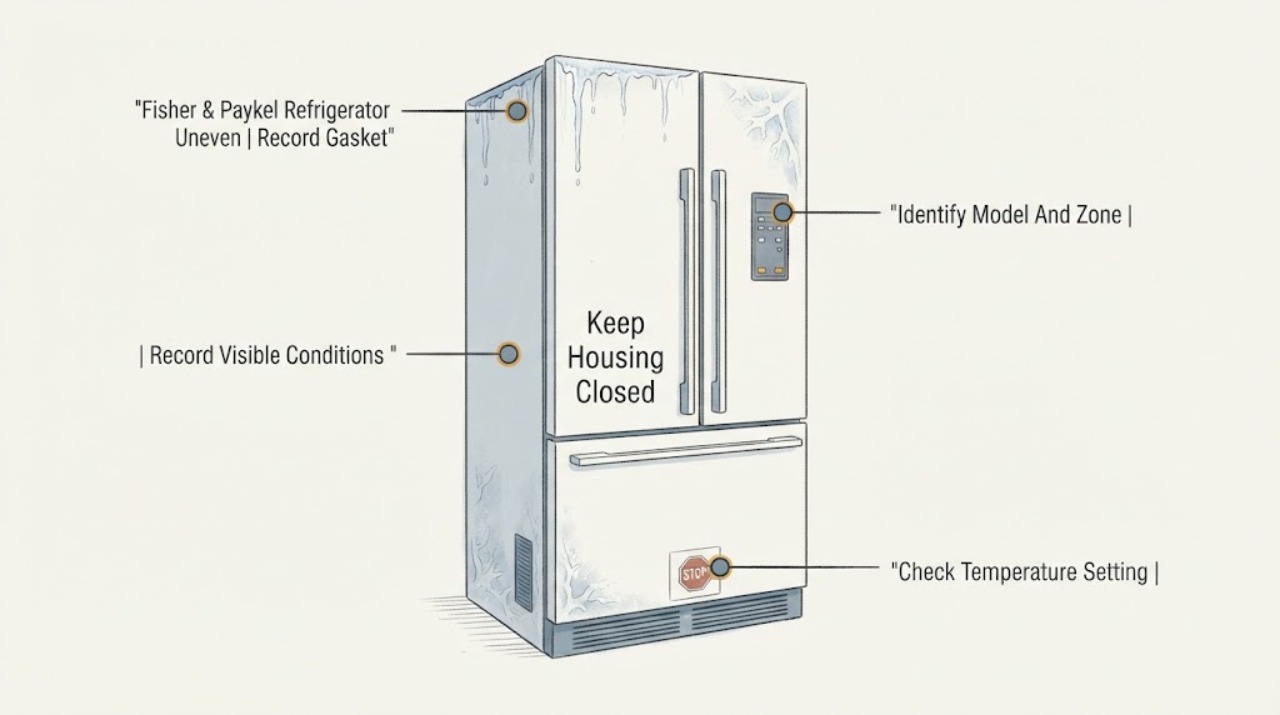
Work through in order
Diagnostic checks
Use only checks that match the exact appliance or system and its official guide.
-
Check 1
If the refrigerator is not getting cold, move perishable food to another working appliance or cooler, then record which compartment, shelf and food locations are warm or frozen and any measured temperatures; do not leave suspect food in place while testing.
Expected result: Perishables are warming/melting, or the issue is limited to a position with no apparent food-safety loss.
Next step: Keep doors closed as much as practical and arrange service promptly when food is warming. For a stable, position-specific pattern, continue only with the visible checks below.
Why this matters
Why: Fisher & Paykel treats loss of cooling as a food-safety issue; a location-specific pattern is useful evidence but does not identify an internal component.
-
Check 2
Record the complete Fisher & Paykel model/serial information, region, refrigerator style and affected zone before changing a setting or using a special mode.
Expected result: The model and zone are known, or the model/region cannot be confirmed.
Next step: Use the exact model in Fisher & Paykel Product Help/manuals. If the model is unavailable, limit work to food placement, visible outlet and door-gasket checks and do not copy numeric settings from another model.
Why this matters
Why: Fisher & Paykel supplies model-specific user guides and temperature-control instructions; a setting or mode from another series may not apply.
-
Check 3
Compare the current temperature setting with the exact model's user guide and make only the documented adjustment; close the doors and allow the cabinet time to stabilize instead of repeatedly changing the control.
Expected result: The setting is outside the model guidance, or it is correct and the warm/cold pattern remains.
Next step: Use the model's documented setting and observe the same locations after stabilization. If the pattern persists, proceed to the airflow and gasket checks and arrange service if unresolved.
Why this matters
Why: Fisher & Paykel lists an incorrect temperature setting as a cause of warm storage or food freezing, but a correct setting with persistent uneven cooling keeps airflow or service conditions in scope.
-
Check 4
Inspect accessible shelves and bins for food or containers directly in front of the model's air outlets; leave circulation paths open and avoid packing a large recent load tightly against outlets.
Expected result: Food is blocking an outlet or chill-sensitive food is directly in the outlet stream, or the outlets are unobstructed.
Next step: Move only the affected items away from the outlet and observe the same shelf after stabilization. If a clear outlet still produces a persistent warm/cold split, do not remove panels; use service.
Why this matters
Why: Fisher & Paykel says food placed directly in front of air outlets may freeze, while its cooling overview says calibrated airflow is intended to distribute cool air evenly.
-
Check 5
Check that doors close fully without packages in the way and that the accessible gasket is clean, flat and making contact; reduce unnecessary or prolonged door openings while the appliance stabilizes.
Expected result: The door does not seal, a gasket edge is displaced/dirty, packages obstruct closure, or the door and gasket appear normal.
Next step: Reposition packages and clean the accessible gasket as the model guide allows. If the gasket/door needs adjustment or the pattern persists with a good seal, arrange service.
Why this matters
Why: Fisher & Paykel lists frequent openings, doors not sealing properly and gasket condition as contributors to warm storage, condensation or inefficient operation.
-
Check 6
From outside the appliance, note whether the motor runs for unusually long periods, a fault alarm/beep or temperature-light sequence appears, and whether the cabinet has recently been moved or installed; do not open the rear cover or sealed system.
Expected result: A fault indication/beep sequence appears, the motor runs continuously after stabilization, or no fault indication is present.
Next step: Record the code/beep sequence and exact model for service. If there is no alarm but uneven cooling persists after the external checks, schedule diagnosis rather than opening covers.
Why this matters
Why: Fisher & Paykel guides use fault signals and model-specific service paths for malfunction; long running can also follow hot weather, frequent openings or a recent large load and is not by itself a compressor diagnosis.
-
Check 7
Arrange Fisher & Paykel service when the model-approved setting, clear outlets, closed door/gasket and stabilization checks do not correct the pattern, or when food is warming or an alarm appears.
Expected result: The refrigerator remains unevenly cold, a compartment is warm, a fault code/beep returns, the gasket/door needs adjustment or any proposed check would require removing a cover.
Next step: Keep the refrigerator closed, protect food and provide the technician the full model, region, zone temperatures, setting, load/door observations and any alarm sequence.
Why this matters
Why: The public family guidance supports external checks and food protection, not a definitive fan, sensor, damper, compressor or refrigerant diagnosis.
Use your observations
Decision map
Find the observation that best matches what you see, then follow the next safe action.
-
PATH 01Next step
What you see
Only food directly in front of an air outlet is freezing while other areas remain stable.
Do this next
Move chill-sensitive food away from the outlet, keep the path open and observe the same location after stabilization.
Why this path and its safety boundary
Why it matters: The model guide identifies outlet placement as a plausible local cause; it does not prove a cooling-system fault.
-
PATH 02Next step
What you see
The whole refrigerator or one compartment is warm after a large load, hot weather or frequent/long door openings.
Do this next
Close doors, reduce openings and allow the exact model to stabilize; move perishables to a cooler if they are warming and call service if recovery does not occur.
Why this path and its safety boundary
Why it matters: Fisher & Paykel lists those conditions as contributors to long running and warm compartments.
-
PATH 03Next step
What you see
A door does not close tightly, the gasket is dirty/displaced, or packages obstruct closure.
Do this next
Reposition packages and clean/reseat only the accessible gasket as the model guide permits; arrange service for misalignment or a persistent seal problem.
Why this path and its safety boundary
Why it matters: A poor seal can admit warm air and create uneven temperatures or condensation.
-
PATH 04Next step
What you see
The model-approved setting is correct, outlets are clear, doors seal and the temperature split persists or an alarm/beep sequence appears.
Do this next
Keep food protected and book Fisher & Paykel service with the model, region, temperature pattern and recorded alarm details; do not open covers or the refrigerant circuit.
Why this path and its safety boundary
Why it matters: The remaining cause cannot be safely distinguished among internal airflow, sensor, damper, compressor or sealed-system conditions from public symptom guidance.
-
PATH 05Next step
What you see
Perishables are melting, the refrigerator is not getting cold, or there is a damaged cord/refrigerant concern.
Do this next
Move perishables to another appliance/cooler, avoid sparks or electrical work and obtain a trained Fisher & Paykel technician promptly.
Why this path and its safety boundary
Why it matters: Food safety and appliance safety take priority over further troubleshooting.
Helpful context
Understand the symptom
Map the pattern before changing settings
Uneven cooling can mean one shelf is warm, food near an outlet is freezing, one compartment differs from another, or temperatures swing after door openings. Fisher & Paykel's current cooling information describes stable refrigeration as a combination of temperature, humidity and airflow. Record the compartment, shelf, food position and measured temperature rather than treating every difference as a failed part.
Use the exact model for temperature controls
Fisher & Paykel refrigerator guides repeatedly direct owners to the temperature-control section for the specific model. Keep the setting within the model's documented range and allow the appliance to stabilize after a large load or repeated door openings. Do not copy a temperature value or special mode from another series or region.
Restore clear airflow and a tight door
The opened refrigerator guides say food in front of air outlets can freeze, while frequent openings, a door that does not seal and a dirty or poorly seated gasket can contribute to temperature problems. Rearrange only accessible food and packages, keep outlets clear and check that the gasket sits flat and the door closes without obstruction. Do not remove interior panels to inspect a hidden fan or evaporator.
Escalate temperature loss with food safety in mind
If ice cream is melting or other perishables are warming, Fisher & Paykel says to move perishable food to another appliance or cooler and call a service technician. A persistent warm zone, a fault alarm or a pattern that remains after visible loading and door checks needs the exact model's Product Help/manual path and trained service rather than a guessed sealed-system or sensor repair.
When checks do not resolve it
Need a professional?
Contact Fisher & Paykel service when uneven cooling persists after exact-model setting, airflow, load, door and gasket checks, when a fault signal appears, or when diagnosis would require removing a cover or entering the sealed system.
Safety scope: Do not open rear covers, enter the refrigerant circuit, bypass sensors, replace a fan/damper/compressor from symptoms alone, or leave perishable food in a warming refrigerator while testing.
Have this ready
- Provide the full model/serial, region, refrigerator configuration, affected compartment/shelf, measured temperatures, temperature setting, recent loading/opening history, outlet and gasket observations, motor behavior and any beep/code sequence.
Common questions
FAQ
Can food placement cause uneven cooling in a Fisher & Paykel refrigerator?
Yes. Fisher & Paykel's refrigerator guidance says food placed directly in front of an air outlet may freeze. Move chill-sensitive food away from the outlet while preserving airflow, then observe the same area after the cabinet stabilizes.
What should I do if ice cream is melting?
Move perishable food to another working appliance or cooler and contact service promptly. Fisher & Paykel's safety guidance specifically treats suspected loss of cooling as a food-protection issue.
Should I use another Fisher & Paykel model's temperature setting?
No. The opened guides direct owners to the temperature-control section for the specific model. Use the exact model's manual/Product Help path and do not infer a numeric setting or special mode from another series or region.
Read the exact guide
Official sources
- CoolingFisher & Paykel USA · Official Fisher & Paykel refrigeration overview used for family-level temperature, humidity and airflow principles; no exact model is supplied.
- Contact UsFisher & Paykel USA · Official support/contact page used for Product Help and service booking after bounded checks.
- Help & Support | Book A Service | Repair | Technician | Fisher and Paykel USAFisher & Paykel USA · Official Fisher & Paykel USA support hub used to direct owners to Product Help and manuals by exact model.
- User Install Guide — Fisher & Paykel Fridge Freezer models RF331T/RF381T/RF411T/RF440T/RF521T/RF373/RF450/E450/RF308/RF388Fisher & Paykel · Official model-family guide used as a bounded example; it is not treated as a universal manual for every Fisher & Paykel refrigerator.
- User Guide — Fisher & Paykel RF605QZUVB1 Quad Door Fridge FreezerFisher & Paykel · Official exact-model guide used for food-safety and external-check boundaries; no exact model is supplied in the task, so model-specific instructions are not generalized.
Community feedback
Share a repair observation
Share a plain-text repair observation. Accepted observations are published automatically; this page may take a moment to update.