
On this page
Start here
Quick answer
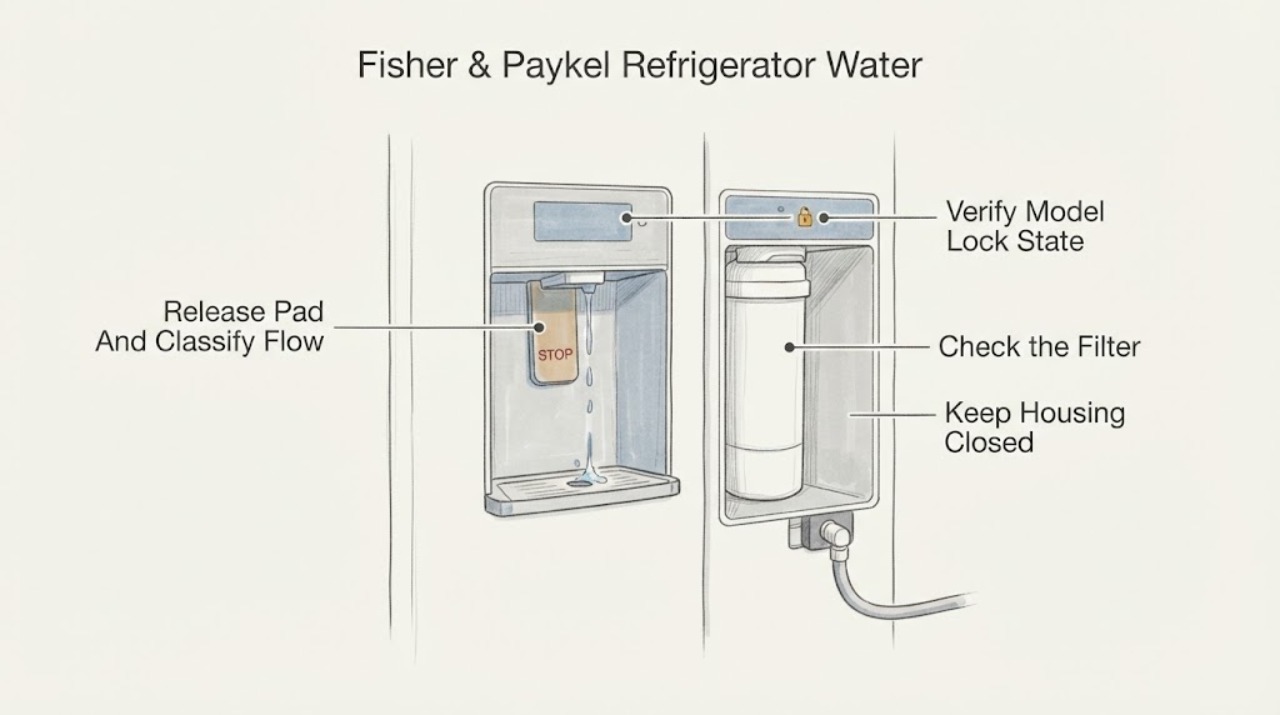
First separate a normal short drip from water that continues to flow after the glass is removed. In Fisher & Paykel's opened RS80/RS90/RS91 guide, the documented stop action is to pull the glass away from the dispensing pad; the same guide says a newly installed system may drip for a few days while trapped air is released. If water still flows after the glass is away, do not press harder, put anything into the opening, or open the door/panel to reach a valve. Place a container under the outlet, close the refrigerator's accessible water-supply shutoff if you can do so safely, protect the floor, and arrange Fisher & Paykel or authorized service. Use the complete model number before applying any lock, flush or filter instruction, because the opened troubleshooting tables are family-specific.
Work through in order
Diagnostic checks
Use only checks that match the exact appliance or system and its official guide.
-
Check 1
From the front of the refrigerator, remove the glass or container completely from the dispensing pad and watch the outlet without putting a hand or object into it. Note whether the stream stops, becomes a brief drip, or continues steadily.
Expected result: The stream stops when the glass leaves the pad; only a few drips remain; or water continues to flow with the pad released.
Next step: For a brief drip, use the installation/air branch below. For continued flow, contain the water and proceed to safe water isolation and service; do not open the dispenser.
Why this matters
Why: The opened Fisher & Paykel guide defines pulling the glass away as the stop action and says pressing harder does not increase flow. A short post-installation drip can be trapped air, while continued flow after release is outside that documented user operation and is not proof of a specific failed valve.
-
Check 2
If the refrigerator or its filter was installed or replaced recently, record that date and compare the symptom with the exact model guide's flushing instructions; do not improvise a flush volume from another Fisher & Paykel family.
Expected result: The drip began after first installation/filter replacement, or the symptom is unrelated to installation and is a steady post-release stream.
Next step: Only when the model manual matches and there is no uncontrolled flow, follow that manual's flush procedure. If the model is unknown or water keeps running, stop testing and arrange service.
Why this matters
Why: Fisher & Paykel documents trapped air and a newly installed filter as causes of drips or air-related dispenser behavior in the opened guides. A persistent stream after release is a different decision branch from a brief installation drip.
-
Check 3
Read the complete refrigerator model from its rating label and check the matching Fisher & Paykel user guide for a dispenser-lock control; if the guide documents one, observe whether the lock indicator is active without repeatedly pressing the dispenser.
Expected result: The exact guide documents a dispenser lock and its indicator is active, or the model guide has no matching lock instruction/identity is uncertain.
Next step: Use only the matching manual's lock control. If flow continues, leave the dispenser alone and use the water-isolation/service branch rather than trying random keys.
Why this matters
Why: The E/RF and RS80/90/91 guides document a lock that prevents dispensing, but the control combination and display differ by family. An unknown model cannot safely inherit a button sequence, and a lock state does not explain a stream that continues after release unless the exact guide says so.
-
Check 4
With the dispenser not being operated, inspect only the visible supply connection and line for a kink, crushing, wetness or an obvious leak; do not pull the refrigerator out unsafely or disconnect tubing.
Expected result: The visible line is kinked, crushed or leaking, or it appears intact while the dispenser still runs after release.
Next step: If there is a leak or uncontrolled flow, close the accessible refrigerator water shutoff and arrange service. Do not straighten a damaged connection by force or remove tubing as a home repair.
Why this matters
Why: Fisher & Paykel lists a blocked/kinked or leaking supply line and a restricted filter in family-specific troubleshooting, but an intact visible line does not prove the internal water path or valve is good.
-
Check 5
If water continues after the glass is removed, place a container or towels under the outlet, keep hands and objects out of the opening, and close the refrigerator's accessible water-supply shutoff if it can be reached without moving the appliance or contacting wet electrical areas.
Expected result: The flow stops after the water supply is safely isolated, or the shutoff cannot be reached safely / water is spreading near electrical equipment.
Next step: Leave the refrigerator unused and book Fisher & Paykel or authorized service. If water is near electrical equipment or the shutoff cannot be reached safely, keep clear and obtain qualified/emergency help rather than moving or opening the appliance.
Why this matters
Why: Stopping the supply limits water damage; it does not identify whether the cause is a valve, control, pad or another internal condition. Water near electrical equipment adds a shock hazard.
-
Check 6
Before contacting service, record the complete model and serial number, whether the flow stops when the glass leaves the pad, whether the appliance/filter was recently installed, the visible leak location and any dispenser-lock indication.
Expected result: The record distinguishes brief post-installation drips from an active stream after release and identifies a matching manual, or the model/manual remains uncertain.
Next step: Give the record to Fisher & Paykel or an authorized service partner. Do not order a valve, board or dispenser assembly solely from the symptom or a similar-looking model.
Why this matters
Why: Fisher & Paykel says the guide specifications apply to the named models and directs users to service; these details let the technician select the correct dispenser architecture without the user naming an unverified part.
Use your observations
Decision map
Find the observation that best matches what you see, then follow the next safe action.
-
PATH 01Next step
What you see
The stream stops as soon as the glass is pulled away from the dispensing pad.
Do this next
Use the pad gently and keep the glass clear when finished. If the pad physically sticks or will not release, stop using it and request model-matched service instead of forcing it.
Why this path and its safety boundary
Why it matters: This matches the documented user operation in the opened RS80/RS90/RS91 guide; the complaint may be a pad/handling expectation rather than uncontrolled flow.
-
PATH 02Next step
What you see
The dispenser was newly installed or the filter was just replaced, the main flow stops after release, and only intermittent drips remain.
Do this next
Follow the exact model guide's flushing procedure only; if the drip persists beyond the manual's stated installation behavior or becomes a steady stream, stop and arrange service.
Why this path and its safety boundary
Why it matters: The opened guides associate post-installation drips or drip-shelf overflow with trapped air or a new filter in their covered families.
-
PATH 03Next step
What you see
A steady stream continues after the glass is removed and the dispensing pad is no longer being pressed.
Do this next
Contain the water, close the accessible supply shutoff if safe, keep the appliance out of use and contact Fisher & Paykel or authorized service. Do not open panels, bypass the pad/lock or perform live tests.
Why this path and its safety boundary
Why it matters: The documented stop action did not stop the water. The public manuals do not establish which internal component is responsible for an unknown model.
-
PATH 04Next step
What you see
There is a visible leak, water is spreading toward an outlet or other electrical equipment, the shutoff cannot be reached safely, or tubing is damaged.
Do this next
Keep clear, obtain qualified help to isolate the water/power safely, and do not move the refrigerator or touch wet electrical connections.
Why this path and its safety boundary
Why it matters: This is a water-damage and possible shock hazard, not a filter or dispenser-setting experiment.
Helpful context
Understand the symptom
Release the dispenser before calling it a continuous-flow fault
The first distinction is whether the glass is still holding the dispensing pad in, whether water only drips briefly after release, or whether a steady stream continues with the glass clear of the pad. Fisher & Paykel's RS80/RS90/RS91 guide says to pull the glass away from the pad to stop the flow and says pressing harder does not increase it. If that documented user action does not stop the water, keep the outlet contained and move to the water-isolation/service branch rather than guessing which internal part is at fault.
A new installation can drip for a different reason
The RS80/RS90/RS91 guide says water may continue to drip for a few days after installation while trapped air leaves the system. The E/RF guide also separates trapped air and a newly installed filter from a restricted filter or a supply-line problem. Those statements support a short, installation-related drip or slow-flow check; they do not explain a dispenser that keeps running indefinitely after the pad is released.
Keep the exact model in control of lock, flush and filter steps
Fisher & Paykel manuals differ by product family. The E/RF guide lists a dispenser lock, trapped-air removal, supply-line checks and filter replacement, while the US/CA RF guide identifies water-supply, pressure, kinked-line and clogged-filter checks for the models it covers. Record the full model and serial number and use its own manual before holding a control button, flushing a stated volume or changing a filter.
When checks do not resolve it
Need a professional?
Call Fisher & Paykel or an authorized service partner when water continues after the glass is removed, when the pad sticks, when there is a visible leak or damaged line, when water is near electrical equipment, or when the exact model manual cannot be identified for a lock/filter/flush procedure.
Have this ready
- complete model and serial number
- whether the water stops when the glass leaves the dispensing pad
- whether the refrigerator or filter was recently installed
- visible leak location and whether the accessible water shutoff was closed
- any dispenser-lock indicator or other display message
Common questions
FAQ
Should I press the dispenser harder to make it stop?
No. The opened RS80/RS90/RS91 guide says pressing harder does not increase flow and instructs the user to pull the glass away from the dispensing pad to stop it. If water continues after release, contain it and move to safe water isolation and service.
Can a new Fisher & Paykel dispenser drip after installation?
The opened RS80/RS90/RS91 guide says a dispenser may continue to drip for a few days while trapped air is released. A separate E/RF guide documents family-specific flushing for trapped air and a new filter. Use the exact model guide and do not treat a continuing stream after release as a proven normal condition.
Can I use the dispenser-lock button to stop a running dispenser?
Only if the complete model's Fisher & Paykel guide documents that lock and its control. The opened guides show family-specific lock instructions; an unknown model should not inherit a button sequence, and a lock does not replace isolating a continuous water flow.
Does this symptom prove the water valve or control board failed?
No. Fisher & Paykel's public guides support user-level distinctions such as pad release, trapped air, filter, supply-line and lock checks, but they do not identify an internal valve or control-board failure for an unknown model. Persistent flow belongs with Fisher & Paykel or authorized service.
Read the exact guide
Official sources
- ActiveSmart Refrigerator Installation and User Guide E and RF modelsFisher & Paykel Appliances Ltd · Opened official PDF; the dispenser troubleshooting table is explicitly for the listed E/RF family and must not be generalized to an unknown model.
- ActiveSmart Refrigerator Installation and User Guide RF135B/RF170BFisher & Paykel Appliances Ltd · Opened official US/CA PDF; its specifications and troubleshooting apply to the models described in that guide.
- ActiveSmart Integrated Refrigerator User GuideFisher & Paykel Appliances Ltd · Opened official PDF; applies to the named RS80/RS90/RS91 family, not every Fisher & Paykel refrigerator.
- Help & Support | Book A Service | Repair | TechnicianFisher & Paykel Appliances Ltd · Official Fisher & Paykel USA support page for obtaining product help and authorized technicians.
Community feedback
Share a repair observation
Share a plain-text repair observation. Accepted observations are published automatically; this page may take a moment to update.