
On this page
Start here
Quick answer
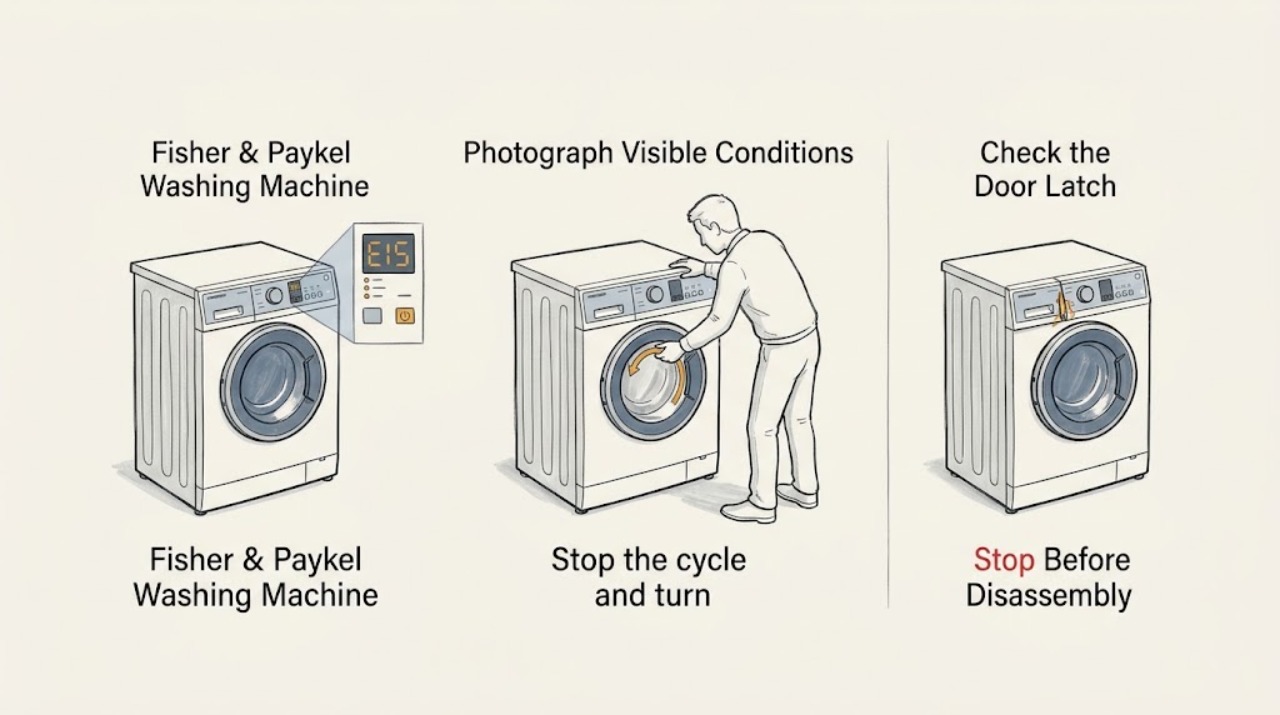
Treat the displayed Fisher & Paykel washer error as a diagnostic clue, not as a part number. Record the exact code, model and serial information, then follow the matching user-guide section: turn the washer off at the power point, wait for the manual's reset interval, remove the load if directed, and run only the indicated test cycle. Check visible door, power, water, and hose conditions without opening the cabinet. If the code returns, the machine will not work, water is too high, or there is a leak or electrical warning, stop and arrange Fisher & Paykel trained service.
Work through in order
Diagnostic checks
Use only checks that match the exact appliance or system and its official guide.
-
Check 1
Photograph or write down the exact text, number, symbols, beeps, and flashing lights on the washer display before touching the controls again. Note whether the machine is a top-loader or front-loader and locate its model and serial information from the normal label location.
Expected result: A stable fault code remains visible, or the display changes after a button is touched.
Next step: Keep the record and continue with one model-appropriate reset. If the display is blank, record that as well and use the power path.
Why this matters
Why: The exact code and model determine which Fisher & Paykel user-guide branch applies; a generic code list cannot safely select a part.
-
Check 2
Stop the cycle and turn the washer off at the power point as described in the user guide. Wait through the guide's stated reset interval, then restore power and make one normal start attempt.
Expected result: The code clears and the washer resumes, or the same code returns immediately or after the next attempt.
Next step: If the code returns, continue only with the visible checks below and prepare the recorded code for trained service.
Why this matters
Why: A single reset can clear a temporary control state, but recurrence indicates an unresolved condition rather than a reason to keep cycling power.
-
Check 3
Check the door or lid from the outside: close it fully, look for clothing or an object protruding through the seal or latch area, and do not force or bypass the lock.
Expected result: The door or lid closes normally and the error clears, or it remains open, loose, locked unexpectedly, or visibly obstructed.
Next step: Remove only a visible obstruction and close the door or lid once. If the latch remains faulty or a locked door contains water, stop and arrange service rather than opening the cabinet.
Why this matters
Why: Fisher & Paykel guides associate a door that is not closed with a no-start and identify the door state as part of fault handling.
-
Check 4
If the display or guide points to water supply, check that the visible hot and cold taps are on as required by the model, hoses are connected to the correct valves, and hoses are not kinked, leaking, or visibly damaged.
Expected result: A closed tap, kink, leak, or damaged hose is found, or the visible water path looks normal but the error returns.
Next step: Correct only a clearly closed tap or accessible kink, clean up any water, and retry once if safe. A leak, damaged hose, persistent water error, or high-water warning needs service.
Why this matters
Why: The user guides list missing water, incorrect connections, blocked hose filters, and damaged or twisted hoses as possible operating causes.
-
Check 5
After the reset and with the washer safe and empty, check that it is visibly level and remove the wash load if the model guide directs that step. Do not reach into a moving or water-filled drum.
Expected result: The washer is visibly unstable, the load was heavily unbalanced, or the same code remains with the load removed.
Next step: Correct only an obvious external loading or leveling issue and follow the guide's indicated rinse or test cycle. If the code remains empty, stop and book trained service.
Why this matters
Why: Fisher & Paykel fault procedures use level and load checks to separate an operating condition from a persistent fault.
-
Check 6
If the user guide identifies a rinse cycle as the follow-up test, run that cycle only after the door, water, and power checks are safe and the drum is not overloaded.
Expected result: The rinse completes and the code stays clear, or the code returns, the washer stops, or the machine still will not work.
Next step: Do not repeat the reset and rinse loop indefinitely. Record the outcome and arrange Fisher & Paykel trained service if the error returns.
Why this matters
Why: A completed rinse can show that the washer recovered from a transient condition; recurrence confirms that further diagnosis is required.
-
Check 7
Before service, gather the exact code, model code, serial number, when the error appears, whether the drum contains water, and what changed after the one reset and any indicated rinse test.
Expected result: The code is persistent, several lights are off or flashing, the washer cannot start, or an internal fault category is shown.
Next step: Give the complete record to Fisher & Paykel or an authorized service partner. Do not order a component from a generic code description.
Why this matters
Why: The remaining fault boundary is model-specific and may involve a sensor, motor, lock, drain, or control system that cannot be confirmed safely from the outside.
Use your observations
Decision map
Find the observation that best matches what you see, then follow the next safe action.
-
PATH 01Next step
What you see
The exact code clears after one documented power-cycle and the washer completes its indicated test.
Do this next
Resume normal use while monitoring for recurrence, and keep the recorded code in case it returns.
Why this path and its safety boundary
Why it matters: The condition may have been transient, but clearing a code does not identify an internal part.
-
PATH 02Next step
What you see
The code returns after the reset or indicated rinse cycle.
Do this next
Stop repeating the sequence and arrange Fisher & Paykel trained service with the code, model, and serial information.
Why this path and its safety boundary
Why it matters: The official fault procedure treats recurrence as a service boundary.
-
PATH 03Next step
What you see
The error is associated with an open door, lid, or lock that will not engage.
Do this next
Remove only visible obstructions and close it once; stop if the lock remains faulty or water is present.
Why this path and its safety boundary
Why it matters: A door or lid interlock can prevent operation, and forcing it creates a safety risk.
-
PATH 04Next step
What you see
The display points to no water, an inlet problem, or a visible hose issue.
Do this next
Check accessible taps and hose routing, but stop for leaks, damage, or a persistent water error.
Why this path and its safety boundary
Why it matters: The water path can cause a fault without proving an electronic failure.
-
PATH 05Next step
What you see
The display indicates high water, the drum cannot safely be opened, or water is on the floor.
Do this next
Stop the cycle, keep clear of the water and electrical connections, and follow the model guide's disconnect and service direction.
Why this path and its safety boundary
Why it matters: Flood and door-safety conditions are outside routine error clearing.
-
PATH 06Next step
What you see
The panel is dark, power is unavailable, or the protective device opens again.
Do this next
Stop resetting and arrange qualified electrical or Fisher & Paykel service.
Why this path and its safety boundary
Why it matters: A supply fault or recurring protective-device operation needs professional diagnosis.
Helpful context
Understand the symptom
Why the exact code matters
Fisher & Paykel washers use different displays and user guides across model families. A number after Fault or Err is a symptom-specific clue, while a blinking panel, a locked door, a water warning, or a no-start condition can point to a different branch. Write down the display before switching the machine off so the service technician can use the same evidence.
Use one controlled reset, not repeated guesses
The official guides use a limited reset followed by checks such as level, load removal, and a rinse cycle. That can clear a transient condition, but it does not prove that an internal part is good. If the same code returns, stop repeating the sequence and arrange trained service with the code, model, serial information, and symptom.
Keep the inspection external
Do not remove panels or attempt to defeat a door lock. Keep clear of a moving drum, and disconnect power and water only when the user guide directs it and it is safe to do so. A high-water warning, leak, burning smell, sparking, or a repeatedly tripping protective device is a stop condition.
Safety boundary
Stop conditions
- Stop immediately for smoke, sparking, a burning smell, a hot plug or outlet, water near electrical parts, a leak, or a protective device that opens again.
- Do not remove panels, probe live wiring, force a locked door, bypass an interlock, or reach into a moving or water-filled drum.
- Stop after one documented reset and any model-indicated test cycle if the error returns; preserve the code and arrange trained service.
When checks do not resolve it
Need a professional?
Arrange Fisher & Paykel trained service when the displayed error returns, the washer still will not work, the door or lid lock will not engage, a high-water or leak condition appears, or the panel remains unavailable after the accessible power check. Use qualified electrical help when the household supply or protective device is the part that remains faulty.
Have this ready
- Exact displayed code and symbols, model code, serial number, affected cycle, water or door state, and the result of the one reset and indicated test cycle.
Common questions
FAQ
What should I do first when my Fisher & Paykel washer shows an error?
Record the exact code and model information, then follow the matching user guide for one controlled reset and any indicated load or rinse check. If it returns, arrange trained service.
Can I clear the error by turning the washer off and on?
The user guides include a limited power-cycle step, but repeated recurrence is a service boundary. Do not keep repeating resets or bypass a door or safety condition.
What information should I give the service technician?
Provide the exact displayed code, model code, serial number, affected cycle, whether water is present, and what happened after the one reset and indicated test cycle.
Read the exact guide
Official sources
- Laundry Appliance Spare partsFisher & Paykel USA · Fisher & Paykel laundry parts catalog and model-specific compatibility context
- Help & Support | Book A Service | Repair | Technician | Fisher and Paykel USAFisher & Paykel USA · Fisher & Paykel product help, manuals, and trained service support
- FAULT CODESFisher & Paykel · Fisher & Paykel WH1260F2 front-load washer fault display, reset, troubleshooting, and service guidance
- FAULT CODESFisher & Paykel · Fisher & Paykel legacy front-load washer fault display, reset, door, power, water, and service guidance
Community feedback
Share a repair observation
Share a plain-text repair observation. Accepted observations are published automatically; this page may take a moment to update.