
On this page
Start here
Quick answer
A Fisher & Paykel washer that will not spin is often responding to an unbalanced load, an unlevel cabinet, or excess suds. Pause it, redistribute the load, confirm that the washer does not rock, and check that it can drain and that the lid or door is closed. If a balanced, correctly installed washer still refuses to spin, an error returns, or there is water left in the drum, stop repeating cycles and arrange qualified Fisher & Paykel service.
Before you begin
Safety first
- User diagnosis is limited to normal controls, safe load observation, visible hose and installation checks, detergent review, and the model's documented one-time recovery. A qualified technician must access internal wiring, pump, latch, suspension, motor, drive, or control components and determine repair scope.
Work through in order
Diagnostic checks
Use only checks that match the exact appliance or system and its official guide.
-
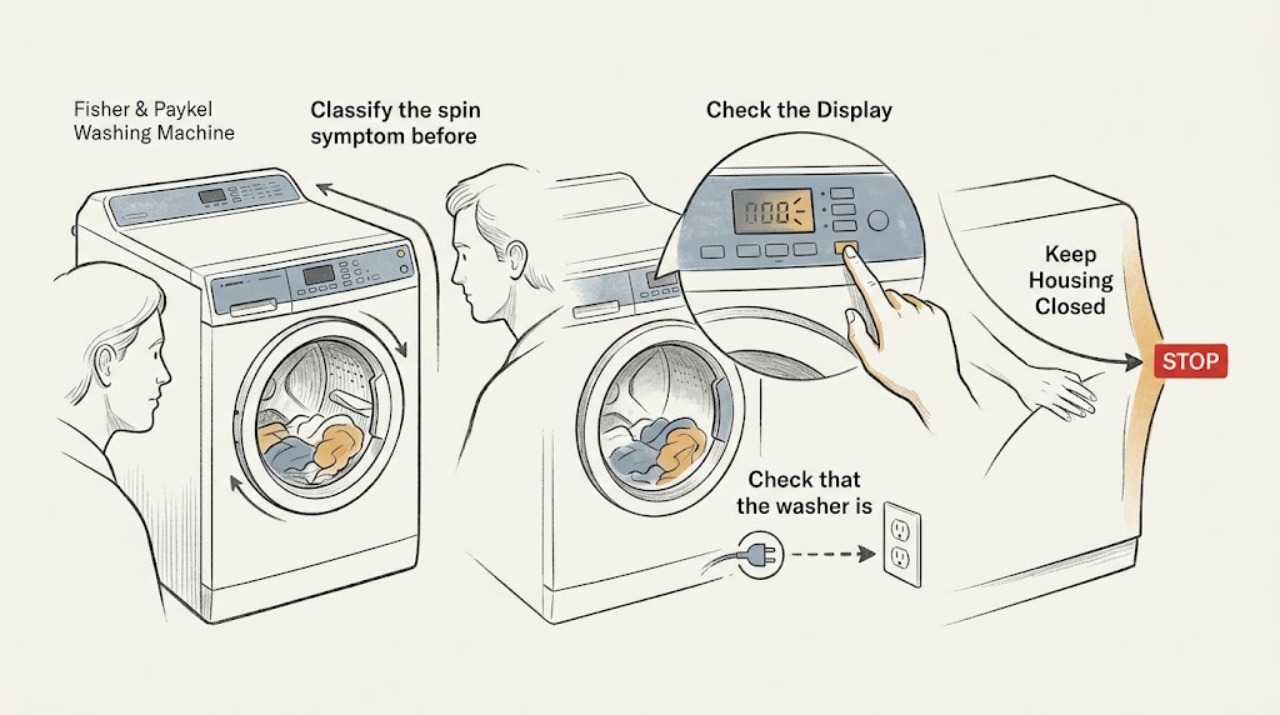
Classify the spin symptom before changing anything
Note whether the washer is a top-loader or front-loader, whether the drum or bowl contains standing water, whether the load is merely damp or soaking wet, and whether a fault code or flashing lid/door indicator is present. Do not open a locked lid or door by force.
Expected result: The washer has no water left but gives a slow or aborted spin, or it stops with water, a lock indication, or a displayed fault.
Next step: Use the water and lock observations to choose the drain, load-balance, latch, or fault branch below; record the exact code and model if service becomes necessary.
Why this matters
Why: A reduced spin can be a protective response to imbalance, while retained water, a lock issue, or a fault points to a different branch than load distribution alone.
-
Redistribute the load and run one controlled retry
Pause the washer only when the controls allow it safely. For a top-loader, spread the items around the bowl; for a front-loader, open the door only after it is unlocked and redistribute or remove a tangled or single heavy item. Then select the model's rinse or spin function and start one retry with a balanced, moderate load.
Expected result: The washer reaches a normal extraction spin after the items are redistributed, or it repeatedly slows, reverses, or stops without extracting.
Next step: If it still will not spin with a balanced load, continue with the level, drain, and suds checks; do not keep adding cycles to force a spin.
Why this matters
Why: A successful retry supports an out-of-balance load as the immediate cause. Repeated correction attempts with a balanced load mean the issue is not just the original arrangement.
-
Check that the washer is level and stable
With the washer stopped, look for rocking, a shifted position, or feet that no longer sit firmly on the floor. Apply only a light hand check to the cabinet; do not tip the appliance or remove panels. If the model guide permits user leveling, follow that guide's leveling procedure.
Expected result: The cabinet rocks or has moved, or it is stable and level but still refuses to spin.
Next step: Correct an accessible installation issue according to the model guide, then retry once. If the washer is already stable or the fault returns, proceed to drainage and suds checks and then service.
Why this matters
Why: Fisher & Paykel links leveling and the absence of rocking with good spin performance. A stable machine makes an out-of-level installation less likely but does not prove a drive or control fault.
-
Check for a drain problem before blaming the spin system
If water remains in the drum or bowl, inspect only the visible drain hose and its accessible connection for a kink, crushing, disconnection, or an obvious blockage. Do not open a pump filter with hot, contaminated, or uncontrolled water, and do not dismantle the washer.
Expected result: The hose is visibly obstructed or disconnected, or the visible drain path is clear but water still remains after the washer's normal drain function.
Next step: Correct only a safe, visible hose issue using the model guide. If water remains, the pump filter needs access, or a drain fault returns, stop the cycle and arrange service rather than testing repeated spins.
Why this matters
Why: A washer that cannot drain may not proceed to extraction. Fisher & Paykel lists a blocked hose, blocked pump filter, or incorrect drain installation in front-load troubleshooting, while the exact access procedure varies by model.
-
Rule out oversudsing
Look for persistent foam, unusually long pauses, or a flashing rinse/spin indication. Compare the detergent type and amount with the model's instructions and the load size; do not add more detergent to a foamy load.
Expected result: Foam is present or the washer pauses while suds dissolve, or there is no visible suds buildup.
Next step: Allow the model's documented recovery to finish and use the correct low-sudsing detergent and dose on a later load. If the washer still will not spin after the suds issue is gone, continue to the service boundary.
Why this matters
Why: Fisher & Paykel identifies suds buildup, incorrect detergent, and excessive detergent as reasons a washer may delay or perform a poor spin. No visible suds makes this explanation less likely, but does not rule out other faults.
-
Confirm the lid or door can close and lock normally
Remove only a visible garment edge or debris that prevents the lid or door from closing. Close it normally and observe whether the lock indication engages; never bypass the lock or insert hands into the machine while it is operating.
Expected result: The lid or door closes and locks, or the lock indication flashes, will not engage, or returns after a visible obstruction is removed.
Next step: If the lock remains unreliable, leave the washer out of service and arrange qualified repair. If it locks normally, use the fault/reset branch only if a code or mid-cycle stop remains.
Why this matters
Why: A washer will not safely spin when its lid or door safety interlock is not satisfied. A persistent latch or lock failure requires diagnosis rather than force.
-
Use one model-guided recovery for a returning fault
If the washer shows a fault or stops mid-cycle, record the display, turn the appliance off using its normal control, and follow the exact reset and rinse or spin sequence in the model's user guide once. Do not repeatedly reset a fault or open the cabinet.
Expected result: The washer completes the guided recovery and spins normally, or the same code, stop, or no-spin symptom returns.
Next step: For a returning fault, stop using the washer and contact Fisher & Paykel or a trained and supported service technician with the model, code, water status, load result, and checks already completed.
Why this matters
Why: Fisher & Paykel guides describe a one-time power-off/restart and a rinse or spin retry for some faults, followed by trained service if the fault recurs. A reset is a diagnostic recovery step, not a repair.
Use your observations
Decision map
Find the observation that best matches what you see, then follow the next safe action.
-
PATH 01Next step
What you see
The washer spins normally after a tangled or uneven load is redistributed.
Do this next
Treat the immediate cause as load balance, avoid mixing a single heavy item with light items, and monitor the next ordinary load. If the symptom recurs with balanced loads, continue the checks.
-
PATH 02Next step
What you see
The washer rocks, has shifted, or repeatedly goes out of balance.
Do this next
Follow the model-specific leveling instructions and retry once. If it remains unstable or continues to stop with balanced loads, arrange service for installation and suspension or drive diagnosis.
-
PATH 03Next step
What you see
Water remains after a drain attempt or the visible drain hose is obstructed.
Do this next
Correct only a safe, visible hose issue according to the model guide. Standing water, a blocked pump filter, or a recurring drain fault needs qualified service before further spin tests.
-
PATH 04Next step
What you see
Foam, a long suds pause, or a flashing rinse/spin indication is present.
Do this next
Let the documented recovery complete, then use the model-approved low-sudsing detergent and dose. If no-spin returns without suds, use the service branch.
-
PATH 05Next step
What you see
The lid or door will not lock, a fault code returns, or the washer stops again after the model-guided recovery.
Do this next
Stop operating the washer and arrange Fisher & Paykel trained service. Do not bypass the lock, repeatedly reset the machine, or remove panels to test the drive or controls.
Helpful context
Understand the symptom
Not spinning can mean two different things: the washer never reaches a fast extraction spin, or it spins but leaves the load unusually wet. Fisher & Paykel's published checks differ slightly between top-load and front-load models, so identify the layout and use the guide for the model number before interpreting a display or selecting a part.
Keep this diagnosis at the user-check level. Do not force a locked lid or door, reach into a moving drum, remove panels, work on live wiring, or repeatedly run a cycle with standing water, smoke, a burning smell, or a damaged power cord.
Safety boundary
Stop conditions
- Do not force open a locked lid or door, reach into a moving drum, bypass a safety interlock, or remove panels as a spin test.
- Stop for smoke, a burning smell, sparking, a damaged power cord, exposed wiring, uncontrolled water, or water near electrical connections; disconnect only if it can be done without touching a hazard and seek qualified help.
- Do not keep running cycles when water remains, the washer repeatedly goes out of balance, or a fault code returns after the documented recovery.
- Do not order a motor, pump, latch, suspension, or control part from the symptom alone; confirm the model and diagnosis first.
Only after diagnosis
Potential parts
- drain pump or drain-path component
Consider this category only when water remains after safe visible hose checks and a technician confirms a blocked or failed drain path; a no-spin symptom alone does not identify the pump.
Confirm the complete model and revision with Fisher & Paykel or the technician before ordering any part. - lid or door interlock
Consider this category only when the lid or door cannot lock normally after visible obstructions are removed and the technician confirms an interlock fault.
Match the part to the exact model and door or lid configuration; do not bypass the safety interlock. - suspension or drive component
Consider this category only after load balance, leveling, drain, suds, and lock checks pass and a technician confirms a mechanical or drive fault.
Use the exact model identification and a technician's diagnosis to establish fitment before purchase.
When checks do not resolve it
Need a professional?
Arrange Fisher & Paykel trained service when the washer remains unable to spin after one balanced-load, stable-installation, drain, suds, and lock check; when water remains; when a fault or lock failure returns; or when diagnosis would require opening the cabinet, accessing internal wiring, or accessing a pump or drive component.
Safety scope: User diagnosis is limited to normal controls, safe load observation, visible hose and installation checks, detergent review, and the model's documented one-time recovery. A qualified technician must access internal wiring, pump, latch, suspension, motor, drive, or control components and determine repair scope.
Common questions
FAQ
Why does my Fisher & Paykel washer spin slowly or stop before the final spin?
The most useful first checks are load balance, cabinet leveling, and suds. Redistribute the load, confirm the washer does not rock, and review the detergent guidance. If water remains or the symptom returns with a balanced load, check the drain branch and arrange service if needed.
Can an unbalanced load prevent a Fisher & Paykel washer from spinning?
Yes. Fisher & Paykel guides describe an out-of-balance load as a cause of improper or reduced spinning. Pause safely, redistribute or remove the problem item, and retry once with a moderate balanced load.
What should I do if my Fisher & Paykel washer has water left in it and will not spin?
Inspect the visible drain hose for a safe, obvious kink or disconnection and follow the model guide. Do not open a pump filter with uncontrolled or contaminated water. A persistent drain problem needs qualified service before further spin tests.
Should I keep resetting a Fisher & Paykel washer that will not spin?
No. Record the display and use the model's documented recovery sequence once. If the fault, lock problem, or no-spin symptom returns, stop operating the washer and arrange trained service.
Read the exact guide
Official sources
- USER GUIDE — FRONT LOADER WASHING MACHINEFisher & Paykel · Fisher & Paykel WH1260F2 front-load washing-machine drainage, spinning, oversudsing, door safety, and fault guidance
- Help & Support | Book A Service | Repair | Technician | Fisher and Paykel USAFisher & Paykel · Fisher & Paykel product help, manuals, service booking, and trained technician support
- FRONT LOADING CLOTHES WASHER — INSTALLATION GUIDE / USER GUIDEFisher & Paykel · Fisher & Paykel WH2424F and WH2424P front-load washer troubleshooting, drainage, balance, suds, and service guidance
- WASHSMART™ AND QUICKSMART™ CLOTHES WASHERS — INSTALLATION GUIDE / USER GUIDEFisher & Paykel · Fisher & Paykel top-load washer spin troubleshooting, leveling, load balance, suds, lid lock, and service guidance
Community feedback
Share a repair observation
Share a plain-text repair observation. Accepted observations are published automatically; this page may take a moment to update.