
On this page
Start here
Quick answer
Switching a freezer off does not by itself prove that an automatic-defrost system has failed. First identify whether the appliance is a manual-defrost or frost-free model from its label and owner manual: a manual-defrost freezer has no defrost heater and must warm with power disconnected, while a frost-free upright normally defrosts on its own cycle. If the manual permits a user defrost, disconnect power, move food to a cooler, leave the door or lid open, contain the meltwater, and use only the manual's safe method; never use a hair dryer, heater, knife, ice pick, or other electrical or sharp tool. In a rented property, photograph the frost and water risk and notify the landlord or property manager before moving, draining, dismantling, or modifying the supplied freezer. Persistent heavy frost, poor cooling, an unknown defrost type, or any water or electrical hazard needs the exact manual and qualified service rather than an assumed automatic-defrost diagnosis.
Before you begin
Safety first
- Do not remove panels, access a defrost heater or control, perform live electrical tests, bypass a thermostat or safety control, use a hair dryer or heater, or chip ice with a knife or ice pick. Keep the appliance disconnected when the manual or a qualified technician directs it, and keep wet connections untouched.
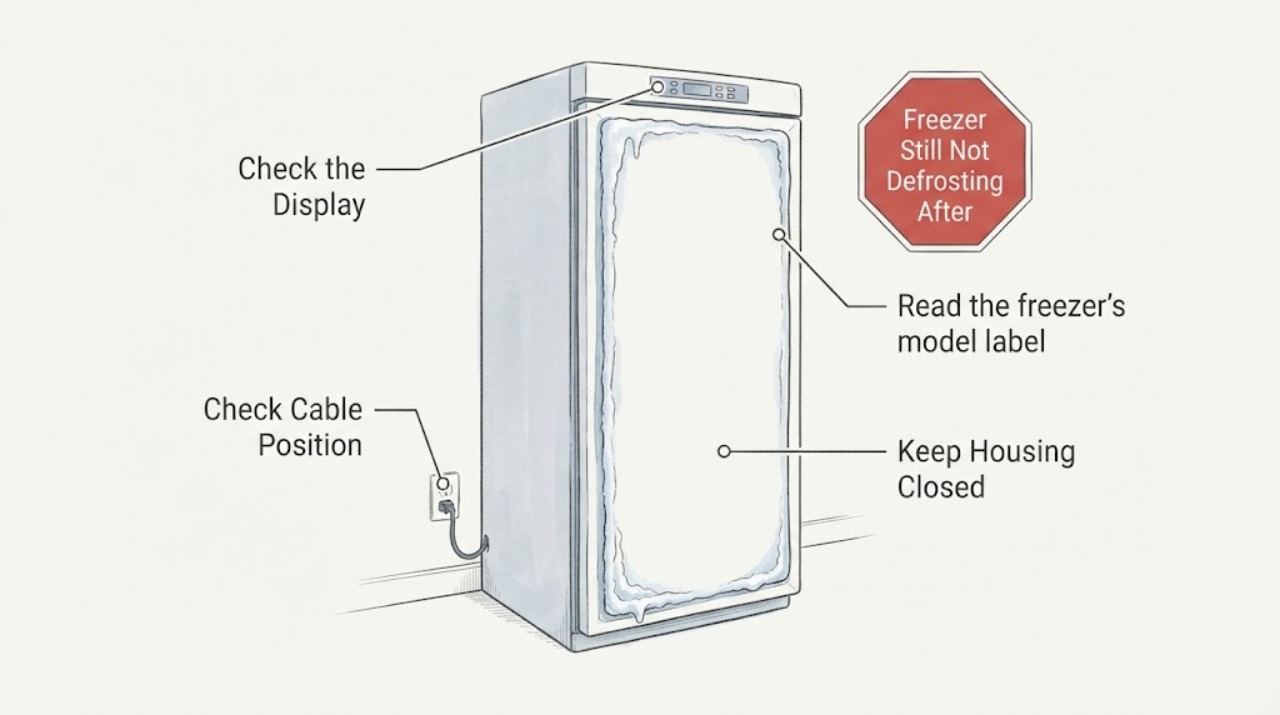
Work through in order
Diagnostic checks
Use only checks that match the exact appliance or system and its official guide.
-
Check 1
Read the freezer's model label and owner manual, and identify whether it is described as manual defrost, frost-free or self-defrost. Check whether it is a chest freezer or an upright, without removing a cover or guessing from its shape alone.
Expected result: The manual clearly says manual defrost, clearly says frost-free or self-defrost, or the type and drain arrangement cannot be confirmed.
Next step: Use the manual's procedure for the confirmed type. If the type remains unknown, photograph the label and frost condition and ask the landlord or property manager for the manual or an approved service contact before draining, moving or dismantling the appliance.
Why this matters
Why: GE says manual-defrost models have no defrost heater and must be warmed with the power off; frost-free upright models use an automatic defrost system. GE also says the drain tube depends on the self-defrost feature, so an unfamiliar freezer cannot safely be assigned a generic drain or defrost procedure.
-
Check 2
If the manual identifies a user-serviceable manual-defrost procedure, disconnect power at the accessible plug or control as the manual directs, remove the frozen food to a cooler, and place towels or an approved pan where meltwater can be contained. Keep the door or lid open while the ice melts.
Expected result: Frost softens and water is contained without wetting the outlet, cord or surrounding floor, or water begins to overflow or the plug and outlet become wet.
Next step: Continue only while the setup remains dry and the manual supports it. If water cannot be contained, stop, keep clear of the electrical connection, and notify the landlord or property manager and qualified service; do not move the freezer or improvise a drain.
Why this matters
Why: Whirlpool and GE both describe power disconnection, food removal and open-door or open-lid melting for manual defrost. GE says the drain is model-dependent; water overflow or a wet electrical area is a safety and property risk, not evidence of a failed defrost component.
-
Check 3
Use only the safe acceleration method named in the applicable manual. Official family guidance permits a bowl or pans of hot water for some manual-defrost models, but do not force stubborn ice and do not use a hair dryer, heater, knife, ice pick, sharp tool or other electrical appliance.
Expected result: Ice loosens gradually with no tool contact, or a thick section remains stuck and would require force or an unlisted heat source.
Next step: Allow more time with the freezer disconnected, following the manual, or stop and contact the property manager or service provider. Do not chip through the ice or apply direct heat.
Why this matters
Why: Whirlpool says hot water may speed melting but specifically warns against electrical appliances, heaters and sharp-pointed tools because they can damage the freezer. A section that will not loosen is a reason to allow more time or use qualified service, not to pierce or pry the cabinet or liner.
-
Check 4
If the manual identifies a frost-free or self-defrost freezer, reconnect it only after any approved cleaning or defrost procedure is complete and the area is dry. Observe normal cooling over the next operating cycle without repeatedly opening the door or trying to force a defrost cycle.
Expected result: The frost does not return abnormally and cooling remains normal, or heavy frost returns, cooling is poor, or the freezer never reaches its normal condition.
Next step: For normal cooling, monitor and follow the exact manual. For recurring frost, poor cooling or an unresolved automatic-defrost symptom, keep the freezer closed, protect food as needed, document the pattern and request qualified service through the landlord or property manager rather than opening panels.
Why this matters
Why: GE describes automatic defrost as a scheduled or usage-based cycle, with a typical defrost period during which compressor and fan sounds stop. A short switch-off period does not prove a failed heater, timer, sensor or control; recurring heavy frost or poor cooling after normal operation needs model-specific service diagnosis.
-
Check 5
Before escalating, record the model label, freezer type, frost thickness and location, whether the problem followed a power interruption, the amount of meltwater, cooling condition and any visible cord or outlet hazard. Take photographs from outside the appliance.
Expected result: The freezer remains heavily iced, does not cool normally, the defrost type cannot be identified, water threatens the property, or the plug, cord or outlet is wet, hot, damaged or smells burnt.
Next step: Keep the appliance out of use when there is an electrical or water hazard, keep food protected, and contact the landlord or property manager for an approved appliance technician. Do not remove panels, perform live tests, bypass a control or purchase a part based only on the frost pattern.
Why this matters
Why: These observations distinguish a documented symptom or property risk from an unverified internal part diagnosis. The supplied task has no model, so a heater, timer, sensor, drain or other part cannot be matched or declared failed from the symptom alone.
Use your observations
Decision map
Find the observation that best matches what you see, then follow the next safe action.
-
PATH 01Next step
What you see
The owner manual identifies a manual-defrost freezer and frost softens after power is disconnected with the door or lid open.
Do this next
Complete the manual's food, drain, meltwater and cleaning steps, then restore power only when the interior and connection area are dry. In a rental, document the result and tell the property manager if the frost returns unusually quickly.
Why this path and its safety boundary
Why it matters: This is the expected manual-defrost behavior; the freezer has no automatic defrost heater in the GE family guidance, so switching it off is part of the defrost process rather than proof of a failed automatic system.
-
PATH 02Next step
What you see
The manual identifies a frost-free or self-defrost upright, but it was only switched off briefly and there is no confirmed loss of cooling or electrical hazard.
Do this next
Restore normal operation according to the manual, monitor cooling and frost, and request qualified service if heavy frost or poor cooling persists. Do not open the cabinet to inspect a heater or control.
Why this path and its safety boundary
Why it matters: A brief power-off interval does not establish an automatic-defrost failure. GE describes automatic defrost as a scheduled or usage-based process rather than a user-triggered melt whenever the plug is removed.
-
PATH 03Next step
What you see
The defrost type, drain arrangement or owner manual cannot be confirmed for the rented freezer.
Do this next
Photograph the model label and condition, ask the landlord or property manager for the appliance manual or approved technician, and avoid draining, moving, opening panels or adding heat until the procedure is confirmed.
Why this path and its safety boundary
Why it matters: Chest, upright, manual-defrost and self-defrost designs can have different drains and procedures; the missing model prevents a safe model-specific instruction.
-
PATH 04Next step
What you see
Meltwater threatens flooring or cabinets, reaches the plug or outlet, or the cord is hot, damaged or associated with a burning smell.
Do this next
Stop the defrost setup, keep clear of wet electrical connections, disconnect only if it can be done safely from a dry accessible point, and notify the landlord or property manager and qualified service. Do not use a hair dryer or other appliance to dry or melt the ice.
Why this path and its safety boundary
Why it matters: This is a water or electrical safety condition and may damage the rented property. It should not be used to infer a failed defrost part or justify moving the appliance without authorization.
-
PATH 05Next step
What you see
Heavy frost returns after the correct manual procedure, or a confirmed self-defrost freezer continues to frost heavily or cool poorly during normal operation.
Do this next
Keep the door closed, protect food if temperature is unsafe, document the frost pattern and arrange an approved appliance service visit through the landlord or property manager. Do not bypass controls or perform internal or live electrical work.
Why this path and its safety boundary
Why it matters: The recurring symptom needs exact-model diagnosis; it does not identify a heater, timer, sensor, drain, seal or control as the failed part.
Helpful context
Understand the symptom
Being switched off is not the same as an automatic-defrost failure
A freezer can be manual-defrost, frost-free, or an older or compact design with different behavior. GE says manual-defrost models must be turned off and allowed to warm because they do not have a defrost heater. GE also describes frost-free upright freezers as using a time-based or usage-based automatic cycle, normally with no compressor or fan sound during defrost. Therefore, a short power-off period is not enough to diagnose a failed heater, timer, sensor, or control, and an automatic model should not be treated as a manual-defrost model without its owner manual.
Treat a rented freezer as a water and authorization problem as well
Defrost water can overflow or damage flooring and cabinets, and the drain arrangement varies by freezer type. GE says chest freezers are manual-defrost and generally do not have a self-defrost drain tube, while current GE upright freezers are self-defrost and older uprights can differ. In a rental, keep the appliance in place, document the condition, and contact the landlord or property manager before using an unfamiliar drain, moving the appliance, removing panels, or arranging a modification. If the unit is wet around the plug or outlet, stop and use qualified help rather than handling the connection.
When checks do not resolve it
Need a professional?
Contact the landlord or property manager and an approved appliance technician when the freezer type is unknown, frost returns after a correct manual defrost, a self-defrost freezer remains iced or warm, meltwater cannot be contained, or any cord, plug or outlet is wet, hot, damaged or smells burnt. Do not diagnose or replace an internal defrost part from the symptom alone.
Safety scope: Do not remove panels, access a defrost heater or control, perform live electrical tests, bypass a thermostat or safety control, use a hair dryer or heater, or chip ice with a knife or ice pick. Keep the appliance disconnected when the manual or a qualified technician directs it, and keep wet connections untouched.
Have this ready
- Provide the complete model and serial information, freezer type if confirmed, photographs of frost and water risk, frost location and thickness, time since power was restored, cooling condition, and any cord, plug or outlet warning signs. Tell the landlord or property manager before moving or modifying the supplied appliance.
Common questions
FAQ
Does switching the freezer off prove that the automatic defrost system is broken?
No. GE distinguishes manual-defrost freezers, which must warm with the power off and have no defrost heater, from frost-free upright freezers that defrost on a time-based or usage-based cycle. A brief switch-off period is not a model-specific test of a heater, timer, sensor or control.
Can I use a hair dryer, heater or knife to make the ice melt faster?
No. Whirlpool says not to use electrical appliances such as hair dryers or heaters and not to use an ice pick, knife or other sharp-pointed tool. Follow the applicable manual; where it permits faster melting, use a bowl or pans of hot water while power is disconnected and the water is controlled.
Why is there no drain tube on my freezer?
The drain depends on the design. GE says chest freezers are manual-defrost and generally do not have a self-defrost drain tube, while current GE upright freezers are self-defrost and older upright models can differ. Use the exact owner manual rather than forcing a plug or improvising a hose.
What should I do if the freezer belongs to my rental home?
Document the model label, frost and any water risk, keep the unit in place, and notify the landlord or property manager before moving it, using an unfamiliar drain, removing panels or arranging a modification. If the cord, plug or outlet is wet, hot, damaged or smells burnt, keep clear and request qualified help.
How long should I wait before deciding that it is not defrosting?
There is no safe universal time for an unidentified freezer. Melting depends on the frost load, room conditions, freezer design and the manual's procedure. Allow the approved manual-defrost process to complete without forcing ice; for a frost-free model, use the normal operating guidance and arrange service if heavy frost or poor cooling persists.
Read the exact guide
Official sources
- Refrigerator and Freezer - Types of Defrost SystemsGE Appliances · Opened official GE Appliances family guidance. It supports the distinction between automatic defrost and manual-defrost or partial-automatic designs, including the fact that manual-defrost compact models have no defrost heater; it is not a diagnosis for a missing model.
- How to Defrost the FreezerWhirlpool · Opened Whirlpool Product Help guidance for chest freezers. Used for family-level manual-defrost steps and the explicit warning against electrical appliances, heaters, knives and ice picks; model-specific drain details remain subject to the owner's manual.
- Upright & Chest Freezer - Vacation SettingsGE Appliances · Opened official GE Appliances support guidance. It supports food removal, turning the control off, disconnecting power, defrosting, drying and leaving the door or lid open when a freezer will remain off; it does not provide a repair diagnosis.
- Refrigerator & Freezer - Drain TubesGE Appliances · Opened official GE Appliances support guidance. It supports the conditional drain discussion for chest versus upright and manual versus self-defrost models; it does not identify the drain arrangement of the unidentified rental freezer.
- Chest Freezer - Manual Defrosting InstructionsGE Appliances · Opened official GE Appliances support guidance for manual-defrost chest freezers. It supports the family-level distinction and external defrost steps; it does not establish a procedure for an unidentified upright or self-defrost model.
- How to Use the Controls (Chest and Upright Freezer)Whirlpool · Opened official Whirlpool Product Help guidance. It supports using the exact owner manual for controls, normal compressor cycling and allowing a freezer to stabilize after adjustment; it does not identify a defrost failure for an unidentified model.
Community feedback
Share a repair observation
Share a plain-text repair observation. Accepted observations are published automatically; this page may take a moment to update.