
On this page
Start here
Quick answer
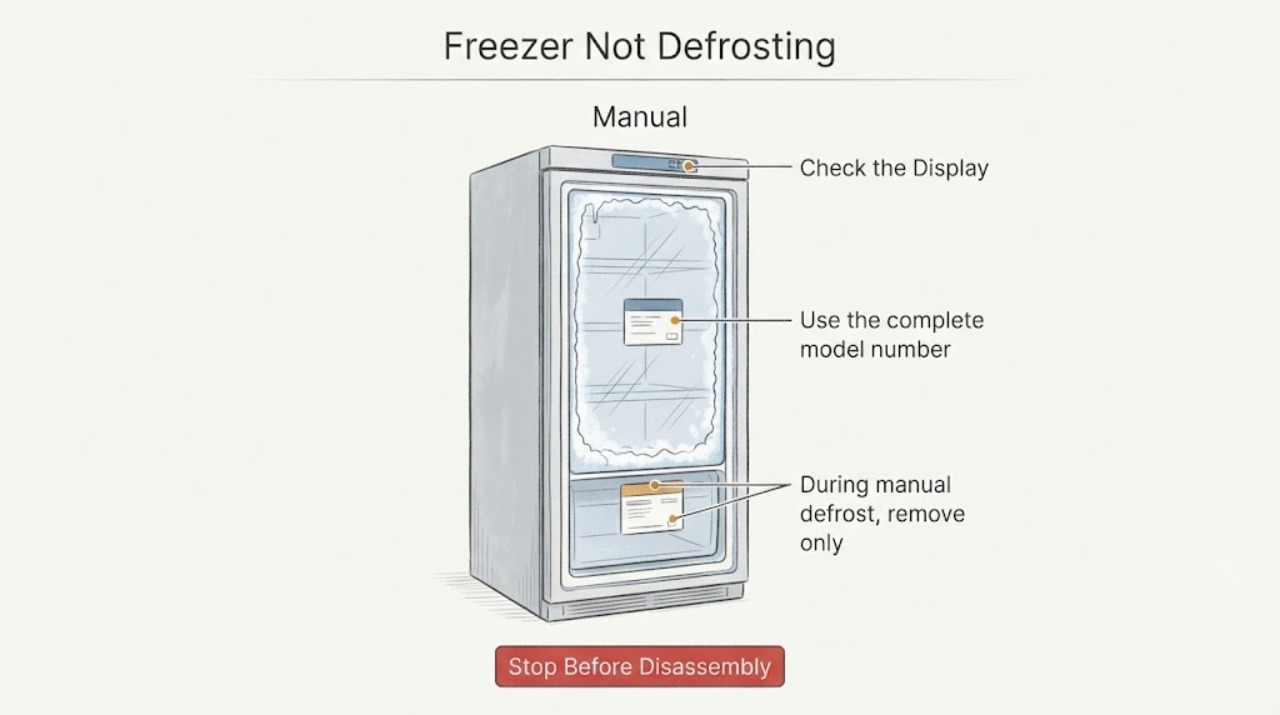
First identify whether the GE freezer is a manual-defrost or frost-free/automatic-defrost model. GE says manual-defrost freezers should be defrosted when frost reaches about 1/4 to 1/2 inch, while frost-free upright freezers defrost automatically and should not be manually scraped or opened to reach an internal heater. For a manual-defrost model, turn the control OFF, unplug it, move food to an insulated container, let frost loosen with the door open or pans of hot water, and use only a plastic scraper if the model instructions permit. Never use a sharp tool, electrical defrosting device, or unauthorized heater. Heavy or unusual frost on an automatic model needs model-matched service rather than a guessed heater or thermostat repair.
Work through in order
Diagnostic checks
Use only checks that match the exact appliance or system and its official guide.
-
Check 1
Use the complete model number and Owner’s Manual to identify the defrost type before touching frost. Check whether the freezer is a chest model, a manual-defrost upright, or a frost-free/self-defrost upright; do not infer the type from appearance alone.
Expected result: The manual explicitly says manual defrost, or it identifies the unit as frost-free/self-defrost; the manual or type remains unknown.
Next step: Follow the matching branch below. If the model/type cannot be confirmed, stop before scraping, heating, removing a drain, or opening panels and obtain the exact manual.
Why this matters
Why: GE says chest freezers are manual-defrost, current GE upright freezers are self-defrosting, and some older GE/Hotpoint uprights vary. The same frost symptom has different safe actions by type.
-
Check 2
For a confirmed manual-defrost freezer, turn the temperature control to OFF and unplug it, move food into an insulated container, and allow the frost to loosen with the door or lid open. Use pans of hot water only as described by the model guidance, and collect meltwater safely.
Expected result: Frost loosens without force, or it remains bonded and water is accumulating near the cabinet or floor.
Next step: Let the frost thaw naturally, use only a plastic scraper where the applicable manual permits it, and manage the drain or plug only as the exact model instructs. Stop if water reaches electrical parts or the cabinet is damaged.
Why this matters
Why: GE’s manual-defrost instructions support controlled thawing, food protection, and water management; they do not support prying or heating the cabinet with an unapproved device.
-
Check 3
During manual defrost, remove only loose frost with a plastic scraper if the model instructions allow it; never use an ice pick, knife, sharp object, hair dryer, heat gun, or other electrical defrosting device.
Expected result: The frost can be removed without sharp tools, or the only way forward appears to require force, heat, or contact with hidden coils.
Next step: Leave the freezer unplugged and allow more time for thawing. If damage, puncture, refrigerant odor, or an unusual frost pattern is suspected, stop and arrange qualified service.
Why this matters
Why: GE warns that sharp instruments can damage the refrigerating system and that electrical devices must not be used for defrosting. A need for force indicates a stop condition, not a repair step.
-
Check 4
For a confirmed frost-free/automatic-defrost model, observe only the external frost pattern, temperature, and whether the issue repeats; do not remove interior panels or attempt to reach the evaporator heater or thermostat.
Expected result: There is only a normal defrost pause with no compressor or fan sound, or there is heavy ice, persistent frost, an uneven frost pattern, or inadequate temperature.
Next step: Allow a normal automatic cycle to finish. If heavy frost/ice persists, the freezer is warming, or the pattern is concentrated on one wall, stop user diagnosis and schedule model-matched service.
Why this matters
Why: GE says automatic defrost can pause compressor and fans for about 25–45 minutes, with dripping, sizzling, or a heater glow potentially normal. Heavy accumulation or an unusual pattern is a service condition.
-
Check 5
After a manual defrost, replace any drain cap, plug, or tube exactly as the model manual shows, dry the interior, restore the normal temperature setting, and monitor whether frost returns abnormally.
Expected result: The freezer returns to normal operation, or frost rapidly returns / water does not drain / the temperature remains abnormal.
Next step: Keep the unit out of service if water leaks toward electrical areas or food cannot stay frozen, and arrange qualified service with the model and frost pattern; do not replace a heater, sensor, thermostat, or seal based on this symptom alone.
Why this matters
Why: GE’s instructions require model-specific drain handling and note that repeated heavy or unusual frost is not solved by repeated scraping.
Use your observations
Decision map
Find the observation that best matches what you see, then follow the next safe action.
-
PATH 01Next step
What you see
The exact GE manual identifies the freezer as manual-defrost and frost has reached the stated accumulation threshold.
Do this next
Turn OFF and unplug, protect food, thaw with the door/lid open or model-approved pans of hot water, and use only a plastic scraper if the manual permits it.
Why this path and its safety boundary
Why it matters: Manual frost removal is an intended maintenance task for that model, but it still requires power isolation and controlled thawing.
-
PATH 02Next step
What you see
The freezer is frost-free/self-defrost and the only observation is a temporary pause, dripping/sizzling, or a brief heater glow.
Do this next
Do not open the freezer or reach the heater. Allow the cycle to finish and monitor temperature and frost.
Why this path and its safety boundary
Why it matters: GE documents these as possible normal automatic-defrost behavior; compressor and fan silence during the cycle is expected.
-
PATH 03Next step
What you see
A frost-free model has heavy ice, persistent frost, inadequate temperature, or a concentrated/uneven frost pattern.
Do this next
Keep the freezer closed as much as practical, protect food, and arrange qualified model-matched service. Do not scrape the evaporator or guess a defrost component.
Why this path and its safety boundary
Why it matters: The official GE support boundary treats heavy accumulation or an unusual pattern as requiring technician diagnosis.
-
PATH 04Next step
What you see
Someone proposes a sharp tool, electrical appliance, heat gun, unauthorized heater, cabinet opening, or the frost/water is near electrical parts.
Do this next
Stop, disconnect power only from a safe position, allow controlled thawing if the model is manual-defrost, and call qualified service when the model or condition is uncertain.
Why this path and its safety boundary
Why it matters: These actions can damage the sealed refrigeration system or create electrical and fire hazards.
Helpful context
Understand the symptom
Defrost type determines the safe action
“Not defrosting” is not enough to justify opening a freezer. A manual-defrost chest or upright freezer can be safely thawed only with the model’s instructions and power disconnected. A frost-free upright uses an internal automatic system; heavy frost or ice there is a service symptom, not an invitation to scrape coils or reach a heater.
When checks do not resolve it
Need a professional?
Arrange qualified service for heavy frost or ice on a frost-free model, an unusual one-sided frost pattern, persistent warming, water near electrical parts, a damaged or punctured cabinet, suspected refrigerant release, or any condition requiring access to a heater, evaporator, thermostat, wiring, or sealed system. Do not use sharp tools, electrical defrosting devices, unauthorized heaters, or internal live tests.
Common questions
FAQ
How do I know whether my GE freezer should defrost itself?
GE says current upright freezers are self-defrosting, while chest freezers are manual-defrost; some older upright models vary. Check the exact Owner’s Manual before scraping or heating frost.
Can I use a knife or hair dryer to remove GE freezer ice?
No. GE’s official instructions warn against sharp or pointed instruments and electrical defrosting devices. Turn the manual-defrost model OFF and unplug it, then use controlled thawing and only a model-approved plastic scraper.
Is it normal for a frost-free GE freezer to stop making noise during defrost?
It can be. GE says an automatic defrost cycle may temporarily stop the compressor and fans, and dripping, sizzling, or a heater glow can occur. Persistent heavy frost, warming, or an unusual pattern requires service.
Read the exact guide
Official sources
- Refrigerator - Manual DefrostingGE Appliances · Official manual-defrost guidance used for the plastic-scraper and unusual-frost-pattern service boundary; not a substitute for an unidentified freezer model manual.
- Refrigerator and Freezer - Types of Defrost SystemsGE Appliances · Official GE family guidance that distinguishes frost-free/automatic, manual-defrost, and cycle-defrost configurations; exact model remains authoritative.
- Refrigerator & Freezer - Drain TubesGE Appliances · Official GE support guidance explaining that drain tubes and plugs depend on self-defrost/manual-defrost type; exact model manual is required.
- Chest Freezer - Manual Defrosting InstructionsGE Appliances · Official guidance for manual-defrost chest freezers, including model-dependent drain adapters and plugs; not a procedure for automatic upright freezers.
- GE Freezer Manual Defrosting Safety InstructionsGE Appliances · Official GE-hosted manual-defrost safety text used only for the explicit prohibition on sharp tools and electrical defrosting devices.
- Refrigerator - Automatic Defrost SystemGE Appliances · Official GE automatic-defrost behavior and service boundary; used to explain normal pauses and why heavy frost/ice accumulation requires a technician.
- Upright Freezer - Manual Defrosting InstructionsGE Appliances · Official GE instructions for manual-defrost upright models; drain and controls may vary by model and the page directs owners to the exact manual.
Community feedback
Share a repair observation
Share a plain-text repair observation. Accepted observations are published automatically; this page may take a moment to update.