
On this page
Start here
Quick answer
Excessive frost in a GE freezer usually means warm, moist air is entering or frost is not being removed as designed. First check for packages, shelves, baskets or bins holding the door or drawer open; then inspect the full gasket perimeter for cuts, tears, gaps or uneven contact. Frequent or prolonged door openings, warm uncovered food and blocked air circulation can also create temporary frost. If the appliance is a manual-defrost model, use only its owner instructions for a full defrost; if it is frost-free, do not chip ice or test the defrost heater, fan or controls yourself. A narrow frost line at one edge points toward a seal or alignment problem, while heavy frost that returns after the door path is clear can require service for the fan, defrost system or another control. Keep the door closed, protect food if the freezer is warming, and arrange qualified GE appliance service when frost continues after safe exterior checks or when the gasket, door, cord or cabinet is damaged.
Before you begin
Safety first
- This article supports only normal storage clearing, accessible gasket cleaning, visual inspection, safe usage changes, model identification and recording frost behavior. Defrost heater, fan, sensor, control, electrical, sealed-system, door-hinge and internal-panel work require qualified service or exact model instructions.
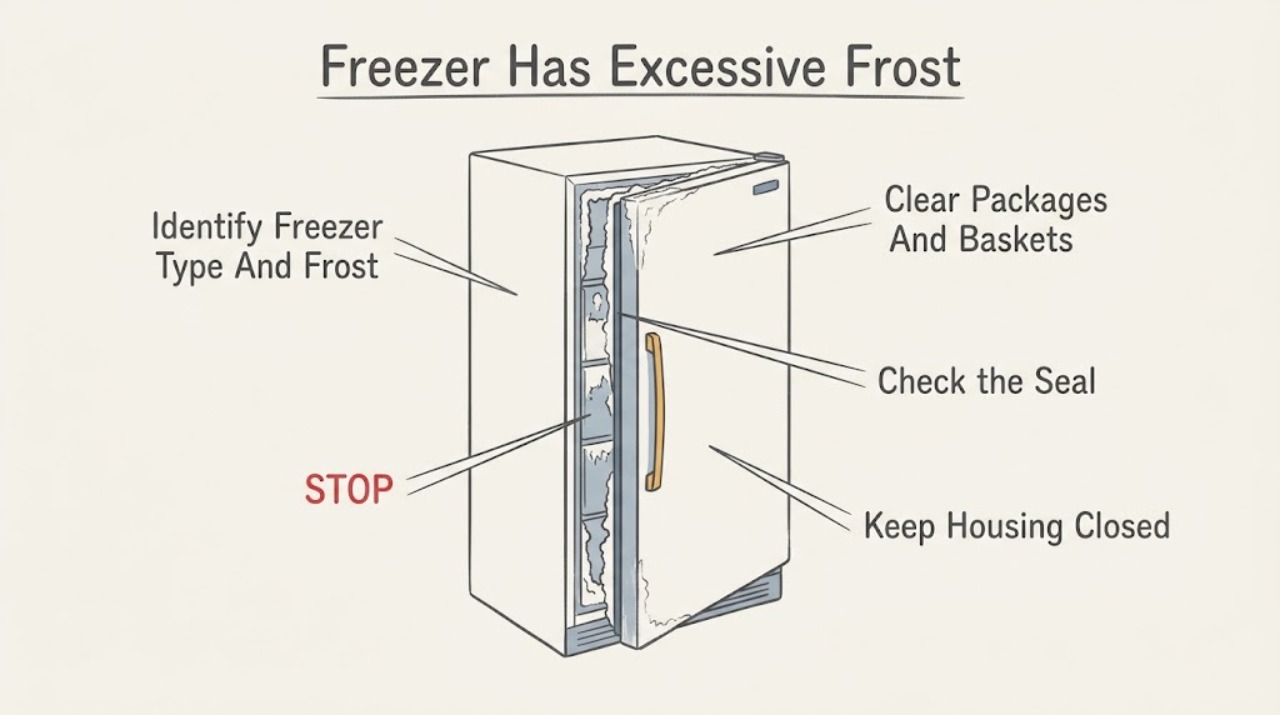
Work through in order
Diagnostic checks
Use only checks that match the exact appliance or system and its official guide.
-
Check 1
Identify whether the GE appliance is an upright or chest freezer, a refrigerator with a freezer, and whether the model is manual-defrost or frost-free by reading the normal product label or owner information. Observe whether frost is on the walls, packages, evaporator cover area, door edge or one localized strip; do not remove an interior panel.
Expected result: The model is manual-defrost, the appliance is frost-free, frost is a thin local line, frost covers a broad wall, or frost is mainly on packages.
Next step: Record the model type and frost location, then use the matching door, gasket, usage and defrost checks below. Do not assume a frost-free appliance can be safely cleared by opening panels or heating hidden parts.
Stop if: Stop if the liner, wiring, cord or interior panel is damaged, or if ice blocks access and would require a sharp or heated tool.
Why this matters
Why: A manual-defrost model can accumulate frost as part of normal operation and needs its model-specific defrost interval. A local line makes air leakage or a door seal more likely; broad frost can follow warm humid air, use patterns or a defrost fault; crystals only on packages may reflect food moisture rather than an appliance failure.
-
Check 2
Open the freezer briefly and check the door shelves, baskets, drawers, shelves and packages for anything protruding into the gasket path or resting against the rear wall. For a bottom-freezer drawer, verify that the lower basket is seated in its slides; remove or reposition only loose items.
Expected result: A package, shelf, bin or basket prevents full closure, or all storage parts are in their intended positions with no contact.
Next step: Close the door normally after clearing the obstruction and observe whether the frost source and perimeter contact improve over subsequent use. If heavy frost persists, continue to the gasket and alignment checks rather than forcing the door.
Stop if: Do not force a drawer, bend a basket, remove fixed rails, or pry away ice that is holding a part in place.
Why this matters
Why: A contact point can hold a good door or drawer open and create frost from air infiltration. If the path is clear, a gasket, door alignment, level, usage or defrost issue becomes more likely.
-
Check 3
Inspect the complete door or drawer gasket and the cabinet mating surface for cuts, tears, splits, dirt, folds, gaps, a section out of its groove or uneven contact. Clean only the accessible gasket with a soft damp cloth and dry it; do not use abrasive chemicals or remove the gasket as a trial.
Expected result: The gasket is dirty but intact, a section is folded or out of position, the gasket has a cut or tear, or it does not touch evenly around the perimeter.
Next step: Close the appliance normally and repeat a visual or paper contact check at several points. Arrange service if a damaged gasket or repeatable gap remains; do not glue, stretch or trim the seal.
Stop if: Stop if cleaning exposes a sharp liner edge, wet electrical area, damaged insulation or a gasket that will not remain seated without force.
Why this matters
Why: Dirt or a fold can interrupt contact and may improve after gentle cleaning. A cut, tear, permanent distortion or uneven contact points toward a gasket, door, hinge or drawer-alignment service need; it does not by itself identify the correct replacement part.
-
Check 4
Review recent use without changing internal components: frequent or prolonged door openings, warm or uncovered food, packages pressed against the rear wall, blocked vents, or unusually humid room conditions. Keep foods covered and allow clear space for the model's normal air circulation without packing items against the door or rear wall.
Expected result: The frost began after a warm load, frequent openings, high humidity or blocked circulation, or none of these patterns is present.
Next step: Minimize openings and observe whether frost stops increasing over the next normal operating period. If it does not improve, keep the door closed and arrange service rather than repeatedly changing the temperature control.
Stop if: Do not block vents, overpack the freezer, place warm uncovered food against the wall, or keep opening the door to monitor frost.
Why this matters
Why: A use-related moisture load can cause temporary frost and should improve after the door path and airflow are corrected. If the freezer is used normally and frost is localized at the seal or quickly returns, an appliance fault is more likely.
-
Check 5
View the freezer or refrigerator from the front and side. Note whether the cabinet rocks, the door or drawer sits unevenly, the gap is wider on one side, the door fails to close by itself, or the issue began after installation or moving. Do not loosen hinges, remove a drawer front or change leveling hardware unless the exact GE instructions direct it.
Expected result: The cabinet is unstable or not level, the door is visibly sagging or uneven, a drawer is not seated, or alignment appears normal.
Next step: Record which side or corner has the gap and any installation history. Use the model installation instructions or qualified service for leveling and door adjustment; do not compensate by forcing or leaning the appliance.
Stop if: Stop if the cabinet could tip, a hinge or rail is bent or loose, the door is unsupported, or adjustment requires removing powered panels.
Why this matters
Why: Improper leveling, door alignment or a drawer that is not seated can prevent gasket contact even when the gasket looks good. A stable, aligned cabinet with a local gap shifts suspicion toward the gasket or another sealing surface.
-
Check 6
After the external checks, record whether the freezer is manual-defrost or frost-free, whether frost returns, whether the fan is audible during normal operation without touching it, whether food is warming, and whether the gasket and door remain sealed. Do not open the evaporator cover or test a heater, sensor, fan or control.
Expected result: Manual-defrost frost improves only after the model's safe defrost procedure, frost-free frost returns, the fan is silent or abnormal, food is warming, or the problem is resolved.
Next step: Arrange qualified GE appliance service for recurring heavy frost, a silent fan, warming food or an unresolved seal. Provide the model, frost pattern, gasket results, door alignment, usage history and any safe defrost already completed.
Stop if: Stop the appliance and seek urgent appliance or electrical help for smoke, burning smell, sparks, a damaged cord, water near controls, a punctured liner or a cabinet that is unsafe.
Why this matters
Why: Manual-defrost maintenance can be appropriate only under the owner manual. Returning frost on a frost-free model, an abnormal or absent fan, or warming food can indicate a fan, automatic-defrost, temperature-control or sealed-system issue that external checks cannot diagnose.
Use your observations
Decision map
Find the observation that best matches what you see, then follow the next safe action.
-
PATH 01Safety boundary
What you see
Do this next
Reposition only the loose item, seat the basket or drawer normally and monitor whether new frost stops increasing. Arrange service if closure remains uneven after the path is clear.
Why this path and its safety boundary
Why it matters: The obstruction is more likely than a failed gasket and can admit warm moist air that freezes near the opening.
Safety stop: Do not force the drawer, bend storage parts, or pry ice away from the liner.
-
PATH 02Safety boundary
What you see
Do this next
Clean the accessible gasket gently, document the gap side and arrange model-specific GE service if contact is not restored. Do not stretch, glue, trim or replace the seal by appearance alone.
Why this path and its safety boundary
Why it matters: A gasket, door, hinge, drawer alignment or cabinet-level issue is more likely than a defrost-system fault; a visible tear does not rule out an alignment contribution.
Safety stop: Stop if the door is unstable, the liner is damaged or any adjustment requires removing a panel.
-
PATH 03Safety boundary
What you see
Do this next
Keep the door closed, cover warm food, restore clear air space and observe the normal operating pattern. If heavy frost does not recede or returns quickly, arrange service.
Why this path and its safety boundary
Why it matters: A temporary moisture load or blocked air path is more likely than a failed component.
Safety stop: Do not repeatedly open the freezer, block vents or use sharp or heated tools to accelerate frost removal.
-
PATH 04Safety boundary
What you see
Do this next
Keep the door closed and arrange qualified GE appliance service for internal diagnosis. Do not open the evaporator cover or test a heater, sensor, fan or wiring.
Why this path and its safety boundary
Why it matters: A fan, automatic-defrost, temperature-control or another internal fault is more likely than a user-correctable seal issue.
Safety stop: Stop for smoke, burning smell, sparks, damaged wiring, a damaged cord, water near controls or a warming freezer.
-
PATH 05Safety boundary
What you see
Do this next
Follow only the exact model's manual-defrost instructions or arrange service. Protect food under local food-safety guidance and provide the model, frost history and temperature symptoms to the technician.
Why this path and its safety boundary
Why it matters: A manual-defrost cycle may be part of ordinary maintenance when the owner manual calls for it, but warming or recurring frost can indicate a seal, defrost, fan, control or sealed-system issue.
Safety stop: Do not chip, puncture or heat the liner, and do not continue operation if electrical, cord, insulation or cabinet damage is present.
Helpful context
Understand the symptom
Separate normal crystals from excessive frost
A small amount of frost or crystals on food can result from moisture in food or warm air entering during normal use. A thick wall layer, a repeating frost line around the door, blocked baskets, or frost that returns soon after clearing indicates a sealing, usage, airflow or defrost question. The freezer type matters: a manual-defrost model and a frost-free upright do not have the same maintenance path.
Start at the door before opening panels
GE's external checks begin with the door or drawer, its gasket, the placement of shelves and baskets, and cabinet level. A package holding the door open can create the same frost pattern as a damaged gasket. Inspect the full perimeter and observe the pattern without removing panels or working on powered parts.
Do not turn frost into a liner or electrical repair
Never chip frost with a knife, puncture the liner, or probe a heater, fan or wiring. For manual-defrost equipment, follow the exact owner manual; for frost-free equipment, recurring heavy frost after the external checks is a service symptom. Keep food cold and limit door openings while arranging help.
Safety boundary
Stop conditions
- Stop and disconnect power only when safe for smoke, burning smell, sparks, a damaged cord or water near electrical controls; leave the area and obtain appliance or electrical help.
- Do not chip frost with a knife, puncture the liner, use a heat gun or hair dryer, pour hot water into the freezer, or open sealed refrigeration components.
- Do not remove evaporator covers, test defrost heaters or fans, probe wiring, force a drawer, bend a door, loosen hinges or replace a gasket without model-specific instructions.
- Keep the door closed and arrange service when heavy frost continues after the door path, gasket, usage and alignment checks, when the freezer is warming, or when an internal fan or defrost symptom appears.
- Use the exact GE owner or installation instructions, or a qualified technician, for manual defrost, leveling, door adjustment, gasket replacement, fan or defrost work and sealed-system diagnosis.
Only after diagnosis
Potential parts
- GE freezer door or drawer gasket
Consider this part only if the gasket is cut, torn, permanently distorted or unable to seal after the door path and alignment are confirmed.
Gasket profile, mounting and dimensions vary by exact GE model and door or drawer design; confirm model fit before ordering. - GE freezer door hinge, drawer rail or alignment hardware
Consider this category only when qualified diagnosis finds a sagging door, uneven gap, unseated drawer or damaged hinge or rail rather than a gasket-only issue.
Orientation, rail geometry, hinge hardware and fasteners are model-specific; do not substitute by appearance. - GE freezer evaporator fan assembly
Consider this part only when a qualified technician confirms an abnormal or nonoperating freezer fan after the door-seal and frost causes are evaluated.
Fan motor, blade, harness and mounting vary by exact model; internal access and electrical diagnosis require qualified service. - GE freezer defrost or temperature-control component
Consider this category only when heavy frost returns on a frost-free model and qualified diagnosis identifies a heater, sensor, timer, adaptive control or related fault.
Control and defrost parts are model-specific and must be diagnosed and installed using the exact service information.
When checks do not resolve it
Need a professional?
Arrange qualified GE appliance service when excessive frost remains after clearing packages, checking the gasket and correcting safe usage causes; when frost returns on a frost-free model; when the fan is abnormal; when the door or drawer is uneven; or when food is warming. Provide the exact model and serial information if safely visible, appliance type, frost location, gasket and paper-contact results, door alignment, usage history and any model-directed defrost completed. Seek urgent appliance or electrical help for smoke, burning smell, sparks, a damaged cord, water near controls, a punctured liner or an unsafe cabinet.
Safety scope: This article supports only normal storage clearing, accessible gasket cleaning, visual inspection, safe usage changes, model identification and recording frost behavior. Defrost heater, fan, sensor, control, electrical, sealed-system, door-hinge and internal-panel work require qualified service or exact model instructions.
Common questions
FAQ
Why does my GE freezer have excessive frost?
The most useful first checks are the door or drawer path, gasket contact, opening and food-loading habits, air circulation and cabinet alignment. GE lists warm moist air, packages or shelves holding the door open, warm food, damaged gaskets and uneven doors as causes. If a frost-free model continues to build heavy frost after those checks, service may be needed.
Can a package cause frost in a GE freezer?
Yes. A package, shelf, bin or basket can keep a door or drawer from sealing, allowing warm moist air to enter and freeze near the opening. Clear only loose obstructions and verify the basket or drawer is seated; do not force the door or pry ice from the liner.
How do I know whether the GE freezer gasket is the problem?
Inspect the full gasket for cuts, tears, folds, dirt, a section out of its groove and uneven contact. A local frost line or repeatable gap makes a seal or alignment problem more likely, but a visible gasket defect does not identify the exact replacement or rule out a door issue. Arrange model-specific service if cleaning and clearing the path do not restore contact.
Should I manually defrost a GE freezer with heavy frost?
Only if the exact model is a manual-defrost appliance and its owner instructions call for that procedure. A frost-free appliance with recurring heavy frost may have a seal, fan or automatic-defrost problem. Never chip ice, puncture the liner or heat hidden components; use the model manual or qualified service.
When does excessive GE freezer frost require a technician?
Arrange service when frost returns after the door path, gasket, usage and alignment checks; when a frost-free model has heavy wall ice; when the fan is not operating normally; or when food is warming. Seek urgent appliance or electrical help for smoke, burning smell, sparks, a damaged cord, water near controls or a damaged liner.
Read the exact guide
Official sources
- Bottom Freezer Refrigerator - Freezer Drawer Not Sealing ProperlyGE Appliances · Official GE support guidance for a bottom-freezer drawer; used for storage obstruction, lower-basket seating, gasket groove and even-contact observations, not as a universal adjustment procedure for every GE model.
- Refrigerator & Freezer - Ice on Freezer WallGE Appliances · Official GE refrigerator and freezer support guidance used for wall-frost causes, gasket checks, fan escalation and the power-isolation boundary for maintenance.
- Refrigerator Manual Defrost Excessive FrostGE Appliances · Official GE support page for manual-defrost refrigerator freezers; used only to distinguish manual-defrost maintenance from frost-free diagnosis and to defer the exact procedure to the model manual.
- Refrigerator - Automatic Defrost SystemGE Appliances · Official GE explanation of automatic defrost in full-sized refrigerators, used to distinguish frost-free operation from user manual defrost and to keep heater, fan and control work within service.
- Refrigerator - Frost or Ice Crystals on Food in FreezerGE Appliances · Official GE support guidance for frost or ice crystals in a refrigerator freezer compartment; used for distinguishing package and usage causes from persistent heavy frost.
- Refrigerator - Frost in FreezerGE Appliances · Official GE support page for frost in a refrigerator's freezer section; used for gasket damage, door alignment, leveling and recurring-frost escalation.
- Upright & Chest Freezer - Not WorkingGE Appliances · Official GE support page used only for the broader internal-fault boundary when a freezer is warming or a temperature or defrost control may be involved.
Community feedback
Share a repair observation
Share a plain-text repair observation. Accepted observations are published automatically; this page may take a moment to update.