
On this page
Start here
Quick answer
A GE freezer leak can come from normal defrost water, a blocked or displaced defrost drain, an overflowing drain pan, frost caused by a door or lid that is not sealing, or—on a refrigerator-freezer with an ice maker or water connection—a valve, fill tube, or supply-line leak. First identify whether the water starts inside the freezer, at the door or lid edge, under the cabinet, or at an external water connection. Keep food cold and the door closed as much as practical, protect the floor, and disconnect power only from a dry, safe location before maintenance or cleaning. Do not chip frost with a sharp tool, use an electrical heater, remove panels, reach into wiring, or improvise a drain repair. If water reaches an outlet or electrical part, the cabinet is unstable, the leak is active, food is warming, or the source remains unclear after safe visual checks, stop using the unit and arrange qualified appliance service.
Before you begin
Safety first
- This article supports dry, ordinary-access observation and an obvious loose-load correction only. The technician handles drain access, defrost components, water valves and tubing, electrical testing, cabinet movement, panels, and refrigeration work.
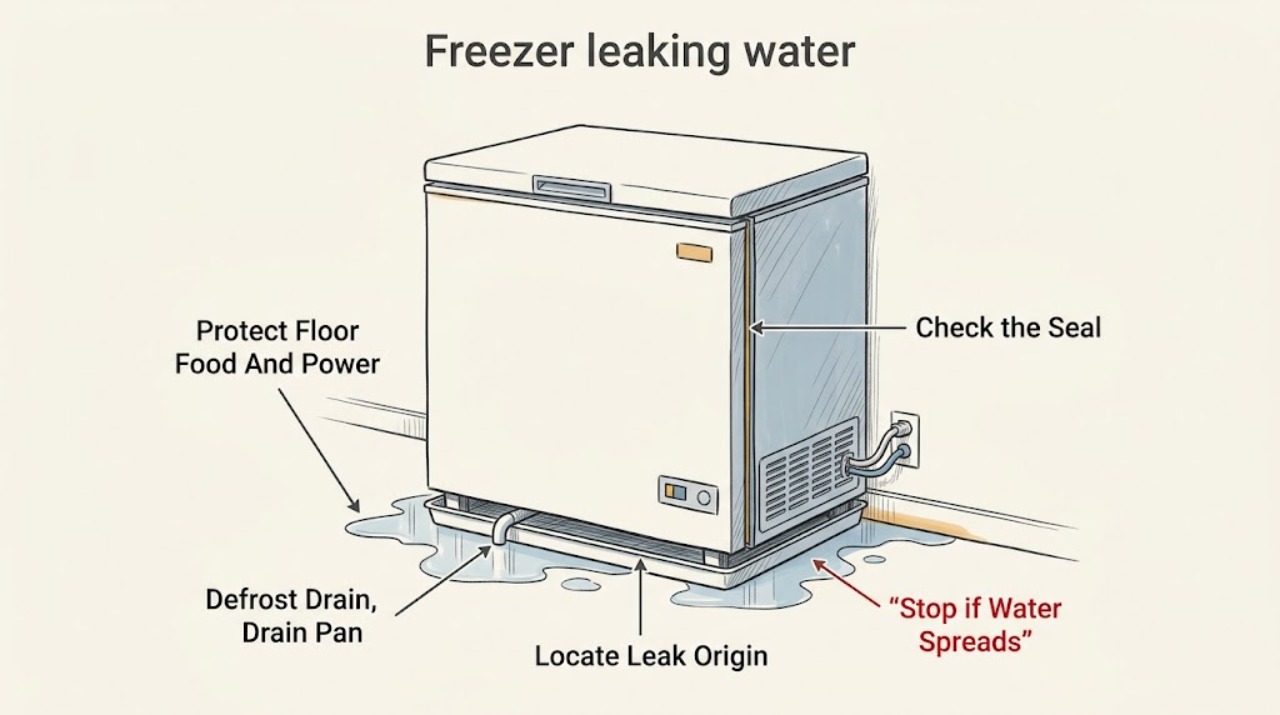
Work through in order
Diagnostic checks
Use only checks that match the exact appliance or system and its official guide.
-
Check 1
From a dry, stable position, note the size and location of the puddle, protect the walking area with towels placed without reaching through water, and look for water touching an outlet, cord, plug, light, control, or other electrical part. Keep the freezer door or lid closed except for a brief safe inspection.
Expected result: The water is confined to a dry, accessible floor area and no electrical part is wet, or water is active, spreading toward electricity, the cabinet is unstable, or food temperature is rising.
Next step: If water is near electricity, do not touch the appliance or wet area; shut power off only from a dry, safe location if that can be done without approach, then obtain qualified appliance or electrical help. Keep the door closed and protect food while arranging service for active leaks or warming contents.
Stop if: Do not step into pooled water, pull the freezer out, touch a wet plug or outlet, or continue cleaning if water reaches electrical equipment.
Why this matters
Why: A contained puddle permits source identification from outside. Water near electricity, an unstable cabinet, an active leak, or warming food is a stop condition rather than a routine drain check.
-
Check 2
Wipe only the accessible exterior dry, then observe without moving the freezer whether water reappears on the freezer floor, at the door or lid gasket, beneath the cabinet, from a rear or front drain area, or at a refrigerator-freezer water connection.
Expected result: The source is inside the freezer, follows the door or lid edge, appears underneath during a defrost event, or is localized to an external valve, fill tube, or supply line; note whether the unit is upright, chest, or part of a refrigerator-freezer.
Next step: Photograph the source and identify the model and freezer type. Use the exact GE manual for any explicitly permitted drain or defrost step; arrange service when the source is hidden, active, or requires moving or disassembly.
Stop if: Do not pull the cabinet from the wall, remove a grille or panel, or disconnect a water line to trace the leak.
Why this matters
Why: Inside-floor water supports a defrost drain or frost path; an edge leak supports gasket, loading, or alignment; water under the unit supports a pan or drain path; a water connection supports an ice-maker or plumbing diagnosis. A normal drip sound alone can occur during frost-free defrosting.
-
Check 3
With the door or lid open only briefly, inspect the gasket path, door or lid corners, shelves, baskets, packages, and visible frost for a protruding item, a gasket that is dirty or folded, a gap, or a frost ridge that prevents full closure.
Expected result: A package or basket is out of position, the gasket has surface soil or a loose-looking edge, the gasket or lid is visibly damaged, or frost blocks the closure path.
Next step: Remove only an obvious loose obstruction without force and close the door. Follow the exact GE manual for cleaning or manual defrost, or request service if frost is thick, the gasket is damaged, or the lid cannot close evenly.
Stop if: Do not force the door or lid, stretch or glue the gasket, chip frost with a knife or ice pick, use an electrical defrost device, or pour boiling water inside.
Why this matters
Why: A load obstruction or gasket-contact problem can admit warm air and create condensation or frost that later melts as water. A damaged gasket, warped lid, or frost that returns is not proven by appearance alone and may require service.
-
Check 4
Use the complete model number to check GE's owner-manual guidance and determine whether the unit is a self-defrost upright with a drain tube, a manual-defrost chest or upright model with a drain plug, or a refrigerator-freezer whose drain is inside the appliance.
Expected result: The manual identifies a drain tube or pan, a drain plug and manual-defrost procedure, or no owner-accessible drain path; the manual is missing or the model type cannot be confirmed.
Next step: Follow only the exact model's external drain or defrost instructions, with power disconnected as the manual requires and food protected. If the drain is behind a panel, under the cabinet, or inaccessible without moving the unit, arrange qualified service.
Stop if: Do not assume every GE freezer has a drain tube, remove an unidentified plug, dismantle the interior, or force a grille, hose, or cap.
Why this matters
Why: GE states that self-defrost and manual-defrost freezers use different water paths, and some older models differ from current models. An unknown layout makes a generic drain-clearing instruction unsafe.
-
Check 5
From safe exterior access only, observe whether the drain pan or drain area overflows during or after defrosting, and on a refrigerator-freezer check for water at the visible ice-maker fill tube, valve area, or supply connection without touching wet electrical parts or loosening fittings.
Expected result: The pan overflows, water returns from the drain area, the drain tube or plug is displaced, or the leak is concentrated at a water connection; alternatively, no external source is visible.
Next step: Use the exact manual for any clearly identified external drain cap or plug, or arrange qualified service for a blocked, hidden, overflowing, or water-connection leak. If a supply line is visibly split or spraying, stop the water from a dry, safe shutoff location only if the model and installation provide one, then obtain service.
Stop if: Do not remove panels, flush an unidentified tube, tighten fittings beside live electrical parts, move the appliance, or run a water/defrost test to make the leak recur.
Why this matters
Why: Overflow or a displaced drain path supports a drainage problem; a water-line or valve leak supports a plumbing or ice-maker service path. No visible source after a safe check points to concealed drainage, cabinet damage, or an internal component.
-
Check 6
After any safe obstruction correction and without repeated door openings, monitor the freezer temperature, frost or condensation recurrence, and whether water returns; record the model, leak timing, source location, and food-protection steps.
Expected result: The leak stops and the freezer holds its normal temperature, or water returns, frost grows, an alarm appears, food softens, or the unit cannot maintain temperature.
Next step: Keep the door closed, follow federal food-safety guidance for any thawed food, and arrange qualified service for recurrence, warming, an alarm, or an unknown source. Give the technician the photos and exact sequence.
Stop if: Do not keep operating a freezer with an active leak, warming food, wet electrical area, repeated alarm, or worsening frost while waiting for a part.
Why this matters
Why: A one-time drip during a documented defrost cycle may be normal, but recurring water, frost, or temperature loss indicates an unresolved drain, seal, pan, defrost, cooling, or water-supply issue.
Use your observations
Decision map
Find the observation that best matches what you see, then follow the next safe action.
-
PATH 01Next step
What you see
The unit is a frost-free model, water is heard or seen only during the defrost cycle, the drain path and pan remain contained, and there is no puddle, recurring floor ice, or temperature rise.
Do this next
Continue normal observation and keep the drain and cabinet area clear. Arrange service if water escapes the pan, returns outside the cycle, or temperature changes.
Why this path and its safety boundary
Why it matters: GE describes water dripping into a defrost pan during automatic defrost as a normal operation sound; a contained drip is different from a leak onto the floor.
-
PATH 02Next step
What you see
Water or ice is on the freezer floor or underneath, the leak returns after defrosting, and the door or lid appears to close normally without a clear external water-line source.
Do this next
Use only the exact model manual for an owner-accessible drain or defrost procedure; otherwise keep the unit closed and request qualified service.
Why this path and its safety boundary
Why it matters: A clogged, frozen, displaced, or inaccessible defrost drain or pan becomes more likely. GE notes that many models require service to access or correct the drain.
-
PATH 03Next step
What you see
The leak begins at the door or lid edge, packages or baskets can hold the closure open, the gasket is dirty or damaged, or frost forms along the contact path.
Do this next
Correct only a loose loading obstruction without force, then follow the model-specific gasket and defrost guidance. Have service assess a torn gasket, warped lid, persistent frost, or temperature rise.
Why this path and its safety boundary
Why it matters: Warm, moist air entering through a loading or gasket-contact problem can create frost and later melt as water. The visible water does not prove the drain is the primary fault.
-
PATH 04Next step
What you see
The freezer is part of a refrigerator-freezer and water appears at the rear valve, fill tube, or supply connection rather than at the defrost path.
Do this next
Do not touch wet electrical components. If a safe, accessible shutoff is available, use the exact installation guidance to stop water and arrange appliance or plumbing service.
Why this path and its safety boundary
Why it matters: The leak is more consistent with the ice-maker water system or household supply than with a standalone freezer drain.
-
PATH 05Next step
What you see
Water reaches an outlet or wiring, the cabinet is unstable, the leak is active or spreading, a temperature alarm sounds, food is softening, or the source cannot be safely identified.
Do this next
Stop using the unit, keep people away from the wet area, preserve food only from a safe position, and obtain qualified appliance, electrical, or plumbing help.
Why this path and its safety boundary
Why it matters: Electrical, structural, and food-safety risks take priority over identifying a drain or ordering a part.
Helpful context
Understand the symptom
First identify where the water begins
The same puddle can have different causes. Water or ice on the freezer floor points toward defrost drainage or a heavy frost event; water that appears during a defrost cycle and ends in the pan may be normal for a frost-free model. A wet gasket or lid edge points toward warm-air entry and condensation. Water only at the back of a refrigerator-freezer with an ice maker points toward the water valve, fill tube, or supply connection rather than the freezer drain. Wipe the outside dry and observe from a safe position without pulling the appliance or opening panels.
GE freezer types do not share one drain layout
GE says current upright freezers are self-defrost models with a defrost drain tube and pan, while chest freezers are manual-defrost models and do not have that same drain-tube arrangement. Older upright models can differ, so the model manual controls the safe procedure. Do not assume a visible puddle means the drain plug, grille, pan, or tube can be removed; the correct access and whether service is required depend on the freezer type and exact model.
A water leak can become a food-safety problem
A leak that follows a door or lid gap can admit warm, moist air and increase frost, while a blocked drain can leave ice or water inside the cabinet. Keep openings brief and monitor the freezer temperature with an appliance thermometer if one is present. If food has partially thawed, follow the federal food-safety guidance for temperature and ice-crystal decisions rather than tasting it. Water at the floor or near an outlet is also an electrical hazard and should not be cleaned by reaching through a wet area.
Do not turn a drain check into an appliance repair
GE's support material directs owners to the exact manual for drain and defrost instructions and notes that many drain problems require service. A drain opening that cannot be seen without removing a panel, a frozen drain that returns after defrosting, a damaged pan, or a leak from a water valve or tube needs model-specific diagnosis. Dry the accessible floor and document the source instead of probing the liner, moving the cabinet, or replacing a part based on a generic diagram.
Safety boundary
Stop conditions
- Stop and obtain qualified help if water reaches an outlet, cord, plug, light, control, or other electrical part; do not touch a wet appliance or outlet.
- Do not chip frost with an ice pick, knife, or sharp-edged tool, use an electrical defrost device, pour boiling water into the cabinet, or probe the liner.
- Do not pull or tip the freezer, remove panels or grilles, disconnect unidentified tubing, or clear a hidden drain without the exact model procedure and safe access.
- If water returns, food warms, frost grows, an alarm appears, the cabinet is unstable, or the leak source remains unknown after safe visual checks, keep the door closed and arrange service.
Only after diagnosis
Potential parts
- defrost drain tube, plug, or drain pan
Consider only after a model-specific diagnosis confirms a blocked, displaced, cracked, or overflowing drain path or pan.
Confirm the complete GE model, freezer type, and exact manual or manufacturer fit information; manual-defrost and self-defrost designs are not interchangeable. - freezer door or lid gasket
Consider only when a torn, hardened, displaced, or permanently deformed gasket prevents closure and creates recurring frost or condensation.
Confirm the exact GE model and approved fit; a similar profile or dimension does not establish compatibility. - ice-maker water valve or fill tube
Consider only when a refrigerator-freezer leak is localized to the ice-maker fill path or valve and a qualified diagnosis confirms the component.
Verify model-specific water-system fit and installation requirements; do not work on wet or energized components. - freezer leveler or door hardware
Consider only when the cabinet or door is visibly out of alignment and a qualified assessment confirms that level or hardware contributes to the seal failure.
Confirm the model and safe support procedure; do not tip or move the freezer from a generic instruction.
When checks do not resolve it
Need a professional?
Call qualified appliance service for recurring or active water, ice or water on the freezer floor, an overflowing or inaccessible drain, a damaged gasket or cabinet, a water-valve or fill-tube leak, warming food, an alarm, or any repair requiring movement, panel access, electrical work, or refrigeration work. Use a plumber for a confirmed household supply-line leak and emergency or electrical help when water reaches electricity.
Safety scope: This article supports dry, ordinary-access observation and an obvious loose-load correction only. The technician handles drain access, defrost components, water valves and tubing, electrical testing, cabinet movement, panels, and refrigeration work.
Common questions
FAQ
Is water dripping inside a GE freezer always a failure?
No. GE says a frost-free upright or chest freezer can drip water into its defrost pan during the automatic defrost cycle, and that sound can be normal. Water on the floor, recurring ice, an overflowing pan, or water outside the contained drain path is different and needs diagnosis.
Does every GE freezer have a defrost drain tube?
No. GE distinguishes current upright freezers, which are self-defrost and have a drain tube and pan, from chest freezers, which are manual-defrost and do not use that same arrangement. Older models can differ, so check the exact owner's manual before looking for a drain.
Can I use a knife or an electric heater to remove the ice causing the leak?
No. GE's manual guidance warns against an ice pick or sharp-edged instrument and against an electrical defrosting device. Follow the exact model's defrost instructions or arrange service; do not puncture the liner or improvise heat.
Why is water leaking from a GE refrigerator-freezer near the freezer?
If the leak is at the rear valve, ice-maker fill tube, or supply connection rather than the freezer floor or defrost path, the water system may be involved. Do not touch wet electrical parts or loosen fittings; use a safe shutoff only when the installation and manual make it accessible, then arrange appliance or plumbing service.
What should I do with food if my GE freezer has been leaking?
Keep the door closed and check an appliance thermometer if available. FoodSafety.gov says a full freezer generally holds a safe temperature for about 48 hours, or about 24 hours when half full, if the door remains closed. If food still has ice crystals and feels as cold as refrigerated, follow the federal chart for refreezing or cooking; never taste food to test safety.
Read the exact guide
Official sources
- Upright Freezer - Manual Defrosting InstructionsGE Appliances · GE manual-defrost upright freezer frost and drain guidance, with model-manual requirement
- Refrigerator - Water on FloorGE Appliances · GE appliance water-on-floor safety, clogged defrost-drain indicators, water-valve/fill-line checks, and service boundaries applicable to refrigerator-freezer water paths
- Upright & Chest Freezer - Explanation of a Water Dripping SoundGE Appliances · GE upright and chest freezer defrost-cycle water dripping and defrost pan behavior
- Owner's ManualGE Appliances · GE freezer owner manual safety, defrost, drain, frost, and water-path variation examples
- Food Safety in a Disaster or EmergencyFoodSafety.gov · U.S. government guidance for freezer temperatures, closed-door cold retention, and food decisions after warming or thawing
- Refrigerator & Freezer - Drain TubesGE Appliances · GE freezer drain-tube applicability by upright or chest and self-defrost versus manual-defrost type
Community feedback
Share a repair observation
Share a plain-text repair observation. Accepted observations are published automatically; this page may take a moment to update.