
On this page
Start here
Quick answer
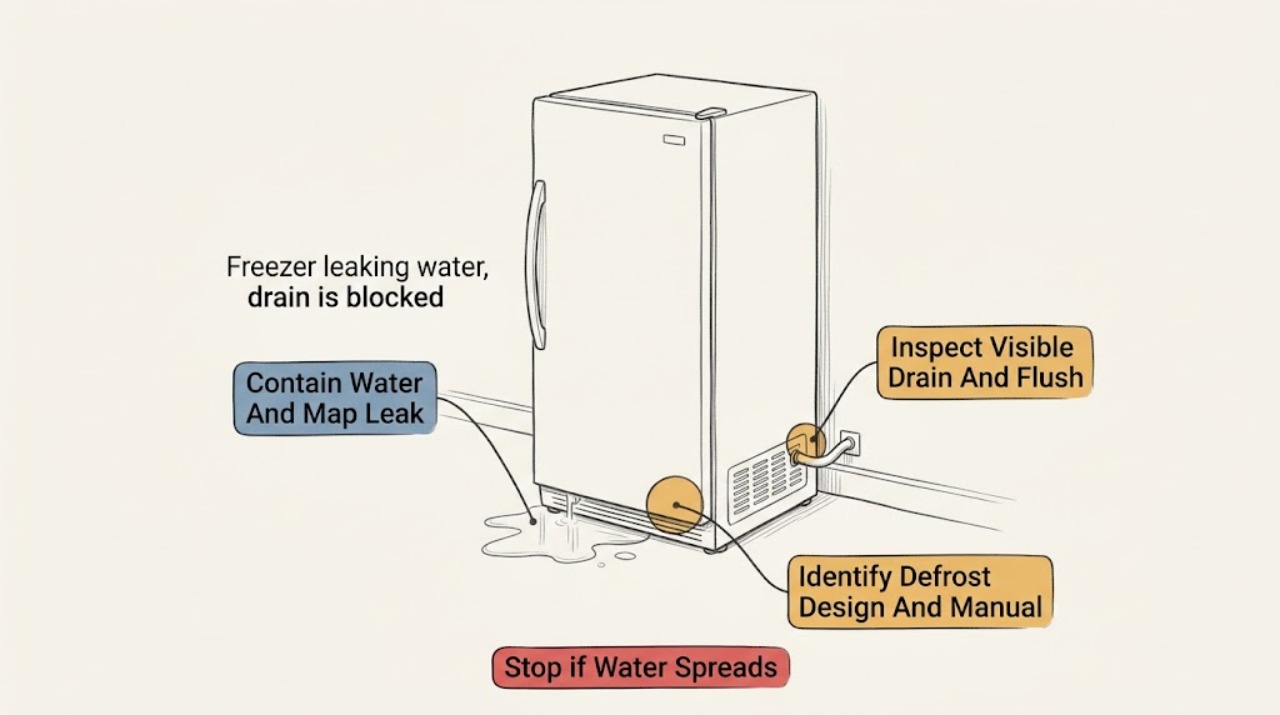
If a freezer is leaking because its defrost drain is blocked, first protect the floor and identify whether water is pooling inside the freezer, under a basket, in a refrigerator compartment, or at the front of the appliance. A self-defrost freezer normally sends meltwater through a drain tube to a pan; ice on the freezer floor plus a recurring puddle supports a blocked or frozen drain. Unplug the appliance only from a dry, safe position before cleaning, and follow the exact model manual: some freestanding models allow a visible drain hole to be flushed with warm water, while many built-in or hidden-panel designs require service. Do not use a knife, ice pick, heat gun, boiling water, chemicals, or a tool through the drain. Also rule out a torn door seal, a water-supply or icemaker leak, a full or damaged pan, and an appliance that is tipped forward. If water remains after a model-approved drain check, the drain is hidden, frost returns, food is warming, or any hose, electrical area, or floor is wet, keep the freezer off and call an appliance technician; shut off the water supply for an active plumbed leak.
Before you begin
Safety first
- This article supports containing water, identifying the freezer type, reading the model manual, inspecting dry accessible areas, clearing loose material at a manual-approved drain opening, and checking visible gasket, pan, leveling, and water-line clues. A qualified technician must handle hidden panels, drain heaters, defrost controls, wiring, pressurized water connections, sealed refrigeration work, and final leak and cooling checks.
Work through in order
Diagnostic checks
Use only checks that match the exact appliance or system and its official guide.
-
Check 1
Stop using the freezer temporarily, remove food from standing water only if it can be done safely, and place towels or a shallow pan to protect the floor. From a dry position, identify whether the water is inside the freezer, under the freezer basket, in a refrigerator compartment, at the front floor, or behind the appliance; do not reach into wet electrical areas.
Expected result: Record ice on the freezer floor, a puddle that returns during or after defrost, water under a drawer, water at the rear, a wet supply line, a full drip pan, a one-time spill, or food warming with heavy frost.
Next step: Keep water use and door opening low, protect the floor, and continue only with dry external observations. For an active supply leak, food warming, or water near electrical connections, unplug only if safe and arrange prompt appliance service.
Stop if: Do not drag the appliance across a wet floor, touch a wet plug or outlet, or keep operating when water reaches electrical parts or the freezer cannot hold food safely.
Why this matters
Why: Ice on the freezer floor with a recurring puddle makes a blocked or frozen defrost drain more likely. Rear or supply-line water points toward an icemaker or dispenser connection. Heavy frost and warming can indicate a door-seal or defrost-system fault that may be producing excess water rather than a simple opening clog.
-
Check 2
Identify whether the appliance is a self-defrost upright, a refrigerator-freezer combination, a manual-defrost chest freezer, or a built-in model. Record the model information from the rating label if safely visible and read the owner manual for the location and permitted access to a drain hole, drain plug, panel, or drip pan.
Expected result: Record a visible drain hole or plug, a drain hidden behind a panel, no drain system, a built-in or tightly fitted appliance, or no accessible model information.
Next step: Follow the manual's access boundary. If the manual does not authorize homeowner clearing, the drain is hidden, or the appliance must be pulled out or dismantled, keep it off and arrange service.
Stop if: Do not remove an interior or rear panel without model instructions, puncture insulation, or assume that another freezer's drain location or procedure applies.
Why this matters
Why: A self-defrost appliance normally has a drain path, while a manual-defrost chest freezer may use a removable plug instead. A hidden drain or a built-in design changes the task to model-specific service; no visible hole does not justify removing a panel by guesswork.
-
Check 3
If the exact manual identifies an accessible drain opening and the appliance is unplugged, remove only loose ice or debris at the opening with a soft cloth or plastic tool. If the manual permits flushing, use a small amount of warm water or the specified method and keep the water away from wiring, lights, fans, and the floor.
Expected result: Record water draining freely to the pan, water standing at the opening, ice returning immediately, debris that will not release, water appearing inside the cabinet, or no visible drain opening.
Next step: Reassemble only what the manual says to replace, dry the compartment, restore power when safe, and monitor one defrost interval. If water does not flow, returns, or the manual requires a panel, keep the freezer off and call a technician.
Stop if: Do not use boiling water, a knife, ice pick, screwdriver, heat gun, chemicals, compressed air, or a probe through the drain; stop if water reaches electrical components.
Why this matters
Why: Free flow to the pan supports a local ice or debris blockage. Standing water or an immediate return of ice suggests a frozen or obstructed tube, a drain-heater or defrost issue, or a path that needs deeper service. No visible opening means the model's access boundary has been reached.
-
Check 4
From outside the appliance, inspect the accessible drip pan for overflow, cracks, or displacement, check that the freezer is not tipped forward, and examine the door gasket for gaps, tears, food debris, or a door that fails to close. Do not remove a pan or adjust leveling parts unless the model manual permits it.
Expected result: Record a full or cracked pan, water at the front edge, a freezer tipped forward, a gasket that does not contact the frame, heavy frost around the door, or a pan and seal that look normal.
Next step: Remove only loose food or debris from the gasket and close the door normally. For a damaged pan, poor seal, recurring frost, or a leveling problem that needs tools, arrange model-specific service.
Stop if: Do not force the door, heat the gasket, bend hinges, pull a heavy freezer alone, or operate with a cracked pan or severe frost that blocks the seal.
Why this matters
Why: An overflowing or damaged pan can leak even when the drain is open. A forward tilt or poor gasket can keep the door from sealing and create excess frost and meltwater. Normal pan, level, and gasket observations keep the blocked drain or hidden defrost-system path more likely.
-
Check 5
If the appliance has an icemaker, dispenser, or plumbed water supply, inspect the visible tubing, fill connection, valve area, and rear hose from a dry position. If a supply leak is active, turn off the appliance water valve only if it is accessible and operates without force; unplug the appliance only from a dry, safe position.
Expected result: Record a dry water line, a loose or split tube, a leaking valve or fitting, water near the icemaker fill area, a translucent ice blockage in a tube, or no water connection at all.
Next step: Shut off the water supply for an active line leak and arrange service. Do not disconnect tubing or attempt to thaw a hidden water line with a flame or high heat.
Stop if: Do not pull the appliance while the water line is taut, loosen a pressurized fitting, use a torch or heat gun, or leave an active line leak running.
Why this matters
Why: A wet supply line, valve, or fill tube can produce floor water independently of a defrost drain. A dry plumbed path with ice on the freezer floor keeps the defrost-drain branch more likely; a tube blockage or damaged fitting needs appliance or plumbing service.
-
Check 6
Record the appliance model, freezer type, location of water, ice and frost pattern, drain or pan result, door-seal result, water-line result, and whether the leak returns during defrost. Keep food in a safe cold-storage alternative if the freezer is off or warming.
Expected result: Provide whether the visible drain flushed freely, water backed up, ice returned, the pan overflowed, the gasket leaked, the supply line leaked, or the drain and external checks were normal.
Next step: Arrange qualified appliance service for a hidden or recurring blockage, water that remains after a model-approved flush, heavy frost or warming, a damaged pan or gasket, an inaccessible appliance, or any active supply leak. Provide the model and the full symptom sequence.
Stop if: Do not order a drain heater, pan, gasket, valve, or tube from the symptom alone, and do not keep restarting a freezer that is leaking into electrical areas.
Why this matters
Why: These observations separate a visible drain blockage from a hidden drain tube, drain-heater or defrost fault, pan or leveling issue, door-seal problem, and water-supply leak. They do not identify a compatible heater, pan, gasket, valve, or tube without the model.
Use your observations
Decision map
Find the observation that best matches what you see, then follow the next safe action.
-
PATH 01Safety boundary
What you see
The freezer is a self-defrost design, ice is on the freezer floor, the model manual permits access, and warm water or the approved method flows freely to the pan.
Do this next
Dry the compartment, reinstall any required cover or plug, restore power safely, and monitor for a return of water. If the blockage returns, arrange service for the deeper tube or defrost system.
Why this path and its safety boundary
Why it matters: A local ice or debris blockage is more likely than a failed pan or supply line.
Safety stop: Do not repeat flushing with tools or chemicals when the drain freezes again.
-
PATH 02Safety boundary
What you see
Water remains at the drain opening, the drain freezes again, water does not reach the pan, the drain is behind a panel, or the appliance is built in or a model-specific manual requires service.
Do this next
Keep the freezer off if water or frost is accumulating and arrange qualified appliance service. Give the technician the model, frost location, drain result, and timing of the leak.
Why this path and its safety boundary
Why it matters: A deeper drain-tube blockage, drain-heater or defrost fault, pan problem, or model-specific repair is more likely than a simple opening clog.
Safety stop: Do not remove hidden panels, puncture insulation, heat the evaporator area, or feed a rigid tool into the drain.
-
PATH 03Safety boundary
What you see
The drain appears open, but the gasket has a gap or heavy frost, the pan is cracked or overflowing, or the freezer is tipped forward and water reaches the front floor.
Do this next
Clear loose gasket debris and close the door normally if safe. Arrange model-specific service for a damaged seal or pan, recurring frost, or leveling work that needs tools.
Why this path and its safety boundary
Why it matters: A seal, pan, leveling, or excess-frost problem is more likely than a blocked drain alone, although a drain can still be partly restricted.
Safety stop: Do not force the door, bend hinges, pull the appliance alone, or operate with a cracked pan or severe frost.
-
PATH 04Safety boundary
What you see
The appliance has an icemaker or dispenser and water is wet at the fill tube, valve, rear hose, or a connection, while the defrost-drain area is not the source.
Do this next
Shut off the appliance water supply if it operates safely, protect the floor, and arrange appliance or plumbing service. Keep the freezer off if water reaches electrical areas.
Why this path and its safety boundary
Why it matters: A pressurized water-line, valve, fill-tube, or fitting leak is more likely than defrost water.
Safety stop: Do not loosen tubing, pull a taut line, apply heat, or continue operating an active supply leak.
-
PATH 05Safety boundary
What you see
The freezer is a manual-defrost chest model with a plug rather than a drain tube, the water source may be a spill, or the drain and external checks do not reproduce the leak.
Do this next
Follow the exact model manual for defrost drainage and use a dry observation to confirm the source. Arrange service if the source is uncertain, water returns, or cooling performance changes.
Why this path and its safety boundary
Why it matters: A blocked self-defrost drain may not be the correct diagnosis. The leak may be a drain-plug, pan, gasket, supply, spill, or another appliance condition.
Safety stop: Do not assume every freezer has a drain tube or pan, and do not remove a plug or panel by force.
Helpful context
Understand the symptom
Confirm that the water is from the freezer
A recurring puddle with ice on the freezer floor or under a basket is a useful clue for a defrost drain problem. A single spill, melted ice, a leaking icemaker line, or water from another appliance can look similar. Dry the area, note where the water returns, and avoid moving a full appliance across a wet floor just to inspect its rear.
Drain design depends on the freezer type
Self-defrost upright and refrigerator-freezer combinations commonly route meltwater through a drain tube to a pan. Manual-defrost chest freezers may instead have a drain plug and no drain tube or pan. GE notes that some models expose a drain hole while built-in and many freestanding designs require service, so the owner manual controls whether a panel or drain can be opened.
A blocked drain can be frozen, dirty, or obstructed farther down
Clearing visible ice at the drain opening does not prove that the tube is open. Warm meltwater must reach the pan without backing up, and a recurring freeze can indicate a deeper obstruction or a defrost-system fault. Use only the model-approved method and stop when the drain is hidden, the path does not flow, or water reaches electrical parts.
Other leaks can coexist with a blocked drain
A poor door seal can add frost and meltwater, a tipped-forward appliance can send water toward the floor, and a loose fill tube or supply connection can leak independently of defrost water. Check these from outside the appliance. Do not treat a dry drain as proof that a pressurized water connection or damaged pan is safe.
Safety boundary
Stop conditions
- Keep the freezer off and obtain prompt service for water near the plug, outlet, wiring, controls, or other electrical parts, food warming, a damaged cabinet, or an active supply-line leak.
- Do not use a knife, ice pick, screwdriver, heat gun, torch, boiling water, chemicals, compressed air, or a rigid probe to clear the drain; do not puncture insulation or remove hidden panels without the model manual.
- Shut off the appliance water supply for an active icemaker or dispenser leak and arrange appliance or plumbing service; do not disconnect a pressurized line.
- Stop DIY clearing when the drain is hidden, the appliance is built in, water does not flow to the pan, the blockage returns, heavy frost or warming appears, or the exact model procedure is unavailable.
Only after diagnosis
Potential parts
- Freezer defrost drain tube, drain plug, or drain pan
Consider this category only when the model manual and service diagnosis identify a blocked, cracked, displaced, or missing drain-path component or pan.
Confirm the exact freezer model, drain design, pan shape, tube routing, plug style, and installation procedure; do not substitute a component from another freezer type. - Freezer defrost drain heater or defrost-system component
Consider this category only when a qualified diagnosis confirms that a drain repeatedly freezes or a defrost-system component fails after the drain path is clear.
Verify the exact model, electrical and mounting requirements, wiring, and approved service procedure; this is not a visual symptom replacement. - Freezer door gasket
Consider this category only when the gasket does not contact the frame, has a tear or distortion, or heavy frost and meltwater follow a confirmed seal problem.
Confirm the exact door and freezer model, gasket profile, corner shape, and installation method before selection. - Freezer icemaker or dispenser water line or valve
Consider this category only when water is traced to the plumbed supply, fill tube, valve, or connection rather than the defrost drain.
Verify the exact model, tubing and connection type, valve arrangement, and safe isolation procedure; pressurized or corroded connections need qualified service.
When checks do not resolve it
Need a professional?
Arrange qualified appliance service when the drain is hidden or model access is unclear, a model-approved flush does not restore flow, water returns after a temporary clearing, the pan or door seal is damaged, frost is heavy, the freezer is warming, or a supply-line, valve, or electrical area is wet. For an active plumbed leak, shut off the appliance water supply if safe; keep the appliance off when water reaches electrical parts.
Safety scope: This article supports containing water, identifying the freezer type, reading the model manual, inspecting dry accessible areas, clearing loose material at a manual-approved drain opening, and checking visible gasket, pan, leveling, and water-line clues. A qualified technician must handle hidden panels, drain heaters, defrost controls, wiring, pressurized water connections, sealed refrigeration work, and final leak and cooling checks.
Common questions
FAQ
How do I know a freezer leak is from a blocked defrost drain?
Ice on the freezer floor or under a basket plus a puddle that returns during or after defrost supports a blocked or frozen defrost drain. Confirm the freezer type and manual procedure before opening a panel or flushing an accessible drain.
Do all freezers have a defrost drain tube?
No. GE explains that self-defrost upright freezers commonly use a drain tube and pan, while manual-defrost chest freezers may use a drain plug and have no drain tube or pan. The exact owner manual controls the design and clearing method.
Can I pour hot water into a blocked freezer drain?
Only if the exact model manual permits flushing and the appliance is unplugged from a dry, safe position. Use the specified warm-water method, keep water away from electrical parts, and never use boiling water, sharp tools, chemicals, or heat guns.
Why does water return after I clear the freezer drain?
The blockage may remain farther down the tube, the drain may be freezing again, or a defrost-system, pan, door-seal, leveling, or supply-line problem may be producing water. A recurring leak needs model-specific appliance service rather than repeated probing.
When should I call an appliance technician for a blocked freezer drain?
Call when the drain is hidden, the appliance is built in, water does not reach the pan, the leak returns, frost is heavy, food is warming, the pan or gasket is damaged, or a water-line or electrical area is wet. Shut off the appliance water supply for an active plumbed leak if safe.
Read the exact guide
Official sources
- Side-by-Side Refrigerator - Water on Floor, Repairing a Clogged Defrost DrainGE Appliances · Official GE Appliances guidance for certain side-by-side refrigerator models; other freezer designs require their own manual.
- Refrigerator - Water on FloorGE Appliances · Official GE Appliances troubleshooting guidance; exact water-line and drain access varies by model.
- How to Fix a Refrigerator That Is Leaking WaterWhirlpool · Official Whirlpool consumer guidance; procedures and component access vary by refrigerator or freezer model.
- Upright & Chest Freezer - Explanation of a Water Dripping SoundGE Appliances · Official GE Appliances explanation for upright and chest freezer dripping sounds; a sound alone does not diagnose a leak.
- Refrigerator & Freezer - Drain TubesGE Appliances · Official GE Appliances guidance; freezer drain construction varies by model and brand.
- What should I do if I suspect my Samsung fridge/freezer is leaking water?Samsung · Official Samsung UK appliance guidance used for general leak-pattern comparisons; model and regional procedures vary.
Community feedback
Share a repair observation
Share a plain-text repair observation. Accepted observations are published automatically; this page may take a moment to update.