
On this page
Start here
Quick answer
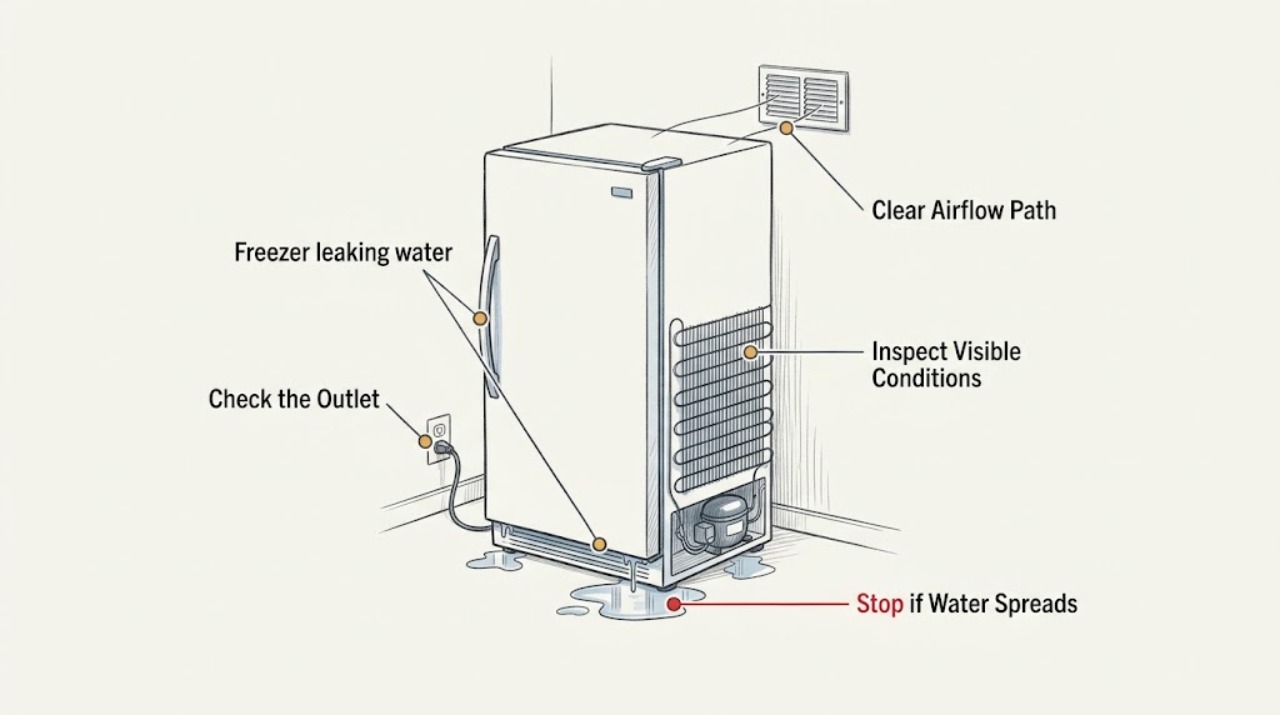
First identify where the water appears and whether it follows a defrost cycle, a door-opening event, a spill, or thawing food. Frost-free freezers normally send defrost water to a drain pan, so water outside the appliance can mean the pan, drain path, door seal, leveling, or a separate spill needs attention. Keep water away from the outlet and electrical parts, do not remove panels or test a defrost heater, and arrange appliance service if the source is not clearly visible or the freezer is warming.
Work through in order
Diagnostic checks
Use only checks that match the exact appliance or system and its official guide.
-
Check 1
From a dry standing position, trace the visible water to its first accessible point without moving the freezer or touching a wet cord, plug, outlet, or electrical component.
Expected result: Record whether water is inside the cabinet, at the door edge, beneath the front, behind the appliance, or coming from a nearby container or thawing package.
Next step: Dry only the accessible floor if it is safe, photograph the source area, and continue with the door, frost, and timing checks without opening panels.
Stop if: Stop immediately if water is near an outlet, plug, power strip, wiring, or a ceiling leak, or if the floor is slippery enough to create a fall risk.
Why this matters
Why: Water inside or at the door points toward an internal drain, seal, frost, or spill pattern; water under or behind the unit can involve the drain pan, a hose, condensation, or a separate plumbing source. The location alone does not identify a failed part.
-
Check 2
Observe the door closing and inspect the visible gasket around the perimeter without pulling it out, removing it, or forcing the door.
Expected result: Note a visible gap, folded or dirty gasket, package preventing closure, frost at the door edge, or water that appears after the door has been opened repeatedly.
Next step: Remove only an obvious package obstruction if it is safe and accessible, then document whether the leak returns; request service if the gasket is torn, the door is misaligned, or the seal remains open.
Stop if: Stop if the door is heavy, unstable, cannot close, the gasket is detached, or correcting the door would require disassembly or moving the appliance.
Why this matters
Why: A door that does not seal can admit warm moist air, increase frost, and contribute to meltwater or condensation. A clean-looking seal does not rule out a drain or pan problem.
-
Check 3
Look through the normal user-accessible interior for an unusual frost pattern, ice at the floor or rear wall, a blocked-looking air path, or food packages that have thawed and refrozen; do not scrape, chip, heat, or remove any panel.
Expected result: Record whether frost is light and even, concentrated around the door, forming a thick area, or absent while food is warming.
Next step: Keep the door closed as much as practical, note the temperature display or visible thermometer if present, and give the frost pattern to an appliance technician.
Stop if: Stop if the interior is warming rapidly, food is thawing, a burning smell or unusual noise is present, or inspection would require removing a liner or panel.
Why this matters
Why: A door-seal or airflow symptom can cause moisture and frost, while a repeated ice or water pattern may involve the defrost drain or another internal system. A warm cabinet with water is a service concern, not a reason to test a hidden heater.
-
Check 4
Record when the water appears relative to a defrost sound, door opening, a large load of food, room humidity, cleaning, or a recent power interruption.
Expected result: Note whether the leak is intermittent, follows a repeatable cycle, begins after the door is opened, or continues steadily even when the freezer remains closed.
Next step: Keep a short time-and-location log and share it with service; do not force a defrost cycle or repeatedly restart the appliance to reproduce the leak.
Stop if: Stop if the leak is steady, spreading toward electrical equipment, or accompanied by loss of cooling, smoke, a burning odor, or a tripped circuit.
Why this matters
Why: Frost-free models normally route melted defrost water to a drain pan, so water that escapes on a cycle may indicate a drain, pan, or overflow path issue. A one-time puddle after a spill or thawing package has a different starting point than a recurring leak.
-
Check 5
From outside the cabinet only, inspect any drain pan or base area that is already visible without removing a grille, tipping, sliding, or reaching behind the freezer.
Expected result: Note a visibly full, cracked, displaced, or overflowing pan, but do not touch standing water or attempt to clear a hidden drain.
Next step: Photograph the accessible area and arrange appliance service if the pan appears damaged or water returns.
Stop if: Stop if the area is wet near the power connection, the pan is inaccessible, the appliance would need to move, or the inspection requires a tool or panel removal.
Why this matters
Why: A visible pan issue can help a technician distinguish a containment problem from an internal drain or defrost problem, but hidden water paths cannot be diagnosed reliably from the floor.
-
Check 6
Check whether the freezer is still holding its normal cold condition using the existing display or a visible appliance thermometer, without opening the cabinet more than necessary.
Expected result: Answer yes if it remains normally cold and the leak is isolated; answer no if the temperature is rising, food is softening, or the display shows an alarm or fault.
Next step: Keep the door closed, protect food using official food-safety guidance, and request appliance service with the water location and temperature trend.
Stop if: Stop troubleshooting if food safety is uncertain, the appliance is warming quickly, or water is near electrical equipment; move people away from the wet area and seek appropriate service.
Why this matters
Why: A leak combined with warming can threaten food and may indicate a refrigeration or defrost problem beyond a simple spill. Do not diagnose a concealed electrical or refrigeration component from this check.
Use your observations
Decision map
Find the observation that best matches what you see, then follow the next safe action.
-
PATH 01Next step
What you see
The water is a one-time spill or comes from a thawing package, while the cabinet remains cold and no repeat leak occurs.
Do this next
Clean only the safe accessible floor and monitor the area; do not assume a freezer part has failed.
-
PATH 02Next step
What you see
Water recurs near a defrost pattern, appears under or behind the appliance, or a visible pan is full or damaged.
Do this next
Arrange appliance service and provide the timing, location, photos, and model information; do not remove panels or clear a concealed drain.
-
PATH 03Next step
What you see
The door does not seal, frost is concentrated at the perimeter, or packages obstruct closure.
Do this next
Remove only an obvious safe obstruction, document the gasket and frost condition, and request service if the door or gasket still does not seal.
-
PATH 04Next step
What you see
Water is accompanied by warming food, an alarm, unusual noise, burning odor, smoke, or repeated power trips.
Do this next
Stop using the appliance and seek qualified appliance or electrical service; protect food according to food-safety guidance and do not repeatedly reset or energize the unit.
-
PATH 05Next step
What you see
Water or ice is near an outlet, plug, cord, power strip, or other electrical equipment.
Do this next
Do not touch the wet electrical area or appliance connection. Keep people away and obtain appropriate electrical/appliance help.
Helpful context
Understand the symptom
Start with the water location
A freezer can produce normal defrost water without leaking onto the floor. The useful distinction is whether water is contained inside the cabinet or pan, appears at the front or rear of the appliance, or is actually coming from a nearby spill or thawing package. Keep the inspection external and dry; do not remove an interior liner, base panel, drain cover, or electrical cover.
Protect the food while you investigate
Limit door opening and note whether the contents still have ice crystals or are becoming soft. If food has warmed or the freezer lost power, use the food-safety guidance for each item rather than tasting food to decide whether it is safe.
Only after diagnosis
Potential parts
- freezer drain heater
Consider only if a technician confirms a model-specific drain-heating fault after ruling out the door, drain, pan, and defrost-system causes; this is not a user-observation repair.
Confirm the exact freezer model, voltage, connector, heater style, and manufacturer fit information before ordering. - freezer drain pan
Consider only if the accessible or technician-inspected pan is cracked, displaced, or unable to contain normal defrost water.
Verify the freezer model, pan location, dimensions, mounting method, and manufacturer compatibility. - freezer door gasket
Consider only if the gasket is visibly damaged or a technician confirms that the door cannot seal and the gasket is the cause of the moisture or frost pattern.
Match the exact model, door orientation, gasket profile, and installation requirements before ordering.
When checks do not resolve it
Need a professional?
Call an appliance technician when water recurs, the source is behind a panel or under the cabinet, the door does not seal, the freezer is warming, the pan appears damaged, or food safety is becoming uncertain. Use electrical service for a wet outlet, damaged cord, smoke, burning odor, or repeated circuit trips.
Have this ready
- Provide the freezer type, model information if available, first visible water location, timing relative to defrost or door opening, gasket and frost observations, temperature trend, photos, and whether food has thawed.
Common questions
FAQ
Is water in a freezer always a failed part?
No. Frost-free freezers normally route melted defrost water to a drain pan, and a single puddle can also come from a spill or thawing package. Recurrence, the exact water location, door-seal condition, frost pattern, and warming determine whether service is needed.
Can I remove the freezer panel to clear the drain?
Not within these user-observation checks. Do not remove panels, heat hidden ice, test a defrost heater, or clear a concealed drain. Record the visible symptoms and arrange qualified appliance service.
What if the freezer is leaking and the food is thawing?
Keep the door closed as much as practical, note the temperature or ice-crystal condition, and use official food-safety guidance for each item. Never taste food to decide whether it is safe.
When is a freezer water leak urgent?
Treat it as urgent when water is near an outlet or cord, the appliance is warming rapidly, food safety is uncertain, there is smoke or a burning odor, or a circuit trips. Keep people away from the wet electrical area and obtain appropriate appliance or electrical help.
Read the exact guide
Official sources
- Freezer OperationWhirlpool · Manufacturer manual guidance for the covered freezer model family; exact behavior and access depend on the user's model.
- Upright & Chest Freezer - Explanation of a Water Dripping SoundGE Appliances · Manufacturer explanation of normal defrost water flowing to a drain pan in frost-free upright and chest freezers.
- Food Safety During Power OutageFoodSafety.gov · Use when a leaking or warming freezer may have affected food; evaluate each food item rather than tasting it.
Community feedback
Share a repair observation
Share a plain-text repair observation. Accepted observations are published automatically; this page may take a moment to update.