
On this page
Start here
Quick answer
If a Frigidaire dishwasher leaves dishes dirty, first confirm that a cleaning cycle—not Rinse, and not Quick Wash or 30 Minute for heavily soiled loads—was selected. Then check that dishes do not block the detergent cup or spray-arm rotation, use fresh automatic-dishwasher detergent at the amount appropriate for the water hardness, and clean the filter, glass trap, and spray arms. Frigidaire also says water heat and pressure affect cleaning; its general guidance recommends at least 120°F water and suggests running the nearby sink tap until hot before starting, subject to the exact model manual. Check drain-hose installation if draining is incomplete. If these external, model-appropriate checks do not improve cleaning, arrange Frigidaire service rather than guessing a pump, heater, spray motor, or control fault.
Before you begin
Safety first
- Keep user checks to cycle selection, loading, accessible detergent and spray-path inspection, cool filter/glass-trap cleaning, and external water/drain observations. Do not reach into a moving dishwasher, use non-dishwasher detergent, open the electrical cabinet, perform live tests, or alter plumbing beyond documented installation.
Work through in order
Diagnostic checks
Use only checks that match the exact appliance or system and its official guide.
-
Check 1
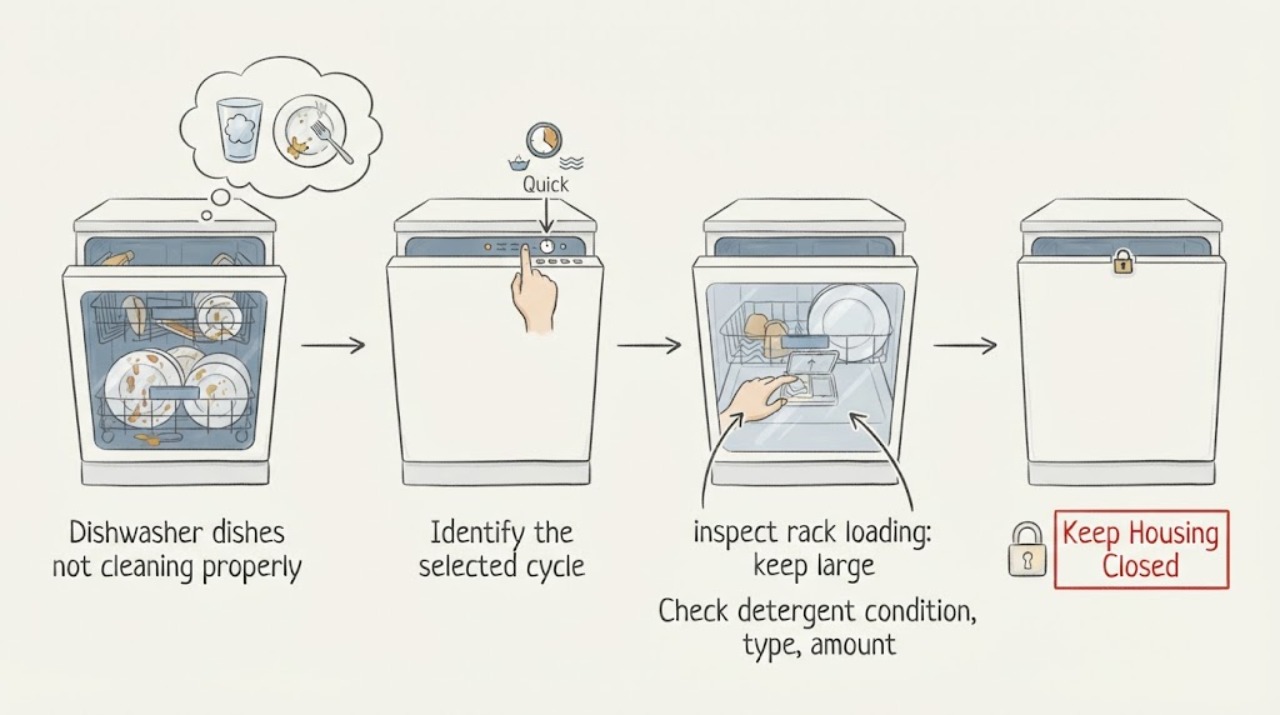
Identify the selected cycle and compare it with the soil level: confirm that the load was run on a cleaning cycle rather than Rinse, and do not judge a Quick Wash or 30 Minute cycle against heavily baked-on soil.
Expected result: The dishwasher was run on Rinse, or a short cycle was used for heavily soiled dishes; or a suitable cleaning cycle was used.
Next step: Use the cycle recommended by the exact model manual for the load and compare one similar load. Do not add extra detergent to compensate for a rinse-only cycle.
Stop if: Continue with loading, detergent, and spray-path checks rather than repeatedly changing cycle names without recording the result.
Why this matters
Why: Frigidaire says Rinse will not clean dishes and that Quick Wash/30 Minute may not clean heavily soiled dishes. A cycle mismatch is a usage condition, not evidence of a failed pump or heater.
-
Check 2
With the dishwasher stopped, inspect rack loading: keep large items from blocking the detergent dispenser or spray arms, place soiled surfaces toward the spray, and rotate each accessible spray arm by hand to confirm the load does not obstruct it.
Expected result: A pan handle, tall item, nested dish, or rack placement blocks a spray arm or detergent cup, or the arms turn freely and the load is separated.
Next step: Rearrange the load according to the model loading guide and run a comparable cleaning cycle. If the spray arm cannot turn freely when empty, stop and use the model manual or service path instead of forcing it.
Stop if: Move to detergent and water checks; a clear load does not prove that the pump or spray motor is functioning correctly.
Why this matters
Why: Frigidaire says poor loading can reduce cleaning and that items must not block detergent release or spray-arm rotation; nested or badly oriented items can shield soil from the water spray.
-
Check 3
Check detergent condition, type, amount, and dispenser release: use fresh automatic-dishwasher detergent, follow the exact model's fill marks and water-hardness guidance, and inspect whether detergent remains in the dispenser after the cycle.
Expected result: Detergent is damp or caked, the amount does not match water hardness, the wrong detergent was used, or detergent remains in the cup after the cycle.
Next step: Correct the detergent choice or amount and clear only an accessible obstruction without opening the door during operation. If the dispenser still does not release detergent, arrange model-specific service.
Stop if: Continue with filter/spray-arm and water-condition checks; do not increase detergent indefinitely to mask a spray or temperature problem.
Why this matters
Why: Frigidaire says too little detergent can cause poor cleaning and filming, too much in soft water can etch glassware, and residue in the dispenser can indicate that something blocked its opening.
-
Check 4
When the dishwasher is stopped and cool enough to handle, clean the filter and glass trap and inspect the spray-arm openings for food debris; rinse accessible parts as described by the exact model manual.
Expected result: Food soil or debris is present in the filter, glass trap, or spray arms, or these paths are clean.
Next step: Reinstall all parts correctly and run the documented empty/high-heat maintenance cycle only if the model manual supports it. Stop if the unit leaks, makes an abnormal noise, or leaves the same soil pattern.
Stop if: Continue with water heat, pressure, and draining checks rather than opening the sump or electrical compartment.
Why this matters
Why: Frigidaire says dish debris can block the filter, glass trap, and spray arms and reduce cleaning performance. Clean paths remove a supported obstruction but do not prove a pump or wash motor fault.
-
Check 5
Check water and drainage conditions externally: confirm the model's water-heating guidance, avoid starting while other high-demand fixtures are reducing pressure, run the nearby sink tap until hot if the manual allows, and inspect the drain hose for the documented high loop/routing and complete draining.
Expected result: Water is not hot enough, pressure is low while another fixture runs, or the drain hose is kinked, displaced, missing the required high routing, or connected to a disposer with its knockout plug still present; or the external conditions are normal.
Next step: Correct only the external water-use or drain installation issue covered by the exact model instructions, then compare one suitable cleaning cycle. Do not modify plumbing or electrical connections beyond documented installation.
Stop if: If suitable cycles still leave dishes dirty after all supported checks, arrange Frigidaire service and provide the cycle, load, detergent, residue pattern, and maintenance history.
Why this matters
Why: Frigidaire says water heat and pressure affect cleaning and that incorrect drain-hose installation can leave food soils in the sump and reduce wash performance. These observations guide external correction but do not identify an internal heater or pump failure.
Use your observations
Decision map
Find the observation that best matches what you see, then follow the next safe action.
-
PATH 01Next step
What you see
Rinse was selected, or Quick Wash/30 Minute was used for a heavily soiled load.
Do this next
Use a suitable cleaning cycle from the exact model manual and compare a similar load before treating the result as a mechanical fault.
Why this path and its safety boundary
Why it matters: Frigidaire says Rinse will not clean dishes and short cycles may be unsuitable for heavy soil.
-
PATH 02Next step
What you see
A rack item blocks the detergent cup or spray-arm rotation, or dishes are nested with soiled faces shielded.
Do this next
Rearrange the load, confirm accessible spray arms turn freely when stopped, and run one suitable cycle; seek service if an empty arm cannot rotate freely.
Why this path and its safety boundary
Why it matters: The load prevents detergent release or water from reaching the surfaces, which Frigidaire identifies as a loading-related cleaning problem.
-
PATH 03Next step
What you see
Detergent is stale, misdosed for water hardness, remains in the dispenser, or the filter/glass trap/spray arms contain debris.
Do this next
Use fresh automatic-dishwasher detergent at the manual's amount and clean the accessible filter, glass trap, and spray arms with the dishwasher stopped.
Why this path and its safety boundary
Why it matters: Frigidaire identifies detergent condition/amount, dispenser obstruction, and debris in the wash path as supported causes of poor results.
-
PATH 04Next step
What you see
Water is cool or pressure is reduced during use, or the drain hose/disposer connection does not match the documented installation.
Do this next
Correct only the external water-use or drain-routing issue covered by the exact model instructions and compare one suitable cycle; do not open the cabinet.
Why this path and its safety boundary
Why it matters: Frigidaire says heat and pressure affect cleaning and incorrect drainage can leave food soils in the sump and reduce wash performance.
-
PATH 05Next step
What you see
Dishes remain dirty after an appropriate cycle, correct loading/detergent, clean wash path, and normal external water/drain conditions.
Do this next
Arrange Frigidaire service, giving the exact model and the soil/residue pattern; stop sooner for leaks, electrical faults, or unsafe access.
Why this path and its safety boundary
Why it matters: The supported user checks have not resolved the symptom. The result does not identify a failed wash motor, pump, heater, spray arm, or control.
Helpful context
Understand the symptom
Dirty dishes do not automatically mean a failed dishwasher part. Frigidaire's opened guidance starts with the selected cycle, loading, detergent, and maintenance of the filter, glass trap, and spray arms. A Rinse cycle is for rinsing rather than cleaning, and a short cycle may be unsuitable for heavily soiled dishes.
Keep the diagnosis tied to what is left on the dishes: food soil, detergent residue or filming, blocked spray coverage, or incomplete draining point to different checks. Use the exact model manual for rack layout, cycle names, water settings, and any cleaning steps that differ by model.
Before removing a filter or spray arm, stop the dishwasher and let hot water cool. Do not reach into a moving spray system, use non-dishwasher detergent, or open the electrical cabinet. If water leaks, the unit trips power, or the symptom remains after the documented user checks, arrange service.
When checks do not resolve it
Need a professional?
Use Frigidaire service for persistent poor cleaning after the official external checks, or sooner for leaks, electrical trips, burning smell, abnormal noise, or unsafe access.
Safety scope: Keep user checks to cycle selection, loading, accessible detergent and spray-path inspection, cool filter/glass-trap cleaning, and external water/drain observations. Do not reach into a moving dishwasher, use non-dishwasher detergent, open the electrical cabinet, perform live tests, or alter plumbing beyond documented installation.
Common questions
FAQ
Will the Rinse cycle clean dirty dishes?
No. Frigidaire says the Rinse cycle will not clean dishes; it is for rinsing food soils when the dishwasher will not be operated immediately. Use a cleaning cycle appropriate for the load.
Can loading cause dishes to remain dirty?
Yes. Frigidaire says large items can block the detergent dispenser or spray arms and that nested or poorly oriented dishes can shield surfaces from water. Check spray-arm rotation with the dishwasher stopped and follow the model loading guide.
Does dirty glassware prove the dishwasher pump or heater failed?
No. Frigidaire first directs owners to cycle, loading, detergent, filter, spray-arm, water heat/pressure, and drain checks. Persistent poor cleaning after those checks needs service rather than a guessed internal part.
Read the exact guide
Official sources
- Dishwasher - Loading GuideFrigidaire · Opened the Frigidaire owner-support loading guide directly. It applies to dishwashers and explicitly covers the assigned poor-cleaning issue; rack features vary by model, so the exact manual remains controlling.
- Dishwasher - Not CleaningFrigidaire · Opened the Frigidaire owner-support article directly. It applies to dishwashers generally and directly covers the assigned dishes-not-cleaning-properly symptom; no model-specific part or cycle claim is imported.
- Dishwashers - How can I ensure the best cleaning results?Frigidaire · Opened the Frigidaire owner-support article directly. It applies to dishwashers generally and is used for external water heat/pressure checks; exact model manual instructions remain controlling.
- Dishwasher - Drain Hose GuideFrigidaire · Opened the Frigidaire owner-support drain-hose guide directly. It states that correct drain installation improves wash performance and identifies disposer knockout-plug and routing checks; exact installation dimensions must be confirmed in the model instructions.
- Dishwasher - Dispenser and Detergents GuideFrigidaire · Opened the Frigidaire owner-support detergent guide directly. It directly labels poor cleaning as an issue and explains detergent condition, water-hardness dosing, dispenser obstruction, and service escalation.
Community feedback
Share a repair observation
Share a plain-text repair observation. Accepted observations are published automatically; this page may take a moment to update.