
On this page
Start here
Quick answer
Classify the odor before cleaning: a newly installed Frigidaire dishwasher can have a temporary new-appliance smell, while food residue, a dirty filter or glass trap, standing water, and an incorrectly installed or kinked drain hose point to different checks. Inspect and rinse the user-accessible filter and glass trap, confirm the tub drains, and check the drain hose or disposer connection if water remains. Frigidaire recommends an empty cleaning cycle or one cup of white vinegar directly in the tub without detergent for odor maintenance. If the smell is burning, acrid, or electrical, or if there is smoke, melting, a breaker trip, or water near wiring, stop the dishwasher at once, isolate power only from a safe accessible point, and arrange service.
Before you begin
Safety first
- Do not run the dishwasher with a burning or electrical smell, smoke, melting, unusual heat, or water near electrical parts. Isolate power only from a safe accessible point, do not open electrical covers or reach into a running tub, and do not bypass a safety device or perform live testing.
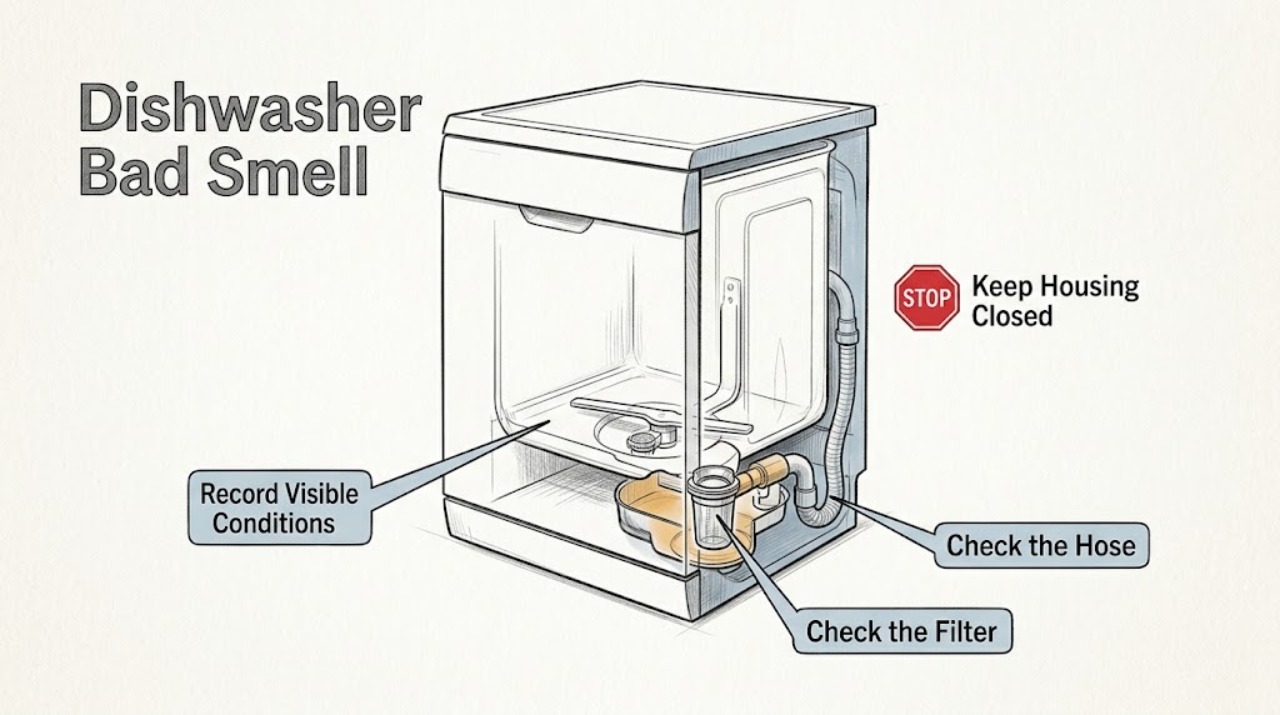
Work through in order
Diagnostic checks
Use only checks that match the exact appliance or system and its official guide.
-
Check 1
Identify the odor and its timing before running another hot cycle. Record whether the dishwasher is newly installed, whether soiled dishes sat inside, whether the smell is food-like or sewage-like, and whether it is acrid, burning, or electrical.
Expected result: The smell is a short-lived new-appliance odor, follows food residue or a damp tub, returns with standing water, or is accompanied by smoke, heat, melting, a breaker trip, or an electrical smell.
Next step: For a burning, acrid, or electrical smell, stop the cycle immediately, keep the door closed if there is smoke or heat, isolate power from a dry accessible switch or breaker if safe, and arrange service. Otherwise continue with the matching low-risk check below.
Why this matters
Why: Frigidaire distinguishes a temporary new smell from odors associated with soiled dishes and poor draining. Burning or electrical signs are not a cleaning issue and can indicate a hazardous fault.
-
Check 2
After the dishwasher is off and safe to access, remove and inspect the user-accessible glass trap and filters at the tub bottom. Empty visible food, glass, bones, or other residue; rinse the parts with warm running water and reinstall them exactly as the owner's manual shows.
Expected result: The trap or filter contains food soil or debris, is missing or seated incorrectly, or is clean and correctly installed.
Next step: Run the normal user-approved cycle or rinse-only cycle once after refitting the filter. If debris rapidly returns, water still covers the filter screen, or the filter cannot be seated, stop repeating cycles and check drainage or arrange service.
Why this matters
Why: Frigidaire says food and debris can build up in the sump and filter, and its i40 guidance links a clogged filter or sump to poor draining. A clean, correctly installed filter makes the drain path, standing water, or another odor source more likely.
-
Check 3
Check whether the completed cycle leaves water covering the filter screen or leaves a large amount of food-laden water. From an accessible location, inspect the drain hose for a kink or displacement and, if connected to a garbage disposer, verify that the disposer inlet's knockout plug was removed during installation.
Expected result: Water remains over the filter, the hose is kinked or lacks the model-specified high loop, the disposer plug is still present, or the drainage path appears clear.
Next step: Correct only an obvious hose kink or accessible connection issue that the model guide permits; do not pull out a built-in dishwasher or disconnect plumbing under pressure. If water remains or the smell returns, stop and use the exact owner's manual or service support.
Why this matters
Why: Standing water can produce odors, and Frigidaire identifies hose installation, kinks, and an unremoved disposer plug as drainage causes. A clear visible setup does not rule out a blocked internal sump or pump.
-
Check 4
For a non-burning odor after the filter and drain checks, clean the empty dishwasher only as Frigidaire describes: use the model-appropriate empty PowerPlus or Heavy cycle with Sanitize, or place one cup of white vinegar directly in the tub and run an empty cycle without detergent.
Expected result: The odor clears after the empty maintenance cycle, returns after a few loads, or becomes stronger or chemically harsh during the cycle.
Next step: Repeat maintenance only at the interval and with the options allowed by the exact owner's manual. Do not mix vinegar with bleach, detergent, or other cleaners. If the odor persists, inspect the drain symptom again or arrange service.
Why this matters
Why: A temporary improvement supports residue or maintenance as the likely source, but recurrence points back to standing water, filter contamination, wash performance, or the drain path. A harsh or abnormal reaction is a reason to stop, not to add more chemicals.
-
Check 5
Check for a safety or mechanical escalation pattern: smoke, an acrid electrical odor, melted plastic, unusual heat, a breaker trip, water near wiring, a persistent fault indication, or a dishwasher that will not drain after the accessible checks.
Expected result: Any safety sign is present, or the odor remains despite a clean filter, correct visible drain setup, and an allowed empty cleaning cycle.
Next step: Stop using the dishwasher, isolate power from a safe accessible point, keep hands and tools out of the tub, and contact Frigidaire support or a qualified appliance technician. Do not bypass a safety device, open electrical covers, or perform live tests.
Why this matters
Why: These results are outside ordinary odor maintenance. An internal heater, pump, wiring, control, sump, or drain fault may be involved, and the visible checks cannot establish which component is responsible.
Use your observations
Decision map
Find the observation that best matches what you see, then follow the next safe action.
-
PATH 01Next step
What you see
Do this next
Use a rinse-only cycle if needed, confirm the unit drains, and monitor as it is used. If the odor does not fade or any burning sign appears, stop and arrange service or contact the installer for a recently installed unit.
-
PATH 02Next step
What you see
Do this next
Clean and reinstall the accessible filter and glass trap, then check the visible drain hose, high loop, and disposer inlet setup. If standing water remains, stop and use the model manual or service support.
-
PATH 03Next step
What you see
Do this next
Do not pour unapproved chemicals into the machine or dismantle the pump. Record whether the cycle stops, the water level, and any lights or error code, then contact Frigidaire support or a qualified technician.
-
PATH 04Next step
What you see
Do this next
Confirm the cycle completes and drains, keep the filter maintained, and follow the exact manual's care instructions. If odor returns despite those steps, arrange service rather than sealing the wet tub or modifying the door.
-
PATH 05Next step
What you see
Do this next
Stop the dishwasher immediately, isolate power from a dry accessible point if safe, keep the door closed if smoke or heat is present, and arrange qualified service. Do not restart it to see whether the smell repeats.
Helpful context
Understand the symptom
Start by identifying the odor and the water state
Do not assume every bad smell is a filter problem. Note whether the odor began immediately after installation, resembles food or sewage, appears only when the tub stays wet, or smells like hot plastic, burning, or an electrical fault. Open the door only if there is no smoke or heat hazard, and check whether water covers the filter area after a completed cycle. A small amount of water in the bottom can be normal, but water covering the filter screen is a drainage clue.
Use only the user-accessible cleaning steps
Frigidaire's odor guidance recommends cleaning the dishwasher about every three months and cleaning the filter and glass trap every two to three months. The filter guide describes rinsing the accessible filters under running water and removing food residue. Keep the pump, wiring, heater, and spray-arm mechanism intact; do not reach into a running unit or remove panels to chase an odor.
Drain installation can create a recurring smell
If standing water or food residue returns after cleaning, the odor may be a symptom of incomplete draining rather than a need for stronger cleaner. Frigidaire's drain guidance calls out a kinked hose, the required high-loop arrangement, and a disposer knockout plug that was never removed. These are installation- and model-dependent checks, so use the exact owner's manual for the connection details.
When checks do not resolve it
Need a professional?
Use Frigidaire support or a qualified appliance technician when the odor persists after the model-appropriate filter, drain, and cleaning checks; standing water remains; an error or incomplete drain recurs; or the smell is burning, electrical, or accompanied by smoke, heat, melting, a breaker trip, or water near wiring.
Safety scope: Do not run the dishwasher with a burning or electrical smell, smoke, melting, unusual heat, or water near electrical parts. Isolate power only from a safe accessible point, do not open electrical covers or reach into a running tub, and do not bypass a safety device or perform live testing.
Common questions
FAQ
Is a new Frigidaire dishwasher smell normal?
Frigidaire says a dishwasher can have a temporary new smell immediately after installation, and it should diminish with use. A smell that persists, is accompanied by standing water, or smells burning or electrical should not be treated as normal.
Can a dirty filter cause a bad dishwasher smell?
Yes. Frigidaire says food and debris can collect in the glass trap, filter, or sump, and that standing water from poor draining can create odors. Turn the unit off, clean the user-accessible filter and glass trap as the manual shows, and investigate drainage if water remains.
What should I do if the smell is burning or electrical?
Stop the dishwasher immediately and do not restart it to test the symptom. Isolate power only from a dry accessible point if safe, keep away from smoke, heat, or wet electrical parts, and arrange qualified appliance service.
Read the exact guide
Official sources
- Dishwasher Error Code i40 - Clogged filter or sumpFrigidaire · Frigidaire dishwasher i40 drainage and filter guidance
- DishwashersFrigidaire · Frigidaire dishwasher owner support and troubleshooting index
- Dishwasher Glass Trap and Filter GuideFrigidaire · Frigidaire dishwasher glass-trap and filter maintenance
- Dishwasher - Drain Hose GuideFrigidaire · Frigidaire dishwasher drain-hose installation and odor-reduction guidance
- Dishwasher - OdorsFrigidaire · Frigidaire dishwasher odor maintenance
- Dishwasher - Why does my dishwasher have an odor and how do I fix it?Frigidaire · Frigidaire dishwasher odor and new-installation guidance
- Dishwashers - Not DrainingFrigidaire · Frigidaire dishwasher drainage troubleshooting
Community feedback
Share a repair observation
Share a plain-text repair observation. Accepted observations are published automatically; this page may take a moment to update.