
On this page
Start here
Quick answer
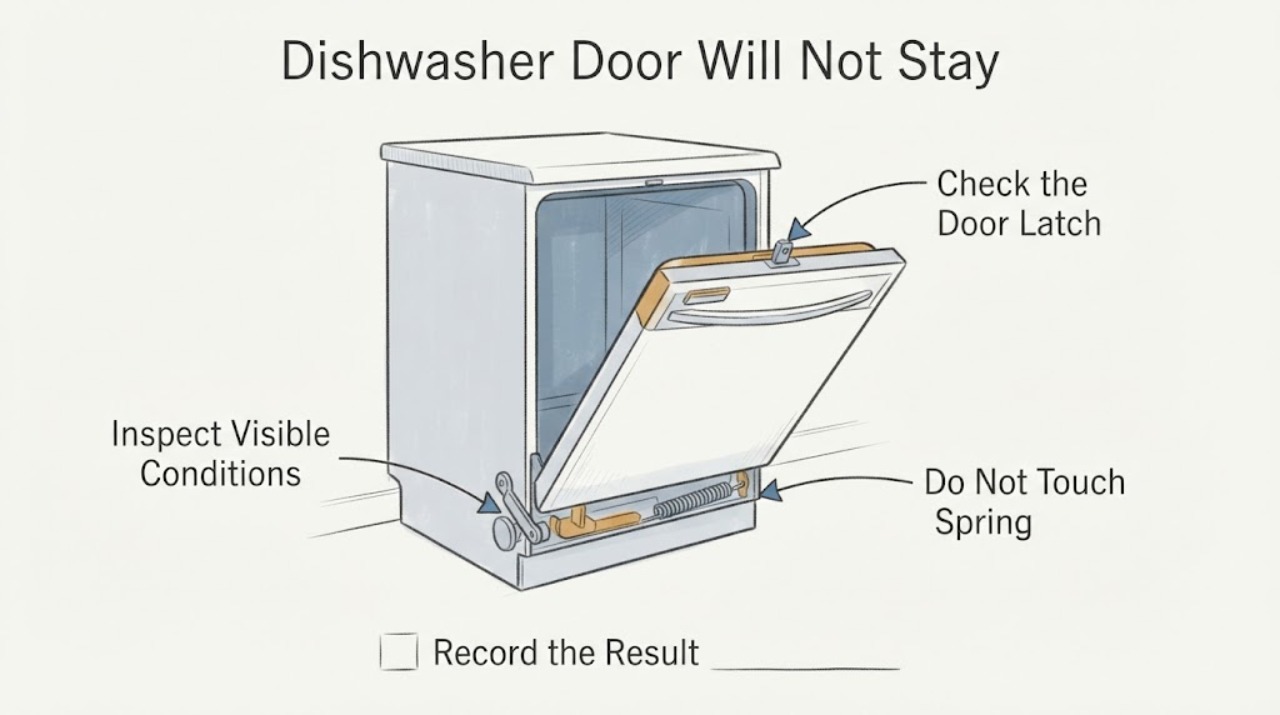
A Frigidaire dishwasher door that will not remain open needs a careful distinction between a visible obstruction or installation issue and an internal hinge, spring, cable, or door-balance fault. With the dishwasher off, inspect the door path and nearby kick plate for interference, and check whether the door can close and latch without force. Frigidaire says the door must close securely for a cycle to start and that a kick plate can prevent complete closure on some installations. Do not hold the door open with an improvised object, force the hinges, remove panels, or order a spring or cable without the exact model. If the door drops, cannot be controlled, will not latch, or the dishwasher leaks, keep it out of use and arrange Frigidaire service.
Work through in order
Diagnostic checks
Use only checks that match the exact appliance or system and its official guide.
-
Check 1
Turn the dishwasher off and inspect the full door swing from closed to open without forcing it. Look for contact at the lower edge, kick plate, adjacent cabinet, racks, or a visibly displaced seal; do not put fingers near a pinch point.
Expected result: The door contacts a visible obstruction, or it moves freely but will not remain at the intended open position.
Next step: Remove only a loose external obstruction that can be removed without tools. For built-in alignment, hinge, spring, cable, or seal work, stop and use the exact model installation or service instructions.
Why this matters
Why: Visible contact may be an installation or clearance problem. Free movement without a visible obstruction leaves an internal door-balance or hinge issue possible but does not identify a part.
-
Check 2
From a normal open position, guide the door closed gently and observe whether it meets the frame evenly and latches without slamming, lifting, or pushing sideways.
Expected result: The door closes and latches normally, closes only with force or lifting, or cannot latch.
Next step: Do not run the dishwasher if the door needs force, will not latch, or can open unexpectedly. Arrange Frigidaire service and do not bypass the latch.
Why this matters
Why: Normal latching does not prove the open-position balance is healthy. Force, uneven contact, or failure to latch is a door alignment or safety concern.
-
Check 3
If the door was opened during a cycle, unlatch it only as the dishwasher instructions describe and wait for wash action to stop before opening fully. Close it firmly and press Start only if the door is stable and latches normally.
Expected result: Wash action stops and the door resumes normally, or the door drops, binds, swings unexpectedly, or fails to latch.
Next step: Stop the cycle and keep the dishwasher off for the second case. Do not use a prop, tape, or bypass; schedule service.
Why this matters
Why: A normal resume confirms only the loading procedure, not the condition of the hinge or balance system. Uncontrolled movement or failed latching is not a normal loading adjustment.
-
Check 4
Look for water at the door edge or floor and check whether the lower kick plate is preventing complete closure. Do not run a cycle to test a door that does not close securely.
Expected result: There is a leak, the kick plate interferes, or the door closes with clear even contact and no leak.
Next step: Keep the dishwasher off for a leak or interference condition and arrange installation or appliance service. Continue only with model identification if the path is clear.
Why this matters
Why: Frigidaire identifies incomplete closure and kick-plate interference as installation concerns and directs unresolved leaks or door problems to service. A dry, clear path does not rule out internal door hardware wear.
-
Check 5
Read the dishwasher model and serial tag from the inside of the door or the right side of the tub, then use that exact identifier when requesting the owner manual or service.
Expected result: The model tag is available and matches the unit, or the tag is missing, unreadable, or differs from the assumed product family.
Next step: Provide the full tag and a description or photograph of the door movement to Frigidaire service. Do not order a part or open the door assembly based on a generic listing.
Why this matters
Why: Door-balance hardware and installation details vary by model. Without the exact tag, a spring, cable, hinge, or panel procedure cannot be verified.
Use your observations
Decision map
Find the observation that best matches what you see, then follow the next safe action.
-
PATH 01Next step
What you see
If the door contacts a kick plate, cabinet, rack, or other visible obstruction
Do this next
Remove only a loose external obstruction; use the exact installation instructions or service for built-in alignment.
Why this path and its safety boundary
Why it matters: A clearance or installation issue is plausible and the door-balance hardware has not been proven faulty.
-
PATH 02Next step
What you see
If the door falls, binds, twists, or cannot be held safely while opening
Do this next
Keep the dishwasher off, do not prop or force the door, and arrange model-specific Frigidaire service.
Why this path and its safety boundary
Why it matters: The door movement is uncontrolled and may involve internal hardware or a damaged mounting point.
-
PATH 03Next step
What you see
If the door closes evenly and latches without force but will not remain open
Do this next
Record the exact model and request service rather than installing a guessed spring, cable, or hinge.
Why this path and its safety boundary
Why it matters: An internal balance or hinge issue remains possible, but the available evidence does not identify the component.
-
PATH 04Next step
What you see
If the door will not latch, CL or Cd remains, or water leaks at the door
Do this next
Do not bypass the latch or run another cycle; keep the unit off and contact Frigidaire service.
Why this path and its safety boundary
Why it matters: The dishwasher cannot be treated as ready for a normal cycle.
Helpful context
Understand the symptom
A door-balance symptom is not a confirmed hinge diagnosis
The label “door not staying open” describes movement, not the failed part. A door may be affected by an obstruction, installation alignment, a hinge or spring system, or a door-related safety problem, and the available topic contains no model or observed damage to separate those possibilities. Start with visible clearance and safe closure; do not transfer a spring, cable, or hinge procedure from another Frigidaire series.
Check the door path and installation clearance
With the dishwasher off, look along the lower door edge and the adjacent kick plate for contact or interference. Frigidaire notes that the kick plate can sometimes prevent the door from closing completely. Do not remove a built-in panel or change mounting hardware just to make the door stay open; an installation document for the exact model controls any adjustment.
The door must still close and latch
A door that will not stay open may also fail to close or latch correctly. Frigidaire's dishwasher support says the door must be properly closed for the machine to start, and CL or Cd indicates that the door has not successfully closed and latched. Check closure without slamming or forcing it; the code meaning does not identify a hinge or spring.
Keep loading and service boundaries separate
Frigidaire's loading guidance permits unlatching during a cycle only after waiting for wash action to stop, then closing the door firmly and pressing Start to resume. It does not provide a generic method to prop the door open or access the balance hardware. If the door falls, twists, binds, or cannot be controlled, leave the dishwasher off and use the exact model support route.
When checks do not resolve it
Need a professional?
Arrange Frigidaire service for a door that drops, binds, twists, will not stay controlled, cannot latch, shows CL or Cd after closure, leaks, or requires hinge, spring, cable, seal, or mounting work.
Have this ready
- Provide the complete model and serial information, photographs of the door path and kick plate, whether the door latches, whether it recently changed, and whether there is a leak or visible damage.
Common questions
FAQ
Why will my Frigidaire dishwasher door not stay open?
The symptom alone does not identify the cause. Check visible clearance and the lower kick plate, then see whether the door closes and latches evenly. If there is no obstruction and the door still falls or binds, have the exact model inspected rather than assuming a spring or hinge part.
Can I hold the dishwasher door open with a prop?
No. A prop can create a pinch, fall, or latch hazard and does not repair the door balance. Keep the dishwasher off and arrange service if the door is uncontrolled.
What does CL or Cd mean on a Frigidaire dishwasher?
Frigidaire says CL or Cd means the door has not successfully closed and latched. Close it fully; if it still will not latch or the door movement is abnormal, contact service rather than bypassing the latch.
Where do I find the model number before requesting door service?
Frigidaire says a dishwasher model number is commonly on the interior side of the door or the right side of the tub, visible with the door open. Use the complete tag because door hardware and installation details are model-specific.
Read the exact guide
Official sources
- What should I do if my dishwasher is not starting?Frigidaire · Opened Frigidaire's official dishwasher support page. It says to close the door properly, press Start/CANCEL, check delay or child lock, confirm water and check household power before contacting support.
- Dishwasher Error Code CL or Cd - Door is openFrigidaire · Opened Frigidaire's official door-status page. It says CL or Cd indicates the door has not successfully closed and latched and directs the owner to close it fully.
- Dishwasher - Water LeakingFrigidaire · Opened Frigidaire's official dishwasher leak page. It says the door must completely shut before running and notes that the kick plate can prevent closure; unresolved problems are routed to service.
- Dishwashers: What should I do when I need to add a forgotten item to a wash cycle that is in process?Frigidaire · Opened Frigidaire's official loading page. It says to unlatch and wait for wash action to stop before fully opening, then close the door firmly to latch and resume.
- Where can I find my model and serial number?Frigidaire · Opened Frigidaire's official model-identification page. It says a dishwasher model number is commonly on the inside of the door or right side of the tub and directs owners to use the tag for support.
Community feedback
Share a repair observation
Share a plain-text repair observation. Accepted observations are published automatically; this page may take a moment to update.