
On this page
Start here
Quick answer
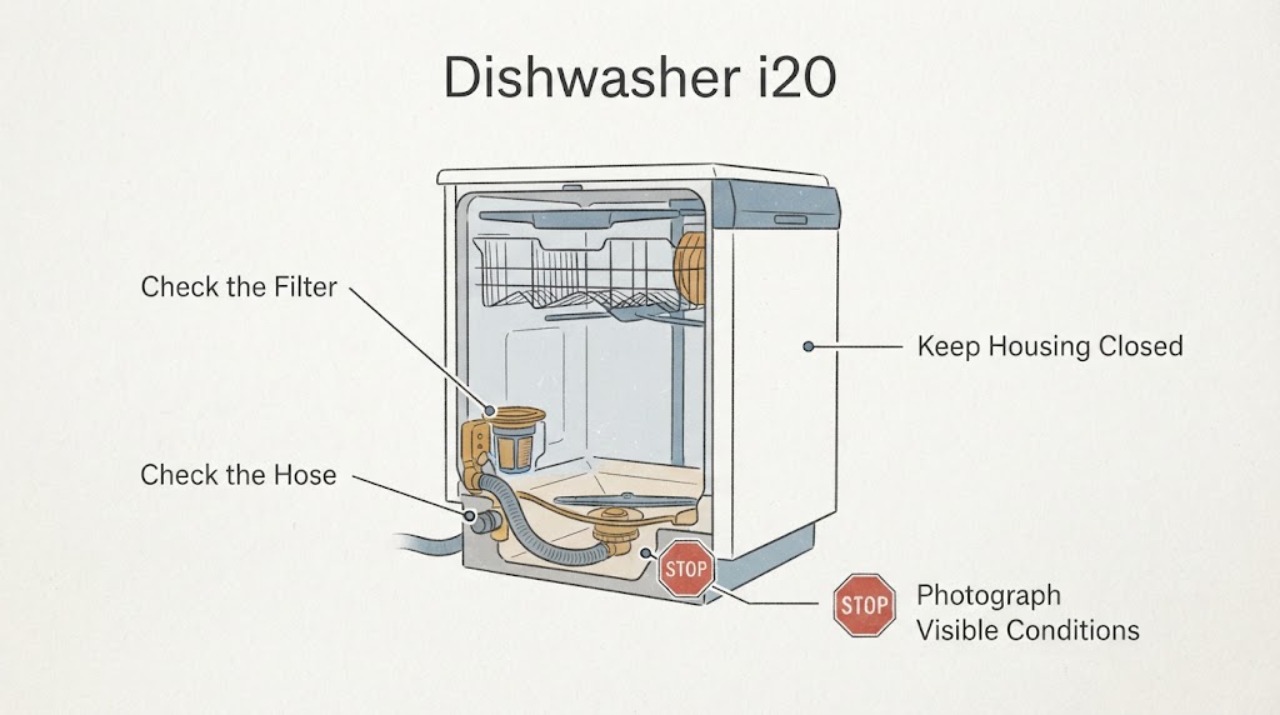
On a Frigidaire Gallery dishwasher, i20 means the dishwasher did not drain properly; it is not proof that the drain pump has failed. With no complete model number, stay with checks that are safe and visible across this family: record the display and standing water, clean the glass trap or filter only as the matching manual allows, inspect the visible drain hose for a kink or restriction, check an accessible air gap or disposer connection, and verify that a disposer knockout plug was removed after installation. Frigidaire also identifies a minimum drain-hose height of 32 inches in its general guide, but the exact installation manual controls for the appliance. Use only the exact model's documented cancel or reset once. If i20 returns, water remains, the hose or sink connection is inaccessible, or there is a leak or electrical hazard, stop and arrange qualified appliance service instead of guessing a pump or using another platform's reset sequence.
Before you begin
Safety first
- User work is limited to reading the model plate, observing the display and water level, cleaning a user-accessible filter or external air gap according to the exact manual, and viewing the visible drain route. Do not pull the built-in dishwasher, open the console or sump, detach hoses, bypass safety devices, enter diagnostics, handle sharp debris bare-handed, or use a cross-platform reset sequence.
Work through in order
Diagnostic checks
Use only checks that match the exact appliance or system and its official guide.
-
Check 1
Before clearing anything, record the exact i20 display or light pattern, whether the dishwasher stopped mid-cycle, how much water is visible in the tub, whether the unit is still humming, and whether the issue began after installation, a disposer change, or a hose being moved. Photograph the rating plate from a safe position and capture every model character; Gallery alone is not a complete model.
Expected result: The display clearly shows i20; only a flashing pattern is present; there is little residual water; the filter is submerged; the unit stopped mid-cycle; or the model label cannot be read.
Next step: Continue only with the matching low-risk branch. If the full model is unavailable, use the family-level checks below and arrange service for anything requiring internal access.
Stop if: Stop for water outside the tub, a leak near electrical parts, smoke, burning odor, sparks, abnormal heat, a damaged cord, or inability to keep hands and the floor dry.
Why this matters
Why: Frigidaire defines i20 as incomplete or improper drainage, but a flashing pattern without a verified model should not be decoded using another dishwasher's table. The water level and timing help separate a drain-path restriction from a broader no-start or leak situation.
-
Check 2
With the cycle stopped and only the user-accessible area exposed, inspect the glass trap or filter for food soils and visible debris. Remove and rinse the filter only if the exact manual permits it and the water is cool enough to handle safely; replace it fully. If a countertop drain air gap is installed, inspect and clean only that external fitting. Do not reach into the sump or remove a pump cover.
Expected result: The filter or air gap is visibly blocked; it is clear; glass or sharp debris is present; or the filter cannot be removed without tools or force.
Next step: Reinstall a clean, undamaged filter and make one normal drain or cycle attempt only if the exact manual permits it and there is no leak. Escalate if i20 or standing water returns.
Stop if: Do not handle broken glass or sharp debris bare-handed, force the filter, remove sump components, or operate the dishwasher with the filter missing.
Why this matters
Why: Frigidaire lists a dirty glass trap or filter as a cause of poor draining and provides a user cleaning route, but a sharp object, inaccessible filter, or obstruction below the filter moves the job beyond a safe surface check.
-
Check 3
From outside the cabinet, inspect the visible drain hose route for a sharp kink, crushing, or an obvious obstruction. Check whether an accessible air gap is clogged and whether a disposer connection is missing its knockout-plug removal after a recent installation. Do not pull the built-in dishwasher, detach a hose, or reach behind a wet cabinet.
Expected result: The hose is kinked or pinched; the air gap is blocked; the disposer was recently installed; the knockout plug may still be present; or the visible route is clear.
Next step: Correct only a clearly visible kink or external air-gap issue, or have the installer remove a disposer knockout plug. If the hose is inaccessible or the code returns, arrange service rather than disassembling the drain path.
Stop if: Do not disconnect plumbing under pressure, loosen hidden clamps, move the appliance, or run a cycle when a hose or connection is leaking.
Why this matters
Why: Frigidaire specifically links i20 to blocked or restricted hoses, incorrect hose routing or height, a blocked air gap, and an unremoved disposer knockout plug. A clear visible route does not rule out an internal restriction or pump fault.
-
Check 4
Confirm the drain hose's visible routing follows the exact installation instructions. Frigidaire's general hose guide calls for a minimum 32-inch height and a route down to the drain, but do not alter the built-in installation without the complete model guide or installer approval. In an apartment, report an inaccessible hose, disposer, sink drain, or air gap to maintenance.
Expected result: The hose routing is visibly low or kinked; the building plumbing or disposer was changed; the connection cannot be inspected safely; or routing matches the guide but i20 remains.
Next step: Have the installer, landlord, or qualified technician verify the complete installation. Preserve the model photo and the i20 sequence for service.
Stop if: Do not pull the appliance out, cut or reroute the hose, open the floor or sink plumbing, or work around wet electrical connections.
Why this matters
Why: Drain geometry can cause incomplete draining even when the dishwasher itself has power. Because the full Gallery model is missing, a general height rule is a screening clue, not permission to re-plumb or choose a model-specific part.
-
Check 5
After a visible filter or external hose issue is corrected, use only the full model's manual to cancel or reset the current cycle once. Wait for the documented drain routine to finish and make one normal test attempt. Do not use an Electrolux, Frigidaire Professional, or another Gallery model's button sequence, and do not repeatedly cycle the appliance to force draining.
Expected result: The dishwasher drains and completes a cycle; i20 returns; water remains; the controls stay locked or unresponsive; or a leak or electrical symptom appears.
Next step: Leave the unit off and schedule qualified service with the complete model, i20 display, water level, filter result, hose observations, and reset result. Do not order a drain pump or control board from i20 alone.
Stop if: Do not reset after a leak, water near electrical parts, smoke, odor, heat, sparks, or a repeat breaker trip; do not enter diagnostics or bypass protection.
Why this matters
Why: A reset can clear a stored cycle state but cannot prove that the drain path, pump, sump, sensor, or control is healthy. A returning i20 after the safe external checks is a service result, not a part diagnosis.
Use your observations
Decision map
Find the observation that best matches what you see, then follow the next safe action.
-
PATH 01Next step
What you see
The filter or visible air gap is blocked, the hose has a clear kink, or a recent disposer installation still has its knockout plug.
Do this next
Clean or correct only the accessible issue according to the matching manual or installer instructions, then make one normal test. Escalate if i20 or standing water returns.
Why this path and its safety boundary
Why it matters: This is a plausible external drain-path cause of i20 and is more actionable than assuming a pump failure.
-
PATH 02Next step
What you see
The filter, air gap, visible hose route, and disposer connection are clear, but i20 returns or water remains in the tub.
Do this next
Stop user troubleshooting and arrange qualified appliance service. Provide the exact model suffix, i20 pattern, residual-water amount, and results of each external check; do not select a pump or board by family name.
Why this path and its safety boundary
Why it matters: The remaining possibilities include an internal restriction, sump, pump, sensor, wiring, or control issue, none of which can be identified safely from the code alone without a complete model and service diagnosis.
-
PATH 03Next step
What you see
Only the word Gallery is known, the rating plate is unreadable, or another code or light pattern appears instead of verified i20.
Do this next
Pause model-specific instructions, capture the rating plate and serial number, and use Frigidaire owner support or a qualified technician to identify the correct documentation.
Why this path and its safety boundary
Why it matters: Gallery is a product family, not enough identity for a code table, reset sequence, filter design, or parts list. The i20 article applies broadly to Frigidaire dishwashers but does not replace the exact manual.
-
PATH 04Next step
What you see
Water leaks onto the floor or electrical area, the dishwasher has a damaged cord, smoke, burning odor, sparks, abnormal heat, or a breaker trips again.
Do this next
Stop the dishwasher, keep clear of wet electrical areas, and arrange qualified appliance or electrical service. In a rental, notify the landlord or building maintenance.
Why this path and its safety boundary
Why it matters: The immediate issue is water and electrical safety, not a drain-code reset or part-shopping problem.
When checks do not resolve it
Need a professional?
Arrange qualified appliance service when i20 returns after the safe filter, air-gap, visible hose, and installation checks; water remains; the hose or sink connection is inaccessible; the complete model is unknown; or an internal pump, sump, sensor, wiring, or control issue is suspected. Stop immediately for water near electrical parts, a leak, smoke, burning odor, sparks, abnormal heat, damaged power parts, or a repeat breaker trip.
Common questions
FAQ
What does i20 mean on a Frigidaire Gallery dishwasher?
Frigidaire defines i20 as the dishwasher not draining properly. It directs attention to the disposer knockout plug, drain hose restrictions and height, and the glass trap or filter; the code alone does not identify a failed pump.
Can I clean the filter myself?
Usually only the user-accessible glass trap or filter described by the matching manual should be removed and rinsed. Do not force it, reach into the sump, or continue when glass, water leaks, or electrical hazards are present.
Why is the full model number important if the dishwasher says i20?
Gallery identifies a product family, not one exact platform. The full model controls the filter layout, drain routing, reset behavior, and parts fitment, so verify the rating plate before model-specific instructions or ordering anything.
Read the exact guide
Official sources
- Dishwasher - Drain Hose Guide | FrigidaireFrigidaire · Frigidaire Gallery dishwasher family drain-hose installation guidance for i20 screening
- Dishwasher Error Code i20 - Unit did not drain properlyFrigidaire · Frigidaire Gallery dishwasher family i20 guidance; the article applies to dishwashers and defines i20 as improper draining without identifying a specific internal part
- Owner Center Resource LibraryFrigidaire · Frigidaire Gallery dishwasher model and manual lookup; exact model identity is required before model-specific instructions
- Dishwashers - Not Draining | FrigidaireFrigidaire · Frigidaire Gallery dishwasher family general no-drain checks, including installation, hose, filter, disposer, and service boundary
- Dishwasher Glass Trap and Filter Guide | FrigidaireFrigidaire · Frigidaire Gallery dishwasher family user-accessible glass trap, filter, and external air-gap guidance
Community feedback
Share a repair observation
Share a plain-text repair observation. Accepted observations are published automatically; this page may take a moment to update.