
On this page
Start here
Quick answer
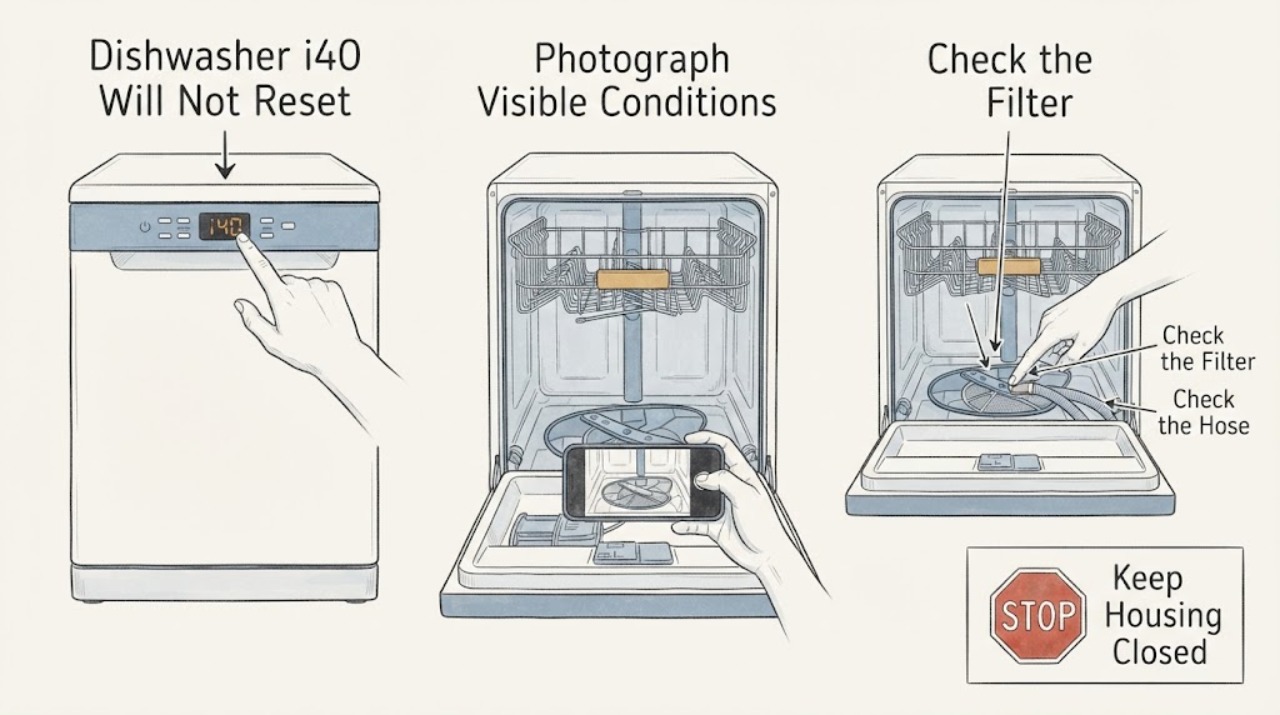
Frigidaire defines i40 as a clogged filter or sump, commonly caused by food soil buildup, and directs the owner to clean the glass trap and filter. Because this task has no complete model number, do not use a cross-model reset sequence or assume the filter, sump, pump, or pressure system has the same access. First record the exact display, standing-water level, and any leak or electrical symptom. Then stop the cycle, keep the area dry, clean only the user-accessible filter or glass trap described by the matching manual, and inspect the external air gap, drain hose, and disposer connection if they are safely visible. Make no more than one normal test after the filter is correctly reinstalled. If i40 will not clear, water covers the filter, water leaks, the drain path is inaccessible, or the appliance has a safety hazard, leave it off and arrange qualified service rather than repeatedly resetting or running it.
Before you begin
Safety first
- User work is limited to reading the model and display, observing standing water, cleaning an exact-manual user-accessible filter or external air gap, and viewing the visible drain route. Do not pull the built-in dishwasher, reach into the sump, remove a pump cover, detach hoses, handle broken glass bare-handed, enter diagnostics, bypass protection, open the console, or use a cross-platform reset sequence.
Work through in order
Diagnostic checks
Use only checks that match the exact appliance or system and its official guide.
-
Check 1
Record the exact i40 display or light pattern, whether the unit stopped mid-cycle, how much water is in the tub, whether water has reached the floor or cabinet, and whether the full model number is available. Photograph the rating plate from a safe position; Gallery or a family name alone is not enough to select a reset or part.
Expected result: The display clearly reads i40; only a flashing pattern is present; water is below the filter; water covers the filter; the unit is leaking; or the model label is incomplete.
Next step: Continue only with the safe external or filter checks below. For an unreadable model, save the photo and use Frigidaire owner support or qualified service before model-specific instructions.
Stop if: Stop immediately for water outside the tub, water near electrical parts, smoke, burning odor, sparks, abnormal heat, damaged power parts, or a repeat breaker trip.
Why this matters
Why: Frigidaire's official i40 page applies to dishwashers and defines the code as a clogged filter or sump, but a different display or a leak changes the decision. Without a complete model, platform-specific access and control behavior remain unverified.
-
Check 2
With the cycle stopped and the water cool enough to handle, inspect the user-accessible glass trap or filter. Remove and rinse it only according to the complete model manual, looking for food soil, labels, bones, glass, or other debris; reinstall every filter section fully. Do not reach into the sump, remove a pump cover, or force a filter that does not match the manual.
Expected result: The filter is visibly clogged; sharp or broken material is present; the filter is clear; the filter is damaged or missing; or it cannot be removed safely.
Next step: Reinstall a clean, intact filter and make one normal test only if the exact manual permits it and no leak or electrical hazard exists. If i40 remains, stop and arrange service.
Stop if: Do not handle broken glass bare-handed, run the dishwasher without its filters, reach under the filter, or use tools to pry the filter or debris loose.
Why this matters
Why: Frigidaire specifically associates i40 with food soil in the filter or sump and provides a glass-trap cleaning route. Sharp debris, a damaged filter, or an inaccessible lower sump is outside a safe user cleaning step.
-
Check 3
From outside the appliance, inspect an accessible countertop air gap, drain hose, sink connection, or disposer connection. Look only for an obvious blockage, kink, loose connection, or a newly installed disposer whose knockout plug may not have been removed. Do not pull the built-in dishwasher or disconnect plumbing.
Expected result: The air gap is blocked; the hose is visibly kinked; the disposer was recently installed; the knockout plug status is unknown; the visible route is clear; or a hose or connection leaks.
Next step: Clean only an accessible external air gap or correct a clearly visible kink according to the installation manual. Have an installer or qualified technician handle a disposer plug, hidden hose, leak, or inaccessible connection.
Stop if: Do not loosen hidden clamps, detach a pressurized hose, reach into the sump, move the appliance, or run another cycle with a leaking connection.
Why this matters
Why: Frigidaire's drainage guidance connects poor draining with hose restrictions, an unremoved disposer knockout plug, and a dirty filter or glass trap. A clear visible route does not rule out a sump, pump, pressure, sensor, or control issue, and a leak is a safety branch.
-
Check 4
Do not reset repeatedly. After the filter is reinstalled and any safe external obstruction is corrected, use only the complete model manual for a cancel or reset action and perform it once. Wait for the documented drain routine to finish before observing the display; do not substitute a sequence from another Frigidaire, Electrolux, or Gallery model.
Expected result: The display clears and the unit drains; i40 returns immediately; water remains; the controls stay unresponsive; or a leak or electrical condition appears.
Next step: If i40 returns or water remains, leave the appliance off and arrange qualified service with the exact model, display pattern, water level, filter result, hose observations, and reset result. Do not order a pump or pressure part from i40 alone.
Stop if: Do not reset after a leak or electrical hazard, repeatedly cycle the dishwasher, enter diagnostics, bypass a float or protection device, or open the console.
Why this matters
Why: Frigidaire's i40 guidance points to filter or sump cleaning, while its error guide says a continuing i40 should be referred for assistance. A reset result does not prove the internal drain, pump, pressure, sensor, or control system is healthy.
-
Check 5
Prepare the service handoff without opening the appliance: complete model and serial number, i40 timing, whether the filter was blocked, standing-water depth relative to the filter, external drain-path findings, whether the code cleared once, and any leak or power event. In a rental, notify the landlord or building maintenance when the installation or plumbing is inaccessible.
Expected result: A full model is available; the family name is the only identity; i40 persists after the safe filter check; or water, wiring, or installation damage is visible.
Next step: Keep the dishwasher off for persistent i40, standing water, a leak, or inaccessible plumbing and schedule qualified appliance service. Give the recorded observations instead of a guessed component diagnosis.
Stop if: Do not pull the appliance, remove panels, disconnect wiring, probe electrical parts, or reconnect it to reproduce a persistent code.
Why this matters
Why: Frigidaire's owner resources and model-specific manuals are needed for exact platform instructions. A persistent i40 after cleaning is a service result, not permission to identify a pump, pressure system, or board by guesswork.
Use your observations
Decision map
Find the observation that best matches what you see, then follow the next safe action.
-
PATH 01Next step
What you see
The complete model manual matches, the accessible filter or glass trap is visibly clogged, and there is no leak or electrical hazard.
Do this next
Follow the matching manual, reinstall the filter correctly, and make one normal test. Stop if i40 or standing water returns.
Why this path and its safety boundary
Why it matters: This is the external or user-accessible condition that Frigidaire directly associates with i40, so it is reasonable to clean and reinstall the filter once.
-
PATH 02Next step
What you see
The filter and visible drain path are clear, but i40 will not reset or water remains over the filter.
Do this next
Leave the dishwasher off and arrange qualified appliance service with the exact model and the recorded observations. Do not guess or order a pump, pressure component, or control board.
Why this path and its safety boundary
Why it matters: The remaining issue may involve an internal sump, pump, pressure, sensor, wiring, or control condition. The public code guidance does not identify which internal part is at fault.
-
PATH 03Next step
What you see
Only a family name is known, the display is not verified as i40, or the model manual cannot be matched.
Do this next
Capture the rating plate and serial number and use Frigidaire owner support or a qualified technician to identify the correct manual before continuing.
Why this path and its safety boundary
Why it matters: Family-level information is enough to identify i40 as a drain/filter clue, but not enough for a platform-specific reset, filter layout, sump access, or part fitment.
-
PATH 04Next step
What you see
Water leaks onto the floor or electrical area, the hose or cabinet is damaged, smoke, burning odor, sparks, abnormal heat, or a repeat breaker trip occurs.
Do this next
Stop the dishwasher, keep clear of wet electrical areas, and arrange qualified appliance or electrical service. In a rental, notify the landlord or building maintenance.
Why this path and its safety boundary
Why it matters: This is an immediate water, electrical, or fire-safety issue, not a reset or filter-cleaning branch.
When checks do not resolve it
Need a professional?
Arrange qualified appliance service when i40 returns after the exact-model filter check and one safe test, water remains over the filter, the drain path or sump is inaccessible, the model is unknown, or an internal pump, pressure, sensor, wiring, or control diagnosis is needed. Stop immediately for leaks, water near electrical parts, smoke, burning odor, sparks, abnormal heat, damaged power parts, or a repeat breaker trip.
Common questions
FAQ
What does i40 mean on a Frigidaire dishwasher?
Frigidaire defines i40 as a clogged filter or sump, often from food soils, and directs the owner to clean the glass trap and filter. If the code continues, service is recommended.
Why will i40 not reset after I clean the filter?
Cleaning the visible filter may not clear an internal sump, drain, pressure, sensor, wiring, or control condition. With no complete model, do not use another platform's reset sequence; stop and arrange service if i40 or standing water returns.
Is some water in the dishwasher always a failure?
Frigidaire says some water in the bottom after a cycle can be normal, but water covering the filter screen or persistent i40 is a different result and requires the drainage checks or service described here.
Read the exact guide
Official sources
- Dishwasher - Drain Hose GuideFrigidaire · Frigidaire Gallery dishwasher family drain-hose and disposer-connection guidance relevant to i40 screening
- Dishwasher Error Code i40 - Clogged filter or sumpFrigidaire · Frigidaire dishwasher family i40 guidance, including Frigidaire Gallery family, and the boundary between filter cleaning and service
- Dishwasher Glass Trap and Filter GuideFrigidaire · Frigidaire Gallery dishwasher family user-accessible glass trap, filter, and external air-gap cleaning guidance
- Dishwasher Error Codes and Alarms GuideFrigidaire · Frigidaire Gallery dishwasher family code-table scope and i40 continuation-to-service guidance
- Dishwashers - Not DrainingFrigidaire · Frigidaire Gallery dishwasher family drainage triage and service boundary
- Owner Center Resource LibraryFrigidaire · Frigidaire Gallery dishwasher owner-support and exact model documentation route
- Why is water in the dishwasher after it runs?Frigidaire · Frigidaire Gallery dishwasher residual-water distinction and drain-path checks
- Dishwasher - Water LeakingFrigidaire · Frigidaire Gallery dishwasher family water-leak, hose, filter, disposer, and service safety boundary
Community feedback
Share a repair observation
Share a plain-text repair observation. Accepted observations are published automatically; this page may take a moment to update.