
On this page
Start here
Quick answer
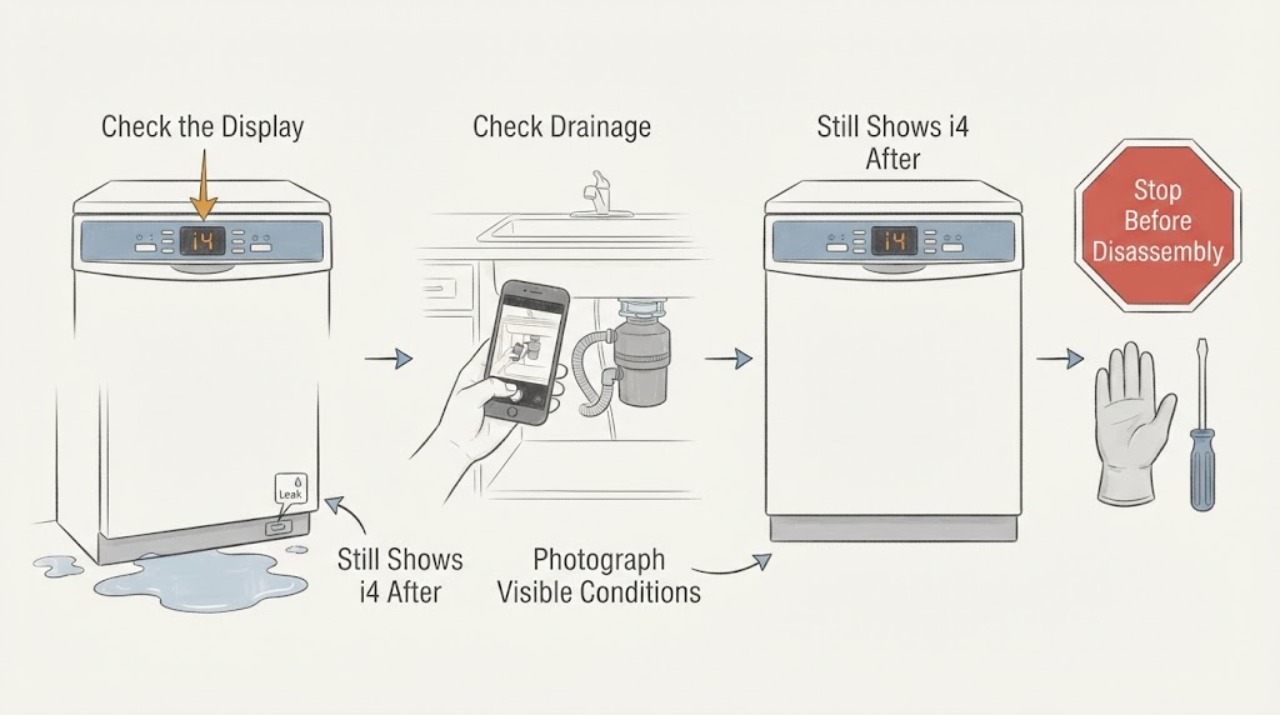
For the exact Frigidaire FFBD1831UW, the official Owner's Guide lists i4 as “Unit leaking.” It does not list i40, so do not translate the display into i40 or use another Frigidaire model's code table. A missing garbage-disposal knockout plug can explain an earlier drainage or leak event, but correcting that installation issue does not prove that the current i4 condition is cleared. Keep the dishwasher off, close its water-supply valve, and arrange service. Do not tilt the machine, remove the bottom pan or float, repeatedly reset or run cycles, or touch wet electrical parts. Only from outside, record whether water is currently visible and whether the sink-side drain hose or disposer connection is kinked, loose, or leaking.
Work through in order
Diagnostic checks
Use only checks that match the exact appliance or system and its official guide.
-
Check 1
Before touching controls or connections, photograph the display, record the complete model FFBD1831UW, and observe from outside for water on the floor, water under the door, a wet toe-kick, damaged cord, burning smell, sparking, or a tripped breaker.
Expected result: Water or electrical damage is visible, or the dishwasher is dry and electrically stable.
Next step: If water is present, close the dishwasher water-supply valve and leave the dishwasher off. Isolate electrical power only from a safe dry location if needed, and arrange service. Do not touch wet wiring or restart the unit.
Why this matters
Why: A leak or electrical hazard takes priority over deciding whether the old disposer installation issue was fixed. A dry exterior does not rule out water in the base pan or an intermittent leak.
-
Check 2
Verify the characters from the photo: compare the display with the exact FFBD1831UW error table and keep i4 separate from i40, i20, or an unclear character. Do not use a different Frigidaire model's error-code guide.
Expected result: The display is clearly i4, it is actually i40 or another code, or the character cannot be read confidently.
Next step: For confirmed i4, keep the water off and use the leak/service branch. For i40, i20, or an unreadable display, preserve the photo and exact model and obtain model-specific support without running cycles to clarify it.
Why this matters
Why: The FFBD1831UW manual explicitly lists i4 as Unit leaking and does not list i40. A different-looking code cannot be assigned a meaning from the nearby family baseline or a generic table.
-
Check 3
With the dishwasher idle and water closed, inspect only the sink-side drain route: look for a kinked, twisted, damaged, loose, or visibly leaking hose, and confirm the disposer connection is the intended connection for this installation. Do not disconnect a fitted hose or reach into the disposer connection.
Expected result: The hose or connection is visibly damaged or leaking, the route is kinked or displaced, or the accessible route looks intact and dry.
Next step: Photograph any visible defect and have the installation or plumbing connection corrected by a qualified person. If the visible route is intact but i4 remains, do not run a confirmation cycle; arrange appliance service.
Why this matters
Why: The exact installation instructions warn that a damaged hose or poor connection can leak, while the support guidance identifies kinked or obstructed drainage and an unremoved disposer knockout as installation-related drainage causes. A dry visible route does not clear an i4 leak indication.
-
Check 4
Treat the disposer-knockout correction as a historical clue only. Record when it was removed, whether the dishwasher had overflowed or leaked before and after the correction, and whether the current i4 appeared during fill, wash, drain, or after the unit stopped. Do not tilt the dishwasher or remove the kickplate, base pan, float, or pump cover.
Expected result: i4 began before the correction and persists afterward, i4 first appeared after the correction, or the event stage and water location are unknown.
Next step: Keep the water closed and provide the timeline, display photo, cycle stage, and visible water observations to service. Do not clear the code by repeated power cycling or repeated starts.
Why this matters
Why: The time relationship can help a technician separate the earlier installation problem from a continuing or new leak, but it cannot prove that the disposer was the only source. Accessing the base to find water or a float is not a safe user-level confirmation.
-
Check 5
Check only the visible door perimeter and floor area for a dish, rack, gasket, or packaging obstruction and note whether the door closes normally. Do not force the door, bypass the latch, or run the dishwasher with water under it.
Expected result: The door is visibly obstructed or damaged, the floor remains dry and the door closes normally, or water reappears after the unit has been left idle.
Next step: Remove only an accessible loading obstruction. For door damage or returning water, keep the supply closed and arrange service; do not restart to see whether the display clears.
Why this matters
Why: A visible door problem can contribute to leakage, but normal door closure does not explain away an exact-model i4. Water that reappears while idle points to a continuing water-supply or leak condition rather than a code-clearing problem.
-
Check 6
Prepare the service record with the exact model and serial, the i4 photo, the disposer-knockout history, water-supply position, visible leak location, sink-side hose observations, cycle stage, and any breaker or odor event. Keep the dishwasher out of service while i4 remains.
Expected result: The record shows a visible external installation leak, no visible leak but persistent i4, or an electrical/water hazard.
Next step: Use qualified appliance service, with a plumber involved for a sink/disposer connection defect. Do not order a pump, float, switch, valve, or control board from i4 alone.
Why this matters
Why: An external connection issue can be repaired by the appropriate qualified person, but persistent i4 without a visible source requires inspection of the dishwasher's leak/overflow system. A hazard requires immediate stop-use rather than more diagnosis.
Use your observations
Decision map
Find the observation that best matches what you see, then follow the next safe action.
-
PATH 01Next step
What you see
Water is on the floor, under the door, at the toe-kick, near electrical parts, or reappears while the dishwasher is idle; or a damaged cord, burning odor, spark, or breaker trip is present.
Do this next
Close the dishwasher water-supply valve, keep the dishwasher off, and isolate electrical power only from a safe dry location. Arrange qualified service; do not touch wet wiring, tilt the unit, or restart it.
Why this path and its safety boundary
Why it matters: The i4 condition may reflect an active or stored leak/overflow with an electrical safety risk, regardless of the earlier disposer-knockout correction.
-
PATH 02Next step
What you see
The display is confirmed as i4 on FFBD1831UW after the disposer knockout was removed, but no water is visible outside.
Do this next
Keep the water closed and arrange qualified appliance service. Do not clear i4 with repeated resets, run an empty cycle, or open the bottom of the dishwasher.
Why this path and its safety boundary
Why it matters: The exact guide still defines i4 as Unit leaking. No visible water does not establish that the base pan, float, hose connection, or leak source is dry or safe.
-
PATH 03Next step
What you see
The sink-side drain hose or disposer connection is visibly kinked, loose, damaged, or leaking.
Do this next
Leave the water off and have the visible connection corrected by a qualified installer or plumber. Do not run the dishwasher afterward merely to test whether i4 clears; have the persistent code and leak history assessed.
Why this path and its safety boundary
Why it matters: The installation path can be a current external source of drainage trouble or leakage; fixing the old knockout alone did not verify the entire path.
-
PATH 04Next step
What you see
The display is actually i40, i20, or another code, or the character cannot be distinguished from i4 in the photo.
Do this next
Do not run cycles to generate another code or apply a different model's filter/drain procedure. Preserve the exact display and model information and obtain model-specific service guidance.
Why this path and its safety boundary
Why it matters: The exact FFBD1831UW guide does not list i40 or i20 in its error table, so a cross-model interpretation would be unsupported.
-
PATH 05Next step
What you see
The dishwasher is dry outside, the door closes normally, the visible drain route looks intact, and confirmed i4 remains after the installation correction.
Do this next
Keep the dishwasher out of service with the water closed and arrange qualified Frigidaire appliance service. Provide the timeline and do not tilt, dismantle, or repeatedly reset the unit.
Why this path and its safety boundary
Why it matters: The remaining condition is not safely explained by the old knockout alone; an internal leak, stored base-pan water, or leak-protection state remains possible without identifying a part.
Helpful context
Understand the symptom
Do not treat the repaired disposal connection as proof that the appliance is safe to run. The FFBD1831UW guide's exact error table says i4 means the unit is leaking; it does not provide an i40 entry. That makes the current display a leak/overflow stop condition, not a filter-code or generic drain-code invitation to keep testing.
The missing knockout plug is a real installation issue when a dishwasher drains into a disposer, but the exact installation guide also warns that drain-hose damage, a bad connection, or a kink can cause leakage. Those visible sink-side checks are different from opening the machine's base or assuming the original cause was the only cause.
Because i4 remains after the knockout was corrected, leave the water off and arrange qualified service. If water is near electrical parts, the cord is damaged, or the breaker trips, isolate power only from a safe dry location; do not reach under the dishwasher or remove panels.
When checks do not resolve it
Need a professional?
Stop immediately and close the dishwasher water supply for any visible water, overflow, returning water, water near electrical parts, damaged cord, burning smell, sparking, or breaker trip. For confirmed FFBD1831UW i4 after the disposer knockout was removed, keep the dishwasher off and arrange qualified appliance service even if the floor looks dry. Do not confuse i4 with i40, run cycles to clear the display, repeatedly reset power, tilt the dishwasher, remove the base pan or float, bypass leak protection, or touch wet electrical parts.
Common questions
FAQ
What does i4 mean on the Frigidaire FFBD1831UW?
The exact FFBD1831UW Owner's Guide lists i4 as Unit leaking. It does not list i40. Keep the dishwasher off and close its water supply rather than applying another Frigidaire model's code meaning.
If the garbage-disposal knockout was removed, why does i4 remain?
The missing knockout may have caused the earlier drainage or leak event, but removing it does not verify that no water remains in the base or that there is no hose, connection, overflow, or new leak. The exact guide still treats i4 as a leaking-unit condition, so do not run repeated cycles to clear it.
Can I tilt the dishwasher or remove the float to clear i4?
No. The safe response to persistent i4 is to close the water supply and arrange service. Tilting, opening the base, removing the float, or touching wet electrical parts can create injury, leak, and shock risks and is not needed to document the problem.
Read the exact guide
Official sources
- Installation Instructions A16308101 for FFBD1831UW | FrigidaireFrigidaire · Opened from the exact FFBD1831UW Frigidaire support page. It warns that damaged or kinked drain routing and loose hose connections can leak, requires a hose clamp, and directs the installer to close the water valve and contact service when an operating error occurs.
- Dishwashers - Not Draining | FrigidaireFrigidaire · Opened official Frigidaire support article. It covers visible drain-hose kinks, high-loop and connection concerns, filter/debris context, disposer knockout removal, and service when drainage trouble continues.
- Complete Owner's Guide A15931101 for FFBD1831UW | FrigidaireFrigidaire · Opened from the exact FFBD1831UW Frigidaire support page. The guide lists i1 and i4 in its error table, defines i4 as Unit leaking, and instructs owners to turn off the main water supply for overflow and handle base-pan water before restarting.
- Frigidaire 18'' Built-In Dishwasher White-FFBD1831UW | Product SupportFrigidaire · Opened official Frigidaire Canada product-support page. It identifies FFBD1831UW as the 18-inch built-in dishwasher and links the exact Complete Owner's Guide and Installation Instructions.
Community feedback
Share a repair observation
Share a plain-text repair observation. Accepted observations are published automatically; this page may take a moment to update.