
On this page
Start here
Quick answer
A small, clear amount of water below the filter after a Frigidaire Gallery dishwasher finishes can be normal. Dirty water that returns or rises while the dishwasher is idle is a different pattern: first record whether it appears after the sink or garbage disposer drains, or whether it rises with no nearby drain event. A drain-path or installation problem becomes more likely when the return is tied to the sink/disposer; a fill-path seepage or another internal water fault becomes more likely when the level rises while idle. Do not assume an inlet valve or pump is failed from the symptom alone. Keep dirty standing water out of contact with dishes, use the exact full model manual for accessible filter and drain checks, and arrange service if the level rises, returns, reaches the floor, or cannot be safely traced.
Before you begin
Safety first
- Owner checks are limited to identifying the full model, observing water level and timing, inspecting visible drain routing from a dry position, and cleaning only model-designated accessible filter or air-gap parts. Do not pull out the built-in unit, disconnect pressurized hoses, open the sump or pump, perform live electrical tests, use drain chemicals, or bypass a safety feature.
Work through in order
Diagnostic checks
Use only checks that match the exact appliance or system and its official guide.
-
Check 1
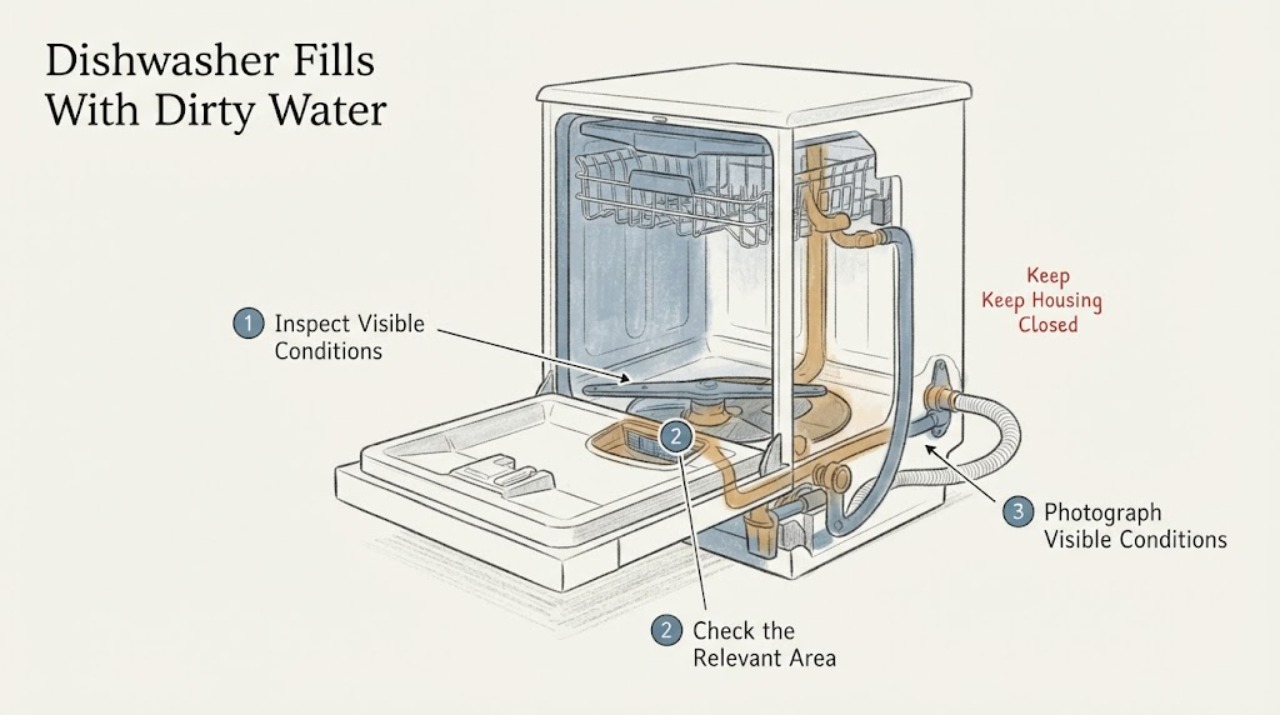
Do not run a dish load while dirty water is present. From a dry, safe position, note the exact model from the rating label, photograph the water level and color or food residue, and record whether water is below the filter, covers it, reaches the floor, or is near any electrical connection.
Expected result: The water is a small stable amount below the filter, or it is dirty, rising, backing up, outside the tub, or near an electrical part.
Next step: If water is rising, overflowing, on the floor, or near electricity, leave the dishwasher off and isolate water or power only from a dry safe position, then arrange qualified service. If it is a small stable amount below the filter, continue with the timing check rather than ordering a part.
Stop if: Do not reach into pooled water, touch a wet plug or wiring, pull out the built-in dishwasher, or continue washing dishes through dirty standing water.
Why this matters
Why: Frigidaire says some water in the bottom after a completed cycle can be normal; water covering the filter or escaping the tub is a different drainage or leak pattern. Dirty standing water should be treated as contaminated for dish-use decisions until the source is corrected, without claiming a laboratory safety result.
-
Check 2
With the dishwasher switched off and no sink or disposer running, mark the visible water level with a photograph or note and check again later without starting a cycle. Keep the supply valve in its normal state until the initial pattern is documented, unless an active leak requires safe shutoff.
Expected result: The water level remains a small, clean-looking stable amount; it slowly increases while the dishwasher is idle; or it is already dirty and continues to rise.
Next step: Monitor only the safe visible pattern. For idle filling or dirty rising water, close the dishwasher water supply from a dry accessible position if possible and request appliance service; do not repeatedly reopen it to test a suspected valve.
Stop if: Do not remove the toe-kick, open the cabinet, disconnect the supply hose, or perform live or internal electrical tests.
Why this matters
Why: A stable small amount fits Frigidaire's normal post-cycle residual-water guidance. A level that increases with no drain event is not explained by the use interval alone and makes a fill-path seepage or another internal water fault plausible, but does not identify an inlet valve without service testing.
-
Check 3
While the dishwasher remains off, observe whether the water returns or rises at the same time that a nearby kitchen sink or garbage disposer discharges. Do not start the dishwasher to create a test; keep hands and plumbing connections dry and accessible.
Expected result: Dirty water appears or the level rises immediately after nearby sink or disposer drainage, or it changes independently of that event.
Next step: If timing follows the sink or disposer, have the visible drain routing, elevated loop, countertop air gap if installed, and disposer connection checked against the exact Frigidaire installation instructions. If timing is independent, keep the appliance off and give service the level and timing record.
Stop if: Do not loosen a drain fitting, remove a disposer, pull the dishwasher, or insert tools or chemicals into the drain path.
Why this matters
Why: Timing with the shared drain makes backflow or an installation drain-path issue more likely than a dishwasher that is actively filling itself. An independent rise keeps a fill-path fault, retained water, or another source in consideration; neither pattern proves a specific part.
-
Check 4
From the ordinary under-sink viewing position, inspect only the visible dishwasher drain hose for a kink or displaced routing, look for a countertop air gap if the home has one, and note whether the dishwasher drains to a garbage disposer. If a disposer was recently installed, record whether its dishwasher inlet knockout-plug question was verified in the installation documentation.
Expected result: The hose is kinked or low-routed, the air gap has visible food residue, the disposer connection is new or uncertain, or the visible routing looks correct and dry.
Next step: Clean only an accessible air-gap cover or model-designated filter as described by the exact manual, and refer a routing or disposer question to the installer or a plumber. If a connection is wet or inaccessible, close water safely and arrange service instead of dismantling it.
Stop if: Do not cut, disconnect, or reseat pressurized plumbing, remove the disposer, move the dishwasher, or work in pooled water.
Why this matters
Why: Frigidaire's drain guidance links proper hose routing, a clean air gap, a clear filter, and removal of a disposer knockout plug with proper drainage; improper draining can leave food soils and odor. A correct visible route shifts the problem toward a concealed drain, valve, or other internal condition rather than proving one.
-
Check 5
After water is isolated and the interior is safe to handle, remove and rinse only the model-designated accessible glass trap or filter as the exact Frigidaire manual shows. Inspect for food soil, glass, or debris and reinstall it correctly; do not open the sump or pump area.
Expected result: The filter or glass trap contains food residue or debris, it is clear and correctly seated, or cleaning requires force, tools, or access below the filter.
Next step: If debris was found, clean it using the model instructions and watch for a recurrence without putting dishes at risk. If dirty water returns, the filter was clear, or the part cannot be safely accessed, request qualified service and provide the photos and timing record.
Stop if: Do not pick up broken glass bare-handed, remove a sump cover, dismantle a pump, use drain chemicals, or run repeated cycles to force a drain.
Why this matters
Why: Frigidaire identifies the filter and glass trap as user-accessible drainage checks and says food and debris can obstruct drainage. A clear filter does not rule out a concealed drain restriction, backflow, or fill-path problem; inaccessible work crosses the owner boundary.
Use your observations
Decision map
Find the observation that best matches what you see, then follow the next safe action.
-
PATH 01Next step
What you see
Only a small, stable amount of clear-looking water remains below the filter after a completed cycle, with no dirty return, rising level, floor water, or backup.
Do this next
Keep the filter clean according to the exact Gallery model manual and monitor whether the water becomes dirty, covers the filter, rises while idle, or returns after sink drainage.
Why this path and its safety boundary
Why it matters: This matches Frigidaire's statement that some water at the bottom after a cycle can be normal; the three-to-four-day use interval is not itself a fault diagnosis.
-
PATH 02Next step
What you see
Dirty water returns or rises when the nearby sink or disposer drains, especially when the drain hose, air gap, or disposer connection is uncertain.
Do this next
Stop using the dishwasher with dirty standing water, have the installer, plumber, or qualified appliance technician check the visible drain arrangement against the exact model instructions, and do not disconnect the plumbing yourself.
Why this path and its safety boundary
Why it matters: The shared drain path or installation is more likely than active dishwasher filling. Frigidaire connects drain routing, air-gap cleanliness, filter condition, and disposer knockout-plug status with proper drainage, but the public guidance does not certify a particular backflow component.
-
PATH 03Next step
What you see
The water level rises while the dishwasher is idle and no sink or disposer discharge occurred, or it continues rising after the shared drain path is known to be clear.
Do this next
Close the dishwasher water supply from a dry accessible position if safe, keep the appliance off, and arrange qualified Frigidaire or appliance service with the model, water-level timeline, and supply-valve state.
Why this path and its safety boundary
Why it matters: An inlet or fill-path seepage, retained water, or another internal water fault is plausible, but a leaking inlet valve is not proven by observation alone.
-
PATH 04Next step
What you see
The filter is clogged, water covers it after a cycle, the unit stops with standing food-laden water, or dirty water persists after the accessible filter and visible drain checks.
Do this next
Do not run repeated contaminated cycles. Request service, or send a recent-installation/drain-routing issue to the installer, and provide the filter condition and photos.
Why this path and its safety boundary
Why it matters: A drainage restriction, concealed drain component, or installation problem remains possible; the visible filter result does not identify the pump or another part.
-
PATH 05Next step
What you see
Water reaches the floor or electrical area, the dishwasher overflows, a connection is actively leaking, there is smoke or a burning smell, or the source cannot be reached without moving the built-in unit.
Do this next
Leave the dishwasher off, isolate water and power only from a dry safe location, keep clear of wet electrical parts, and arrange qualified appliance or electrical help; use emergency procedures for active smoke or fire.
Why this path and its safety boundary
Why it matters: This is a water-damage or electrical-safety path that ordinary owner checks cannot safely resolve.
Helpful context
Understand the symptom
The use interval of every three to four days does not by itself explain a tub that fills with dirty water between cycles. It can make old food soil or odor more noticeable, but the key evidence is the timing and level: a small, stable amount below the filter after a completed cycle is different from dirty water that rises later or returns when a nearby sink or disposer drains. The Gallery name is a product line, not a complete model number, so controls and removable parts must be checked against the rating-plate model and its manual.
Frigidaire's opened dishwasher guidance supports checking an unobstructed filter and drain path, an elevated or correctly routed drain hose, a countertop air gap when fitted, and a disposer knockout plug when applicable. Those checks can show where to send the installation or service request; they do not prove that a particular valve, pump, or hose is the failed part.
Only after diagnosis
Potential parts
- dishwasher inlet valve or fill-path component
Consider this category only if qualified service confirms that water rises while the dishwasher is idle with no shared-drain event and the exact model's fill path is implicated.
Gallery is a product line, not a complete model number; confirm the full rating-plate model and the technician's diagnosis before any part selection. - dishwasher drain hose, air-gap, disposer connection, or drain-path component
Consider this category only when the dirty-water return is tied to sink or disposer drainage or when a qualified inspection finds a restricted or incorrectly routed drain path.
Do not order by the Gallery name or appearance; verify the complete model and installation arrangement, and have pressurized or concealed plumbing work performed by a qualified provider.
When checks do not resolve it
Need a professional?
Call qualified appliance service for idle filling, recurring dirty water, standing water covering the filter, overflow, an inaccessible wet point, or any need to inspect the inlet valve, pump, sump, concealed hose, or wiring. Call the installer or a plumber for a recent installation or disposer drain-routing issue.
Safety scope: Owner checks are limited to identifying the full model, observing water level and timing, inspecting visible drain routing from a dry position, and cleaning only model-designated accessible filter or air-gap parts. Do not pull out the built-in unit, disconnect pressurized hoses, open the sump or pump, perform live electrical tests, use drain chemicals, or bypass a safety feature.
Have this ready
- Provide the full model and serial information, the Gallery line name, the water level and color, photographs, when the last cycle finished, whether the level changed while idle, whether the sink or disposer was draining, filter and air-gap observations, any recent installation or disposer work, and whether the water reached the floor.
Common questions
FAQ
Is a little water in a Frigidaire Gallery dishwasher always a leak?
No. Frigidaire says some water at the bottom after a completed cycle can be normal. A dirty or rising level, water covering the filter, return after sink drainage, or water outside the tub is a different pattern that needs investigation.
Why does dirty water appear between dishwasher cycles?
First correlate it with nearby sink or garbage-disposer drainage. A timed return makes a shared drain or installation path more likely; a rise while the dishwasher is idle makes a fill-path or internal water fault plausible. Neither observation proves a specific part.
Should I run the dishwasher to flush the dirty water?
Do not run repeated cycles while dirty standing water is present or when water is rising, overflowing, or near electricity. Record the pattern, perform only the exact manual's accessible filter or drain checks, and request service if it recurs.
Can I replace the inlet valve based only on the water rising while idle?
No. Idle filling makes a fill-path problem plausible but does not distinguish an inlet valve from another internal fault or retained water. Close the water supply safely and have the full model and symptom timing assessed by qualified service.
Does using the dishwasher only every three or four days cause dirty water to fill the tub?
The interval can make food soil or odor more noticeable, but it does not establish why water is returning or rising. Timing, level, filter condition, and the shared drain connection are more useful observations.
Read the exact guide
Official sources
- Why is water in the dishwasher after it runs?Frigidaire · Opened Frigidaire's dishwasher support article; it applies at the general dishwasher level and does not identify a specific Gallery model or prove the cause of dirty water returning between cycles.
- Dishwasher Glass Trap and Filter GuideFrigidaire · Opened Frigidaire's official guide; it supports only the accessible filter and air-gap checks that the exact Gallery model also designates as user-serviceable.
- Dishwashers - Not DrainingFrigidaire · Opened Frigidaire's official drainage article; it provides general checks and explicitly remains model-dependent for reset or drain behavior, so it is not used to infer a Gallery-specific control sequence.
- Dishwasher - Not FillingFrigidaire · Opened Frigidaire's general dishwasher fill article; it confirms that the water valve and supply line are model-relevant checks but does not establish that idle dirty-water rise is an inlet-valve failure.
- Dishwasher - Drain Hose GuideFrigidaire · Opened Frigidaire's drain-hose guide for general dishwasher installation context; exact Gallery routing must be checked against the full model's installation instructions.
Community feedback
Share a repair observation
Share a plain-text repair observation. Accepted observations are published automatically; this page may take a moment to update.