
On this page
Start here
Quick answer
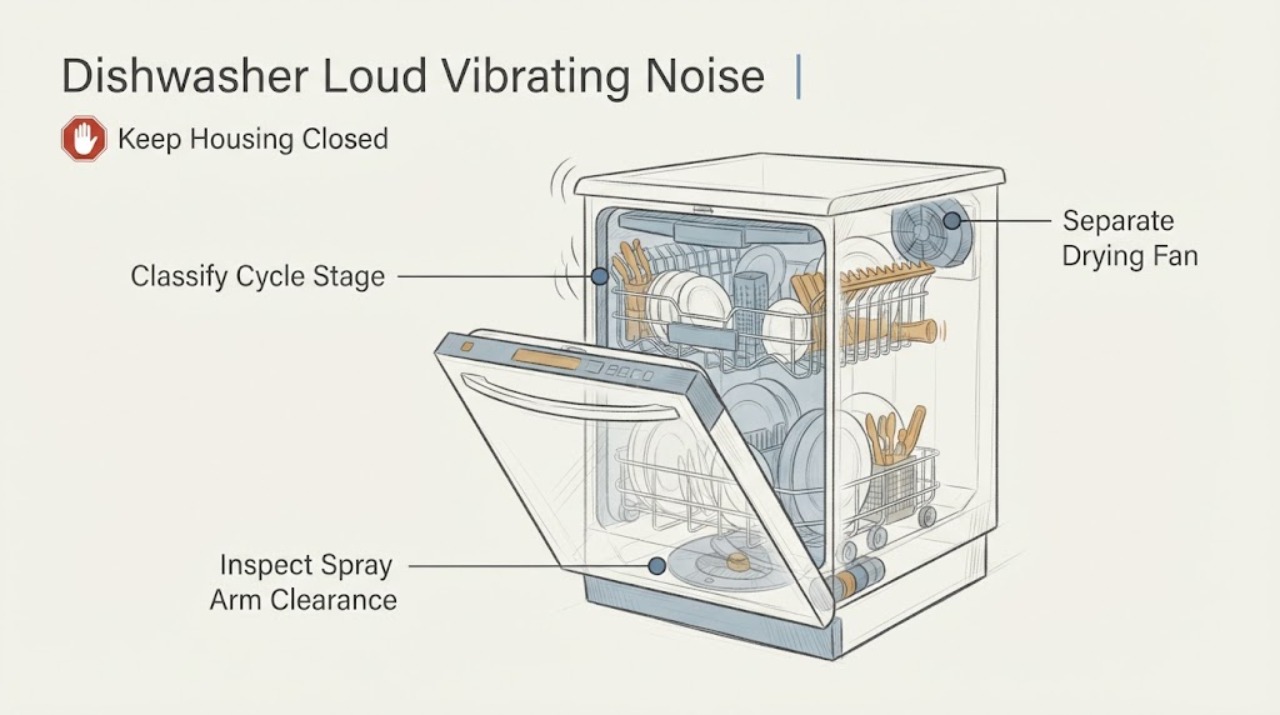
First identify when the sound occurs. Frigidaire describes water filling, pump humming, changing spray-arm whooshing, a drain-pump hum that changes as water leaves, and a drying fan on equipped models as normal operating sounds. A knock or vibration can instead occur when a tall dish, pan or utensil interferes with a spray arm. Stop the cycle before opening the door, let hot water or steam clear, and reposition only the accessible item that is visibly in the spray-arm path. Do not reach into moving spray arms or open the dishwasher cabinet. If the sound is a persistent harsh vibration, metallic scrape, electrical noise, leak or burning smell, keep the dishwasher off and arrange model-matched service; the sound alone does not identify a failed pump or motor.
Before you begin
Safety first
- Limit owner work to recording the model and sound timing, stopping the cycle, waiting for hot water or steam to clear, and repositioning a clearly accessible dish or utensil. Do not reach into moving spray arms, remove pump covers or racks to access hidden parts, open panels, perform live electrical tests, or order an internal part from sound alone.
Work through in order
Diagnostic checks
Use only checks that match the exact appliance or system and its official guide.
-
Check 1
Record whether the sound occurs during filling, wash circulation, spray-arm alternation, draining or drying, and describe it as a hiss, hum, whoosh, knock, vibration or scrape.
Expected result: The sound matches one of Frigidaire's described operating stages, or it is a harsh sound that does not follow a normal stage.
Next step: Use the matching normal-sound or abnormal-sound branch below; do not diagnose a pump or motor from the label alone.
Why this matters
Why: A stage-matched hiss, pump hum, spray-arm whoosh or equipped-model drying fan can be normal; an unexplained harsh vibration or scrape needs a separate service decision.
-
Check 2
Stop the cycle and wait for spraying and hot steam to clear, then inspect the loaded racks for a tall dish, pot, pan or utensil in the visible spray-arm path.
Expected result: A load item is visibly positioned where a spray arm could contact it, or no such item is visible.
Next step: Reposition only the accessible item and monitor the next ordinary cycle if the appliance has no hazard sign; if no obstruction is found or the sound continues, keep investigating only through the safe branches and service boundary.
Why this matters
Why: Frigidaire identifies spray-arm contact with an overly tall item as a cause of clunking or knocking; no visible obstruction leaves the noise cause unresolved.
-
Check 3
If the sound occurs during drying, check the exact model manual or feature list for Frigidaire Even Dry or Perfect Dry before treating a fan sound as a failure.
Expected result: The dishwasher has an identified fan-assisted drying feature, or the model does not confirm one.
Next step: Treat only the documented equipped-model fan operation as a normal possibility; for an unconfirmed model or harsh noise, stop and use model-specific support.
Why this matters
Why: Frigidaire says a fan may operate at various times on equipped models; the same explanation cannot be transferred to a model without that feature.
-
Check 4
Stop using the dishwasher immediately if the vibration is accompanied by a leak, burning smell, smoke, arcing, electrical odor, cabinet movement or persistent metallic scraping.
Expected result: A water, fire, electrical or mechanical hazard sign is present, or the noise is only a stage-matched operating sound.
Next step: Keep the appliance off, keep water away from electrical areas, and arrange qualified service; do not open panels or perform live tests.
Why this matters
Why: The normal-sound guidance does not cover hazardous symptoms; continuing a cycle could worsen damage or expose the user to water or electrical risk.
-
Check 5
Give Frigidaire support or a qualified technician the full model number, the cycle stage, sound description, whether a tall item was present, and whether the noise persists after the load is corrected.
Expected result: The sound persists, returns without a visible obstruction, or cannot be matched to a normal operating stage.
Next step: Use model-matched service rather than ordering a guessed pump, motor, bearing or other part.
Why this matters
Why: The public Frigidaire pages support symptom classification and the spray-arm check, but not a definitive internal component diagnosis for an unidentified model.
Use your observations
Decision map
Find the observation that best matches what you see, then follow the next safe action.
-
PATH 01Next step
What you see
The sound is a brief hiss while filling, a wash-pump hum that starts and stops, a changing spray-arm whoosh, or a drain-pump hum that changes as water leaves.
Do this next
Record the timing and monitor normal operation; escalate if the sound becomes harsh, persistent outside that stage, or is accompanied by a hazard sign.
Why this path and its safety boundary
Why it matters: Frigidaire documents these as normal operating sound patterns for dishwashers.
-
PATH 02Next step
What you see
The dishwasher knocks or bangs and a tall dish, pot, pan or utensil is in the spray-arm path.
Do this next
Stop the cycle, allow hot water and steam to clear, reposition the accessible item, and seek service if the sound remains without that obstruction.
Why this path and its safety boundary
Why it matters: The load may be interfering with spray-arm movement rather than proving an internal pump failure.
-
PATH 03Next step
What you see
The sound occurs during drying and the exact model is confirmed to have Even Dry or Perfect Dry.
Do this next
Follow the model manual and monitor; do not use the fan explanation if the model or feature is not confirmed.
Why this path and its safety boundary
Why it matters: Frigidaire says a drying fan can operate at various times on models with those systems.
-
PATH 04Next step
What you see
The noise persists after the load is corrected, cannot be matched to a normal stage, or includes scraping, burning odor, smoke, arcing, a leak or cabinet movement.
Do this next
Keep the dishwasher off and arrange qualified, model-matched service without opening the cabinet or running repeated tests.
Why this path and its safety boundary
Why it matters: The opened Frigidaire sound guidance does not support a safe owner diagnosis of the internal part, and the added symptom is a safety or service boundary.
Helpful context
Understand the symptom
Classify the sound by cycle stage
Write down whether the sound happens while the dishwasher fills, during wash circulation, when spray arms alternate, while water drains, or during drying. Frigidaire describes a valve hiss during filling, wash-pump humming that starts and stops as spray arms alternate, a drain-pump hum that changes as water is pumped out, and spray-arm whooshing that changes when the arms switch. A sound that only matches one of those stages is not automatically a failed motor or pump.
Stop and clear visible spray-arm interference
If the noise is a knock or bang, stop the cycle and wait until the dishwasher is no longer spraying or hot before opening it. Look for a tall plate, pot, pan or utensil that could be in the path of a spray arm. Reposition only the accessible load item; do not force a spray arm, reach into moving parts, or remove a rack or pump cover to investigate.
Do not mistake drying-fan operation for a fault
If the sound appears during drying and the model has Frigidaire Even Dry or Perfect Dry, a fan can operate at different times in the cycle. Check the exact model manual before treating that sound as a mechanical failure. A loud grinding, scraping, electrical sound, burning odor or leak is outside this normal-sound explanation and is a stop-use condition.
Escalate when the pattern is abnormal or persistent
If the sound remains loud after the visible load is corrected, occurs in more than one stage, or is accompanied by movement, scraping, a leak, burning odor or electrical symptoms, record the full model number and keep the dishwasher off. Frigidaire’s public noise guidance does not identify a pump, motor or bearing from sound alone. A qualified technician should match any internal diagnosis or repair to the exact model.
When checks do not resolve it
Need a professional?
Use Frigidaire or qualified appliance service for persistent or unexplained vibration, metallic scraping, a leak, electrical or burning symptoms, cabinet movement, or any repair requiring access below or inside the dishwasher.
Safety scope: Limit owner work to recording the model and sound timing, stopping the cycle, waiting for hot water or steam to clear, and repositioning a clearly accessible dish or utensil. Do not reach into moving spray arms, remove pump covers or racks to access hidden parts, open panels, perform live electrical tests, or order an internal part from sound alone.
Common questions
FAQ
Is a humming or whooshing sound normal on a Frigidaire dishwasher?
Often. Frigidaire describes wash-pump and drain-pump humming, water-valve hissing and changing spray-arm whooshing as normal operating sounds. The cycle stage and whether the sound is harsh or hazardous matter more than the word humming alone.
What commonly causes a dishwasher knocking sound?
Frigidaire says a dish, pot, pan or utensil that is too tall can interfere with a spray arm. Stop the cycle safely and reposition the accessible item; do not assume the pump has failed if the sound is load-related.
Can the drying fan make noise?
Yes, on models equipped with Frigidaire Even Dry or Perfect Dry. Confirm the feature for the exact model before using that explanation, and escalate a harsh or hazardous sound.
Should I replace the wash pump because the dishwasher vibrates?
No. The opened Frigidaire pages support sound classification and checking spray-arm clearance, but a loud vibration does not identify a failed pump or motor. Persistent or hazardous noise needs model-matched qualified service.
Read the exact guide
Official sources
- Dishwasher - Noise GuideFrigidaire Owner Support · Direct Frigidaire dishwasher noise guidance; no model is supplied by the task, so it is used for generic sound classification and the spray-arm obstruction check.
- Dishwashers - What are normal dishwasher operations sounds?Frigidaire Owner Support · Direct Frigidaire generic dishwasher sound guidance; it applies to dishwashers and explicitly limits the drying-fan statement to models equipped with Even Dry or Perfect Dry.
Community feedback
Share a repair observation
Share a plain-text repair observation. Accepted observations are published automatically; this page may take a moment to update.