
On this page
Start here
Quick answer
Do not use the visible water depth in a Frigidaire dishwasher tub as proof that the FFCDUS2A is underfilling. The available Frigidaire material does not confirm FFCDUS2A as a complete regional model number, so read the entire rating-plate model and market and use that exact manual first. Then distinguish the programme stage from a real symptom: during circulation, water is being pumped through the spray system rather than sitting at a fixed height. Check for normal filling and spray activity from a safe position, incoming water temperature and household pressure, an open valve and kink-free supply line, and clean accessible filters and spray arms. If the dishes remain dry or dirty, the dishwasher never fills, water covers the filter, a leak appears, or the condition returns after one safe external check, stop using it and arrange qualified service. Do not hand-fill the tub, remove an inlet valve, open the sump, or select a part from the apparent water level alone.
Before you begin
Safety first
- Keep the dishwasher off when it leaks, stays dry after a cycle, repeatedly fails to fill, or has a recurring display or electrical symptom. Do not hand-fill the tub, open the sump, remove an inlet valve or float, disconnect plumbing, pull out or tilt the appliance, bypass a door or water-level safety, or perform live electrical tests.
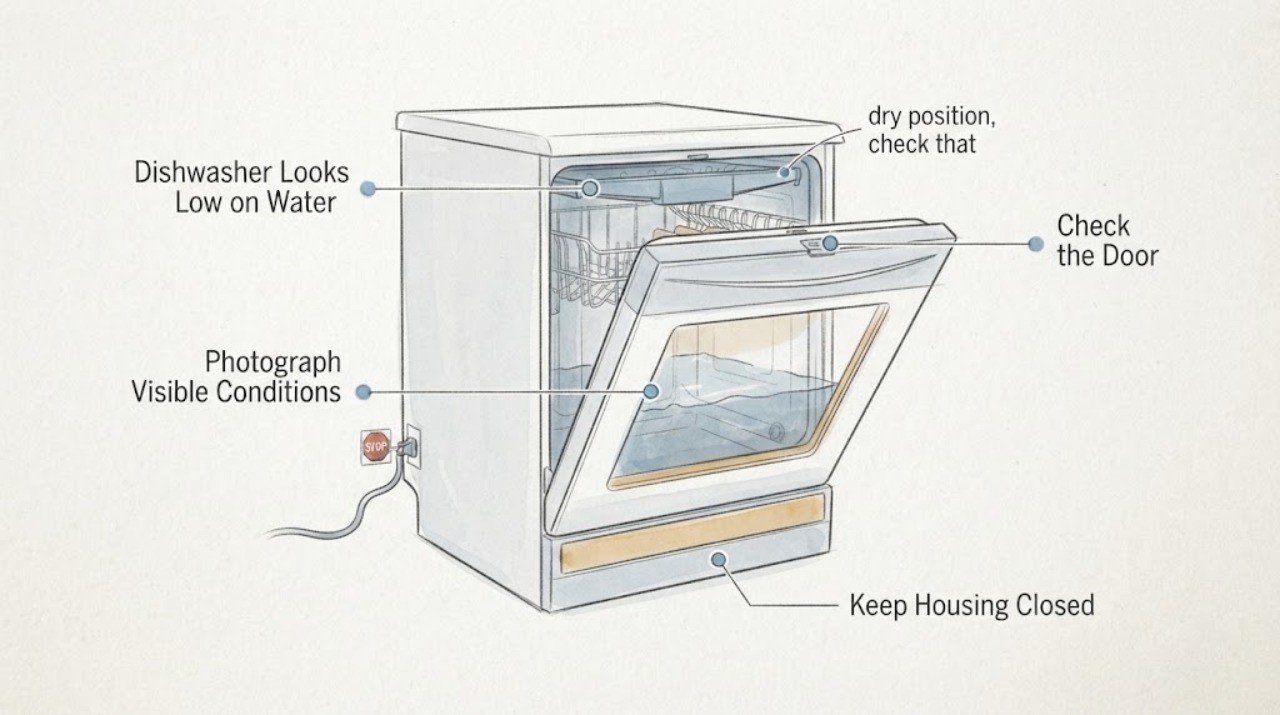
Work through in order
Diagnostic checks
Use only checks that match the exact appliance or system and its official guide.
-
Check 1
Before interpreting the level, photograph or transcribe the complete rating-plate model, suffix, serial information, and market. From the control panel, note whether the selected programme is Hi-Temp or Heavy, which stage is active (fill, wash/circulation, drain, or dry), and whether any display message is present. Do not use a generic cycle chart if the full model is different.
Expected result: The label confirms a complete model that matches FFCDUS2A, the label has a suffix or market not provided in the question, or the string cannot be read reliably; the low-looking water is seen during filling, circulation, draining, or after the cycle.
Next step: Use the exact model manual for any programme-specific level or filter instruction. Until the identity and stage are known, continue only with the external and user-accessible observations below; do not order a valve or add water by hand.
Stop if: Stop and arrange service if the label is damaged or unavailable and the appliance also leaks, overheats, trips a breaker, exposes wet electrics, or displays a recurring fault.
Why this matters
Why: The current official Frigidaire support route requires the complete model number to locate the matching manual, and the same visual level has different meaning at different stages. A partial or unmatched identity prevents a model-specific water-height claim; water seen during active circulation is not a measurement of the fill volume.
-
Check 2
If there is no active leak or electrical hazard, listen from outside the closed dishwasher during the beginning of one normal, model-approved cycle and note whether there is a brief filling sound followed by water-circulation or spray sound. Do not open the door while the machine is running, reach into the tub, or put a hand near a moving spray arm.
Expected result: There is a fill sound followed by steady circulation and the interior or dishes are wet after the completed cycle; there is no fill sound, only a hum, a dry interior, or no spray/cleaning result.
Next step: For normal fill and wet dishes, judge the result by cleaning and drying rather than tub depth. For no fill or a dry load, stop repeated tests and check only the external water supply and accessible parts in the next actions before requesting service.
Stop if: Stop immediately for water on the floor, smoke, burning odor, a breaker trip, an exposed or wet electrical connection, or abnormal grinding or impact sounds.
Why this matters
Why: Frigidaire identifies filling, circulating water, and motor operation as normal sounds. A wet interior and spray-related sound make a merely low-looking water line less concerning; no fill or a dry load is a genuine fill/circulation symptom, but it does not distinguish an external supply issue from an internal valve, pump, float, or control fault.
-
Check 3
From a safe, dry position, check that the dishwasher's water shutoff valve is open, the visible supply line is not kinked or crushed, and no visible connection is wet. Before starting the cycle, run the kitchen tap until hot and avoid starting the dishwasher while a shower, washer, or other fixture is using substantial water. Do not loosen a pressurized fitting or pull the dishwasher out.
Expected result: The shutoff is closed, the line is restricted or visibly leaking, hot water is delayed, or water use elsewhere is reducing household pressure; or the accessible supply looks normal and the machine still has no fill or poor cleaning.
Next step: Correct only a clearly accessible valve position or hose-routing issue without disconnecting plumbing, and wait until household demand is low. If the connection leaks, keep the water supply off when safe and contact the installer or service; if supply conditions are normal but no-fill persists, arrange qualified appliance service.
Stop if: Do not work on a wet connection, disconnect the line, move the dishwasher, measure live voltage, or keep running it with an active leak.
Why this matters
Why: Frigidaire's not-filling guidance calls out open valves and a supply line that is not pinched or restricted. Its cleaning guidance says water at least 120°F at the start and low household pressure can affect results. These conditions can explain poor Hi-Temp/Heavy performance without proving an appliance inlet valve is bad.
-
Check 4
With the dishwasher stopped, cool, and isolated from power by the ordinary user control or a safe accessible disconnect, inspect only the filter, glass trap, and spray-arm openings that the exact manual identifies as user-accessible. Remove visible food or mineral debris as the manual permits and confirm that the spray arms turn freely by hand only when the machine is off; do not reach into the sump or remove a pump cover.
Expected result: A filter or spray opening is visibly blocked, the accessible parts are clear and correctly seated, or a part cannot be reached without tools, force, or lifting the appliance.
Next step: Restore only clean, undamaged user-serviceable parts and follow the exact manual. If the parts cannot be safely accessed or the dry/poor-cleaning symptom returns, leave the dishwasher off and provide the technician the model, stage, and observations.
Stop if: Do not insert tools into the sump, pick up hidden glass, remove the pump or float, use drain chemicals, or perform any inspection with power connected.
Why this matters
Why: Debris can reduce spray coverage or cleaning and can make a water-level impression misleading. Clear accessible parts shift attention back to supply, programme conditions, drainage, or service diagnosis; an inaccessible part is not evidence that the inlet valve or pump should be replaced.
-
Check 5
Review one recent load without changing multiple variables: use only fresh automatic dishwasher detergent in the dispenser, keep the dispenser and spray paths unobstructed, and note whether the dishes are wet but dirty, dry, covered with residue, or clean. Follow the exact model manual for detergent quantity rather than adding detergent to compensate for a low-looking level.
Expected result: Dishes are wet but poorly cleaned, the detergent is caked or misdosed, the dispenser was blocked, water is cold at the start, or dishes and tub are dry after the cycle.
Next step: Correct one safe loading, detergent, or hot-water condition according to the exact manual and do not run repeated confirmation cycles. Escalate a dry load, recurring no-fill symptom, or returning poor result after the safe correction.
Stop if: Do not use hand dish soap, mix cleaners, add chemicals or extra water to the tub, or continue if foam, leakage, smoke, or electrical danger is present.
Why this matters
Why: Frigidaire says detergent quantity depends on water hardness, fresh automatic detergent should be used, and starting with water at least 120°F improves performance. Wet but dirty dishes point toward temperature, pressure, loading, detergent, or spray coverage; dry dishes or no water entry is a stronger fill/circulation branch and still does not select a valve.
-
Check 6
After the cycle is complete and the machine is safe to open, inspect the bottom without reaching into a concealed sump. Note whether a small amount of water sits below the filter, whether water covers the filter screen or backs up, and whether any water reached the floor. Do not hand-fill the tub or run repeated cycles to compare levels.
Expected result: Only a small amount remains below the filter, water covers the filter or backs up, the tub is dry after an apparent no-fill event, or water is outside the dishwasher.
Next step: Monitor only the normal residual condition. If water covers the filter, backs up, leaks onto the floor, or the dishwasher remains dry and dirty, stop using it and arrange service; provide the water pattern and cycle stage.
Stop if: Do not remove the drain hose, tilt or pull out the dishwasher, open the sump, work near wet electrical parts, or use drain chemicals.
Why this matters
Why: Frigidaire says some water at the bottom after a cycle can be normal, while water covering the filter points to checking the drainage path. Standing water or an outside leak changes the problem from a visual fill question to a drain, installation, leak, or safety issue; an empty tub alone does not prove a failed inlet valve.
Use your observations
Decision map
Find the observation that best matches what you see, then follow the next safe action.
-
PATH 01Next step
What you see
The complete model is still unknown, and the water only looks low while the dishwasher makes a normal fill/circulation sound and leaves the load wet.
Do this next
Photograph the rating plate and use the exact Frigidaire manual. Judge performance by spray activity, wetness, cleaning, and final drainage; do not buy a valve or add water based on appearance.
Why this path and its safety boundary
Why it matters: This pattern does not establish underfilling. The model and programme stage are not sufficiently identified for a numerical level claim, and circulating water is not expected to remain at a fixed visible height.
-
PATH 02Next step
What you see
Hi-Temp or Heavy leaves dishes wet but poorly cleaned, while water enters and the accessible supply, filter, and spray-arm checks are normal.
Do this next
Use the exact model loading and detergent guidance, start with hot supply water, avoid simultaneous high water use, and request service if the result persists without selecting an inlet valve or pump.
Why this path and its safety boundary
Why it matters: Incoming temperature or household pressure, loading, detergent, or spray coverage is more plausible than a proven low-fill fault. Frigidaire specifically links at-start water temperature and low household pressure with cleaning results.
-
PATH 03Next step
What you see
There is no fill sound, the tub and dishes remain dry, or the cycle repeatedly fails to fill even though the visible shutoff valve is open and the supply line is not kinked.
Do this next
Stop repeated tests and arrange qualified appliance service with the full model, cycle, stage, and supply observations. Do not remove or test the inlet valve, bypass a float or door safety, or hand-fill the tub.
Why this path and its safety boundary
Why it matters: A genuine fill/circulation problem is more likely than a visual-level misunderstanding, but the official guidance does not identify one internal part from this symptom. The inlet valve, float or level system, wiring, control, and circulation path remain service diagnoses.
-
PATH 04Next step
What you see
Water covers the filter, backs up, or reaches the floor, or a visible supply connection is wet while the dishwasher is filling or washing.
Do this next
Keep the dishwasher off, close the water supply from a dry safe position if possible, and arrange qualified service or installer review. Give the first wet point, cycle stage, filter coverage, and photos; do not run another cycle to measure it.
Why this path and its safety boundary
Why it matters: The situation is now a drainage, installation, leak, or water/electrical safety branch rather than a low-water-level observation. Frigidaire distinguishes normal small residual water from water covering the filter and points unresolved problems to the manual or service.
-
PATH 05Next step
What you see
The exact model cannot be verified, a display condition returns, or the symptom persists after one safe external correction and an accessible clean filter/spray path.
Do this next
Stop use and request qualified Frigidaire or appliance service. Provide the full rating-plate identity, market, programme and option, stage, display text, water/spray result, supply temperature or pressure concern, and whether any leak or standing water occurred.
Why this path and its safety boundary
Why it matters: The remaining possibilities are model-specific fill, drain, level-sensing, circulation, wiring, or control conditions that the available broad Frigidaire pages cannot safely separate. A partial model number is not permission to borrow a different platform's water level or part diagnosis.
Helpful context
Understand the symptom
A dishwasher does not maintain one user-visible water line throughout a wash. It fills, then circulates water through the spray system, so the tub can look relatively empty while the pump is operating. A useful distinction is whether water entered and is spraying, whether the dishes and tub are wet at the end, and whether cleaning is poor because the incoming supply is cold or weak. Frigidaire describes filling and circulating water as normal operating sounds and directs unresolved no-fill symptoms to service.
The string FFCDUS2A could not be matched to a complete Frigidaire owner document during this research. Confirm every character, including any suffix, on the rating plate before applying a cycle name, filter procedure, water-level specification, or fault code. The checks below stay at safe, accessible observation level and do not establish that an inlet valve, circulation pump, float, or control is defective.
Only after diagnosis
Potential parts
- dishwasher inlet valve or fill assembly
Consider this category only if qualified service confirms that the complete model's fill path and supply are correct but the appliance does not admit the specified water; a low-looking tub during circulation is not enough.
FFCDUS2A was not matched to a complete official model document in this research. Confirm every model and market character and the manufacturer's fit information before any part is ordered.
When checks do not resolve it
Need a professional?
Use the exact Frigidaire manual for model-specific instructions, but arrange qualified appliance service for a persistent no-fill or dry-load result, water covering the filter, unexplained standing water or floor leakage, or a symptom that remains after the safe external valve, supply-line, temperature, detergent, and accessible filter/spray checks. Contact the installer when the supply or drain connection is visibly wet or its routing is uncertain.
Safety scope: Keep the dishwasher off when it leaks, stays dry after a cycle, repeatedly fails to fill, or has a recurring display or electrical symptom. Do not hand-fill the tub, open the sump, remove an inlet valve or float, disconnect plumbing, pull out or tilt the appliance, bypass a door or water-level safety, or perform live electrical tests.
Have this ready
- Provide the entire rating-plate model and market, the selected Hi-Temp or Heavy programme, stage when the low level was noticed, whether filling and circulation were audible, wetness and cleaning result, water temperature or household-pressure observations, visible supply-line condition, filter coverage, any display text, and photos of the tub or leak from a safe position.
Common questions
FAQ
Should I see a high water line in a Frigidaire FFCDUS2A during Hi-Temp or Heavy?
Not necessarily. During washing, water is circulated through the spray system rather than held at a fixed visible height. Confirm the complete model and programme stage, then judge whether water entered, spray activity occurred, dishes were wet, and cleaning was effective. Do not add water by hand or infer a valve fault from the tub's appearance.
Can cold water or low household pressure make Hi-Temp or Heavy clean poorly?
Yes, Frigidaire says cleaning can suffer when the water is not at least 120°F at the start or when other household use lowers water pressure. Run the kitchen tap until hot before starting and avoid competing high water use, while keeping the exact model manual as the authority for the appliance.
Does a dry tub prove that the FFCDUS2A inlet valve needs replacement?
No. A dry load or no-fill symptom needs the full model, cycle stage, supply valve and line, door and control state, and safe service diagnosis considered together. If the visible supply is normal and the dishwasher still does not fill, stop repeated cycles and request service rather than removing or ordering an inlet valve.
Is water below the filter after a Frigidaire dishwasher cycle always a problem?
No. Frigidaire says some water at the bottom can be normal. Water that covers the filter screen, backs up, reaches the floor, or appears with a continuing no-fill or cleaning problem is a service branch. Do not use drain chemicals or open the sump to investigate.
Read the exact guide
Official sources
- Dishwashers - How much detergent to use in my dishwasher?Frigidaire · Official Frigidaire dishwasher guidance for detergent and cleaning-result branches; exact dose remains model and water-hardness dependent.
- Dishwashers - What are normal dishwasher operations sounds?Frigidaire · Official owner guidance applies to Frigidaire dishwashers, including the safe distinction between filling/circulation sounds and a loading-related spray-arm knock; it does not establish FFCDUS2A-specific water volume.
- Why is water in the dishwasher after it runs?Frigidaire · Official Frigidaire dishwasher guidance for the post-cycle water observation; it does not define the FFCDUS2A fill level.
- Product Support | FrigidaireFrigidaire · Official Frigidaire product-support and manual lookup page for verifying the complete model, suffix, market, and matching owner documentation.
- Dishwashers - How can I ensure the best cleaning results?Frigidaire · Official Frigidaire dishwasher guidance for interpreting poor Hi-Temp/Heavy cleaning; it does not define an FFCDUS2A tub water height.
- Dishwasher - Not FillingFrigidaire · Official Frigidaire dishwasher guidance for safe external no-fill checks; it does not identify an inlet valve or other internal part from a symptom.
Community feedback
Share a repair observation
Share a plain-text repair observation. Accepted observations are published automatically; this page may take a moment to update.