
On this page
Start here
Quick answer
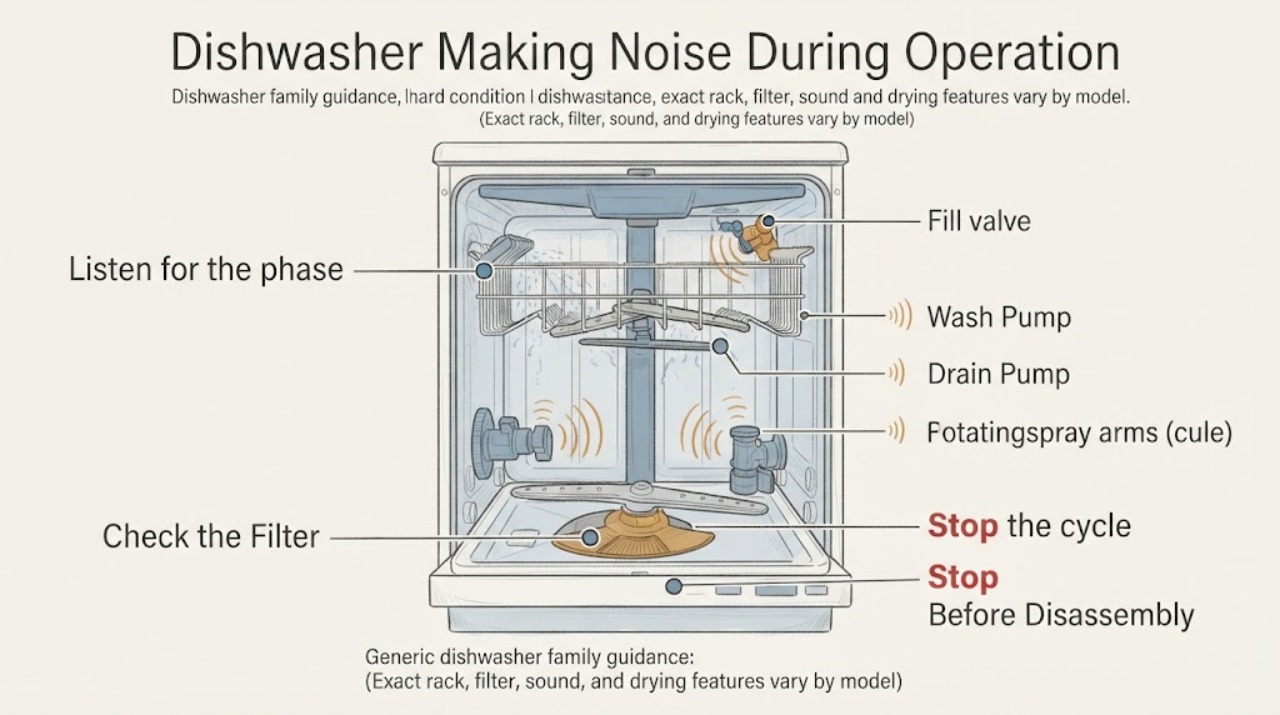
Some Frigidaire dishwasher noise is expected: water filling, water circulating, the motor, spray-arm whooshing, and on equipped models the Even Dry or Perfect Dry fan. Frigidaire's noise guide distinguishes fill-valve hissing, wash- or drain-pump humming, dispenser or ball-valve clunks, and spray-arm clunks. First note when the sound occurs, then stop the cycle and check that dishes, pans, handles, or tall items are not blocking a spray arm. With power off and the model guide in hand, clean only the accessible filter or glass trap as directed. If the sound persists with clear loading, or there is grinding, scraping, smoke, burning odor, leaking, or repeated breaker operation, stop using the dishwasher and arrange model-specific service; do not diagnose or open a pump, motor, valve, or wiring.
Before you begin
Safety first
- No pump, motor, valve, bearing, control, cabinet, wiring, or live-electrical repair instructions are provided.
Work through in order
Diagnostic checks
Use only checks that match the exact appliance or system and its official guide.
-
Check 1
Listen for the phase and character of the sound: fill, wash circulation, spray-arm change, drain, detergent release, drying, or an unrelated continuous noise.
Expected result: The sound is a brief hiss during fill, alternating hum during wash, changing hum while draining, a single dispenser clunk, a whoosh as spray arms alternate, or a harsh sound not matching those phases.
Next step: If the sound matches a documented phase and the dishwasher otherwise operates normally, continue with the loading check; if it is harsh, new, continuous, or accompanied by a hazard, stop and use the service boundary.
Stop if: If timing cannot be established safely, record the cycle, sound, and model instead of repeatedly running the dishwasher to reproduce it.
Why this matters
Why: Frigidaire's noise guide associates the first group with water valves, wash or drain pumps, dispenser, spray arms, or other documented operating sounds; a harsh continuous sound is not identified as a specific failed part by this evidence.
-
Check 2
Stop the cycle and, with the racks accessible, check that no plate, pan, utensil, handle, or tall item protrudes into the path of a spray arm; rotate the accessible arm only as the exact model guide permits.
Expected result: An item touches or blocks the spray arm, or the racks and arms have clear space but the noise remains.
Next step: Reposition the item according to the model's loading guide and stop testing if the sound remains after the obstruction is removed.
Stop if: If the arm path is clear, continue with the accessible filter and debris check rather than opening the pump area.
Why this matters
Why: Frigidaire identifies incorrect loading or an item contacting the spray arm as a cause of knocking or clunking; clear space removes that external explanation but does not diagnose an internal part.
-
Check 3
With the dishwasher stopped and safe to access, inspect the accessible filter, glass trap, and visible spray-arm openings for food, glass, bones, or other debris, and rinse or replace the filters only as the model instructions show.
Expected result: Debris is visible, a filter is not seated, or the accessible area is clear and the noise continues.
Next step: Remove only accessible debris and correctly reseat the model-supported filter; stop if glass, sharp objects, or a damaged part cannot be handled safely.
Stop if: If the area is clear, do not remove covers or reach into pump or wiring areas; continue to the controlled observation or service step.
Why this matters
Why: Frigidaire says debris can collect in the filter, glass trap, and spray arms, and its filter guide documents external rinsing and replacement; this does not prove a pump or motor fault.
-
Check 4
After correcting loading or an accessible filter issue, compare the sound on one normal cycle only if there is no leak, electrical damage, smoke, burning odor, or other hazard; record whether it changes with wash, drain, or drying.
Expected result: The noise disappears, changes with a specific phase, or remains harsh and unchanged despite clear loading and accessible filters.
Next step: If the noise persists or worsens, stop using the dishwasher and provide the technician the model, cycle, sound timing, loading result, and filter result.
Stop if: If the noise cannot be compared safely, skip further runs and request model-specific service.
Why this matters
Why: A change tied to loading supports an external obstruction; a phase-specific sound may match normal operation guidance, while a persistent harsh sound remains unresolved and cannot be assigned to a part from this task.
-
Check 5
Stop using the dishwasher immediately for smoke, burning odor, sparking, visible electrical damage, active leaking, water near electrical equipment, repeated breaker operation, or a loud grinding or scraping sound that does not stop with the cycle.
Expected result: A safety sign is present, or the noise remains after the safe external checks.
Next step: Leave the dishwasher off, isolate power or water only when safe and accessible, and arrange qualified appliance or electrical service. Do not open the cabinet, bypass a door or float safety, or perform live testing.
Why this matters
Why: The problem is beyond the documented sound and loading checks; the official family guidance does not support a user diagnosis of an internal pump, motor, valve, bearing, or control.
Use your observations
Decision map
Find the observation that best matches what you see, then follow the next safe action.
-
PATH 01Next step
What you see
The sound is a brief fill hiss, alternating wash hum, drain hum, dispenser clunk, or spray-arm whoosh and the dishwasher has no hazard sign.
Do this next
Check the load for spray-arm interference and consult the exact model guide if the sound is new, unusually loud, or changes the cycle result.
Why this path and its safety boundary
Why it matters: Frigidaire lists these as recognizable operating sounds, with timing tied to filling, pumps, dispensing, or spray-arm movement.
-
PATH 02Next step
What you see
A plate, pan handle, utensil, or tall item contacts or blocks a spray arm.
Do this next
Stop the cycle, reposition the item according to the model guide, and stop further testing if the sound remains.
Why this path and its safety boundary
Why it matters: The official loading and normal-sounds guidance supports an external loading cause for a knock or bang.
-
PATH 03Next step
What you see
Accessible filter, glass trap, or spray-arm openings contain debris, or the filter is not seated correctly.
Do this next
Clean and reseat only the model-supported accessible parts; request service if the noise continues.
Why this path and its safety boundary
Why it matters: Frigidaire says debris can block these accessible areas, but clearing them does not establish an internal pump or motor diagnosis.
-
PATH 04Next step
What you see
The noise is harsh or persistent after safe external checks, or there is smoke, burning odor, sparking, leakage, visible damage, or repeated breaker operation.
Do this next
Stop using the dishwasher, disconnect or shut off power or water only if safe, and arrange qualified appliance or electrical service without opening the cabinet.
Why this path and its safety boundary
Why it matters: The external explanations have not resolved the symptom and the condition may be an electrical, water, or mechanical safety issue.
Helpful context
Understand the symptom
A dishwasher can sound different at fill, wash, drain, detergent release, spray-arm changes, and drying. Frigidaire's opened noise guide labels these sounds by timing and type; the normal-operations page also says water filling, circulation, motor operation, and an equipped drying fan can be normal. Identify the phase before treating the sound as a failed component.
A sudden knock or clunk during spray-arm movement is first an external loading question. Frigidaire says a tall item, pan handle, or other object protruding through a rack can block or contact a spray arm, and its rack layout varies by model. Stop the cycle before moving an item and use the exact owner's manual for rack and filter differences.
If the accessible loading and filter checks do not change a persistent or harsh noise, do not infer a bad pump, motor, valve, bearing, or control. Stop for smoke, burning odor, leakage, exposed damage, or repeated breaker operation, and arrange qualified appliance service without opening the cabinet or testing live wiring.
When checks do not resolve it
Need a professional?
Arrange model-specific appliance service when the noise remains after safe loading and accessible filter checks, is harsh or worsening, changes operation, or cannot be matched to a normal phase. Use qualified electrical service for damaged wiring, outlet or breaker behavior.
Safety scope: No pump, motor, valve, bearing, control, cabinet, wiring, or live-electrical repair instructions are provided.
Common questions
FAQ
Is it normal for a Frigidaire dishwasher to make noise while running?
Often, yes. Frigidaire says filling, water circulation, motor operation, spray-arm whooshing, and on equipped models a drying fan can be normal. The sound's phase and character still matter.
Why does the dishwasher knock or clunk?
Frigidaire says a dish, pot, pan, utensil, tall item, or handle can interfere with spray-arm rotation. Stop the cycle and correct the loading using the exact model guide before considering service.
Should I clean the filter for a noisy dishwasher?
With the dishwasher stopped and safe to access, inspect and clean only the accessible filter or glass trap as the model instructions show. Frigidaire also identifies debris in filters, glass traps, and spray arms as a maintenance issue, but cleaning does not prove a failed internal component.
When should I stop using a noisy dishwasher?
Stop for smoke, burning odor, sparking, active leakage, water near electrical equipment, visible damage, repeated breaker operation, or a persistent harsh grinding or scraping sound. Arrange qualified service rather than opening the cabinet or testing live wiring.
Read the exact guide
Official sources
- Dishwasher - Not CleaningFrigidaire · Frigidaire dishwasher debris checks for filter, glass trap and spray arms and unresolved-issue service boundary
- Dishwasher Glass Trap and Filter GuideFrigidaire · Frigidaire dishwasher accessible glass-trap and filter inspection, rinsing and replacement guidance
- Dishwasher - Noise GuideFrigidaire · Frigidaire dishwasher operating-noise descriptions for fill valve, wash pump, drain pump, dispenser, ball valve, spray arms and whooshing
- Dishwashers - What are normal dishwasher operations sounds?Frigidaire · Frigidaire dishwasher normal filling, circulation, motor and model-dependent fan sounds, plus spray-arm loading check
- What is the best way to load my dishwasher to optimize my cleaning performance?Frigidaire · Frigidaire dishwasher model-dependent loading and spray-arm clearance guidance
Community feedback
Share a repair observation
Share a plain-text repair observation. Accepted observations are published automatically; this page may take a moment to update.