
On this page
Start here
Quick answer
A dishwasher sound by itself is not enough to identify a replacement part. Frigidaire says water-valve hissing, wash-pump or drain-pump humming, detergent-dispenser or ball-valve clunks, and spray-arm whooshing can be part of normal operation; a clunk can also occur when a tall dish or utensil is struck by a spray arm. Note when the sound occurs, stop the dishwasher before inspecting it, unload the racks, and rotate the accessible spray arms by hand to check for loading interference. Clean only the accessible filter or glass-trap areas when the exact model manual permits it. Do not open the pump, remove the enclosure, or order a motor or pump from an audio description. Stop using the dishwasher for grinding with leaks, smoke, burning odor, repeated electrical trips, or a sound that persists after safe external checks, and arrange qualified service.
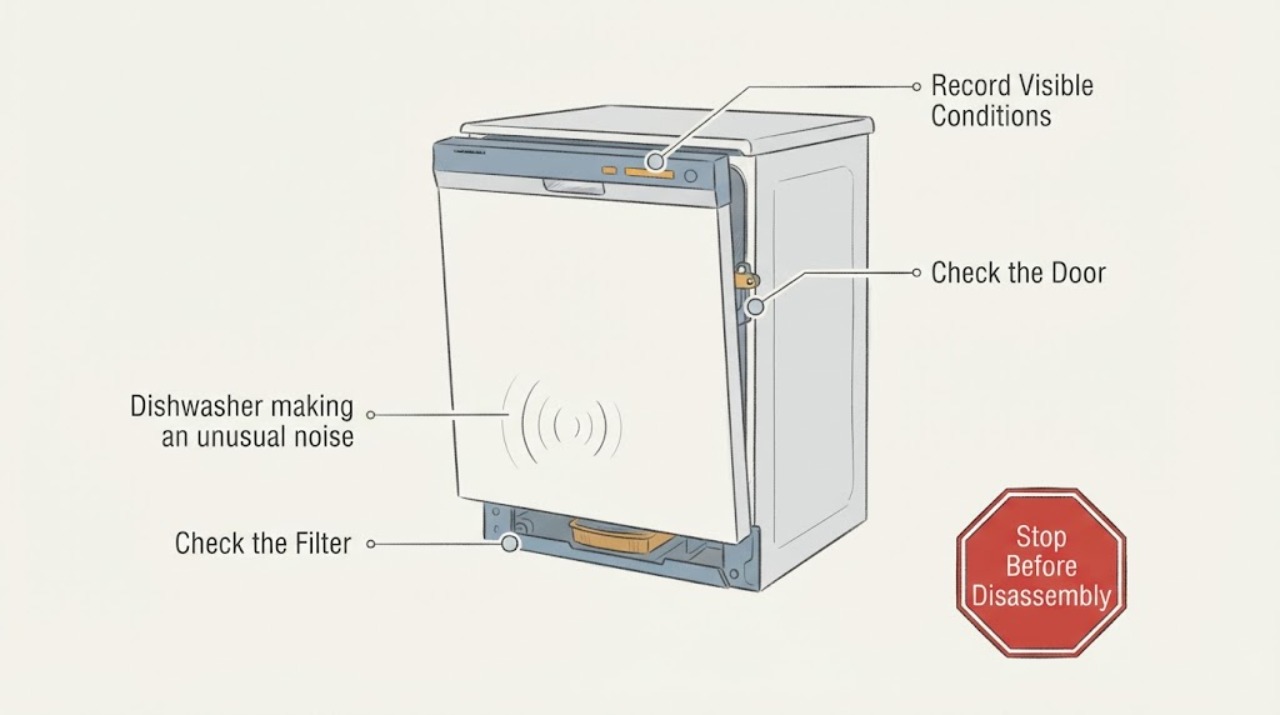
Work through in order
Diagnostic checks
Use only checks that match the exact appliance or system and its official guide.
-
Check 1
Write down the sound's character and timing: hissing during fill, humming during washing, humming during drain, a single clunk, repeated clunking, whooshing, scraping, grinding, or a noise that continues after the cycle stage changes.
Expected result: The sound matches a listed fill, wash-pump, drain-pump, dispenser, ball-valve, or spray-arm pattern, or it is new, harsh, and not tied to a recognizable cycle stage.
Next step: Continue with the unplugged loading and spray-arm checks for an identifiable contact or obstruction. If there is smoke, burning odor, leaking, or an electrical symptom, stop and request service immediately.
Why this matters
Why: Frigidaire identifies several stage-linked sounds as normal operating noises. A new persistent grinding or an unidentified sound cannot be assigned to a pump, motor, valve, or other part from the sound label alone.
-
Check 2
Cancel the cycle and wait for wash action and hot water to stop before opening the door. Remove the racks or move them only as the model manual allows, then check for a tall dish, pan handle, utensil, or loose item that could touch a spray arm.
Expected result: An item projects into the spray-arm path, or the racks and spray-arm path are clear.
Next step: Reposition the item and continue only if there is no damage or other safety symptom. If the path is clear and the sound remains, move to the accessible filter and debris check rather than removing the pump.
Why this matters
Why: Frigidaire says a dish, pot, pan, or utensil can cause knocking or banging when it interferes with spray-arm circulation. A clear path makes that particular loading cause less likely but does not identify an internal part.
-
Check 3
With power disconnected, rotate each accessible spray arm by hand and check for rubbing, a loose arm, visible cracks, or a small object at the accessible filter or glass-trap area. Follow the exact model manual for any filter removal; do not reach into a concealed sump or pump.
Expected result: A spray arm rubs or is obstructed, visible debris is present in a user-accessible filter area, or the arms and accessible areas are clear.
Next step: Remove only loose visible debris using the model-approved cleaning method, reinstall user-removable filters correctly, and stop if a part is cracked or cannot be removed safely. Do not disassemble the wash or drain pump.
Why this matters
Why: A contact point or accessible debris can explain a rhythmic noise without proving a pump failure. A clear accessible area does not rule in a pump, motor, bearing, or impeller fault.
-
Check 4
Inspect the floor around the dishwasher and the visible door, inlet, and drain connections for water, then note whether the unusual noise occurs while filling, washing, draining, or after the cycle. Do not pull out a built-in dishwasher or loosen a connection to reproduce the sound.
Expected result: Water is present, a connection is visibly wet, or the floor is dry and the sound is stage-specific.
Next step: If water is present, stop the cycle, disconnect power if safe, close the water supply, and arrange service. If dry, record the cycle stage and proceed only with the exact model's user guidance.
Why this matters
Why: A leak changes the priority from sound identification to water and electrical safety. A dry floor with a stage-specific sound can help a technician compare the symptom with the official noise descriptions, but it still does not name a replacement part.
-
Check 5
If no obstruction or accessible debris explains the sound, locate the dishwasher's full model number and consult its Frigidaire manual before any part search. Compare the symptom and cycle stage with that model's troubleshooting section.
Expected result: The exact manual provides a model-specific user check, or no safe external check explains the persistent noise.
Next step: Use the documented model-specific check only if it is an external user procedure. Otherwise leave the dishwasher out of service and provide the model number, cycle stage, sound description, and leak or loading observations to qualified service.
Why this matters
Why: Frigidaire manuals and features vary by model. A generic dishwasher noise article cannot establish a compatible pump, motor, valve, spray arm, or bearing.
Use your observations
Decision map
Find the observation that best matches what you see, then follow the next safe action.
-
PATH 01Next step
What you see
The sound is a brief hiss during filling, a changing whoosh when spray arms alternate, or a hum that starts and stops with washing or changes as draining finishes.
Do this next
Check for a new change in volume, a leak, poor washing or draining, or an obstruction; if none is present, monitor the dishwasher without choosing a replacement part from the sound.
Why this path and its safety boundary
Why it matters: The pattern is consistent with Frigidaire's listed normal valve, spray-arm, wash-pump, or drain-pump operating sounds.
-
PATH 02Next step
What you see
A repeated knock or clunk occurs while the spray arms rotate, and a dish, pan handle, or utensil is in the arm's path.
Do this next
Stop the cycle, wait for the wash action to stop, reposition the item, and hand-check accessible arm rotation with power disconnected.
Why this path and its safety boundary
Why it matters: The loading arrangement can be causing the contact; this is an external loading issue rather than evidence of a failed motor or pump.
-
PATH 03Next step
What you see
The spray-arm path and accessible filter area are clear, but a new grinding, scraping, or harsh humming continues at the same cycle stage.
Do this next
Keep the dishwasher powered off and request qualified service with the exact model and a description of the stage and sound. Do not order a pump or motor solely from an audio description.
Why this path and its safety boundary
Why it matters: The safe external checks have not identified the cause. The sound could involve an internal pump or another component, but the observation does not distinguish among them.
-
PATH 04Next step
What you see
The unusual sound occurs with a leak, burning smell, smoke, exposed wiring, repeated breaker trips, or a hot-water or electrical hazard.
Do this next
Stop the cycle, disconnect power only if it is safe, close the water supply for a leak, keep people away, and arrange qualified appliance service. Do not run another test cycle.
Why this path and its safety boundary
Why it matters: The appliance may present a property, burn, or electrical risk, so sound diagnosis is no longer the priority.
Helpful context
Understand the symptom
A sound is a symptom, not a part number
No model number or recording is supplied, and even a recording would not prove which component needs replacement. Frigidaire's own noise guide describes several sounds that can be normal at different stages of a cycle. The useful first distinction is where in the cycle the sound occurs and whether it changes when the spray arms alternate, water fills, or draining begins.
Use loading and accessible debris checks first
A tall plate, pan handle, utensil, or loose item can contact a spray arm and create a repeated clunk or scrape. Frigidaire's manual says to check spray-arm rotation by hand after loading and identifies filters as maintenance items, but it does not support diagnosing a pump or motor from sound alone. Only inspect parts that the model's own manual identifies as user-removable.
Do not operate the dishwasher with enclosure panels removed, tamper with controls, reach toward a running spray arm or heating element, remove a pump cover, or probe wiring. Disconnect electrical power before any service-level inspection. A leak, smoke, burning smell, exposed wiring, repeated breaker trip, or persistent grinding requires qualified service rather than a parts guess.
When checks do not resolve it
Need a professional?
Stop using the dishwasher for persistent grinding, a leak, smoke, a burning odor, exposed wiring, repeated breaker trips, a hot-water hazard, or any sound that remains after the safe external checks. Disconnect power before servicing and leave enclosure panels and internal pump work to a qualified technician.
Have this ready
- Provide the full Frigidaire model number, the cycle stage and duration of the noise, a written sound description, whether the dishwasher fills, washes, and drains, and any loading, debris, leak, or electrical observations.
Common questions
FAQ
Can you identify the exact dishwasher part from a recording of the noise?
No. A recording can help describe timing and sound character, but Frigidaire's own guide maps several normal sounds to different stages and components. Confirm the model, cycle stage, loading, accessible obstruction, and safety symptoms before service; do not buy a pump or motor from sound alone.
Is a humming or whooshing dishwasher always a failure?
No. Frigidaire describes wash-pump and drain-pump humming, water circulation, and changing spray-arm whooshing as normal operating sounds in the appropriate cycle stages. A new harsh sound, leak, poor performance, or sound outside those patterns needs further checking or service.
What should I check when the dishwasher knocks or bangs?
Stop the wash action and check whether a tall dish, pan handle, or utensil is interfering with the spray arm. With power disconnected, follow the model manual to check accessible spray-arm rotation. Do not reach into a running dishwasher or remove internal covers.
Should I open the dishwasher or replace the pump to test the noise?
No. Frigidaire says to disconnect electrical power before servicing, keep enclosure panels in place during operation, and have repairs done by a qualified technician. Use the exact model manual for user-level checks and provide the technician with the sound timing and observations.
Read the exact guide
Official sources
- Dishwasher - Noise GuideFrigidaire · Official Frigidaire family-level dishwasher noise guidance used to distinguish stage-linked normal sounds from an unidentified persistent noise; no exact model was supplied.
- Dishwashers - What are normal dishwasher operations sounds?Frigidaire · Official Frigidaire dishwasher guidance used for normal water, motor, circulation, fan, and spray-arm interference checks; it is not treated as an exact model repair diagnosis.
- Frigidaire Dishwasher Use & Care Manual A28805101Frigidaire / Electrolux Major Appliances · Opened Frigidaire dishwasher manual used for general user-level safety and spray-arm checks. Model features vary, so the exact dishwasher manual controls the allowed filter or maintenance procedure when a model number is available.
Community feedback
Share a repair observation
Share a plain-text repair observation. Accepted observations are published automatically; this page may take a moment to update.