
On this page
Start here
Quick answer
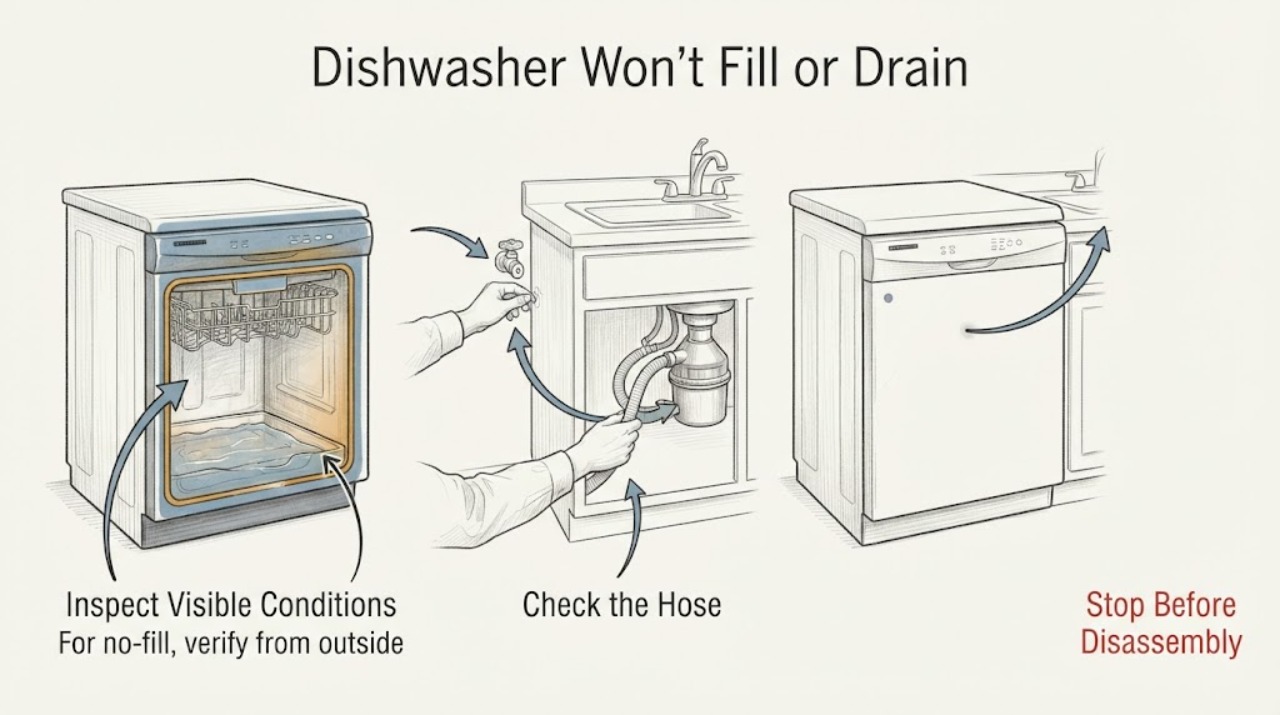
First decide whether the Frigidaire dishwasher is failing to fill, failing to drain, or stopping before either stage. For a fill problem, verify the household water valve is open and the dishwasher supply line is not pinched or blocked. For a drain problem, check that the cycle is complete, the drain hose is not kinked and has its required high loop, the glass trap/filter is clear, and a connected disposer has its knockout plug removed. Use Cancel or the model's documented reset once; if water remains, the unit leaks, the symptom returns, or a new installation is involved, stop troubleshooting and contact the installer or Frigidaire service.
Work through in order
Diagnostic checks
Use only checks that match the exact appliance or system and its official guide.
-
Check 1
Run or observe one cycle only long enough to identify the stage: note whether the dishwasher is paused or stopped before water enters, whether spray action occurs, whether water remains after the cycle, and whether any leak or unusual electrical symptom is present.
Expected result: There is no incoming water, or the unit has water in the tub after an otherwise completed cycle; the unit may also be paused or stopped mid-cycle.
Next step: Follow the fill checks only for no-fill, the drain checks only for standing water/no-drain, and stop for leaks, smoke, burning odor or an electrical hazard.
Why this matters
Why: No incoming water points to the fill path; standing water after completion points to the drain path; a paused or interrupted cycle must be reset according to the model before interpreting the symptom.
-
Check 2
For no-fill, verify from outside the appliance that the dishwasher water valve is open and water is available, then inspect the supply line for a pinch, restriction or visible blockage without loosening a pressurized connection.
Expected result: The valve is closed or water is unavailable/restricted, or the valve and supply line are open and unobstructed but the dishwasher still does not fill.
Next step: Restore the household supply if safe and retry once. If the supply is normal and the dishwasher still will not fill, contact the installer for a recent installation or Frigidaire service.
Why this matters
Why: A closed valve or restricted line explains the no-fill symptom; an open, unobstructed supply leaves a model-specific inlet or control issue unresolved and is not a reason to replace a part by guesswork.
-
Check 3
For no-drain, confirm the cycle is complete and inspect the accessible drain hose for a kink or displacement, confirm its required high-loop installation, clean the glass trap/filter as the manual permits, and check that a connected disposer has its knockout plug removed.
Expected result: A kink, missing high loop, blocked glass trap/filter or intact disposer knockout plug is found, or these checks are normal but water still remains.
Next step: Correct only the accessible installation/cleaning issue and run the model-approved drain/reset procedure once. If water remains, contact Frigidaire service rather than opening the pump or wiring.
Why this matters
Why: The found installation or obstruction issue can prevent draining; normal external checks do not prove a failed drain pump or motor.
-
Check 4
If the cycle stopped, use Cancel for 5–10 seconds as Frigidaire describes, then start a new cycle; if the fill guide's power reset is applicable, disconnect power for three minutes only when the cord/breaker and appliance are safe to handle.
Expected result: The unit completes the cycle after one reset, or it still fails to fill/drain, leaks, trips power or stops again.
Next step: Do not keep repeating resets. Keep the dishwasher out of use if the failure recurs or water/electrical hazards appear, and contact the installer or Frigidaire service.
Why this matters
Why: Recovery after one documented reset supports an interrupted cycle; recurrence or a safety symptom requires model-specific diagnosis and service.
Use your observations
Decision map
Find the observation that best matches what you see, then follow the next safe action.
-
PATH 01Next step
What you see
The dishwasher never receives water, and the household valve is closed or the supply line is visibly pinched/restricted.
Do this next
Restore the valve or correct the external restriction if safe, then retry once; request service if the supply is normal but filling still fails.
Why this path and its safety boundary
Why it matters: The accessible water-supply path is the first likely explanation for the no-fill symptom.
-
PATH 02Next step
What you see
The cycle completes or stops with water in the tub, and the drain hose is kinked/displaced, the filter is clogged, or a disposer knockout plug remains.
Do this next
Correct the accessible issue according to the owner manual, reset the cycle once and request service if standing water remains.
Why this path and its safety boundary
Why it matters: The observed obstruction or installation issue can prevent the dishwasher from draining without proving a failed pump.
-
PATH 03Next step
What you see
The unit is newly installed or was recently moved and the fill/drain symptom began immediately afterward.
Do this next
Have the installer verify the water connection, high loop and disposer knockout rather than replacing internal parts.
Why this path and its safety boundary
Why it matters: Frigidaire's support path treats installation, hose routing and disposer preparation as a distinct cause category.
-
PATH 04Next step
What you see
The valve, supply line, drain hose, filter and disposer connection are correct, but the dishwasher still will not fill or drain, or the issue returns after one reset.
Do this next
Keep the dishwasher out of use if it leaks or is electrically unsafe and contact Frigidaire service; do not open the pump, valve or control area.
Why this path and its safety boundary
Why it matters: The remaining cause is model-specific and cannot be safely identified from the symptom alone.
Helpful context
Understand the symptom
Do not treat fill and drain as the same failure
A dishwasher can appear not to fill because it is still paused, because the cycle stopped before the fill stage, or because water supply is restricted. It can appear not to drain because the cycle is incomplete, the hose or filter is obstructed, or the disposer connection was not prepared. Note whether there is water in the tub, whether the spray arms ever ran, and where the cycle stopped before choosing the check.
Start with accessible plumbing and filter checks
Frigidaire's guidance supports checking the water valve and supply line for filling problems, and the drain hose, high loop, glass trap/filter and disposer knockout plug for draining problems. These are external or user-accessible checks only; the model manual controls exact filter access and cleaning details.
Reset once, then use the service boundary
For a stopped drain cycle, Frigidaire says to hold Cancel for 5–10 seconds and start a new cycle; its fill guide also describes a three-minute unplug or breaker reset. Do not repeatedly reset a leaking, damaged or electrically unsafe appliance. If the problem remains after the applicable external checks, request service rather than guessing at a pump, valve or control repair.
When checks do not resolve it
Need a professional?
Contact the installer for a recent installation or Frigidaire service when the water supply and drain path are correct but the dishwasher still will not fill or drain, when the issue recurs after one reset, or when there is a leak, burning odor, smoke, damaged wiring or another electrical hazard. Do not open the pump, inlet valve or control area.
Common questions
FAQ
Why does my Frigidaire dishwasher seem to do neither fill nor drain?
First determine where the cycle stops. No incoming water points to the valve and supply line; water left after completion points to the drain hose, filter or disposer connection. A pause or interrupted cycle can also make the sequence look like both problems, so use the model's Cancel/reset procedure once before escalating.
What should I check if water is left in the dishwasher?
Confirm the cycle completed, check the drain hose for a kink and correct high-loop installation, clean the glass trap/filter as the owner manual allows, and verify that a connected disposer has its knockout plug removed. If water remains after these checks, contact Frigidaire service.
Can I keep resetting the dishwasher until it starts filling or draining?
No. Frigidaire documents a limited Cancel or three-minute power reset, but repeated resets do not identify the underlying cause. Stop if the unit leaks, smells burnt, trips power or shows damaged wiring, and request professional service.
Read the exact guide
Official sources
- Dishwasher - Drain Hose GuideFrigidaire / Electrolux Home Products · Frigidaire dishwasher family guidance; confirm exact installation instructions for the model.
- Dishwasher - Not FillingFrigidaire / Electrolux Home Products · Frigidaire dishwasher family guidance; exact model manual controls access and cycle behavior.
- What can I do if my dishwasher is not draining?Frigidaire / Electrolux Home Products · Frigidaire dishwasher family guidance.
- Dishwashers - Not DrainingFrigidaire / Electrolux Home Products · Frigidaire dishwasher family guidance; exact model manual controls filter access.
Community feedback
Share a repair observation
Share a plain-text repair observation. Accepted observations are published automatically; this page may take a moment to update.