
On this page
Start here
Quick answer
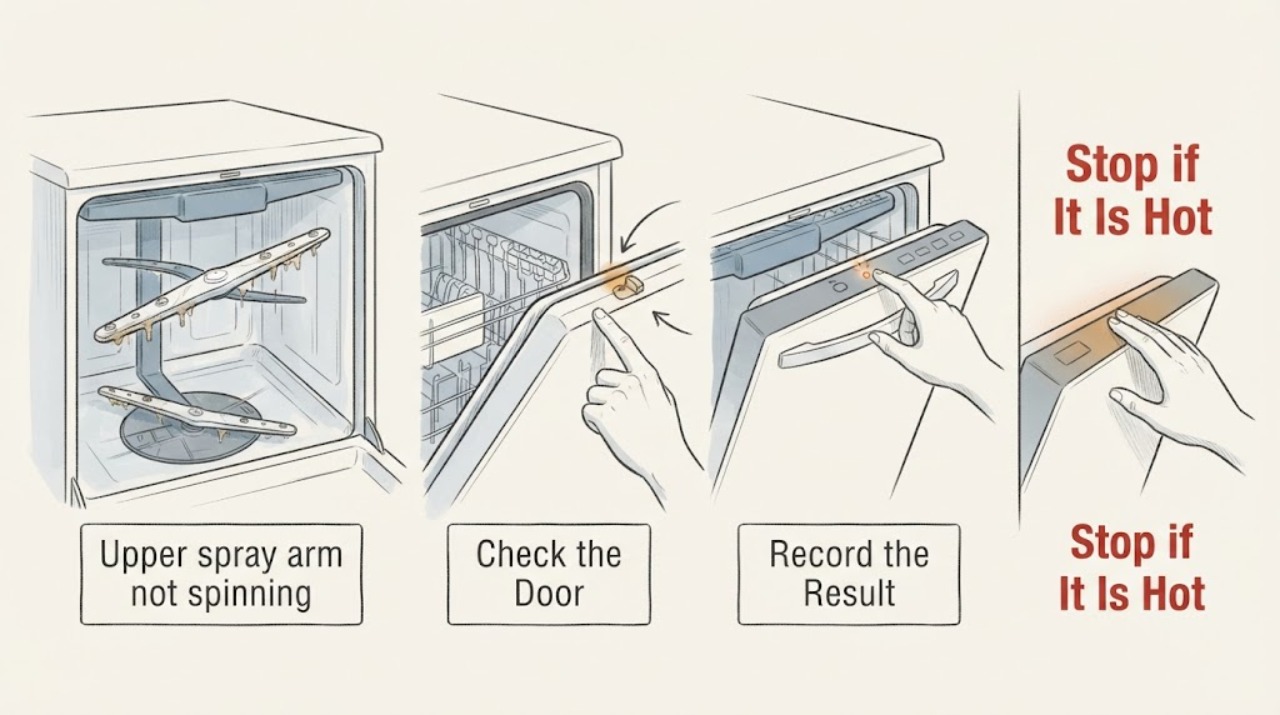
On the Frigidaire FDB1050REC2, an upper spray arm that is not seen moving is not automatically failed: Frigidaire says the wash pump starts and stops as spray arms alternate, and the spray arms switch between the bottom and top. With the dishwasher off and cool, first check that the rack or a tall item is not blocking the arm and that the arm turns freely by hand. Then inspect accessible spray-arm openings and the filter for visible food or mineral residue, and use fresh automatic-dishwasher detergent in an amount suited to the water hardness. If the arm turns freely, the openings look clear, and the upper rack still cleans poorly or the circulation sound is weak, stop short of pump or wiring diagnosis and arrange appliance service.
Work through in order
Diagnostic checks
Use only checks that match the exact appliance or system and its official guide.
-
Check 1
Before another cycle, note whether the upper-rack dishes remain dirty, whether the lower rack cleans normally, whether detergent remains in the dispenser, and whether there is standing water, a leak, a burning smell, or severe striking or grinding noise. Keep the door closed during operation and do not reach toward a moving spray arm.
Expected result: The lower rack cleans while the upper rack does not; both racks are poor; detergent is undissolved; standing water or a leak is present; or the sound is a hard strike, grinding, or electrical/burning noise.
Next step: For a leak, burning or electrical smell, smoke, exposed wiring, or severe grinding/striking, stop using the dishwasher and arrange qualified service. Otherwise continue only with the dishwasher stopped and cool.
Why this matters
Why: Upper-rack-only soil points toward upper-arm reach, loading, or upper-level circulation, while poor cleaning everywhere makes water temperature, pressure, filtration, or overall circulation more relevant. A leak, burning smell, or severe mechanical noise is not a safe spinning test.
-
Check 2
If you only saw the upper arm stopped, listen and observe from outside during one normal cycle instead of opening the door: note whether the wash-pump hum starts and stops and whether the whooshing changes between lower and upper spray periods.
Expected result: The pump sound and whoosh alternate, or there is a brief quiet interval before spray resumes; alternatively the wash phase is persistently quiet with no normal circulation sound.
Next step: If the cycle has the described alternating sound and the cleaning pattern is normal, do not replace a spray arm based on sight alone. If circulation is persistently absent, stop repeated test cycles and use the service boundary after the safe checks below.
Why this matters
Why: Frigidaire describes pump sound that starts and stops when spray arms alternate and a whoosh that changes as spray moves from bottom to top. A single stationary view is therefore weak evidence of a failed upper arm; persistent absence of circulation is a stronger reason to investigate water delivery or service.
-
Check 3
Switch the dishwasher off, let it cool, and isolate it from power as the exact manual directs. Remove or rearrange the upper-rack load, then turn the upper spray arm gently by hand; look for a tall item, pan handle, rack wire, or utensil protruding into its path.
Expected result: The arm catches or cannot complete a free turn, or a dish/rack item clearly contacts it; otherwise the arm turns freely with no visible load interference.
Next step: Remove only the visible obstruction and reload so nothing interferes with spray-arm rotation. If the arm still binds when unloaded, do not force it or dismantle the rack; arrange service. If it turns freely, continue to the visible cleaning checks.
Why this matters
Why: A bind or contact is a physical loading or alignment clue, not proof of a failed motor. A free hand rotation rules out a simple static obstruction but cannot prove that enough water is reaching the arm during the cycle.
-
Check 4
With the dishwasher still off and cool, inspect the upper arm openings and the accessible filter or glass trap. Follow the exact FDB1050REC2 manual if it permits removal; otherwise leave the arm in place. Rinse an accessible part with water and use a soft brush only, without wire, picks, abrasive scraping, or mixed cleaners.
Expected result: Food debris, chalky scale, or film is visible in openings or the filter; the openings look clear; a part is cracked or missing; or the arm/filter will not safely come out or seat.
Next step: Rinse and refit only parts the exact manual identifies as user-accessible, making sure the filter is fully seated. Do not run without the filter, ream holes larger, use acid or bleach mixtures, or force a retained part; arrange service for damage or persistent blockage.
Why this matters
Why: Frigidaire identifies filters, glass traps, and spray arms as places where debris can be trapped. Visible residue supports a cleanable obstruction, but hard-water scale alone does not identify a pump or establish that the arm is the wrong part. Damage or an inaccessible obstruction needs service.
-
Check 5
After the visible checks, use fresh automatic-dishwasher detergent and the amount suited to the measured water hardness; make sure the dispenser can open and avoid starting while another household demand is reducing water pressure. Use the exact manual for the model's water-temperature and cycle instructions.
Expected result: The detergent dissolves and cleaning improves; hard-water film or spotting remains; detergent stays in the cup; or the upper rack remains dirty despite a clear, free-turning arm.
Next step: Correct detergent, loading, and household water-use conditions only within the manual's limits. If the arm is free and clear but circulation remains weak, the upper rack remains dirty, or the issue returns with normal water and detergent conditions, leave the dishwasher off and arrange qualified appliance service.
Why this matters
Why: Frigidaire says detergent amount depends on water hardness, too little can cause hard-water filming or spotting, and low water pressure or cool incoming water can reduce cleaning results. These observations can mimic a spray-arm complaint and do not justify selecting a pump or valve from the symptom alone.
Use your observations
Decision map
Find the observation that best matches what you see, then follow the next safe action.
-
PATH 01Next step
What you see
The upper arm is not seen during a brief look, but the wash pump hum and whoosh alternate and the upper rack cleans normally.
Do this next
Keep the arm installed and do not replace a part from the visual snapshot; monitor a normal load and investigate only if cleaning or sound changes.
Why this path and its safety boundary
Why it matters: This pattern is consistent with Frigidaire's described alternating spray-arm operation and does not establish a failed arm.
-
PATH 02Next step
What you see
The upper arm catches by hand or a dish, utensil, or rack component contacts it when the load is arranged.
Do this next
Remove the visible obstruction, reload within the rack guidance, and stop if an unloaded arm still binds or is visibly damaged.
Why this path and its safety boundary
Why it matters: A physical obstruction or alignment issue is more likely than a hidden circulation component.
-
PATH 03Next step
What you see
The arm turns freely, no visible residue blocks its openings, but the upper rack remains dirty and circulation is persistently weak or absent.
Do this next
Stop repeating cycles and arrange appliance service with the model, programme, sound timing, hand-rotation result, filter condition, and cleaning result. Do not open the pump or take electrical measurements.
Why this path and its safety boundary
Why it matters: A water-delivery or internal circulation problem remains possible; the hand check cannot distinguish a pump, pressure, valve, or control cause.
-
PATH 04Next step
What you see
Chalky residue or hard-water filming is visible, detergent is poorly dissolved, or spotting is present, but there is no bind, leak, or hazardous noise.
Do this next
Use the water-hardness information and exact manual to set fresh automatic-dishwasher detergent, correct loading, and approved cleaning. Never mix cleaners or use metal tools in spray openings.
Why this path and its safety boundary
Why it matters: Water hardness, detergent amount, temperature, or pressure may be reducing cleaning and can be mistaken for an arm fault; the observation does not identify a replacement part.
-
PATH 05Next step
What you see
There is a leak, standing water with electrical exposure, smoke, burning or chemical odor, exposed wiring, severe grinding/striking, or a tripped breaker.
Do this next
Stop using the dishwasher. Leave the area for immediate danger; disconnect power or close the water supply only if it can be done without contacting water or energized equipment, then use qualified appliance or plumbing service.
Why this path and its safety boundary
Why it matters: This is a water, electrical, fire, or mechanical hazard outside ordinary spray-arm checks.
Helpful context
Understand the symptom
What “not spinning” can mean
The upper arm is fed by the dishwasher's wash circulation, and the arms may alternate rather than move together. A brief look through the door can therefore show a stationary upper arm even when the cycle is operating normally. A hard-water setting changes detergent needs and can leave visible filming or spotting; it does not, by itself, prove that the arm, pump, or control has failed. The official sources below are general Frigidaire dishwasher guidance. They do not name the assigned FDB1050REC2, so use the exact owner's manual for any model-specific removal or cleaning step.
Use the result, not the part name
Treat hand rotation, visible obstruction, cycle sound, cleaning result, and any standing water as separate observations. A free-turning arm narrows the question to water delivery and circulation; it does not identify a pump or valve. Do not enlarge spray holes, scrape scale with metal, mix cleaners, run the dishwasher with a removed filter, or open the pump housing to make the upper arm move.
When checks do not resolve it
Need a professional?
Arrange qualified appliance service when the unloaded upper arm binds, a spray arm or filter is damaged or cannot be safely reseated, circulation remains absent after the visible checks, upper-rack cleaning remains poor with correct loading and detergent, or any leak, burning smell, smoke, exposed wiring, severe grinding, or breaker trip occurs.
Common questions
FAQ
Should the Frigidaire upper spray arm spin continuously?
No. Frigidaire's noise guide says the wash pump starts and stops as the spray arms alternate, and the spray arms switch between the bottom and top. A stationary view of the upper arm is not enough to call it failed.
Can hard water alone stop the upper spray arm?
Hard water can contribute to filming, spotting, and detergent-dose problems. Look for actual residue or blocked openings and follow the exact manual; do not infer a pump or arm failure from water hardness alone.
What should I record before calling service?
Record the full model, programme and stage, whether circulation sounds alternate, whether the upper arm turns freely when the dishwasher is off and cool, any load contact or visible scale, filter condition, standing water, and whether only the upper rack is dirty.
Read the exact guide
Official sources
- Dishwasher - Noise GuideFrigidaire · General Frigidaire dishwasher noise and alternating spray-arm guidance; FDB1050REC2 is not named on this page.
- Dishwasher - Water LeakingFrigidaire · General Frigidaire dishwasher leak-safety and visible installation guidance; FDB1050REC2 is not named on this page.
- Dishwashers - How can I ensure the best cleaning results?Frigidaire · General Frigidaire dishwasher cleaning-performance guidance; FDB1050REC2 is not named on this page.
- Dishwasher - Dispenser and Detergents GuideFrigidaire · General Frigidaire dishwasher dispenser and detergent guidance; FDB1050REC2 is not named on this page.
- Dishwashers - How much detergent to use in my dishwasher?Frigidaire · General Frigidaire dishwasher detergent and water-hardness guidance; FDB1050REC2 is not named on this page.
- Dishwasher - Loading GuideFrigidaire · General Frigidaire dishwasher loading guidance; the assigned FDB1050REC2 is not named on this page, so apply only the symptom-level rotation and obstruction guidance and verify the exact manual.
- Dishwashers: What are normal dishwasher operation sounds?Frigidaire · General Frigidaire dishwasher sound guidance for symptom interpretation; FDB1050REC2 is not named on this page.
- Dishwasher - Not CleaningFrigidaire · General Frigidaire dishwasher cleaning guidance; FDB1050REC2 is not named, so this is not an exact-model service procedure.
Community feedback
Share a repair observation
Share a plain-text repair observation. Accepted observations are published automatically; this page may take a moment to update.