
On this page
Start here
Quick answer
On a Frigidaire FFID2426TS5A that has been stored and has already had its water inlet valve replaced, do not assume the new valve is the cause or the cure. The Frigidaire FFID2426TS family manual describes a sequence of fill, wash-pump spray through the arms, and drain-pump discharge. First confirm that the tub fills to the normal operating level, the door latches, and the machine is not leaking after storage or the valve work. With power off and the interior cool, check that the lower and middle spray arms can rotate freely, no tall item blocks an arm, and the glass trap is correctly seated and free of debris. If the tub fills but there is no wash-pump sound or spray, or if the valve connector or water connection is wet, stop and arrange service; a circulation pump, wiring, control, or storage-related damage cannot be selected from the symptom alone.
Before you begin
Safety first
- Disconnect electrical power before service and do not operate the dishwasher with enclosure panels removed. Do not loosen a water connection, reach into the sump, probe live wiring, bypass the door latch, or energize the unit after a leak or suspected freeze damage.
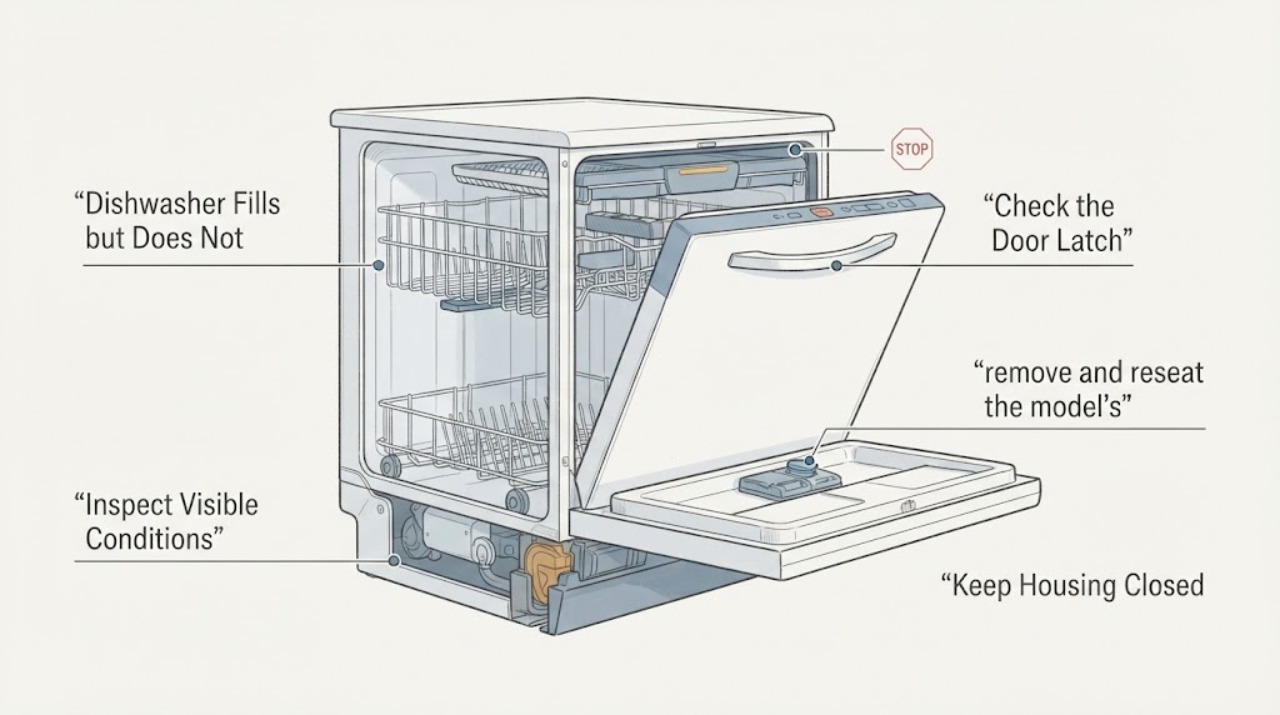
Work through in order
Diagnostic checks
Use only checks that match the exact appliance or system and its official guide.
-
Check 1
Stop the dishwasher before investigating. From a dry, stable position, record the exact model suffix, cycle and options, whether the unit fills, when the inlet valve was replaced, and whether storage was in an unheated or potentially freezing location. Look for water at the valve connection, beneath the tub, around the door, or near the electrical supply; do not touch wet wiring or run a cycle to find a leak.
Expected result: There is a visible leak, a wet valve connection, cracked or bulged tubing, water near electrical parts, a burning smell, a tripped breaker, or no visible hazard.
Next step: Keep the dishwasher off and close the water supply from a dry safe position if a connection leaks. Arrange qualified service for any concealed or electrical issue; do not pull the dishwasher out or tighten a wet fitting.
Stop if: Do not energize the unit with a wet connection, cracked line, damaged cord, active leak, smoke, or burning odor.
Why this matters
Why: A post-storage or post-valve leak changes this from a no-spray diagnosis to a water and electrical safety event. An unheated storage location also raises the possibility of damaged supply or circulating lines, while a dry exterior leaves a circulation or spray-path question open.
-
Check 2
With the dishwasher empty, cool, and disconnected from power, check that the door closes and latches normally and that no rack item protrudes into the spray-arm path. Turn the accessible lower and middle spray arms gently by hand, looking for a tall pan, utensil, or debris blocking rotation; do not remove the inner door or force an arm.
Expected result: An item blocks an arm, an arm turns freely, an arm is cracked or loose, the door will not latch, or the gasket prevents closure.
Next step: Remove only the accessible loading obstruction and restore the racks normally. If an arm or latch is damaged, keep the dishwasher off and arrange model-specific service rather than replacing a valve again.
Stop if: Do not force a spray arm, bend the rack, bypass the door latch, or operate with a damaged seal or door.
Why this matters
Why: Frigidaire's manual says loading must not block spray-arm rotation and that the door must latch for operation. A visible loading obstruction can suppress or redirect spray; a clear path with no latch issue makes a hidden circulation or control fault more likely.
-
Check 3
While power remains disconnected and the heating element is cool, remove and reseat the model's accessible glass-trap and spray-arm assembly only as the Frigidaire manual describes. Empty visible glass, bones, pits, or other debris into a container, check the arm openings, and make sure the assembly is fully snapped and locked back in place.
Expected result: The glass trap is clogged, the arm openings are obstructed, the assembly was not seated, or the accessible parts are clean and correctly installed.
Next step: Correct only the visible trap, arm, or seating issue, then leave the machine ready for one supervised model-approved check. If access requires tools or a sump cover, stop and arrange service.
Stop if: Do not pick up broken glass with bare hands, probe the sump, remove the pump cover, or use chemical drain cleaner.
Why this matters
Why: The manual identifies the glass trap as the accessible collector for broken glass and debris and warns that the spray arm and trap must be fully snapped in place. A blocked or mis-seated user-serviceable assembly can reduce spray; clean parts do not rule out the circulation pump or internal sump path.
-
Check 4
Separate the fill test from the spray test. Note whether water enters and reaches the normal level, then listen from outside the closed door for the wash-pump motor and splashing sound described in the manual. Do not open the door while energized just to watch the spray; if you need to inspect inside, cancel the cycle, wait for wash action to stop, and disconnect power before opening.
Expected result: The tub fills and a normal wash-pump/splash sound follows; the tub fills but is quiet; the tub never reaches a normal level; or the pump sound starts and stops abnormally.
Next step: Keep the inlet-valve replacement in the service history and provide the fill level and sound timing to a technician. Do not order a circulation pump or control until the exact model diagnosis distinguishes no-fill from no-circulation.
Stop if: Do not run the dishwasher with the door unlatched, reach inside while the pump or heater may be operating, or make live electrical measurements.
Why this matters
Why: Filling after an inlet-valve replacement shows that some supply path is functioning, but no wash-pump sound after fill points toward the circulation pump, harness, control, or a water-level condition rather than automatically toward the valve. A low or absent fill level can still involve supply, valve installation, float, or control.
-
Check 5
Review the storage restoration and valve work without disassembling plumbing: confirm the water supply is on, the valve connection is dry, the drain hose and air-gap or disposer connection are not visibly kinked or blocked, and the exact replacement work left no loose exterior harness or hose. If a food disposer was added or changed during storage, confirm the installation record addresses its inlet knockout plug.
Expected result: The supply or drain connection is wet, routing is kinked or uncertain, the unit was winterized and restored by a qualified person, or the visible installation appears correct.
Next step: Correct only a clearly visible external routing issue under the installation instructions. Leave uncertain, wet, or concealed connections for the installer or qualified service technician.
Stop if: Do not loosen water lines, disconnect the replacement valve, pull the dishwasher out, or work in pooled water.
Why this matters
Why: Storage and valve replacement can change the timing or location of a supply issue, but they do not establish that the wash pump is faulty. A drain or installation issue can also make a cycle appear to stop before normal wash action completes.
-
Check 6
After the visible checks are complete and there is no leak, electrical hazard, damaged line, or hot element, run one short model-approved wash observation while remaining nearby. Stop at the first abnormal sound, leak, overflow, smoke, or failure to progress; do not repeat cycles to force a spray diagnosis.
Expected result: Water fills and normal wash-pump/spray sounds occur, the tub fills but remains quiet, the spray remains absent, or a leak or abnormal stop appears.
Next step: Stop use and give the technician the exact model, storage conditions, valve replacement details, fill level, pump sound, spray-arm inspection, and the time at which the cycle stopped.
Stop if: Do not run repeated tests, operate with panels removed, bypass the door latch, or continue after water or electrical symptoms.
Why this matters
Why: One normal supervised wash supports that the accessible obstruction or seating issue was corrected, but it does not prove the pump or control will remain reliable. A filled tub with no spray and no normal wash-pump sound needs internal diagnosis; a leak after storage or valve work needs immediate service.
Use your observations
Decision map
Find the observation that best matches what you see, then follow the next safe action.
-
PATH 01Next step
What you see
The tub fills to a normal level, the door latches, the spray arms are clear and seated, but there is no wash-pump sound or spray.
Do this next
Leave the dishwasher off and arrange qualified Frigidaire service for a circulation-path diagnosis. Provide the valve replacement record and ask the provider to verify pump command, wiring, and water path before selecting a part.
Why this path and its safety boundary
Why it matters: The inlet valve has allowed water into the tub, but circulation is not established. A circulation pump or motor, harness, control, or internal sump path is more plausible than another blind inlet-valve replacement, but the symptom does not identify one part.
-
PATH 02Next step
What you see
The tub fills and the wash pump sounds normal, but one or more spray arms do not move after a cool, powered-off inspection found a blockage or mis-seated glass trap.
Do this next
Correct the visible obstruction or seating issue and perform only one supervised model-approved check. If the arms still do not spray, stop and request service rather than replacing the inlet valve again.
Why this path and its safety boundary
Why it matters: A loading obstruction, blocked arm opening, or mis-seated accessible assembly can restrict the spray even when the pump runs. Clean and correctly seated parts with continuing low spray move the diagnosis deeper into the delivery tube, sump, or pump path.
-
PATH 03Next step
What you see
The tub does not fill normally after the valve replacement, the connection is wet, or the water level changes unpredictably.
Do this next
Keep the water supply closed if a connection leaks and arrange service or installer follow-up. Provide the exact model, valve work details, fill timing, and photographs; do not disconnect the valve or test it live.
Why this path and its safety boundary
Why it matters: This is still a fill, valve installation, supply, float, or control branch; a no-spray conclusion would be premature because the circulation pump cannot spray without the appropriate water level.
-
PATH 04Safety boundary
What you see
The dishwasher was stored in a freezing or unheated location and now shows a cracked line, post-fill leak, unusual pump noise, or water beneath the tub.
Do this next
Leave the dishwasher off, isolate water and power only from a dry safe position, and arrange qualified service to inspect the lines, pump, sump, and connections.
Why this path and its safety boundary
Why it matters: Frigidaire warns that freezing can rupture supply and circulating lines. The storage history adds a property-damage and concealed-leak risk that cannot be resolved by changing spray arms or repeating cycles.
Safety stop: Do not pull the dishwasher out, remove the base, energize a wet unit, or continue a cycle after a post-storage leak.
-
PATH 05Next step
What you see
The exact model variant, replacement valve identity, or matching manual cannot be confirmed, or the issue persists after the visible checks and one supervised observation.
Do this next
Stop use and arrange model-specific service. Provide the rating label, the old and new valve details if available, storage conditions, fill level, pump sound, spray-arm findings, and any leak timing.
Why this path and its safety boundary
Why it matters: A family-level manual can support safe observations but cannot establish part compatibility or a hidden circulation fault for an uncertain variant. The replacement history is evidence to give the technician, not a reason to keep swapping parts.
Helpful context
Understand the symptom
The FFID2426TS series uses a direct-feed wash system: the tub fills, water is pumped through the spray arms, and the wash and drain pumps can switch on and off during a cycle. A dishwasher that fills but has no spray has already passed one part of the water path, but that does not prove that the circulation pump is running or that the spray arms are unobstructed. Long storage and an inlet-valve replacement add two important questions: was the unit restored without a leak or freeze-related line damage, and did the valve work leave a connector or hose condition that affects safe operation?
Do not use a wash-cycle sound or a briefly wet tub as proof of spraying. The manual says pumping and spraying sounds vary and that the wash action can switch between arms with pauses. The useful distinction is whether water enters, whether a normal wash-pump sound follows the fill, whether the arms move when the machine is safely stopped, and whether any water or electrical hazard appeared after storage or the valve replacement.
Only after diagnosis
Potential parts
- circulation pump or wash motor assembly
Consider only if a qualified technician confirms that the tub fills correctly but the wash pump is not circulating water or the pump fails the exact model's electrical and mechanical checks. The inlet-valve replacement does not prove this part is failed.
Verify FFID2426TS5A, the market, connector configuration, and the measured failure before ordering; do not select a pump from the no-spray symptom alone. - spray arm, delivery tube, glass-trap, or sump water-path component
Consider only when the pump is proven to circulate but spray pressure or arm delivery is abnormal and the technician identifies a blocked, cracked, or mis-seated water-path component.
Confirm the exact variant and assembly fit. A visible clean arm does not prove the internal delivery path is sound, and no user should open the sump to find out. - wiring, control, or replacement-valve connection
Consider only after service testing shows that the valve replacement or its connector is causing an incorrect fill state, or that the control is not commanding or sensing the circulation sequence correctly.
Treat the already-replaced valve as repair history. Verify the exact part, terminals, harness routing, and control revision before any further replacement.
When checks do not resolve it
Need a professional?
Call qualified Frigidaire appliance service for a filled tub with no wash-pump spray, an abnormal or silent circulation pump, a recurring leak after storage or inlet-valve work, uncertain model or part identity, or any diagnosis beyond accessible spray-arm and glass-trap cleaning.
Safety scope: Disconnect electrical power before service and do not operate the dishwasher with enclosure panels removed. Do not loosen a water connection, reach into the sump, probe live wiring, bypass the door latch, or energize the unit after a leak or suspected freeze damage.
Have this ready
- Provide FFID2426TS5A, country and rating-label details, storage duration and temperature conditions, the old and replacement valve information, whether the tub fills, pump sound timing, visible spray-arm and glass-trap findings, connection photographs, and the exact cycle and options used.
Common questions
FAQ
If I replaced the Frigidaire inlet valve, why does the dishwasher still not spray?
The valve controls incoming water; spraying requires the tub to fill and the wash pump to circulate that water through the arms. Confirm the fill level and dry connections, then inspect only the accessible arms and glass trap. A filled but quiet tub needs circulation-path diagnosis, not another valve by assumption.
Can storage damage cause a Frigidaire dishwasher to stop spraying?
If storage exposed the unit to freezing, Frigidaire warns that supply and circulating lines can rupture. Look for a post-fill leak or water beneath the tub from a dry, safe position and stop use if found. Ordinary room-temperature storage is history, not proof of a pump failure.
How can I check whether the spray arms are the problem?
Disconnect power, let the heating element cool, remove only the accessible glass-trap and spray-arm assembly as the matching manual describes, clear visible debris, and make sure it is fully seated. Also ensure tall dishes do not block rotation. Do not remove the sump cover or run the dishwasher with the door open.
Should I replace the circulation pump because there is no spray?
Not yet. First establish whether the tub fills normally, whether the wash-pump sound is present, whether an arm or glass trap is blocked, and whether a leak or valve-connection issue appeared after storage. Choose a pump only after a qualified technician proves the exact model's circulation path has failed.
Read the exact guide
Official sources
- Frigidaire Dishwasher FFID2426TS5A PartsFrigidaire Appliance Parts · Opened as an exact-model identity reference only: the page explicitly labels FFID2426TS5A as a Frigidaire dishwasher and lists model-level spray-arm, pump, filter, latch, and drain symptom categories. It is not used to recommend a part, price, or purchase path.
- Frigidaire Dishwasher Use & Care GuideFrigidaire · Opened official Frigidaire Use & Care Guide linked from the product-support page. It documents fill-to-spray-to-drain operation, normal pump sounds, loading and spray-arm clearance, glass-trap removal and seating, drain checks, storage/winterizing risks, and the qualified-service boundary.
- Product Support: Frigidaire 24'' Built-In Dishwasher Stainless Steel-FFID2426TSFrigidaire Canada · Opened official Frigidaire product-support page for the FFID2426TS family. It confirms the 24-inch built-in dishwasher family and links the Complete Owner's Guide, installation instructions, support, and model specifications. The assigned FFID2426TS5A is a suffix variant, so the exact rating label remains required.
Community feedback
Share a repair observation
Share a plain-text repair observation. Accepted observations are published automatically; this page may take a moment to update.