
On this page
Start here
Quick answer
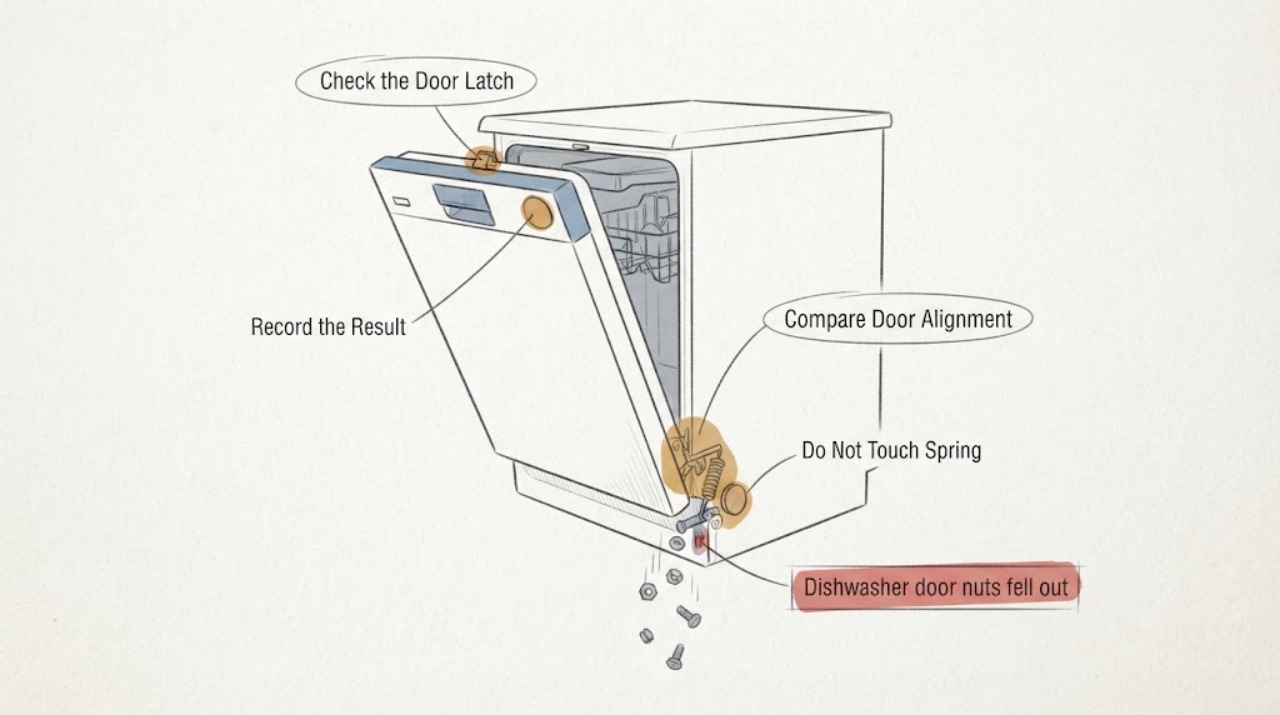
Treat loose nuts falling from a Frigidaire dishwasher door as an unresolved hardware problem until their location and function are identified. Do not put the nuts back into a threaded hole, tighten a random door or hinge fastener, or run a cycle to see whether the door stays closed. Keep the dishwasher off, collect and photograph the pieces, and inspect only from the outside for a door that no longer sits square, latches fully, seals evenly, or has a visible gap or obstruction. Frigidaire says the door must be properly closed and latched before operation and that a door should be unlatched and allowed to stop washing before it is opened during a cycle. Because there is no model number or verified attachment point, use the model/serial label and the owner manual or qualified service to identify the hardware before any repair.
Work through in order
Diagnostic checks
Use only checks that match the exact appliance or system and its official guide.
-
Check 1
Stop using the dishwasher and collect every loose nut, washer or screw without trying to reinstall it. Photograph the pieces and the door from both sides while it is closed; do not open the inner door panel or reach into the hinge area.
Expected result: The pieces are complete and can be kept together, or a sharp fragment, damaged edge, spring, wire or missing-looking fastener is visible.
Next step: Leave the dishwasher unused and move to the external closure check. For sharp, loose or electrical-looking damage, keep people away from the door and arrange service without further handling.
Stop if: Stop handling the door for a pinched spring, exposed wire, sharp metal, a door that drops or a water leak.
Why this matters
Why: Keeping the hardware together preserves evidence for model matching; visible damage or a spring/wire concern raises the risk beyond a harmless trim piece, but still does not identify the correct replacement.
-
Check 2
With the dishwasher empty and powered off from a safe, dry location, inspect the closed door from the front and sides. Check whether the gaps look even, the door sits level, the latch engages without force, and the seal contacts evenly; do not press, lift or force the door to make it latch.
Expected result: The door is visibly sagging, rubbing, twisted, unable to latch, or leaving an uneven seal; alternatively it closes evenly with no visible movement.
Next step: If fit or latching is abnormal, do not run the dishwasher and arrange model-matched service. If the fit looks normal, continue only with identifying the model and the hardware; do not run a cycle as a test.
Why this matters
Why: An abnormal fit can indicate that door hardware or an installation condition needs attention, while a normal-looking fit does not prove that the loose nut is unrelated or that the door is safe under wash pressure.
-
Check 3
Check only for accessible obstructions that prevent complete closure, such as a rack, dish or kick plate visibly in the way. Do not remove trim, adjust hinge screws or tighten an unknown nut.
Expected result: A movable item clearly blocks the door, or nothing visible blocks closure but the loose hardware remains unexplained.
Next step: Remove only the plainly movable obstruction, then recheck the unforced door fit. If the hardware source remains unknown or the door still does not latch evenly, keep the dishwasher out of service and contact Frigidaire/qualified service.
Why this matters
Why: Frigidaire notes that the door must close completely and that an installation component can prevent closure; clearing a plainly movable obstruction is different from repairing unidentified door hardware.
-
Check 4
Locate and record the full Frigidaire model and serial number from the dishwasher door interior or right side of the tub, then use that identity for the owner manual and service request. Include the photos, the number and where the nuts were found.
Expected result: The model and serial are readable and the owner documentation identifies the relevant door hardware, or no exact hardware information is available.
Next step: Use only the exact manual procedure or a qualified technician. If the manual does not identify the loose hardware, provide the pieces and photos to service rather than ordering a generic nut or running the machine.
Why this matters
Why: Frigidaire says dishwasher model information is commonly on the interior door or right side of the tub; exact identity is needed before a part or tightening procedure can be matched.
Use your observations
Decision map
Find the observation that best matches what you see, then follow the next safe action.
-
PATH 01Next step
What you see
The door is sagging, will not latch, rubs, or leaves an uneven seal after the nuts fell out.
Do this next
Do not run the dishwasher; keep the water supply available only as needed for a technician and arrange model-matched service.
Why this path and its safety boundary
Why it matters: The loose hardware may affect door structure or closure, but the exact part and failure are unconfirmed.
-
PATH 02Next step
What you see
The door closes evenly and latches, but the origin of the nuts is still unknown.
Do this next
Keep the nuts and photos, identify the model/serial and obtain the exact manual or service assessment before operating it.
Why this path and its safety boundary
Why it matters: A normal-looking closure does not prove the remaining hardware is secure or that the nuts are harmless trim.
-
PATH 03Next step
What you see
A leak, exposed wire, sharp metal, loose spring or door movement is visible.
Do this next
Stop handling the dishwasher and keep it out of service; isolate water or power only from a safe, dry location and contact qualified appliance service.
Why this path and its safety boundary
Why it matters: This is a water, electrical or mechanical safety concern, not a routine loose-part observation.
-
PATH 04Next step
What you see
A clearly movable rack, dish or kick plate blocks full closure, and the door hardware itself is not being forced.
Do this next
Remove only that obstruction, then reassess the unforced door fit. If the loose hardware remains unexplained, do not run a cycle and seek model-matched guidance.
Why this path and its safety boundary
Why it matters: The visible obstruction may be preventing the complete closure that Frigidaire requires before operation, but it does not explain unidentified nuts.
Helpful context
Understand the symptom
Why an unidentified nut matters
A loose nut from a dishwasher door could belong to a structural, latch, trim or installation connection, but the supplied description does not establish which. Its presence is enough to stop normal use while the source is identified. A door that appears to close is not proof that the remaining hardware is secure, and a weekly schedule does not make a missing fastener safe.
Keep the first inspection external
Do not remove the inner door panel, hinge spring, latch, insulation or wiring to chase a loose nut. From a dry, powered-off position, document where each piece was found and look only for visible door misalignment, an incomplete latch, a gap in the seal or an obstruction. Exact hardware identification requires the model-specific manual or a qualified technician.
Do not use a test cycle as a repair check
Frigidaire says the door should be closed and latched before a cycle runs. If the door is not square, does not latch positively, rubs, leaks or has visible movement, leave the unit unused. The correct next step is model and serial verification and a service assessment, not randomly tightening a fastener whose thread, torque or location is unknown.
When checks do not resolve it
Need a professional?
Arrange Frigidaire or qualified appliance service before running the dishwasher when nuts or other hardware fell from the door and their attachment point is unknown, or whenever the door sags, rubs, fails to latch, leaks or shows exposed wiring/springs. Provide the full model/serial, photos and the collected pieces. Do not order a hinge, latch, panel kit or generic fastener from the symptom alone.
Common questions
FAQ
Can I put the nuts back and tighten them?
Do not tighten an unidentified door fastener. Without the model and attachment point, the nut could belong to different hardware with different fit and safety requirements. Keep it for identification and use the exact manual or qualified service.
If the dishwasher door still closes, can I run one cycle to see whether it is safe?
No. A door that appears to close does not identify the missing hardware. Frigidaire requires the door to be properly closed and says the door should be fully closed before running; use model-matched guidance first.
Where is the dishwasher model number?
Frigidaire says it is commonly on the interior side of the door or along the right side of the tub, visible when the door is open. Record it along with the serial number for the manual or service request.
Read the exact guide
Official sources
- What should I do if my dishwasher is not starting?Frigidaire Support · Opened official Frigidaire dishwasher support page. It supports the requirement to close the door properly before operation and escalation when unresolved; it does not identify the loose nut or a model-specific door part.
- Dishwasher - Water LeakingFrigidaire Support · Opened official Frigidaire dishwasher leak page. It supports checking complete closure and escalating unresolved conditions; it does not identify the fallen nuts or authorize tightening door hardware.
- Where can I find my model and serial number?Frigidaire Support · Opened official Frigidaire identity page. It supports locating the dishwasher model on the interior door or right side of the tub for model-matched documentation; it does not establish a door-part fit.
- Dishwashers - Forgot to load an item to a wash cycle that is in process?Frigidaire Support · Opened official Frigidaire dishwasher support page. It supports waiting for wash action to stop after unlatching and firmly latching the door before resuming; it does not support opening a door with unknown loose hardware.
Community feedback
Share a repair observation
Share a plain-text repair observation. Accepted observations are published automatically; this page may take a moment to update.