
On this page
Start here
Quick answer
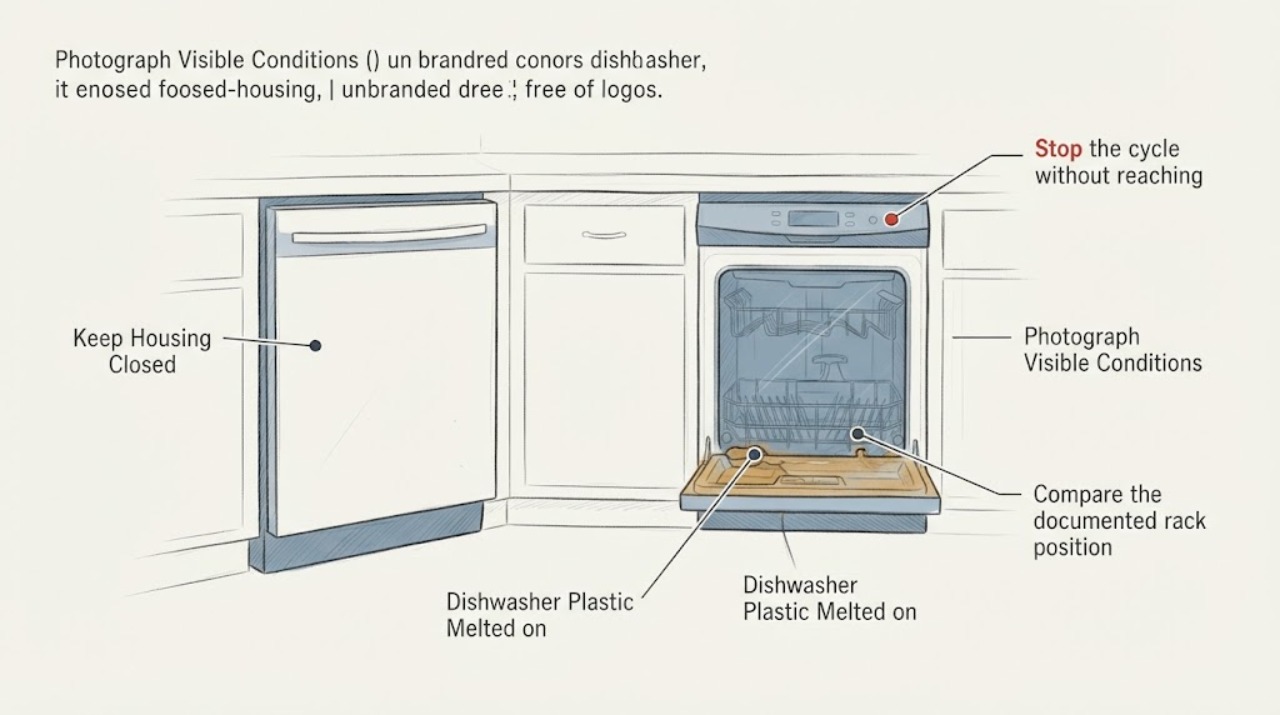
Treat plastic melted onto the bottom ring or heater area as a stop-use and service question, not a burn-off or scraping job. Cancel the cycle if it is safe, isolate power from a dry position, and let the dishwasher cool completely. Do not restart it, select Heat Dry, heat the residue, pry on the ring, open the cabinet, or test wiring. When it is cool and power is isolated, document the model and serial, the melted object, the rack position, any smoke or scorching, and whether the spray arm can rotate without contact. Frigidaire's loading guidance puts plastic in the upper rack and warns that items must not block spray-arm rotation, but it does not establish the cause of this event or authorize heater repair. Arrange model-specific service if residue is fused to the bottom ring, the ring/heater is distorted, there is smoke or an electrical odor, or the cause is not plainly an unheated loose item.
Before you begin
Safety first
- Keep the dishwasher off for fused residue, any smoke/scorching/electrical odor, visible damage, water near controls, or an unexplained repeat event. Do not open the cabinet, perform live electrical tests, heat the plastic, or bypass a safety device.
Work through in order
Diagnostic checks
Use only checks that match the exact appliance or system and its official guide.
-
Check 1
Stop the cycle without reaching into the tub, isolate dishwasher power from a dry position, and leave the machine off until the tub and melted plastic are completely cool.
Expected result: Smoke, a hot electrical smell, visible scorching, a hot plug or cord, or a tripped breaker is present; or the event is only a cooled residue with no active warning.
Next step: For any smoke, scorching, hot electrical part, or repeated trip, keep the dishwasher isolated and arrange qualified service. Never heat the residue to remove it.
Why this matters
Why: Heat or electrical warning signs make repeated operation unsafe. A cooled residue still does not establish that the heater or wiring is sound.
-
Check 2
With power isolated and the appliance cold, photograph the model/serial label, the bottom ring or heater area, the melted object, the rack position, and any visible damage before moving anything.
Expected result: The residue is loose and away from the ring, fused to the ring, or accompanied by a deformed ring, damaged rack, melted insulation, or soot.
Next step: Do not pry, scrape, bend, or remove fused residue. Give these photographs and the exact model to service; if a loose item lifts without touching the ring, set it aside rather than reinstalling it.
Why this matters
Why: A loose object preserves a possible loading explanation; fused residue or secondary damage requires an inspection that cannot be scoped from a generic page.
-
Check 3
Compare the documented rack position with Frigidaire's loading guide: plastics belong in the upper rack, nothing should protrude through the rack, and the spray arm should turn freely by hand while the appliance is cold and powerless.
Expected result: A plastic item or handle was below the upper rack, protruded through a rack, or blocked the spray arm; or the spray arm is already clear and free.
Next step: Correct the documented loading issue for future loading only after service confirms the dishwasher is safe. Do not run a test cycle to prove the correction.
Why this matters
Why: The first condition identifies a loading or clearance condition worth reporting, but it does not prove why plastic melted. A clear arm does not rule out heater-area damage.
-
Check 4
Check the cool, visible interior for a persistent chemical/plastic odor, smoke residue, cracked or displaced rack parts, standing water near controls, or a breaker that trips when the circuit is restored; do not open panels or perform live tests.
Expected result: Any odor, soot, damaged rack or heater area, water near controls, or recurring electrical trip remains; or no secondary sign is visible.
Next step: Keep the dishwasher off and request model-specific service whenever a secondary sign is present or the cause remains uncertain.
Why this matters
Why: A secondary sign keeps an electrical, heating, or installation fault in scope. No visible sign only means the cause is unresolved, not that a restart is safe.
-
Check 5
Prepare a service report with the exact model/serial, cycle and options in use, whether Heat Dry was selected, the rack position, what melted, the time of the event, power-trip or smoke details, photographs, and every external check completed.
Expected result: The model is available and the event can be documented, or the model is missing and the appliance cannot be matched to a manual or part list.
Next step: Arrange qualified Frigidaire or appliance service and do not order a heater, ring, rack, or wiring part from the symptom alone.
Why this matters
Why: Frigidaire's support material is generic across dishwashers and sends unresolved problems to the owner's manual or service; the model is needed before a technician can evaluate a heater-area part or repair path.
Use your observations
Decision map
Find the observation that best matches what you see, then follow the next safe action.
-
PATH 01Next step
What you see
Smoke, scorching, hot electrical odor, a hot cord, water near controls, or a breaker trip occurred.
Do this next
Keep power isolated if safe and arrange qualified service; do not restore power to see whether the dishwasher still runs.
Why this path and its safety boundary
Why it matters: The event has a safety or electrical warning that cannot be cleared by a loading adjustment.
-
PATH 02Next step
What you see
The plastic is fused to the bottom ring/heater area, the ring is distorted, or the residue cannot be lifted without contacting the ring.
Do this next
Leave the residue in place, do not heat or scrape it, and book model-specific service with photographs.
Why this path and its safety boundary
Why it matters: The heat-transfer surface or nearby components may be damaged, and the generic Frigidaire guidance does not support a user removal or part diagnosis.
-
PATH 03Next step
What you see
A cool, loose item was below the upper rack or blocked spray-arm clearance, but there is no confirmed damage.
Do this next
Remove only the loose item without touching the ring, preserve photos, and have service confirm the appliance before the next heated cycle.
Why this path and its safety boundary
Why it matters: The loading position is a documented condition to report, not proof that it caused the melting or that the appliance is safe to run.
-
PATH 04Next step
What you see
The residue is gone but the plastic smell, smoke mark, rack damage, or cause remains unexplained.
Do this next
Do not use a rinse, heated, or drying cycle as a test; provide the exact model and event record to service.
Why this path and its safety boundary
Why it matters: The absence of a visible obstruction does not rule out heat-area, wiring, or control damage.
Helpful context
Understand the symptom
Plastic on the bottom ring can be a melted loading item, but the visible residue does not prove that the heater, wiring, or control failed. Because the event involves heat and a potentially damaged appliance, preserve the evidence and keep the dishwasher out of service until the cool, external checks below are complete.
Stop the heat and make the appliance safe
Do not run another cycle to melt or wash the plastic away. Do not use Heat Dry as a test, put a tool against the ring, or scrape while anything is warm. From a dry position, cancel if the controls respond safely and isolate the dishwasher at its accessible disconnect or breaker. Leave it off until the tub and residue are fully cool; smoke, a hot electrical smell, a hot cord, a tripped breaker, or visible scorching is a service boundary.
Use the loading guide only to check the outside cause
Once the dishwasher is cold and power is isolated, photograph the model and serial label, the bottom ring/heater area, the melted object, and the rack position. Frigidaire says plastic items should be in the upper rack, nothing should protrude through the rack, and the spray arm should turn freely by hand. These checks can document a loading or clearance condition, but they do not prove that it caused the melting. Do not remove a fused piece or touch the heater to make the check.
Decide whether this is a service job
A loose, cool item that can be lifted away without contacting the ring is different from plastic fused to the ring, a deformed ring, damaged rack, melted insulation, smoke, or a recurring odor. The latter conditions need a qualified technician with the exact model, because Frigidaire's generic support pages direct unresolved dishwasher issues to the owner's manual or service and do not establish a compatible heater or replacement part.
When checks do not resolve it
Need a professional?
Arrange service before the next cycle if plastic is fused to the bottom ring/heater area, the ring or rack is damaged, smoke or a persistent plastic/electrical odor occurred, the breaker tripped, water is near controls, or the cause is not certain. Keep the dishwasher isolated until it is inspected.
Safety scope: Keep the dishwasher off for fused residue, any smoke/scorching/electrical odor, visible damage, water near controls, or an unexplained repeat event. Do not open the cabinet, perform live electrical tests, heat the plastic, or bypass a safety device.
Have this ready
- Exact model and serial, photographs before moving residue, cycle and drying option, rack position, what melted, event timing, smoke/odor/scorching, breaker behavior, and the external checks completed.
Common questions
FAQ
Can I run the dishwasher to burn the plastic off?
No. Do not use Heat Dry or another cycle to soften or burn away residue. Isolate power, let the appliance cool, and use photographs and model information for service.
Does a plastic item in the wrong rack prove the heater failed?
No. Frigidaire says plastics belong in the upper rack and items must not block spray-arm rotation, but that loading guidance does not identify the cause of melting or prove that the heater is undamaged.
Can I scrape the cooled plastic off the bottom ring?
Do not pry or scrape residue that is fused to the ring or requires contact with it. Leave it for model-specific service; only a loose, cool item away from the ring should be set aside without touching the heater area.
What should I tell the technician?
Provide the exact model and serial, photographs, the cycle and drying option, rack position, melted object, time of the event, smoke or odor, breaker behavior, and checks already completed. Frigidaire directs unresolved dishwasher problems to the owner's manual or service.
Read the exact guide
Official sources
- Dishwasher - Loading GuideFrigidaire · Official support page applies to dishwashers; rack appearance varies by model, so it supports only the stated loading and clearance checks, not a model-specific heater diagnosis.
- Dishwasher - Why does my dishwasher have an odor and how do I fix it?Frigidaire · Official dishwasher support is used only for odor observation, owner-manual routing, and service escalation; it does not identify the cause of plastic melting.
- What should I do if my dishwasher is not starting?Frigidaire · Official dishwasher support supports external door, water, breaker, manual, and service routing checks; it is not evidence for opening the cabinet or diagnosing the heater.
- Dishwasher - Noise GuideFrigidaire · Official dishwasher support only supports the distinction that a tall item can contact a spray arm; it does not diagnose this melted-plastic event.
- Dishwasher - Not DryingFrigidaire · Official dishwasher support explains that plastics may retain water, Heat Dry is model-dependent, and unresolved issues go to service; it does not authorize burning or scraping melted plastic.
Community feedback
Share a repair observation
Share a plain-text repair observation. Accepted observations are published automatically; this page may take a moment to update.