
On this page
Start here
Quick answer
Some vapor at the vent can be normal on the Frigidaire Gallery GDPH4515AF2B, especially during a heated or sanitize drying phase, and the owner's guide warns that vapor may be hot. Steam that wets the underside of a new countertop, the top control area, or exposed insulation is different: leave the dishwasher off until the installer checks the drying-vent hose, leveling, anchoring, cabinet fit, and moisture protection. Do not tape over the vent, pull the built-in unit out yourself, or keep running sanitize cycles to test it. The installation instructions specifically warn not to disconnect the vent hose attached to the top and recommend moisture-resistant protection under the countertop.
Before you begin
Safety first
- Do not cover or block the vent, pull the built-in dishwasher out, disconnect the top vent hose, remove enclosure panels, or work around electrical and water connections as an owner troubleshooting step. Keep clear of hot vapor and the heating element. Stop immediately for water near wiring, a hot or damaged control area, smoke, burning or electrical odor, a leak, exposed wiring, or repeated breaker operation.
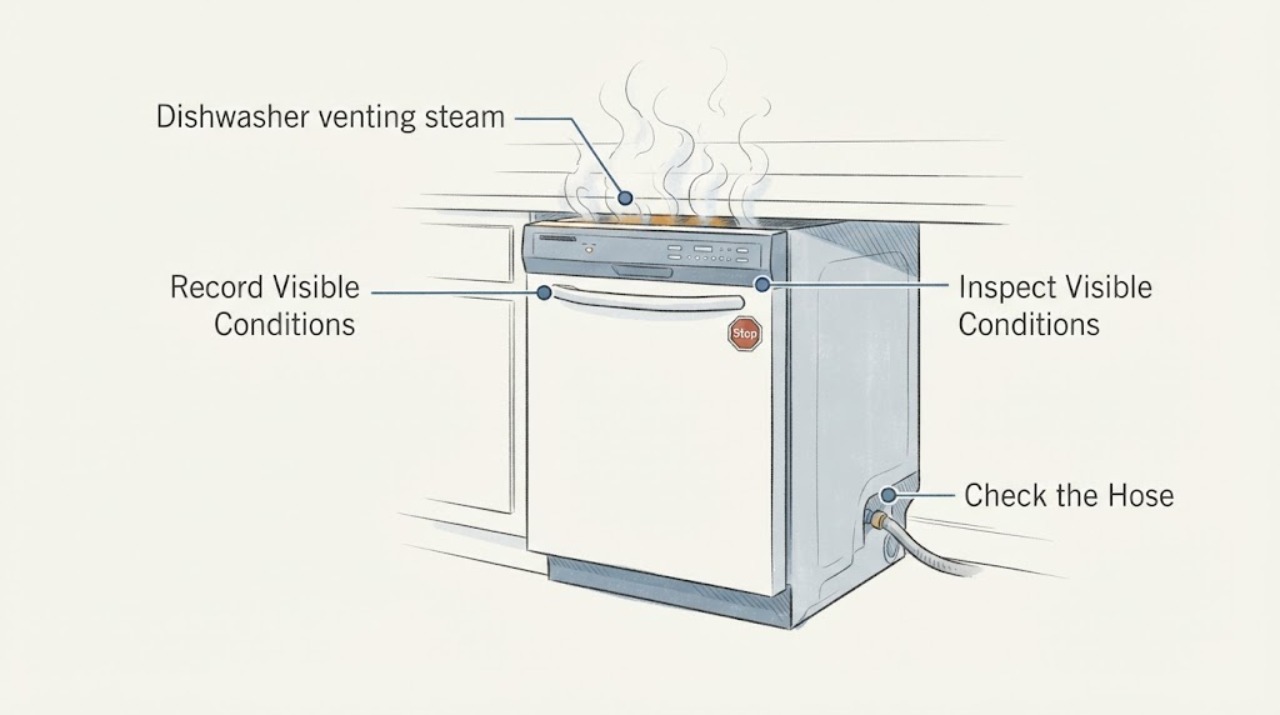
Work through in order
Diagnostic checks
Use only checks that match the exact appliance or system and its official guide.
-
Check 1
Confirm the rating-label model is GDPH4515AF2B and record the cycle and drying option. Note whether vapor appears during the cycle, immediately after completion, or only when the door is opened, and whether it exits at the intended vent area or spreads across the counter and top control panel.
Expected result: Brief vapor is visible near the vent with no water collecting, or moisture is condensing on the counter underside, control area, or exposed insulation.
Next step: If vapor is brief and contained, continue with the visible installation checks. If surfaces or insulation are getting wet, stop using Heat/MaxBoost/Sanitize and contact the builder or installer with photos and the exact model.
Why this matters
Why: The owner's guide warns that vent vapor can be hot, and Frigidaire describes vapor during drying as a possible normal effect; widespread condensation or wetting in a new installation points to fit, routing, or moisture-protection concerns rather than vapor alone.
-
Check 2
With the dishwasher cool and not running, inspect only the visible cabinet opening from the front and sides. Look for a gap between the top of the dishwasher and the underside of the counter, exposed insulation, moisture staining, or a door that is not centered in the opening. Do not remove the kickplate or pull the unit forward.
Expected result: The dishwasher sits close and evenly under the counter with no dampness, or there is a visible gap, exposed insulation, uneven fit, or moisture damage.
Next step: Photograph the gap and moisture without touching wiring or plumbing. Ask the installer to verify leveling, anchoring, cabinet fit, and the underside moisture protection; do not fill the gap with foam, tape, or a homemade cover.
Why this matters
Why: The installation guide calls for a properly sized cabinet opening, a level and anchored dishwasher, and moisture-resistant protection around the enclosing cabinets. A gap or exposed insulation can let vented moisture reach the counter rather than remaining in the intended drying path.
-
Check 3
Ask the installer to verify the top drying-vent hose and its connection while the dishwasher is safely isolated according to the installation instructions. The owner should not access the hose by moving the built-in unit or opening electrical or plumbing compartments.
Expected result: The installer finds the vent hose connected and undamaged, or finds it disconnected, pinched, displaced, or routed into the cabinet opening.
Next step: Have the installer restore the hose and any required cabinet sealing or routing using the model's installation instructions. Do not operate the dishwasher with a loose hose, open enclosure, or exposed wiring.
Why this matters
Why: Frigidaire's installation document specifically identifies a drying-vent hose attached to the top and warns that it can be disconnected during installation or removal. A displaced hose is an installation fault to correct before deciding that the appliance itself has failed.
-
Check 4
After the installer confirms the vent path, fit, and moisture protection, run one supervised cycle using a lower-heat or Air Dry option first, staying clear of the vent. Check the underside of the counter and the top control area after the cycle has cooled; do not touch the vent during or immediately after a sanitize cycle.
Expected result: The cycle finishes with contained vapor and no new wetting, or moisture again reaches the counter, controls, or insulation.
Next step: If the cabinet stays dry, continue normal use while keeping the vent unobstructed. If wetting returns, stop using the dishwasher and arrange Frigidaire or qualified appliance service; do not select a fan, vent, seal, or control part from the symptom alone.
Why this matters
Why: A dry cabinet after the installation correction makes a routing or fit problem more likely than an appliance failure. Recurring wetting after the vent and fit are verified needs appliance service, because the symptom alone cannot identify a fan, duct, seal, or control part.
Use your observations
Decision map
Find the observation that best matches what you see, then follow the next safe action.
-
PATH 01Next step
What you see
Vapor is brief, appears at the vent near the end of drying, and does not leave droplets on the counter underside, control area, or insulation.
Do this next
Keep the vent area clear, avoid touching it while hot, and monitor one ordinary cycle. No vent cover or replacement part is justified by visible vapor alone.
Why this path and its safety boundary
Why it matters: This pattern is consistent with normal drying vapor for the GDPH4515AF family, especially when a heated or sanitize option was selected.
-
PATH 02Next step
What you see
The dishwasher is in a new-construction opening with a visible gap or exposed insulation, and vapor or droplets are wetting the underside of the counter or the top control area.
Do this next
Stop heated or sanitize drying, document the gap and moisture, and send the photos and model number to the builder or installer for a fit, level, anchor, vent-hose, and cabinet-sealing correction.
Why this path and its safety boundary
Why it matters: The installation and moisture-protection path is more likely than a failed dishwasher component. The exact community report describes this same symptom pattern, while Frigidaire's installation document identifies the top vent hose and cabinet protection as installation-sensitive areas.
-
PATH 03Next step
What you see
The installer verifies the vent hose, level, anchoring, and cabinet protection, but steam still wets the counter or controls, or there is a leak, electrical odor, visible damage, or repeated breaker operation.
Do this next
Leave the dishwasher off and arrange qualified appliance service; disconnect power only from a safe dry location when there is no contact with water or energized equipment. Do not open the cabinet or recreate a hot-steam or electrical fault.
Why this path and its safety boundary
Why it matters: The symptom has moved beyond a safe owner observation and may involve an internal vent, fan, seal, heater, control, or water/electrical condition that cannot be selected from condensation alone.
Helpful context
Understand the symptom
Normal vapor versus an installation problem
The owner's guide lists vapor at the vent as a heat and burn consideration, not as proof that the dishwasher is broken. The same model family uses Heat, Air, and MaxBoost drying options, so the amount and timing of visible vapor can change with the selected cycle. The decision changes when moisture is landing on the counter, controls, or insulation: that pattern needs an installation and vent-routing check, not a blocked vent or a replacement part chosen from the symptom.
Why the new-construction detail matters
A gap above the dishwasher, a unit that is not level or anchored, or a drying-vent hose disturbed during installation can direct warm moist air into the cabinet opening. Frigidaire's installation instructions tell the installer to protect the underside of the countertop from possible steam damage and to take care not to disconnect the vent hose on top of the dishwasher. A homeowner can document these visible conditions, but the built-in unit should not be pulled out or its vent or electrical connections handled as a casual check.
When checks do not resolve it
Need a professional?
Contact the builder or installer first when the unit is new, has a visible gap, exposed insulation, wet cabinet, or a disturbed vent hose. Arrange qualified appliance service when installation is verified but wetting continues, the cycle fails, the dishwasher leaks, or the cause would require internal access.
Safety scope: Do not cover or block the vent, pull the built-in dishwasher out, disconnect the top vent hose, remove enclosure panels, or work around electrical and water connections as an owner troubleshooting step. Keep clear of hot vapor and the heating element. Stop immediately for water near wiring, a hot or damaged control area, smoke, burning or electrical odor, a leak, exposed wiring, or repeated breaker operation.
Have this ready
- Provide the exact model GDPH4515AF2B, purchase and installation date, cycle and drying option, when vapor appears, photos of the vent path and counter gap, whether the top control area or insulation becomes wet, and whether the dishwasher completes and drains normally.
Common questions
FAQ
Is it normal for the Frigidaire Gallery GDPH4515AF2B to vent steam from the top?
Some vapor at the vent can occur during drying, and the owner's guide warns that vapor may be hot when Sanitize is selected. It should not be assumed normal when it repeatedly wets the counter underside, top controls, or insulation, especially in a new installation.
Should there be a gap between this dishwasher and the countertop?
Do not judge the gap by appearance alone or fill it yourself. Frigidaire's installation instructions require a correctly sized opening and a level, anchored dishwasher, and they recommend moisture-resistant protection for the underside of the counter. Have the installer verify the fit and vent path.
Can I block the top vent to stop the steam?
No. Do not cover, tape over, or redirect the vent. The vent and its hose are part of the drying and installation path; have the installer or a qualified technician check the hose, cabinet fit, leveling, and moisture protection instead.
Read the exact guide
Official sources
- DISHWASHER use & care A21513101BFrigidaire · Official owner's guide linked from Frigidaire's GDPH4515AF product-support page; the task's GDPH4515AF2B is the exact model suffix supplied for this family topic.
- Dishwasher Installation Instructions 154427301HFrigidaire · Official installation PDF opened through the exact Frigidaire Gallery GDPH4515AF support page; it covers the built-in installation details relevant to the assigned new-construction symptom.
- Frigidaire Gallery Dishwasher venting steam out top wetting counter and top of dwReddit r/Appliances · Exact Reddit post opened for the assigned GDPH4515AF2B model, new-construction condition, top-vapor, counter-wetting, and visible-gap symptom report; it is not a manufacturer diagnosis or confirmed repair.
- Dishwasher - Not DryingFrigidaire · Official Frigidaire dishwasher support article used for the distinction between expected vapor during Air Dry and an installation follow-up for recent installations.
Community feedback
Share a repair observation
Share a plain-text repair observation. Accepted observations are published automatically; this page may take a moment to update.