
On this page
Start here
Quick answer
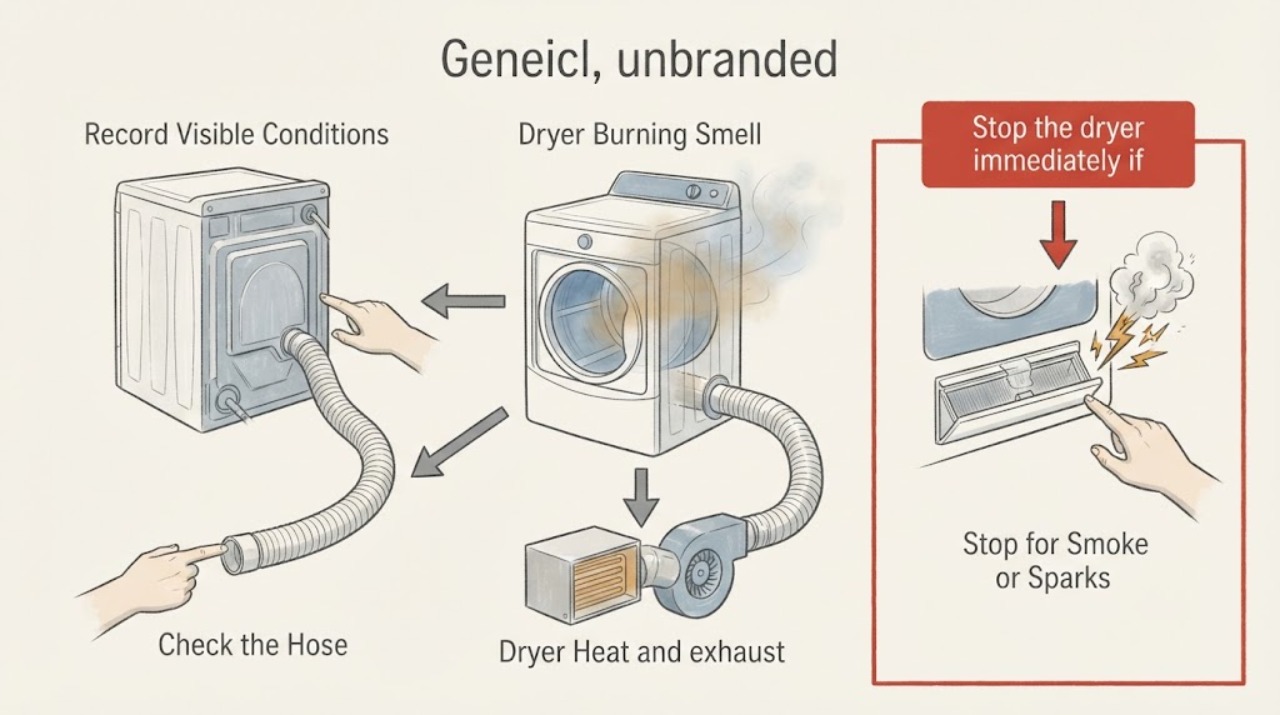
Stop using a Frigidaire dryer when it smells like burning until the cause is assessed. Smoke, sparks, a hot or damaged cord, visible flame, or a strong electrical or gas odor requires the dryer to remain off and may require emergency help; do not run another load to reproduce it. When the dryer is off and cool, clean the lint screen and inspect only the accessible exhaust path and outside hood for blockage or crushing. Frigidaire warns that a blocked lint screen or exhaust duct affects safe dryer operation, and the U.S. Consumer Product Safety Commission says lint in the dryer or duct can restrict airflow, build heat, and cause a fire. Do not open the cabinet, inspect a belt or heater, perform live tests, or choose a part from the odor alone. Give the exact model, gas/electric type, smell timing, load, and visible vent observations to qualified Frigidaire service.
Before you begin
Safety first
- Keep the dryer off after a burning smell until qualified service clears it. Do not open the cabinet, inspect guarded components, perform live tests, bypass thermal or door protection, or run another load to reproduce the odor.
Work through in order
Diagnostic checks
Use only checks that match the exact appliance or system and its official guide.
-
Check 1
Stop the dryer immediately if the burning smell is accompanied by smoke, sparks, flame, a hot or damaged cord or receptacle, melted material, or an unusually hot cabinet. If safe from a dry location, isolate power without touching a hazardous connection; do not start another cycle.
Expected result: A fire/electrical warning is present, or the odor is present without visible smoke or damage.
Next step: Keep the dryer off and obtain qualified appliance service; use emergency assistance for active smoke or flame. Do not open the cabinet or reset and retry to locate the cause.
Why this matters
Why: The odor may indicate a fire, electrical, gas, or overheating hazard. The absence of visible smoke does not clear the dryer or make a powered test safe.
-
Check 2
Read the model and serial label, identify whether the dryer is gas or electric, and record when the odor appeared: at startup, during heat, after a load, with an empty drum, or after a recent installation or repair. Do not reproduce the smell deliberately.
Expected result: The exact model and fuel type are known, or the model/fuel type remains unknown; the odor timing is repeatable from prior observation or cannot be established safely.
Next step: Use the exact manual only for external care instructions and give the recorded sequence to service. If the model or fuel type is unknown, do not borrow internal procedures from another Frigidaire dryer.
Why this matters
Why: Frigidaire manuals and service paths are model and installation dependent. Timing helps service separate a load or exhaust condition from an appliance fault, but it does not identify a belt, heater, motor, or control.
-
Check 3
With the dryer off and cool, clean the lint screen and inspect the accessible exhaust hose and outside vent hood for lint, a crushed or kinked duct, blockage, or no obvious exhaust opening. Do not reach into the cabinet or remove guarded panels.
Expected result: The lint screen is blocked or damaged, the exhaust path is restricted/crushed, the outside hood is blocked, or the accessible path appears clear.
Next step: Do not operate with a blocked, damaged, or missing lint screen or a restricted exhaust. Arrange qualified vent/chassis cleaning when needed; if the path is clear but the smell persists, keep the dryer off and request appliance service.
Why this matters
Why: Frigidaire and CPSC identify lint screens, exhaust ducts, and outside venting as airflow and fire-safety points. A clear accessible path does not rule out lint inside the chassis or an internal component fault.
-
Check 4
Check the load history without running the appliance: note any gasoline, cooking oil, cleaning solvent, wax, plastic, rubber, or unusually hot item that was dried, and remove such items from the laundry area. Do not put a contaminated load back into the dryer.
Expected result: The load included volatile chemicals, oils, plastic/rubber, or another unusual material, or no such material is known.
Next step: Keep the questionable load out of the dryer and follow the product or fire-safety guidance. If the machine itself smelled burned, arrange service before any further use.
Why this matters
Why: CPSC warns that some volatile or oil-contaminated items can contribute to ignition in a dryer. This does not explain an odor from the machine itself and does not make continued operation safe.
-
Check 5
Prepare a service handoff with the full model and serial, gas/electric type, odor description and timing, load contents, prior repair or installation, lint/vent observations, visible damage, smoke or sparks, and whether the odor remains while the dryer is off.
Expected result: The smell returns, the dryer has any hazard sign, the accessible vent is clear but the odor persists, or the cause cannot be safely observed externally.
Next step: Leave the dryer out of service and arrange qualified Frigidaire appliance service; use qualified gas/electrical help for supply or installation concerns. Do not order a belt, heater, motor, or board from the odor alone.
Why this matters
Why: The remaining possibilities include internal lint, heat, wiring, drive, control, gas, or installation problems. The no-model symptom cannot select a safe component or repair procedure.
Use your observations
Decision map
Find the observation that best matches what you see, then follow the next safe action.
-
PATH 01Next step
What you see
There is smoke, flame, sparking, a hot/damaged cord or receptacle, or a strong burning odor that continues after the dryer is stopped.
Do this next
Keep people away, leave the dryer off, and use emergency assistance for active smoke or flame. Do not touch a hazardous connection, open the cabinet, or run another load.
Why this path and its safety boundary
Why it matters: The situation has a fire or electrical safety priority, independent of the exact internal cause.
-
PATH 02Next step
What you see
The lint screen is blocked/damaged, the visible exhaust duct is crushed or restricted, or the outside hood does not allow exhaust to escape.
Do this next
Keep the dryer off until the lint/vent issue is corrected or professionally cleaned. Have qualified service inspect the chassis if lint may have accumulated inside.
Why this path and its safety boundary
Why it matters: Restricted airflow is a documented dryer fire concern and can create excess heat; it still does not identify an internal part.
-
PATH 03Next step
What you see
The accessible lint and exhaust path is clear, but the burning smell returns or began after a repair, installation, or abnormal noise.
Do this next
Leave it out of service and arrange qualified Frigidaire service. Provide the exact model and sequence instead of testing a suspected belt, heater, motor, or control.
Why this path and its safety boundary
Why it matters: An internal mechanical, heat, electrical, gas, or installation issue remains possible; external checks have not cleared the dryer.
-
PATH 04Next step
What you see
The load contained volatile chemicals, cooking oils, plastic, rubber, or another item that should not be dried.
Do this next
Keep the load out of the dryer and follow the relevant safety guidance; arrange appliance service before using the dryer again if the machine emitted the odor.
Why this path and its safety boundary
Why it matters: The load itself can contribute to ignition or odor, but it does not make a machine that smelled burned safe to reuse.
Helpful context
Understand the symptom
Burning odor is not a parts diagnosis
A Frigidaire dryer can have different electrical, gas, heat, drum, and exhaust arrangements. The task has no model, and an odor alone cannot distinguish lint, airflow, a hot item, a mechanical problem, a heater, wiring, or another cause. Keep the article at safe external checks and provide the exact model and event sequence to service.
Treat lint and exhaust as a fire-safety issue
The CPSC says lint in a dryer or exhaust duct can block airflow, create excessive heat, and result in a fire. Frigidaire's dryer guidance likewise says to clean the lint screen, check the exhaust duct and hood, and keep gas-dryer exhaust vented outdoors. Interior chassis cleaning and any guarded component inspection should be handled by qualified service.
When checks do not resolve it
Need a professional?
Call qualified Frigidaire appliance service before further use when the burning odor returns, any smoke/spark/flame/heat or cord damage is present, the accessible exhaust is restricted, the odor followed a repair, or the cause cannot be established safely. Use qualified gas or electrical help for supply and installation concerns.
Safety scope: Keep the dryer off after a burning smell until qualified service clears it. Do not open the cabinet, inspect guarded components, perform live tests, bypass thermal or door protection, or run another load to reproduce the odor.
Have this ready
- Full model/serial, gas or electric type, odor timing and description, load contents, prior repair/installation, lint and exhaust observations, visible damage, smoke/sparks, and whether the smell remains after shutdown.
Common questions
FAQ
Can I keep using the dryer if there is no smoke?
No. The absence of smoke does not identify or clear the cause. Stop use, check only the cool external lint and exhaust path, and arrange service if the smell persists or any heat, cord, smoke, or vent warning exists.
Could lint or a blocked vent cause a burning smell?
It can create a fire concern: CPSC says lint in the dryer or exhaust duct can restrict airflow, build excessive heat, and result in fire. Clean only accessible lint and have internal chassis or guarded areas serviced professionally.
Should I replace the belt or heating element first?
No. A no-model burning odor does not distinguish a belt, heater, motor, control, wiring, gas, or lint problem. Give the exact model and event sequence to qualified service instead of ordering a part by symptom.
Read the exact guide
Official sources
- What should I do if my Frigidaire Laundry Center is not properly heating or drying?Frigidaire · Official Frigidaire guidance for laundry centers used only for gas/electric and external airflow boundaries; it is not transferred as an internal burning-smell diagnosis for every dryer.
- Overheated Clothes Dryers Can Cause FiresU.S. Consumer Product Safety Commission · Official CPSC safety alert used for lint/exhaust fire risk, qualified interior chassis cleaning, volatile-chemical load warnings, and stop-use safety boundaries; it is not a Frigidaire component diagnosis.
- Dryer - Not Drying and Extended Drying TimeFrigidaire · The opened Frigidaire support article applies to dryers generally and supports external lint-screen, exhaust-duct, hood, gas-exhaust, and service boundaries. It does not diagnose the assigned burning smell or identify an internal part.
Community feedback
Share a repair observation
Share a plain-text repair observation. Accepted observations are published automatically; this page may take a moment to update.