
On this page
Start here
Quick answer
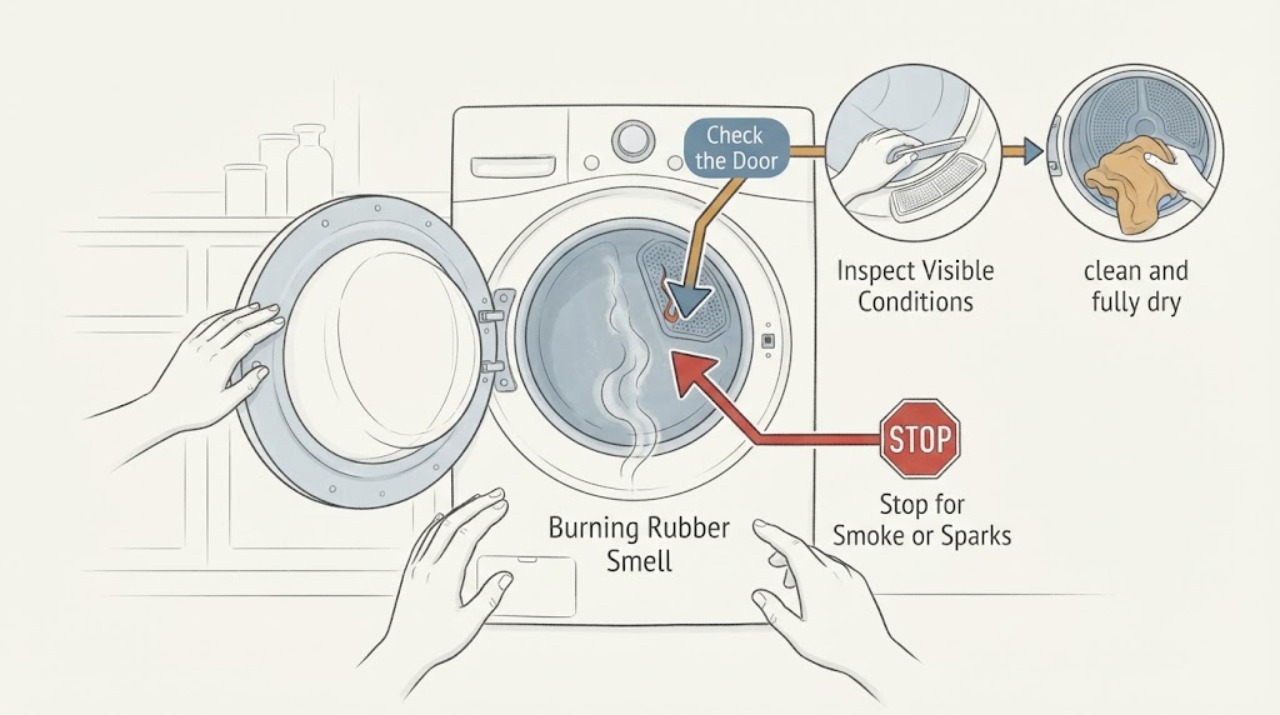
Stop the Whirlpool WED4900XW0 as soon as a burning-rubber smell appears. Do not run another cycle just to identify the odor. This model belongs to Whirlpool's traditional electric WED4900XW family, so the useful separation is room or load contamination, a lint or exhaust restriction, a visible foreign object or drum-drive symptom, and an electrical connection or internal electrical fault. After any smoke, flame, sparking, scorching, abnormal heat, or hot plug or outlet, leave it off and use emergency or qualified electrical help as appropriate. Once the dryer is cool and safely disconnected, perform only accessible checks; a recurring odor, an odor with the load removed, scraping or drum resistance, or any electrical sign requires qualified service.
Before you begin
Safety first
- Only inspect or clean accessible areas after the dryer is cool and safely disconnected. Do not run a smell test, open the cabinet, probe live wiring, bypass a safety device, force the drum, adjust a belt or pulley, or replace a heater, motor, belt, pulley, or control from the odor alone.
Work through in order
Diagnostic checks
Use only checks that match the exact appliance or system and its official guide.
-
Check 1
Stop the cycle normally from a safe position. If there is no smoke, flame, sparking, or gas-like odor and the drum has stopped, remove the load only if the door opens normally; otherwise leave the area and do not touch a hot or damaged cord. Do not restart an empty cycle to smell-test it.
Expected result: Record whether there is smoke or flame, a melting-plastic or electrical smell, scorching, rapidly increasing cabinet heat, a hot plug or outlet, an active breaker trip, or an odor limited to the load or room.
Next step: For active fire, smoke, or gas odor, leave and contact local emergency services. Otherwise keep the dryer off and continue only after it is cool and no immediate hazard is present.
Stop if: Do not run another cycle, keep resetting a tripping breaker, or handle a hot, loose, melted, or scorched plug, cord, or outlet.
Why this matters
Why: Smoke, flame, sparking, scorching, abnormal heat, or an electrical odor is a safety or service boundary. A load-only or room-only odor can have a different source, but the dryer still stays off until the source is identified.
-
Check 2
With the dryer off and cool, separate the possible source without applying heat: smell the removed load and the laundry-room air from a safe distance, and look for nearby painting, staining, varnishing, refinishing, damp-stored items, oil, grease, solvent, or an obvious foreign item on the load or in the drum opening.
Expected result: The odor follows the clothing or room air, the drum itself still smells burned with no load, the dryer is new and the smell was mild, or a foreign object or melted residue is visible without reaching into the cabinet.
Next step: Ventilate and keep the dryer off while fumes remain. Rewash a load only after the air is clear and the item is safe to heat; keep oily, fuel-smelling, solvent-smelling, or otherwise questionable items out of the dryer. Remove only an obvious loose item that is reachable without tools or cabinet access.
Stop if: Do not heat a contaminated load, run during refinishing, scrape a melted object from a hot drum, or open the cabinet to search for a foreign object.
Why this matters
Why: Whirlpool identifies first-use element odor, room fumes, and damp-load mildew as separate possibilities. A visible contaminant or load-only smell does not prove an appliance failure; an empty-drum rubber smell makes an appliance, exhaust, or power path more concerning.
-
Check 3
After the dryer is cool and safely disconnected through its normal disconnect, clean and fully dry the lint screen, confirm that it is seated, and inspect only the accessible duct, outside hood, and visible area behind the appliance for lint, a crushed or kinked duct, a blockage, or a nest. Do not disconnect the exhaust and operate the dryer.
Expected result: The screen is missing, damaged, wet, or heavily coated; the duct is crushed or kinked; the hood has little opening or lint; the dryer was recently moved; or drying had become longer and the cabinet hotter than usual.
Next step: Leave the dryer off, correct only an obvious external kink, and arrange qualified vent or cabinet cleaning when the restriction is beyond the accessible area. Use the appliance only after the complete exhaust path is safe and the burning odor has not returned.
Stop if: Do not operate without the lint screen, keep testing a restricted path, reach into the cabinet, or treat a vent cleaning as permission to ignore an electrical odor.
Why this matters
Why: Whirlpool links long dry times, a dryer that is hot to the touch, weak airflow, and burning scent with restricted venting. Lint and obstruction can raise heat and create a fire risk, but an airflow finding does not clear a hot cord or a recurring rubber odor.
-
Check 4
With power safely isolated and the drum stopped, inspect the visible drum opening and surrounding accessible area for a foreign object, melted residue, lint buildup, or a rubbing mark. If the drum can be moved gently by hand without force, note scraping, binding, or unusual resistance; do not remove panels, lubricate, adjust a belt or pulley, or force the drum.
Expected result: A loose object or residue is visible, the drum moves smoothly with no appliance odor after the source is removed, or the empty drum has a persistent smell, scraping, squealing, rubbing, or resistance.
Next step: Remove only a plainly loose, cool item that is safely reachable. For persistent odor, resistance, or noise, keep the dryer out of service and provide the observations to qualified appliance service.
Stop if: Do not open the cabinet, touch the heater or wiring, force a bound drum, or order a belt, pulley, motor, or heater from the smell alone.
Why this matters
Why: A visible external object can explain a localized odor, while persistent odor with an empty drum or a mechanical symptom makes a drum-drive, belt, pulley, motor, heater, or other internal condition possible. These observations do not identify which part has failed.
-
Check 5
From outside the appliance, inspect the plug, cord, outlet face, and visible connection only after the dryer is cool and de-energized. Look for looseness, heat damage, discoloration, cracking, fraying, melting, or scorching, and note whether the dryer was recently moved or an extension cord was used.
Expected result: The plug or outlet is hot, loose, discolored, damaged, or smells electrical; a breaker has tripped; the connection is questionable; or none of those signs is present but the burning odor returns from an empty drum.
Next step: Leave the dryer off and arrange qualified electrical service for the cord, plug, outlet, or breaker; arrange qualified appliance service for a recurring appliance odor or mechanical symptom. Provide the model, timing, airflow result, and photos of visible damage without opening the cabinet.
Stop if: Do not probe the outlet, tighten live terminals, repair scorched wiring, use an extension cord, increase fuse capacity, or repeatedly reset a breaker.
Why this matters
Why: Whirlpool says an electrical-type odor on an electric dryer can come from a cracked, corroded, or frayed cord or a poor outlet connection that overheats. A recurring empty-drum odor without visible cord damage still needs appliance diagnosis; it is not cleared by a visual check.
Use your observations
Decision map
Find the observation that best matches what you see, then follow the next safe action.
-
PATH 01Next step
What you see
The smell is limited to a load or the surrounding room, disappears after ventilation or removing a plainly contaminated item, and there is no appliance odor, heat damage, or airflow concern when the dryer is cool.
Do this next
Ventilate, rewash only after fumes are gone, and keep oily, solvent-smelling, or questionable items away from heat. Keep the dryer out of service if the appliance itself later smells burned.
Why this path and its safety boundary
Why it matters: Whirlpool's documented room-fume, damp-load, and first-use odor paths are more likely than a confirmed internal dryer failure, but the rubber-like description means the load must not be reheated until its source is safe.
-
PATH 02Next step
What you see
The lint screen or accessible exhaust path is restricted, drying had become slow, the dryer was unusually hot, or outside airflow is weak, with no hot or damaged electrical connection found.
Do this next
Leave the dryer off, restore the full safe exhaust path through qualified cleaning when needed, and obtain service if the burning smell remains or returns.
Why this path and its safety boundary
Why it matters: Restricted airflow is the leading accessible branch: Whirlpool says lint or a blocked, crushed, kinked, or nested vent can reduce airflow, increase heat, and create fire risk. It does not prove the odor was only the vent.
-
PATH 03Next step
What you see
A loose object or melted residue is visible at the drum opening and the odor stops once the cool, accessible object is removed, with no scraping, resistance, smoke, or heat damage.
Do this next
Keep the dryer off until the object and any residue are safely removed and the drum opening is intact; arrange service if any mark, noise, resistance, or odor remains.
Why this path and its safety boundary
Why it matters: The visible object may have been rubbing or heating against the drum, but a stopped odor does not authorize cabinet access or confirm that internal surfaces are undamaged.
-
PATH 04Safety boundary
What you see
The odor remains with the load removed, returns after safe room, load, lint, and exhaust checks, or is paired with scraping, squealing, drum resistance, or abnormal cabinet heat.
Do this next
Keep the dryer out of service and request qualified Whirlpool appliance diagnosis. Provide the exact WED4900XW0 model, when the smell starts, whether the drum is empty, the airflow result, and any sound or heat observations.
Why this path and its safety boundary
Why it matters: A drum-drive, belt, pulley, motor, heater, wiring, or another internal condition is possible, but Whirlpool's public guidance does not select one part from smell alone.
Safety stop: No cabinet removal, live testing, belt or pulley adjustment, lubrication, or symptom-only parts order.
-
PATH 05Safety boundary
What you see
The plug, cord, or outlet is hot, loose, cracked, frayed, discolored, melted, or scorched; the breaker trips; or the smell is distinctly electrical or melting plastic.
Do this next
Stop using the dryer and arrange qualified electrical service; arrange appliance service as well if the appliance or cord connection is damaged. For smoke or active fire, leave and contact emergency services.
Why this path and its safety boundary
Why it matters: Whirlpool treats this as a possible electric power-connection overheating issue, separate from lint or ordinary drum odor.
Safety stop: Do not touch damaged conductors, probe the outlet, reset the breaker repeatedly, or restart the dryer to confirm the smell.
Helpful context
Understand the symptom
A rubber-like burning odor is a stop condition, not a smell to chase with repeated cycles. The exact WED4900XW family is electric, so a hot or damaged cord, plug, or outlet matters as much as the exhaust path. The public Whirlpool guidance supports safe separation of room/load odors and airflow problems; it does not identify a belt, pulley, motor, heater, or control part from smell alone.
The WED4900XW0 suffix is more specific than the public family page. Use the exact manual for any model-specific access or cleaning procedure. The checks below stay outside the cabinet and are intended to classify the handoff, not to authorize live electrical testing or internal repair.
When checks do not resolve it
Need a professional?
Call qualified appliance service for a recurring or empty-drum burning odor, mechanical noise or resistance, abnormal heat, or a smell that persists after safe room, load, lint, and exhaust checks. Call a qualified electrician for a hot or damaged cord, plug, outlet, or repeated breaker trip.
Safety scope: Only inspect or clean accessible areas after the dryer is cool and safely disconnected. Do not run a smell test, open the cabinet, probe live wiring, bypass a safety device, force the drum, adjust a belt or pulley, or replace a heater, motor, belt, pulley, or control from the odor alone.
Have this ready
- Provide Whirlpool WED4900XW0, whether the dryer is new, when the smell starts, whether the load or room also smells, lint-screen and vent findings, outside airflow, plug or outlet condition, any noise or drum resistance, and photos of visible damage taken without opening the cabinet.
Common questions
FAQ
Can I run the Whirlpool WED4900XW0 empty to find out where the rubber smell comes from?
No. Stop the dryer and do not repeat a heated cycle just to smell-test it. A first-use electric-element odor is a separate Whirlpool-documented possibility, but a burning-rubber smell, recurrence, abnormal heat, noise, or any electrical sign needs the dryer kept off and safely checked or serviced.
Could a blocked vent cause a burning smell?
Yes, it can. Whirlpool links a burning scent, excess heat, longer drying, weak airflow, and lint or duct restrictions with a possible vent problem and fire risk. Leave the dryer off and restore the complete exhaust path; do not disconnect the vent and run it.
How do I know whether the smell is electrical?
With the dryer cool and off, look only from outside for a hot, loose, cracked, frayed, melted, discolored, or scorched cord, plug, or outlet, or a tripped breaker. Whirlpool says an electrical-type odor can come from a poor connection that overheats. Do not probe or repair it yourself; use a qualified electrician.
Does a rubber smell prove the belt or motor is bad?
No. The same symptom can involve a foreign object, airflow restriction, power connection, heater area, drum-drive component, or load or room contamination. A recurring empty-drum smell, scraping, squealing, resistance, or abnormal heat needs qualified diagnosis rather than a symptom-only part order.
Read the exact guide
Official sources
- How to Check VentingWhirlpool Product Help · Used for accessible vent observations and the qualified-cleaning boundary; it does not identify a WED4900XW0 internal part.
- Dryer Vent May Be Blocked or RestrictedWhirlpool Product Help · Used to interpret weak airflow, excess heat, long drying, and visible lint or blockage in this dryer symptom; it is not a component diagnosis.
- Odor or Smell in Commercial DryerWhirlpool Product Help · This page is for Whirlpool commercial-grade residential dryers, not the exact WED4900XW0. It is used only for the general electrical safety principle that an electrical odor warrants an external cord/outlet check and qualified electrician, never as an exact model diagnosis.
- Odor or Smell from a DryerWhirlpool Product Help · Used narrowly to distinguish paint, stain, varnish, damp-load, and drum-residue odors; the article deliberately does not recommend a heat test for a burning-rubber report.
- Cleaning the Dryer DrumWhirlpool Product Help · Used for cool, de-energized accessible cleaning and the lint/airflow safety boundary, not for belt, motor, heater, or wiring diagnosis.
- Whirlpool WED4900XW Traditional Electric DryerWhirlpool · The opened Whirlpool page identifies the WED4900XW family as a Traditional Electric Dryer; use the WED4900XW0 model label and exact manual for suffix-specific procedures.
Community feedback
Share a repair observation
Share a plain-text repair observation. Accepted observations are published automatically; this page may take a moment to update.