
On this page
Start here
Quick answer
Treat a burning smell on the Samsung DV218AEW/XAC after heater and belt work as an unresolved safety symptom, not proof that either replaced part is defective or that another part should be ordered. Stop the dryer, let the drum stop, and disconnect power only from a dry, safe position; do not run it again to locate the odor, open the cabinet, make a live test, or continue changing parts. Samsung's exact-model support page provides the model's manuals and service route, while Samsung's dryer guidance says visible smoke or an electrical smell requires the dryer to be stopped and serviced, and a continuing burning smell requires power to be shut off at the circuit breaker. Have a qualified technician recheck the repair assembly, terminals and wiring, drum and blower clearance, thermal protection, and exhaust path as a system, then document what was actually found.
Before you begin
Safety first
- Disconnect or isolate power only from a dry, safe position. Do not open panels, handle the heater or belt path, splice or identify wiring, bypass thermal protection, make live measurements, or run the dryer with panels or exhaust safety parts removed.
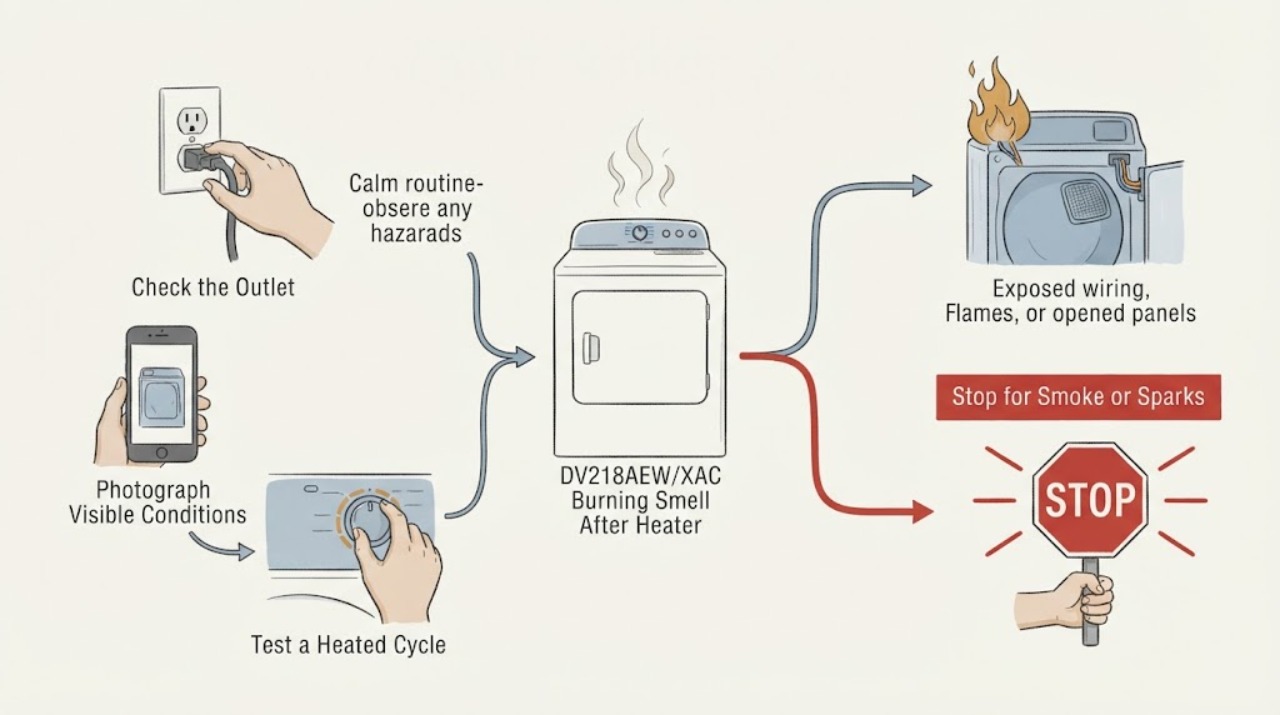
Work through in order
Diagnostic checks
Use only checks that match the exact appliance or system and its official guide.
-
Check 1
Stop the dryer from a safe position and wait for all motion to end. If there is smoke, a spark, flame, a hot cabinet or outlet, an electrical or melting-plastic smell, or a breaker event, keep clear and isolate power only when that can be done without touching a wet or damaged connection. Do not restart the dryer to reproduce the smell.
Expected result: Record whether there was visible smoke, an arc or spark, abnormal heat, a tripped breaker, damaged insulation, or only an odor after the repair.
Next step: Keep the dryer out of use and arrange qualified appliance service; include an electrician if the outlet, plug, cord, or branch circuit is hot, discolored, damaged, or repeatedly trips.
Stop if: Do not touch exposed conductors, wet electrical parts, the heater area, belt path, or a hot cabinet; do not reset a breaker repeatedly or run another cycle.
Why this matters
Why: Smoke, heat, sparking, or an electrical odor moves this out of normal odor troubleshooting and into fire or shock-risk service. Even without those signs, a post-repair smell is not evidence that the repair is safe.
-
Check 2
Preserve the repair history without opening the dryer: photograph the DV218AEW/XAC rating label, the plug and outlet from a safe distance, the repair date, the exact heater and belt descriptions if available, and where the odor was first noticed. Keep removed parts and fasteners together for the technician rather than reinstalling or substituting them.
Expected result: The model suffix is confirmed, the odor began immediately after the repair or after a later cycle, and the smell was noticed at the drum, rear, outlet, or another area without touching it.
Next step: Give the record to the service provider and ask for a model-specific inspection before authorizing another part. If the exact suffix, configuration, or repair part identity is uncertain, resolve that from the rating label and invoices rather than guessing.
Stop if: Do not remove panels, pull the dryer out, reconnect loose wires, identify wires by colour, or select a replacement from a photograph or odor.
Why this matters
Why: Timing and location help the technician distinguish an assembly or clearance issue from a load, vent, or supply problem, but a visual location is not a component diagnosis.
-
Check 3
With power isolated and the dryer fully cool, inspect only ordinary-access areas: the lint filter and housing, visible drum surface, door area, and floor around the appliance. Look for lint, melted residue, a foreign object, a scorched item, or a belt fragment that is visible without reaching into the cabinet. Do not use a new load or an empty heated cycle as a test.
Expected result: The filter is blocked or damaged, a load is scorched, melted material or an object is visible, or all visible areas look normal.
Next step: Remove only loose visible laundry or residue when the appliance is cool and de-energized. Keep the dryer off for any melted material, recurring odor, or need to reach behind the drum, and have service inspect the internal assembly.
Stop if: Do not reach behind the filter housing, touch a belt or heater, scrape melted material from an internal surface, or use solvents or water inside the cabinet.
Why this matters
Why: A load or accessible lint/residue can contribute to an odor, but a clean visible area does not clear the newly repaired heater, belt path, wiring, thermal protection, blower, or internal lint path.
-
Check 4
From outside the cabinet, inspect the visible exhaust connection and exterior hood only after power is isolated and the dryer is cool. Note a crushed or kinked duct, lint at the hood, a disconnected connection, or a hood that cannot open freely; do not disconnect the duct or run a heated test after the smell appeared.
Expected result: The accessible exhaust path is restricted or damaged, the dryer has recently been moved, or the visible path looks clear but the odor or overheating began after repair.
Next step: Arrange qualified vent service for an inaccessible or restricted duct and qualified appliance service for the dryer. Tell both providers that the odor appeared after heater and belt work; do not operate to compare airflow or heat.
Stop if: Do not operate with a disconnected or damaged exhaust, remove the rear panel, reach into the blower or heater path, or treat a vent cleaning as proof that the repair is safe.
Why this matters
Why: Samsung identifies lint and restricted exhaust as fire and heat-removal risks, but a clear exterior path does not rule out an internal duct, blower, heater, thermal, wiring, or assembly problem.
-
Check 5
Ask the technician for a written post-repair inspection that covers the exact DV218AEW/XAC configuration, heater and belt installation, terminal and harness condition, drum and blower clearance, thermal-protection path, lint path, exhaust connection, and electrical supply. The request should distinguish a confirmed failure from a part changed as a precaution.
Expected result: The provider can show a documented failed condition and the test that isolated it, or proposes another heater, belt, fuse, motor, or wiring part without explaining what failed.
Next step: Approve work only after the technician identifies the unsafe condition, the corrective action, and the no-odor/no-overheat recurrence criteria. Seek a second qualified opinion if the diagnosis remains a part guess.
Stop if: Do not authorize blind parts replacement, bypass a thermal device, splice wiring, or accept a reset or one-minute run as proof of repair.
Why this matters
Why: A post-repair odor can result from an assembly or installation error, damaged connection, foreign material, airflow problem, or unrelated internal fault. A part list without a finding does not establish the cause.
-
Check 6
Before service arrives, prepare the exact symptom timeline: which cycle and heat setting were used, whether the drum turned, when the odor began, whether clothes or the cabinet became hot, whether drying time changed, and whether any code or breaker event occurred. Do not extend the timeline by operating the dryer again.
Expected result: The odor occurs with the first post-repair run, returns on every run, is present with the load removed, or was accompanied by smoke, heat, sparks, or power interruption.
Next step: Keep the dryer isolated and provide the timeline, photos, repair invoices, removed parts, and exact model label to qualified Samsung or appliance service. Reopen the electrical-service question if the outlet or cord was involved.
Stop if: Stop owner troubleshooting when diagnosis requires cabinet access, electrical testing, belt or heater handling, or a powered recurrence test.
Why this matters
Why: A repeatable post-repair symptom is useful evidence for service, but none of these patterns selects a heater, belt, motor, thermal part, control, or wire without an inspection.
Use your observations
Decision map
Find the observation that best matches what you see, then follow the next safe action.
-
PATH 01Safety boundary
What you see
Smoke, flame, sparks, a hot or discolored plug/outlet, melting insulation, a strong electrical smell, or repeated breaker operation is present.
Do this next
Keep clear, isolate power only from a safe dry position, and contact emergency services for active fire or dangerous smoke. Arrange qualified electrical and appliance inspection before any use.
Why this path and its safety boundary
Why it matters: This is an immediate fire or electrical safety branch; it is not a heater-or-belt troubleshooting exercise.
Safety stop: Do not restart, reset the breaker repeatedly, touch damaged wiring, or use the dryer until it is cleared.
-
PATH 02Next step
What you see
The burning odor began after the heating element and belt replacement, returns with the dryer or an empty drum, or is localized near the rear or repair area without a visible external vent explanation.
Do this next
Keep the dryer off and request a written, model-specific post-repair inspection. Require the technician to identify the tested condition before another part is ordered.
Why this path and its safety boundary
Why it matters: A repair-assembly, clearance, connection, thermal-protection, blower, or internal-lint problem is possible, but timing and smell do not prove one component.
-
PATH 03Next step
What you see
The odor is confined to one load, with scorching, melted fibers, foam, oil, solvent, or another contaminated item, and the cool empty drum and appliance have no independent odor or electrical symptom.
Do this next
Keep the suspect items out of the dryer and follow the material maker's safe handling guidance. Have the dryer serviced if any odor remains or returns with safe laundry.
Why this path and its safety boundary
Why it matters: The laundry may be the source, but contaminated or melted material can still be a fire or handling hazard and does not validate the repair.
-
PATH 04Next step
What you see
The visible exhaust route is crushed, disconnected, lint-blocked, or associated with worsening dry time or abnormal heat, even if the post-repair odor was first noticed elsewhere.
Do this next
Keep the dryer off and arrange appropriate qualified vent and appliance service; provide the full post-repair timeline to both providers.
Why this path and its safety boundary
Why it matters: Restricted airflow can trap heat and increase fire risk, but correcting the vent alone does not prove that a newly repaired heater, belt path, or wiring connection is sound.
Helpful context
Understand the symptom
The DV218AEW/XAC is listed in Samsung Canada's support center with model-specific manuals and support material. Because the odor appeared after a heater and transmission belt replacement, the useful question is not which part to swap next. It is whether the repair left a terminal, wire, shield, belt path, drum clearance, thermal protection path, blower path, or exhaust condition that must be checked by a qualified technician.
Samsung's smoke-and-odor guidance allows a limited first-use shipping-residue explanation for a new dryer, but that exception does not fit an older dryer that has just been opened and repaired. A recurring, electrical, melting-plastic, or worsening smell is a stop-use event. Do not make the smell disappear by running another load.
When checks do not resolve it
Need a professional?
Call qualified Samsung or appliance service for any post-repair burning smell, recurring odor, smoke, abnormal heat, power event, or need to inspect the heater, belt installation, terminals, wiring, blower, thermal protection, or internal exhaust. Use electrical service for a suspect outlet, plug, cord, or branch circuit and vent service for an inaccessible or restricted exhaust.
Safety scope: Disconnect or isolate power only from a dry, safe position. Do not open panels, handle the heater or belt path, splice or identify wiring, bypass thermal protection, make live measurements, or run the dryer with panels or exhaust safety parts removed.
Have this ready
- Provide DV218AEW/XAC, serial and rating-label information, electric configuration, repair dates, exact heater and belt descriptions, the odor timeline and location, cycle and heat setting, load history, visible filter and exhaust observations, photographs from a safe distance, and any smoke, heat, spark, code, or breaker event.
Common questions
FAQ
Does the smell prove the new heating element or belt is bad?
No. The timing makes the repair assembly important to inspect, but smell alone cannot identify a heater, belt, terminal, harness, thermal device, blower, lint path, or exhaust fault. Stop using the dryer and require a documented inspection before another part is selected.
Can I run it empty for a minute to locate the smell?
No. Samsung's limited empty-run guidance is for a new dryer shedding shipping residue, not for an older dryer that smells after repair. Do not run a heated or empty test to reproduce a post-repair odor, especially if it is electrical, worsening, or accompanied by heat or smoke.
Could the exhaust still be involved if the heater and belt were just replaced?
Yes, a restricted exhaust can trap heat and increase fire risk, but a clear-looking exterior vent does not clear the internal dryer or the repair. Have the vent and appliance assessed separately and do not use vent cleaning as proof that the repair is safe.
What should I ask for at the next service visit?
Ask the provider to record the exact DV218AEW/XAC identity, the odor timeline, the tested condition, the observed failure, the corrective work, the vent and supply checks, and the specific no-odor/no-overheat condition that will count as a successful return to service.
Read the exact guide
Official sources
- Samsung dryer smokes or smellsSamsung Canada · Samsung's opened Canadian dryer guidance; it is used for safety and escalation boundaries, not to infer a failed DV218AEW/XAC component.
- DV218AEW | Samsung Support CASamsung Canada · Samsung Canada's opened model support page identifies DV218AEW/XAC and exposes the model's user-manual entries and service/support links.
- Why cleaning or replacing your Samsung dryer vent is importantSamsung Canada · Samsung's opened Canadian vent guidance; it is used to require an exhaust-path check and does not establish a part diagnosis for DV218AEW/XAC.
Community feedback
Share a repair observation
Share a plain-text repair observation. Accepted observations are published automatically; this page may take a moment to update.